

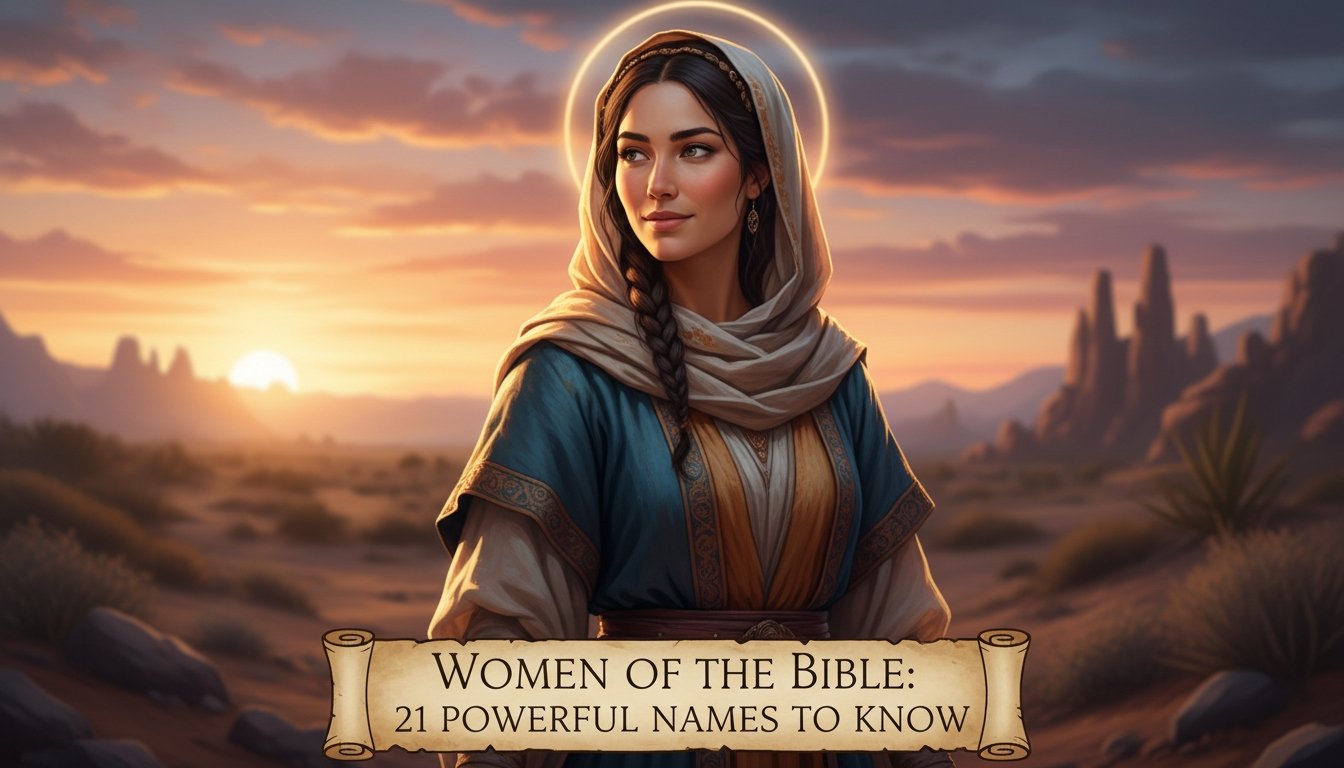
21 Apr Women of the Bible List: 21 Powerful Names to Know
You’ll discover how each woman—Eve, Sarah, Hagar, Lot’s daughters, Rebekah, Vashti, Jezebel, Athaliah, Mary, and many others—shaped faith, leadership, and destiny in ways that still resonate. Their stories reveal resilience, strategic courage, and divine encounters that altered nations. As you explore their lives, you’ll see a thread of powerful influence that challenges and inspires. The next name will surprise you.
Table of Contents
Eve – First Woman, Mother of All Living, and Her Biblical Significance
Since the garden’s creation, Eve stands as the first woman and the mother of all living, a role that shapes every subsequent biblical narrative. You’ll notice she’s introduced in Genesis 2 as the companion fashioned for Adam, a partner who shares his stewardship of creation. When the serpent tempts you, you see how her decision to eat the forbidden fruit initiates the fall, altering humanity’s relationship with God. Yet her story doesn’t end in tragedy; Genesis 3:16 promises pain in childbirth and a yearning for her husband, foreshadowing the redemption arc that follows. You’ll recognize that Eve’s lineage produces the patriarchs—Abraham, Isaac, Jacob—making her the ancestral root of Israel. Her name also appears in the New Testament, where Paul cites her as a model of faith (Romans 5:14). Understanding Eve’s significance helps you grasp the theological foundation for sin, grace, and the promise of a Messiah.
Sarah – Faithful Biblical Woman Who Brought Isaac at Age 90
Ever wondered how a woman who waited decades could become the mother of Israel’s promised heir? You’ll find Sarah’s story a masterclass in perseverance and faith.
At ninety, she defied cultural expectations, trusting Abraham’s promise that God would bless her with a son. When Isaac finally entered her womb, she named him “he laughs,” reflecting both the astonishment of his birth and the joy that followed years of barrenness.
Her laughter isn’t just humor; it’s triumph over doubt, a testament to believing God’s timeline over yours. Sarah’s willingness to share her husband with Hagar, despite personal sting, shows her commitment to the covenant’s fulfillment.
Yet, she also wrestles with insecurity, pleading for a child and confronting her own doubts. Her journey reminds you that patience, prayer, and openness to divine surprise can turn the longest wait into a legacy that shapes nations.
Hagar – Ishmael’s Mother and Promise’s Doubt Survivor
What does Hagar’s story reveal about surviving doubt in God’s promise? You see her, Sarah’s Egyptian maid, thrust into desert exile when she bears Abraham’s first son, Ishmael. Faced with abandonment, she cries out, and an Angel of the Lord assures her that Ishmael will become a great nation. You learn that even when God’s covenant feels distant, He still speaks to the marginalized. Hagar’s journey teaches you to cling to divine assurance, not the surrounding circumstances. She names the well “Beer‑lahi,” meaning “well of the Living One,” a reminder that God provides sustenance amid uncertainty. Her resilience shows you that doubt doesn’t nullify promise; it refines trust. By trusting the Angel’s word, she secures Ishmael’s future and demonstrates that God’s faithfulness extends beyond the chosen line, reaching those who persevere despite doubt.
Lot’s Daughters – Founders of Moabite & Ammonite Nations
After Hagar’s desert encounter, the narrative shifts to another desperate flight—Lot’s family escaping Sodom’s ruin. You watch as the city’s ash settles behind them, and the night’s silence presses on the survivors. In the cave, fear and isolation drive Lot’s daughters to a drastic plan: they intoxicate their father and each bears a child. You recognize the resulting sons, Moab and Ben‑Ammi, as the progenitors of the Moabite and Ammonite peoples, nations that later clash repeatedly with Israel. Their actions, though morally ambiguous, illustrate how survival instincts can reshape lineage and geography. You see them as pivotal, if controversial, architects of regional identity, their stories echoing through later biblical conflicts and prophecies. Their legacy reminds you that even marginal figures can spawn entire nations, influencing the biblical world’s political and spiritual landscape.
Rebekah – Matriarch Who Shaped Jacob and Esau’s Destiny
How did Rebekah’s quiet confidence steer the fate of Jacob and Esau? You see her as a subtle strategist, not a dramatic heroine. When Isaac’s household needed a wife for his son, she offered water to the travelers and secured the covenant promise. Later, sensing God’s prophecy that the younger would lead, she took decisive action: she disguised Jacob, coaxed Isaac, and secured the blessing meant for Esau. Her intuition and willingness to bend tradition saved the lineage she valued. You notice how she balanced tenderness with resolve—she comforted Isaac after Sarah’s death, yet she orchestrated a pivotal deception without hesitation.
Rebekah’s influence reshaped the patriarchal narrative, ensuring the covenant continued through Jacob. Her story reminds you that quiet conviction can redirect destiny, shaping nations from behind the scenes.
Leah – Mother of Six Tribal Leaders, Jacob’s First Wife
Ever wondered why Leah, Jacob’s first wife, became the matriarch of six tribal heads? You’ll find that her story hinges on perseverance and divine purpose. Though Jacob loved Rachel more, Leah bore him six sons—Reuben, Simeon, Levi, Judah, Issachar, and Zebulun—each destined to lead a tribe of Israel. Her repeated prayers for children turned into a legacy that shaped the nation’s geography and leadership. You can see how Leah’s name, meaning “weary,” reflects her endurance amid rivalry and disappointment, yet her offspring secured her place in biblical history.
When you study the tribal allotments, you’ll notice Leah’s lineage occupies the central heartland, symbolizing stability and continuity. Her experience reminds you that even when overlooked, steadfast faith can produce lasting impact, echoing through generations of believers.
Rachel – Beloved Mother of Joseph and Benjamin
Why does Rachel’s story still captivate readers today? You see a woman whose love for Jacob fuels a saga of longing, rivalry, and divine promise. You watch her wrestle with infertility while Leah bears children, yet Rachel’s faith never wavers. When she finally bears Joseph, you feel the surge of joy that validates her patience, and later Benjamin, the beloved youngest, embodies her enduring hope. You notice how Rachel’s tender care shapes Joseph’s character, preparing him for leadership in Egypt. Her death on the journey to Ephrathah, and Jacob’s mournful lament, reveal a deep emotional bond that transcends generations. You recognize her as a model of perseverance: she petitions God, endures hardship, and ultimately secures a legacy that defines two tribes of Israel. Rachel’s narrative invites you to reflect on love’s power to transform destiny.
Bilhah – Servant Who Raised Dan and Naphtali
Rachel’s devotion to her children sets the stage for another pivotal figure in Jacob’s household: Bilhah, Rachel’s maidservant, whom she entrusts with the hope of bearing sons when her own womb remains barren. You see Bilhah step into a crucial role after Rachel’s initial infertility, bearing Dan and Naphtali for Jacob. Her story illustrates how a servant’s womb could shape Israel’s tribal map, granting her a lasting legacy despite her low status. You recognize that Bilhah’s sons become founders of two northern tribes, each contributing warriors and leaders to Israel’s history. Her experience also reflects the emotional weight of surrogacy in ancient times—Rachel’s yearning, Jacob’s acceptance, and Bilhah’s obedience intertwine. You appreciate how Bilhah’s quiet strength underpins the larger narrative of family, promise, and the complex dynamics within Jacob’s household.
Zilpah – Servant Who Brought Gad & Asher to the Tribe
Zilpah, Leah’s maidservant, steps into Jacob’s household when Leah’s own fertility wanes, and she bears two sons—Gad and Asher—who become heads of distinct northern tribes.
You’ll notice how Zilpah’s role mirrors Leah’s, yet her contribution reshapes Israel’s tribal map.
Gad’s lineage thrives in the fertile plains east of the Jordan, known for warriors who defend the nation’s borders.
Asher’s descendants settle along the Mediterranean coast, celebrated for abundant harvests and rich resources.
By bearing these leaders, Zilpah secures a legacy that rivals the patriarchs’ own sons, reminding you that influence often springs from unexpected sources.
Her story underscores the importance of faithful service and the ripple effect of a single life on an entire people.
When you study Israel’s tribes, remember Zilpah’s quiet power that helped shape the nation’s destiny.
Dinah – Daughter in the Honor‑Revenge Story
From Zilpah’s quiet service to the dramatic events surrounding Jacob’s daughter, Dinah’s story thrusts you into a tense honor‑revenge cycle that reshapes family dynamics. You meet Dinah as Jacob’s only daughter, a young woman living in Shechem when Shechem’s son, a Hivite prince, violates her. The prince’s desire to marry Dinah sparks a fragile peace, but his father’s plea for a covenant blinds the brothers. You watch Simeon and Levi, driven by outrage, ambush the unsuspecting city, slaughtering its men and seizing women and children. Their brutal retaliation forces Jacob to rebuke them, fearing the fallout with the surrounding nations. This episode forces you to confront how personal violation can ignite collective vengeance, how honor and shame dictate actions, and how a single tragedy can fracture tribal loyalty, leaving lasting scars on the family’s legacy.
Deborah – Biblical Woman Prophetess and Judge Who Led Israel to Victory
Ever wondered how a single woman could turn the tide of war? You meet Deborah, a prophetess and judge who commanded respect in a male‑dominated era. Sitting under the palm of Ramah, she heard Israel’s cries, delivered God’s directives, and summoned Barak to confront Canaanite king Jabin’s commander, Sisera. You’ll see her confidence when she says, “If you’ll go, I’ll go with you,” showing that leadership isn’t about gender but obedience to divine purpose.
The battle unfolds, and despite initial hesitation, Barak follows her counsel, trusting her insight. When the Israelites triumph, Deborah’s song in Judges 5 celebrates the victory, honoring the brave women who gathered at the wells. You recognize her legacy: strategic wisdom, spiritual authority, and the courage to rally a nation.
Deborah proves that decisive, faith‑driven leadership can reshape history, inspiring you to act boldly when called.
Jael – Heroine Who Defeated General Sisera
How could a single woman change the course of a war with a tent peg? You meet Jael, the Kenite wife who turned a battlefield into a personal arena. When Sisera, Canaan’s commander, fled after Deborah’s victory, he sought refuge in her tent, assuming hospitality would protect him. You watch Jael offer him a drink, then a place to rest, all while she steadies her resolve. As his guard drops, she grabs a heavy tent peg and a hammer, drives the peg through his temple, and ends his reign in a single, decisive blow. Her act shatters the enemy’s morale and secures Israel’s triumph, proving that courage can eclipse rank. You see how her boldness, quick thinking, and willingness to act when others hesitated become a timeless example of unexpected heroism, echoing through Scripture as a testament to divine empowerment of ordinary women.
Hannah – Prayerful Biblical Woman Who Brought Samuel to Life
What drives a barren woman to pray until her tears become a covenant? You feel Hannah’s anguish as she stands before the temple, lips trembling, heart spilling out a desperate petition for a child. You watch her vow that if God grants her a son, she’ll dedicate him wholly to His service, a promise she seals with a solemn oath. When Eli, the priest, rebukes her, you sense her resolve deepen, not falter, and you hear her silent prayer echoing through the sanctuary. God answers, and Hannah bears Samuel, who grows into the prophet‑king’s trusted advisor. You see her fulfill the vow, bringing the infant to the tabernacle, offering him to the Lord’s house. Her story models fierce faith, persistent prayer, and unwavering gratitude—reminding you that heartfelt petitions, paired with committed dedication, can reshape destiny.
Miriam – Prophetess Who Led Worship After the Red Sea
Three verses after the Israelites crossed the Red Sea, Miriam—Moses’ sister and a gifted prophetess—raises a timbrel and leads the women in a triumphant song of praise, declaring, “The Lord is great, the Lord is mighty!” (Exodus 15:1‑2). You feel the rhythm of her voice echo through the camp, a reminder that God’s power delivered them from Egypt. Miriam’s leadership isn’t limited to music; she interprets God’s will, speaking with authority that matches Moses’ and Aaron’s. When the people grumble, her prophetic insight steadies them, urging trust in divine promise. You can see how her role models communal worship, turning triumph into collective memory. Her story shows that women can wield spiritual influence, shaping Israel’s identity after a miracle. By honoring God’s deliverance, Miriam sets a precedent for future prophetesses, reminding you that praise and prophecy often walk hand‑in‑hand.
Delilah – Woman Who Betrayed Samson, Leading to Israel’s Defeat
From Miriam’s triumphant song at the sea, the narrative shifts to a darker tale of trust broken. You meet Delilah, a Philistine woman whose charm masks deadly intent. The judges’ story tells how Samson, Israel’s strongest judge, falls for her allure.
You watch as she pressures him nightly, demanding the secret of his uncut hair—his source of divine strength. When he finally confides, she summons the Philistines, cuts his hair, and strips him of power. You see Samson captured, blinded, and forced to labor for his enemies, a stark reversal of Israel’s earlier victories.
Delilah’s betrayal isn’t merely personal; it catalyzes a national defeat, exposing Israel’s vulnerability to foreign oppression. Her actions illustrate how deceit can undermine even the mightiest guardian, reminding you that trust, when misplaced, can bring a nation to its knees.
Bathsheba – Biblical Mother of Solomon and Influential Woman
Ever wondered how a single woman reshaped Israel’s royal line? You’ll find Bathsheba’s story begins with a tragic encounter—David’s illicit desire for a beautiful wife of Uriah’s household. After Uriah’s death, she became David’s queen, bearing him a son, Solomon, who’d inherit the throne.
You see her influence grow when David’s old age approaches; she wisely intervenes, reminding him of his promise to make Solomon king, thereby averting a succession crisis.
Her political acumen shines as she secures Solomon’s ascendancy, ensuring continuity of David’s covenant.
You also notice her role in the temple narrative: after Solomon’s death, she appears in 1 Kings 2, urging him to honor David’s legacy.
Bathsheba’s journey from scandal to sovereign matriarch illustrates resilience, strategic insight, and the power of a mother’s advocacy in shaping Israel’s destiny.
Esther – Biblical Woman Queen Who Saved Her People From Genocide
Bathsheba’s strategic influence over the throne sets the stage for another remarkable queen—Esther, who rises from a modest Jewish orphan to Persia’s most powerful woman and ultimately thwarts a plot to annihilate her people. You’ll see how she navigates court intrigue, winning King Ahasuerus’s favor while keeping her identity hidden. When Haman’s decree threatens genocide, Esther risks her life, pleading for a banquet that reveals her heritage. Your reading of the text shows her boldness: she asks the king to suspend the edict, then orchestrates a second feast where the truth surfaces. The king’s rage redirects toward Haman, who meets the very fate he plotted. By the story’s end, you recognize Esther’s legacy: a courageous leader who transforms fear into deliverance, turning a moment of darkness into a celebration of survival for her people.
Vashti – Defiant Biblical Queen Who Refused Objectification
Why did Vashti’s refusal to appear before King Ahasuerus matter? You see, her defiance shattered a royal expectation that a queen exist solely for male display. When the king demanded she parade her beauty for a drunken banquet, she chose dignity over humiliation, refusing to be reduced to a decorative object. Her stance forced the court to confront the cost of unchecked authority and opened a space for a more principled successor—Esther—who could wield influence without compromising integrity.
Vashti’s decision also echoed a broader biblical theme: God values character over appearance. By walking away, she protected her self‑respect and set a precedent for women who resist exploitation. In a culture that prized obedience, her boldness signaled that personal worth outweighs royal whims, reminding readers that true power often lies in saying “no” when demanded to be objectified.
Jezebel – Influential Biblical Woman Who Promoted Baal Worship
Jezebel’s story picks up the thread of royal defiance, but instead of protecting dignity, she used her position to reshape Israel’s worship. You’ll find that as Ahab’s Phoenician queen, she introduced Baal rites, erected altars, and hired priests who defiled the temple. Her influence spread through lavish feasts, incense, and the notorious persecution of prophets like Elijah, who dared to confront her.
You’ll notice how she leveraged political power to enforce idolatry, turning the nation’s heart toward foreign deities. Her infamous episode with Naboth’s vineyard illustrates her ruthless use of law and bribery to acquire land, while her support for Jezebel‑named priests cemented a cult that threatened Israel’s covenant. You’ll see how, biblical writers portray her as a symbol of moral decay, a stark warning that personal ambition can corrupt a people’s faith.
Ultimately, Jezebel’s legacy endures as a cautionary tale about the dangers of blending authority with false worship.
Athaliah – Ambitious Regent Who Seized Judah’s Throne
How did a queen mother turn a kingdom upside down? You’ll find Athaliah’s story in 2 Kings 11 and 2 Chronicles 22‑23. After her son Ahaziah dies, you seize the throne, bypassing the rightful heir, the infant Joash. You rally loyal soldiers, imprison the royal family, and declare yourself regent, ruling Judah for six years. Your reign is marked by ruthless suppression of the Davidic line; you order the massacre of all potential male heirs, aiming to cement your power. Yet, the priest Jehoiada orchestrates a counter‑coup: you hide Joash in the temple, then reveal him to the people. A swift uprising topples you, and you meet a violent end, your head thrown from the palace wall. Athaliah’s ambition illustrates how a single woman could dominate a nation, but also how her tyranny sparked a decisive restoration of the Davidic dynasty.
Mary – Mother of Jesus and Nativity Central Figure
Ever wonder who stands at the heart of the Nativity story? You meet Mary, a young woman from Nazareth who embraces a divine summons without hesitation. When the angel Gabriel appears, you see her humble “yes” reverberate through Scripture, turning an ordinary life into a cornerstone of salvation history. Her journey from the Annunciation to the humble stable in Bethlehem showcases unwavering faith, courage, and obedience. You witness her labor, her tender care of the newborn, and her protective presence during the shepherds’ adulation and the Magi’s gifts. Even as a mother, she models steadfast devotion, praying in the temple and nurturing Jesus as He grows. Mary’s role isn’t merely maternal; she embodies the bridge between humanity and the divine, inviting you to reflect on humility, trust, and the power of answered to. Her legacy endures as the central figure who anchors the Nativity narrative.
Frequently Asked Questions
Did Any of These Women Have Roles Beyond What’s Described Here?
Yes, many of them did more. You’ll find Eve’s role expands into theological symbolism of humanity’s fall and redemption. Sarah’s faith becomes a model for patience. Deborah’s military leadership includes strategic planning, not just judging. Miriam’s music leads national worship. Mary’s influence reaches beyond motherhood, shaping early Christian devotion. Priscilla teaches doctrine, shaping church doctrine. Lydia funds ministries, and Phoebe’s deaconess work includes overseeing church finances, showing broader leadership.
How Are These Women Referenced in Later Biblical Literature?
You’ll find them quoted in Psalms, Proverbs, and the New Testament as archetypes—Eve’s fall and Sarah’s faith appear in Hebrews; Deborah’s courage fuels Judith’s story; Hannah’s prayer shapes the Magnificat; Mary’s humility guides early Christian hymns; Esther’s bravery inspires later Jewish liturgy; and Phoebe’s service models deaconess roles in Pauline letters. These references reinforce moral lessons, prophetic fulfillment, and communal identity throughout Scripture.
What Cultural Customs Influenced Their Actions and Decisions?
You’re shaped by patrilineal inheritance, honor‑based marriage contracts, and purity laws that dictate household authority and sexual conduct. You obey tribal customs that prioritize male lineage, observe Sabbath rest that structures work and worship, and respect prophetic authority that validates divine messages. You navigate hospitality rites, sacrificial offerings, and burial traditions, all of which steer your choices and define your legacy within the community.
Are There Archaeological Findings That Support Their Stories?
You’ll find that many of these women’s stories have archaeological echoes, even if direct evidence is rare. Excavations at sites like Hebron, Bethel, and the ancient city of Ai reveal settlement layers matching biblical timelines, supporting the backdrop of figures such as Sarah and Rebekah.
Inscriptions mentioning “Deborah” and “Miriam” appear among cultic artifacts, and the palace at Nineveh aligns with the narrative of Queen Vashti.
While definitive proof of individual lives remains elusive, material culture consistently validates the broader historical setting.
Do Any of These Women Appear in Apocryphal or Extra‑Biblical Texts?
You’ll find many of them resurfacing in apocryphal and extra‑biblical works. Deborah, Hannah, and Miriam appear in the Book of Judith and the Midrashic literature; Sarah, Hagar, and Rebekah are expanded in the Genesis Apocrypha and the Qur’an; Esther and Judith have parallel narratives in the deuterocanonical books; Mary Magdalene, Martha, and Priscilla are mentioned in the Gospel of Thomas and the Acts of Paul and Thecla. These texts add legends, dialogues, and moral teachings not present in the canonical canon.
Conclusion
You’ve seen how each woman—Eve’s curiosity, Sarah’s patience, Hagar’s endurance, Lot’s daughters’ survival, Rebekah’s wisdom, Vashti’s defiance, Jezebel’s influence, Athaliah’s ambition, and Mary’s devotion—shapes the biblical story. Their lives remind you that faith, courage, and perseverance can change nations and generations. Let their legacies inspire you to act with conviction, knowing that even ordinary people can leave an extraordinary mark on history.










No Comments