

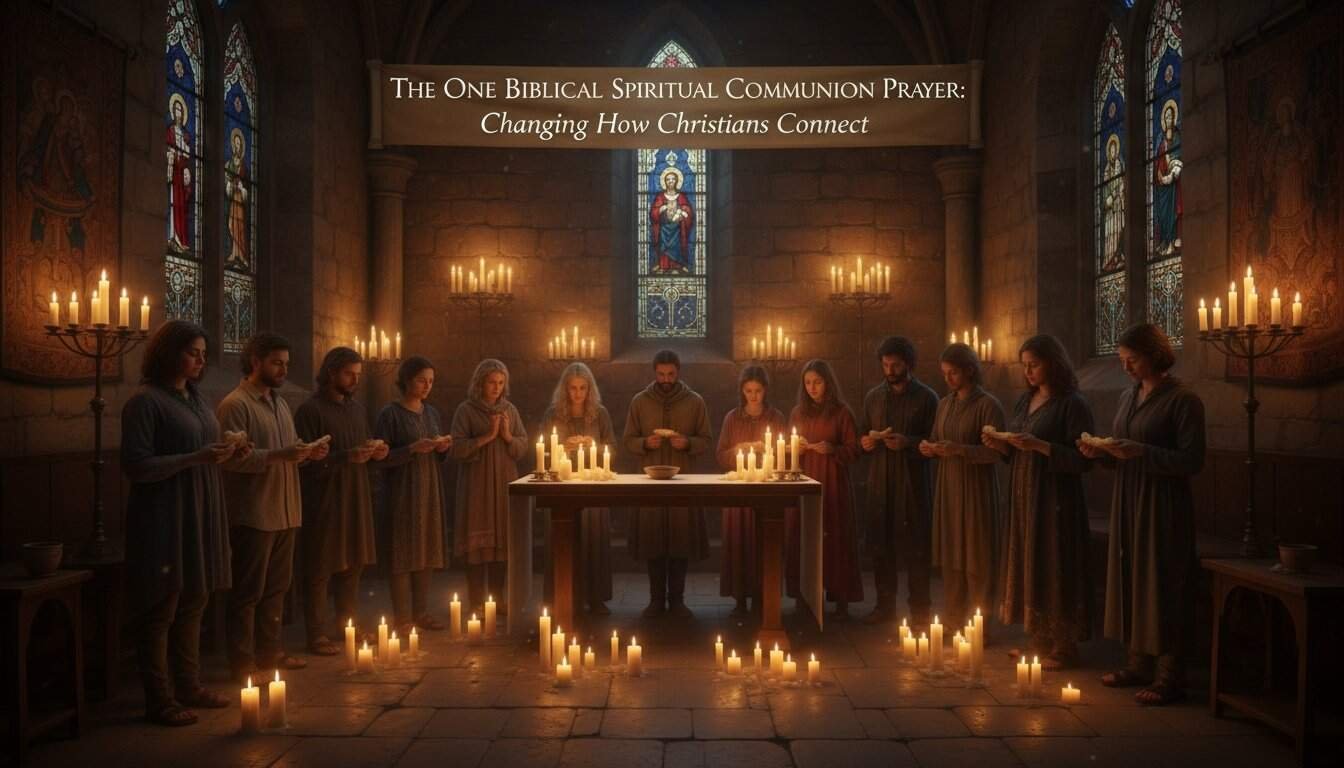
21 Jan The One Biblical Spiritual Communion Prayer Changing How Christians Connect
You’re witnessing a profound revival of spiritual communion—an ancient prayer practice rooted in Christ’s command “Do this in remembrance of me” (Luke 22:19) that’s uniting Catholics, Protestants, and Orthodox believers worldwide. This devotional tradition allows you to connect with Christ’s real presence through faith alone, transcending physical barriers and sacramental limitations. By simply acknowledging your unworthiness, confessing sins, and inviting Jesus into your heart, you’re participating in a biblical practice that’s reshaping how modern Christians experience intimate fellowship with Christ across denominational boundaries and continents.
Table of Contents
Key Takeaways
- Spiritual communion prayer enables Christians to unite with Christ’s real presence through faith alone, transcending physical sacramental limitations.
- The practice roots in Jesus’s memorial command “Do this in remembrance of me,” establishing spiritual dimension beyond physical boundaries.
- Catholics, Protestants, Anglicans, and Orthodox Christians increasingly embrace this ancient devotional practice for cross-denominational unity.
- Digital platforms amplify global participation, creating invisible congregations spanning continents during simultaneous prayer experiences.
- Simple practice requires only sincere faith, humble repentance, and invitation of Jesus into the heart—no special preparation needed.
What Is Spiritual Communion and Why Are Christians Embracing It?
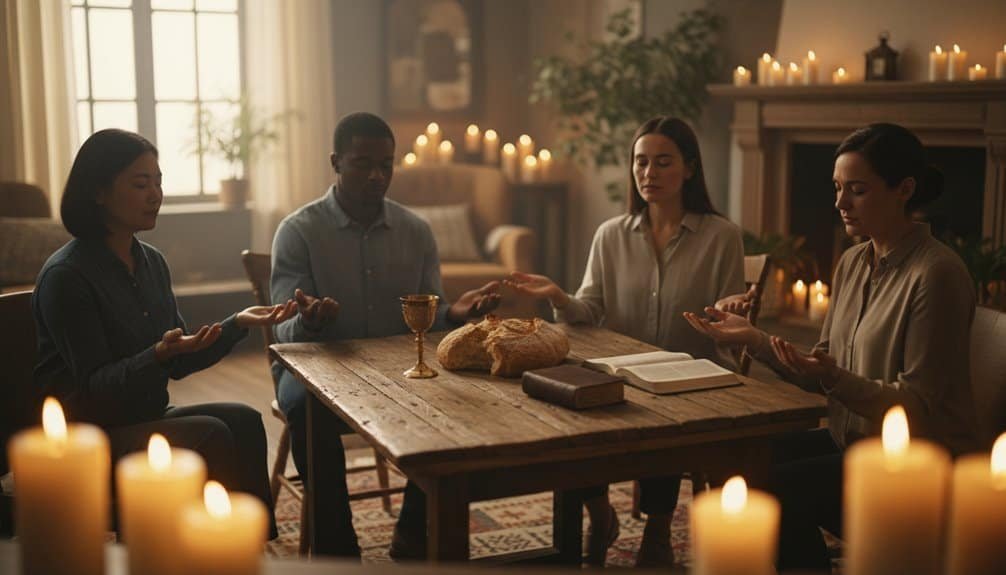
How can believers maintain intimate fellowship with Christ when physical participation in the Eucharist isn’t possible?
Spiritual communion offers a profound answer, representing a devotional practice where you unite your heart with Christ’s real presence through prayer and faith alone.
This ancient Christian tradition, rooted in patristic theology, acknowledges that physical reception of the sacrament isn’t always feasible due to illness, distance, or extraordinary circumstances.

This timeless practice recognizes that circumstances beyond our control sometimes prevent physical sacramental participation while preserving spiritual connection.
The prayer evolution within contemporary Christianity has witnessed renewed interest in spiritual communion across denominational lines.
Catholics invoke it during illness or Eucharistic absence, while Protestants embrace it as meaningful communion with Christ’s body and blood.
This belief diversity demonstrates Christianity’s adaptive capacity while maintaining doctrinal integrity.
Scripture supports this practice through Jesus’ words: “Whoever eats my flesh and drinks my blood remains in me” (John 6:56).
You’re invited into Christ’s presence through faith, transcending physical limitations and fostering deeper spiritual intimacy with the divine.

The Biblical Roots of Spiritual Communion Prayer
Though spiritual communion emerged as formal practice centuries after Christ’s ascension, its theological foundations rest firmly within Scripture’s earliest testimonies about divine presence and faith-based fellowship.
You’ll discover Eucharistic origins in Christ’s words: “Do this in remembrance of me” (Luke 22:19).
This memorial command transcends physical limitations, establishing communion’s spiritual dimension.
When Jesus promised, “Where two or three gather in my name, there am I with them” (Matthew 18:20), He validated presence beyond sacramental boundaries.
Apostolic practice demonstrates this principle.
Paul addressed the Corinthians about communion while physically absent (1 Corinthians 11:23-26), indicating spiritual participation’s validity.
The disciples on Emmaus Road recognized Christ in breaking bread (Luke 24:35), revealing how remembrance creates genuine encounter.
Scripture consistently affirms that faith, not proximity, enables divine communion.
“Blessed are those who haven’t seen and yet have believed” (John 20:29) validates spiritual connection’s authenticity, establishing biblical precedent for communion through faithful remembrance.
How Catholics Share This Ancient Prayer Across Denominations
Where denominational boundaries might seem to divide Christian practice, Catholic spiritual communion prayer demonstrates remarkable ecumenical reach that transcends traditional theological barriers.
You’ll discover that Protestant ministers increasingly incorporate these prayers into their worship services, recognizing their scriptural foundation in John 6:51-58 and 1 Corinthians 11:23-26.
This ecumenical sharing reflects growing unity among Christians who seek deeper communion with Christ outside sacramental reception.
When you examine contemporary liturgical exchange, you’ll find Anglican, Lutheran, and Methodist congregations adapting Catholic spiritual communion texts while maintaining their theological distinctives.
Episcopal priests particularly embrace these prayers during communion services, acknowledging their patristic origins in Augustine and Aquinas.
You can observe this phenomenon during pandemic restrictions, where virtual worship necessitated non-sacramental communion experiences.
Orthodox Christians similarly employ comparable prayers, demonstrating universal Christian hunger for mystical union with Christ that supersedes denominational formulations while preserving doctrinal integrity.
Daily Spiritual Communion: Simple Steps for Every Christian
Since daily spiritual communion requires no special preparation beyond sincere faith, you can establish this transformative practice through straightforward biblical steps that connect you directly with Christ’s presence.
Begin your daily devotion by acknowledging your unworthiness and desire for Christ, following the tax collector’s humble posture in Luke 18:13.
Express genuine repentance for sins, as Scripture commands in 1 John 1:9.
Next, invite Jesus into your heart through prayer, echoing the disciples’ request in Luke 24:29: “Stay with us.”
These simple rituals form the foundation of spiritual communion.
Read Scripture focusing on Christ’s promises about His presence, particularly Matthew 28:20 and John 14:18.
Conclude by offering thanksgiving for Christ’s spiritual nourishment, remembering Paul’s instruction in 1 Thessalonians 5:18.
Through consistent practice, you’ll discover this ancient prayer transforms ordinary moments into encounters with the living Christ, fulfilling His promise to remain with His faithful people.
Why This Prayer Is Uniting Christians Worldwide
As believers across denominational lines embrace spiritual communion prayer, they’re discovering a profound unity that transcends traditional ecclesiastical boundaries.
This prayer practice creates unprecedented global ecumenism, drawing Catholics, Orthodox, Anglicans, and Protestants into shared devotional experiences centered on Christ’s real presence.
Spiritual communion prayer unites believers worldwide, transcending denominational barriers through shared encounters with Christ’s transformative presence.
You’re witnessing digital outreach platforms amplify this phenomenon, enabling millions to participate simultaneously across continents. When you engage in spiritual communion prayer, you’re joining an invisible congregation that spans cultures, languages, and theological traditions. Paul’s vision of one body with many members (1 Corinthians 12:12) finds contemporary expression through this practice.
The prayer’s biblical foundation—rooted in Christ’s words “do this in remembrance of me” (Luke 22:19)—provides common theological ground. You’re participating in a movement that prioritizes Christ’s invitation over institutional divisions, fostering genuine Christian brotherhood that reflects Jesus’s prayer for unity in John 17:21.
Frequently Asked Questions
Can Children Participate in Spiritual Communion Prayer?
Yes, you can include children in spiritual communion prayer based on their understanding and faith development.
Age eligibility isn’t strictly defined scripturally, but Jesus welcomed children, saying ‘Let the little ones come to me’ (Matthew 19:14).
Children’s participation depends on their ability to comprehend Christ’s sacrifice and express genuine faith.
You’ll find that even young believers can meaningfully engage when guided appropriately through this sacred practice.
How Often Should Someone Practice Spiritual Communion Daily?
You should practice spiritual communion according to your personal calling and spiritual maturity, as Scripture doesn’t prescribe specific daily frequency requirements.
While some believers find morning and evening sessions beneficial, establishing a consistent ritual cadence matters more than quantity.
The Apostle Paul’s instruction to “pray without ceasing” (1 Thessalonians 5:17) suggests continuous communion rather than rigid schedules.
Let the Holy Spirit guide your devotional rhythm and spiritual hunger determine frequency.
Is Spiritual Communion Acceptable During Illness or Travel?
You’ll find spiritual communion particularly appropriate during illness or travel when physical participation isn’t feasible.
Church illness guidelines consistently affirm this practice’s validity, as Scripture emphasizes heart devotion over physical presence (John 4:24).
Travel feasibility makes spiritual communion essential for maintaining communion with Christ.
The Catechism supports this doctrine, recognizing that sincere desire and spiritual reception fulfill sacramental grace when circumstances prevent physical reception.
What Specific Words Should Be Included in Spiritual Communion Prayer?
You should incorporate theological vocabulary expressing desire for Christ’s presence and acknowledgment of unworthiness. Traditional liturgical wording includes “Lord, I’m not worthy that you should enter under my roof, but only say the word and my soul shall be healed” (Matthew 8:8). Include petitions for spiritual reception of Christ’s Body and Blood, thanksgiving for redemptive sacrifice, and requests for grace until sacramental communion’s possible.
Does Spiritual Communion Replace Regular Church Attendance and Physical Communion?
No, spiritual communion doesn’t replace regular attendance or physical communion.
Scripture emphasizes gathering together (Hebrews 10:25) and Christ’s physical sacramental presence.
In theology comparison, spiritual communion serves as supplemental devotion when you can’t physically participate.
The practical implications show it enhances rather than substitutes sacramental life.
You’re called to both corporate worship and personal spiritual communion for complete doctrinal faithfulness.
Conclusion
You’ll discover that spiritual communion transcends denominational boundaries, rooting itself in Christ’s promise “where two or three gather in my name, there am I with them” (Matthew 18:20). As you embrace this ancient practice, you’re participating in the mystical body of Christ alongside believers worldwide. This prayer doesn’t replace physical Eucharist but strengthens your spiritual hunger for communion with Jesus. You’re witnessing Christianity’s return to its contemplative foundations through this transformative devotional practice.











No Comments