

20 Dec The Best Topmarks Christmas Games Kids Love in 2025—Fun, Free, and Teacher-Approved
You’ll discover Topmarks Christmas games offer the perfect blend of festive excitement and curriculum-aligned learning for children ages 3-11. These free, browser-based activities require no downloads or accounts while targeting essential skills like visual discrimination, pattern recognition, and mathematical concepts. From Christmas Spot-the-Difference building observation skills to interactive jigsaws developing problem-solving abilities, each game supports classroom learning and home extension. These teacher-approved resources transform holiday enthusiasm into meaningful educational experiences that’ll enhance your child’s development this season.
Key Takeaways
- Topmarks Christmas games are completely free, browser-based resources requiring no downloads, accounts, or payments for instant classroom access.
- Games target ages 3-8 with curriculum-aligned math and literacy skills including counting, patterns, visual discrimination, and vocabulary recognition.
- Popular titles include Christmas Spot-the-Difference, Decorate the Christmas Tree, Ornament Shooter, and Christmas Teddy Numbers with festive themes.
- Interactive whiteboard compatibility and QR codes enable whole-class instruction plus individual practice on tablets and mobile devices.
- Three difficulty levels provide differentiated learning while supporting fine motor development, concentration skills, and problem-solving abilities.
Why Topmarks Christmas Games Are Perfect for Holiday Learning
When you’re searching for educational activities that capture your students’ holiday excitement while maintaining rigorous learning standards, Topmarks Christmas games deliver the perfect balance of festive fun and curriculum alignment.
Topmarks Christmas games seamlessly blend holiday excitement with rigorous educational standards, creating the ideal festive learning experience for students.
These browser-based resources map directly to Key Stage requirements, supporting targeted learning objectives across math and literacy domains.
You’ll find games like Christmas Patterns and Teddy Numbers reinforcing number sense and sequencing, while themed vocabulary activities build word recognition within seasonal contexts. The collection includes visual-spatial activities like Christmas Symmetry Matching that develop spatial reasoning through mirroring Christmas-themed images and patterns.
Christmas Spot the Difference provides detective-style challenges where students compare similar festive pictures to identify small differences in colour or shape. The differentiated difficulty levels enable you to scaffold practice for mixed-ability classrooms effortlessly. Christmas Patterns features three progressive levels that advance from simple pattern continuation to complex sequences with missing elements in various positions.
Digital accessibility makes these games particularly valuable—they require no accounts or payments, work seamlessly on interactive whiteboards, and support remote learning through simple browser access.
Parent engagement increases naturally when families can access the same festive learning tools at home, creating consistent educational experiences across environments while leveraging children’s intrinsic seasonal motivation.
Christmas Spot the Difference: Building Observation Skills Through Festive Fun
You’ll discover eight festive picture pairs that challenge your eyes to spot subtle differences hidden within Christmas scenes.
Each puzzle strengthens your concentration skills as you carefully compare Santa’s workshop details, holiday decorations, and seasonal characters. These Christmas-themed activities are perfect for kindergarten students who benefit from developing visual discrimination abilities through holiday fun.
These engaging activities train your brain to notice small changes while you’re having fun with Christmas-themed imagery. The black and white versions can double as coloring sheets, adding an extra creative element to the observation challenge.
Eight Festive Picture Pairs
Eight carefully crafted picture pairs await your detective skills in this engaging Christmas spot-the-difference game.
It transforms holiday imagery into an educational puzzle adventure.
Each pair features classic seasonal symbols like Santa, Christmas trees, and festive decorations, creating rich visual storytelling opportunities that captivate young learners aged 5-11.
You’ll examine nearly identical images, searching for subtle variations in colors, shapes, and details.
The game’s visual storytelling approach helps develop critical observation skills while maintaining the magic of Christmas.
Without time pressure, you can focus on accuracy and thorough examination of each festive scene.
These thoughtfully designed picture pairs support Key Stage 1 and 2 learning objectives, making observation practice both educational and entertaining through beloved seasonal symbols.
Concentration Skills Development
How effectively can a simple spot-the-difference game transform scattered attention into laser-focused concentration? You’ll discover that Topmarks’ Christmas spot-the-difference activities function as powerful mindfulness exercises, training your students’ visual selective attention through systematic scanning techniques.
Each festive image pair requires sustained focus, preventing mind-wandering while strengthening working memory as children track previously inspected regions.
The game’s design supports attention monitoring by providing clear feedback when differences are found or missed. This immediate reinforcement helps students recognize their concentration patterns and develop better focus strategies. As children practice with the eight Christmas picture pairs, they’re building perceptual speed and visual discrimination skills that transfer directly to classroom tasks like proofreading, error-spotting in math, and detailed observation in science activities.
Decorate the Christmas Tree: Creative Expression Meets Digital Play

When creativity meets technology in Topmarks’ Decorate the Christmas Tree game, you’ll discover an engaging digital playground that transforms traditional holiday decorating into an interactive learning experience.
This festive activity lets you select colorful baubles, delightful Christmas characters, and decorative elements to create your custom tree design.
Perfect for early years children aged 3-8, the game emphasizes open-ended creative expression rather than structured challenges.
You’ll develop fine motor skills through intuitive drag-and-drop mechanics while exploring artistic choices without time pressures or level restrictions.
The game’s collaborative decoration features shine on interactive whiteboards, making it ideal for classroom group activities.
Teachers appreciate its curriculum alignment with art, seasonal themes, and digital literacy development.
Accessibility options include mobile and tablet compatibility via QR codes, ensuring every student can participate.
You’ll access this browser-based game instantly through topmarks.co.uk/christmas/decorate-tree without downloads or login requirements, making festive learning immediately available.
Christmas Jigsaws: Problem-Solving Adventures for Every Skill Level
You’ll find Christmas Jigsaws offers three distinct difficulty levels that adapt perfectly to your child’s developing skills.
The puzzles range from beginner-friendly 9-piece options for younger learners to challenging 25-piece adventures for more experienced puzzle solvers.
This flexible approach ensures your 4-9 year old can progress at their own pace while building essential problem-solving abilities through festive, engaging gameplay.
Multiple Difficulty Options Available
Since learners develop problem-solving skills at different paces, Topmarks Christmas games offer multiple difficulty tiers that adapt to your child’s current abilities and growth trajectory.
You’ll find three discrete levels in sequencing games, with level three introducing missing elements in varied positions to challenge advanced learners. Christmas jigsaws provide clear progression through 9, 16, or 25-piece options, allowing stepwise complexity increases. Wordsearches include selectable parameters like grid size and diagonal word placement.
Lower levels emphasize pattern recognition and basic sequencing, while intermediate stages require multi-step ordering and visual discrimination. Higher difficulties tax spatial reasoning through larger piece counts and unpredictable missing positions.
These accessibility options support differentiated instruction, and parental controls help you select appropriate challenges that build confidence while preventing frustration.
Age-Appropriate Puzzle Pieces
Christmas jigsaws on Topmarks feature eight distinct puzzles that target children ages 4-9 with carefully calibrated piece counts.
You’ll find three selectable difficulty levels offering 9, 16, or 25 pieces per puzzle, ensuring age-appropriate challenges that match developmental capabilities from Early Years through Key Stage 2.
The piece ergonomics accommodate small hands and developing fine motor skills, while digital safety standards eliminate choking hazards associated with physical puzzle pieces.
You can select 9-piece puzzles for younger children building foundational problem-solving skills, or challenge older students with 25-piece configurations that enhance spatial reasoning and visual recognition.
This thoughtful progression supports educational growth while maintaining engagement across the 4-9 age range, making Christmas jigsaws versatile classroom tools that adapt to diverse learning needs and skill levels.
Math-Focused Christmas Games That Make Learning Numbers Exciting
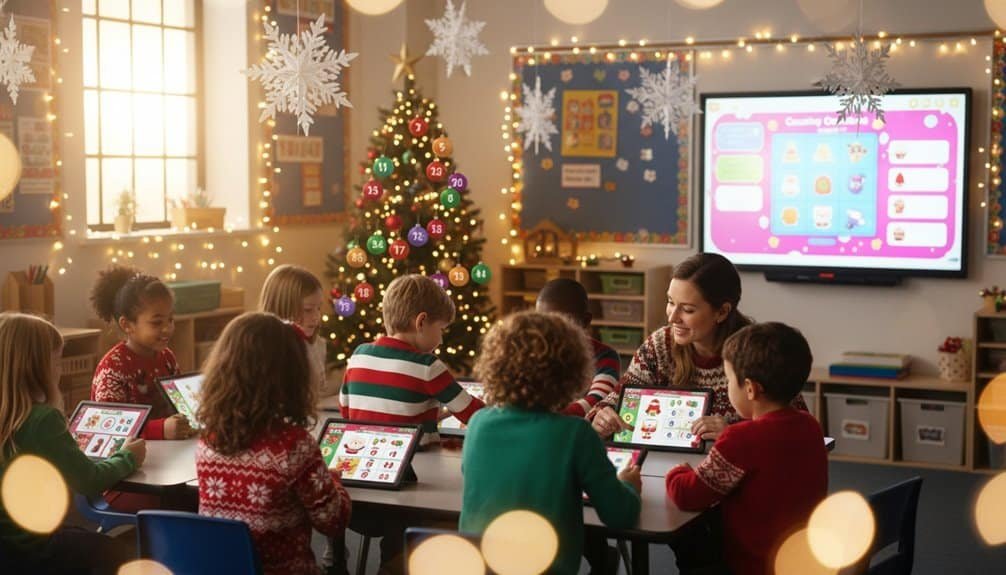
When learning becomes playful, young students absorb mathematical concepts more effectively, and Topmarks’ Christmas-themed math games transform number practice into engaging holiday adventures.
You’ll find counting activities that pair festive visuals with numbers 1-9, helping children build essential numeral recognition skills through matching exercises.
The sequencing games challenge students to order numbers within 10, progressing from basic smallest-to-largest arrangements to complex pattern completion with missing elements.
Three difficulty levels provide adaptive feedback that adjusts to your child’s developing abilities.
Addition and subtraction exercises use Christmas imagery to make abstract concepts concrete.
Students add “one more” to holiday sets or cross out items to practice subtraction within six, building foundational number bonds through visual representation.
Data-handling games like Santa’s Helpers pictograms and Christmas tree tally charts develop interpretation skills while encouraging parental involvement in discussing real-world data applications.
These activities target ages 3-8, making mathematical learning both festive and foundational.
Christmas Teddy Numbers and The Gingerbread Man Game: Counting Made Fun
Among Topmarks’ most beloved counting games, Christmas Teddy Numbers and The Gingerbread Man Game turn numerical learning into delightful holiday experiences for children aged 2-5.
Christmas Teddy Numbers builds essential counting skills through festive drag-and-drop activities where you’ll help children count presents up to 15. The game reinforces one-to-one correspondence while teaching both numerals and number words, making it perfect for nursery and reception settings.
Christmas Teddy Numbers transforms counting into festive fun, teaching children numerals and number words through engaging drag-and-drop present activities.
The Gingerbread Man Game complements this learning with counting, matching, and ordering activities using gingerbread figures with buttons. Children practice counting to 10 while developing comparative language skills through size ordering tasks.
Both games work brilliantly on interactive whiteboards for whole-class sessions. You can implement effective teacher strategies by using differentiated levels to match individual abilities. For home extension activities, parents can reinforce classroom learning through these free, browser-based resources that support fine motor development and mathematical confidence building.
Christmas Symmetry Matching and Musical Christmas Wreath: Pattern Recognition Games
You’ll strengthen your visual-spatial reasoning and pattern recognition abilities through two engaging Christmas-themed games that challenge different cognitive skills.
Christmas Symmetry Matching develops your understanding of reflective symmetry by having you complete mirror images of festive pictures and shapes.
Musical Christmas Wreath trains your auditory memory through musical sequence challenges.
Both games offer multiple difficulty levels that adapt to your developmental stage, ensuring you’re appropriately challenged whether you’re working with simple picture symmetry or complex randomly generated patterns.
Visual Pattern Recognition Skills
Visual pattern recognition skills develop rapidly when children engage with Christmas symmetry matching games and musical pattern activities that challenge their spatial reasoning abilities.
You’ll notice your students strengthen visual discrimination as they complete missing halves of Christmas trees, wreaths, and ornaments.
These activities build early geometry foundations through hands-on manipulation of concrete materials like cut-outs and grid overlays.
Pattern transfer occurs naturally as children apply symmetry concepts from holiday imagery to mathematical contexts.
Start with simple mirror placement for preschoolers, then progress to coordinate-grid reflections for older students.
Multi-sensory approaches combining visual and kinesthetic elements support diverse learning profiles while reducing visual clutter through scaffolded templates.
Short timed rounds provide immediate feedback, enhancing error detection and boosting persistence as students test and adjust their symmetrical designs.
Musical Sequence Memory Training
Musical sequence memory training transforms pattern recognition from static visual exercises into dynamic auditory challenges that strengthen working memory and sequential processing skills.
You’ll develop rhythm recall abilities as you listen to Christmas melodies and reproduce their temporal patterns through clapping, tapping, or vocal repetition.
These activities enhance your brain’s capacity to process sequential information while building auditory discrimination skills.
Melody chunks become manageable learning units when you break complex Christmas songs into smaller musical phrases.
You’ll strengthen cognitive confidence by successfully replicating increasingly complex musical sequences, while fine motor skills refine through coordinated hand movements that match rhythmic patterns.
Your spatial reasoning enhances as you visualize musical patterns, connecting auditory input with visual representation.
Pattern recognition develops through repeated exposure to musical structures, creating neural pathways that support both mathematical thinking and creative expression in holiday-themed learning environments.
Age-Appropriate Difficulty Levels
Christmas pattern recognition games effectively adapt to different developmental stages through carefully structured difficulty levels that match your child’s cognitive abilities and learning progression.
Early years children (ages 3-5) work with simple two-item patterns using familiar Christmas icons, while Key Stage 1 students (ages 5-7) tackle multi-step sequences with missing elements in various positions.
Scaffolding strategies ensure smooth advancement as your child masters each level.
Level 1 presents obvious repeating patterns with missing elements at sequence ends.
Level 2 introduces longer alternating patterns requiring mid-sequence inference.
Level 3 challenges students with randomly generated patterns and dual-axis symmetry tasks.
Progression mapping allows single activities to serve multiple age groups simultaneously, making classroom implementation efficient while supporting individualized learning paths through increasingly complex cognitive challenges.
Puzzle Games for Critical Thinking: Ornament Shooter and Christmas Wordsearch
Developing critical thinking skills becomes engaging when students tackle puzzle games that combine festive themes with cognitive challenges.
Ornament Shooter transforms pattern recognition into an arcade-style adventure where you’ll match identical Christmas ornaments under time pressure.
This fast-paced game develops visual recognition skills while building concentration through repetitive gameplay.
The time limit creates urgency that enhances decision-making abilities.
Christmas Wordsearch offers a different cognitive approach, strengthening vocabulary recognition through systematic searching.
You’ll find Christmas-themed words hidden diagonally, backwards, and forwards across multiple grid sizes.
The varying difficulty levels accommodate different skill ranges, making collaborative play natural in mixed-ability classrooms.
Both games provide immediate feedback timing that helps students adjust strategies quickly.
The festive context maintains engagement while developing essential problem-solving skills.
These teacher-approved puzzle games integrate seamlessly into holiday learning activities, supporting individual focus and group discussions about different solving approaches.
Age-Appropriate Game Selection: From Early Years to Key Stage 2
Selecting games that match your students’ developmental stages maximizes both engagement and learning outcomes across the primary years.
Early Years learners (3-5) thrive with simple counting games like Christmas Teddy Numbers and visual sequencing in Christmas Patterns, building foundational numeracy skills through colorful, interactive experiences.
Key Stage 1 students (5-7) can tackle more complex challenges like Shape Patterns and Christmas Jigsaws with varying piece counts, developing problem-solving abilities while maintaining festive appeal.
The Christmas Jumper Designer encourages creativity across this age range.
Key Stage 2 learners (7-11) benefit from advanced games like Higher and Lower, which introduces fractions and negative numbers, plus Musical Christmas Wreath for memory development.
Parent guidance becomes crucial at this level to monitor appropriate screen time and ensure educational value.
Each game’s progressive difficulty levels let you differentiate instruction within mixed-ability classrooms, supporting every learner’s journey from basic counting to complex mathematical concepts.
Complementing Digital Games With Christmas-Themed Worksheets and Activities
While digital games capture students’ attention effectively, you’ll maximize learning impact by pairing them with hands-on worksheets and craft activities that reinforce the same mathematical concepts.
Combine engaging digital math games with tactile worksheets and creative crafts to strengthen conceptual understanding through multiple learning modalities.
Topmarks offers extensive Christmas-themed worksheets covering counting, addition, subtraction, data handling, and symmetry.
You can start with counting activities featuring Christmas trees and snowmen for early years, then progress to missing numbers within 20 and sequencing exercises.
The pictogram worksheets about Santa’s helpers and Christmas tree baubles strengthen data handling skills while maintaining festive engagement.
For Parent Engagement, these printable resources extend learning beyond the classroom, allowing families to practice mathematical concepts together during holiday breaks.
The worksheets create clear Curriculum Links between festive fun and educational objectives, ensuring you’re meeting learning standards while celebrating the season.
Complement these with craft activities like Christmas jigsaws, tree decorating games, and jumper design activities that develop problem-solving skills through creative, hands-on experiences.
Frequently Asked Questions
Are Topmarks Christmas Games Completely Free to Access and Play?
Yes, you can access and play Topmarks Christmas games completely free without paywalls or subscriptions.
However, you should verify funding sources and usage restrictions before redistributing content in classrooms.
While the games don’t require paid accounts, licensing terms for downloading PDFs or printing materials aren’t clearly specified.
You’ll want to check Topmarks’ terms of use if you’re planning educational reuse beyond basic classroom projection.
Do the Christmas Games Work on Tablets and Mobile Devices?
Yes, most Christmas games work on tablets and mobile devices through standard web browsers. You’ll find QR codes on game pages for quick mobile access, and touch responsiveness works well for simple activities like jigsaws.
However, browser compatibility varies—avoid Flash-based games that won’t run on modern devices. Test each game beforehand since precision tasks may be challenging on smaller screens without stylus support.
Can Teachers Track Student Progress While Playing These Christmas Games?
You can’t track student progress automatically since these games don’t include built-in analytics or dashboards.
However, you’ll gather valuable formative feedback through direct observation during gameplay.
Use the interactive whiteboard to watch students work through different difficulty levels, enabling differentiated instruction.
Monitor completion times, observe problem-solving strategies, and note which difficulty levels students choose to informally assess their skill development.
Are the Christmas Games Available Year-Round or Only During Holidays?
You can access these Christmas games year-round without any seasonal restrictions.
They’re permanently available through direct URLs and the main Topmarks site, giving you complete flexibility for classroom planning.
Whether you’re teaching patterns in February or need engaging activities during summer school, you won’t face holiday-only limitations.
This consistent seasonal access lets you integrate these educational games into your curriculum whenever they best support your students’ learning objectives.
Do Any Christmas Games Require Account Registration or Personal Information?
No, you won’t need to register accounts or provide personal information for these Christmas games. They’re designed with privacy safeguards that let you play immediately without data collection barriers.
Since no registration’s required, there’s no parental consent process either. You can access activities like Christmas jigsaws, memory matching, and tree decorating games directly through your browser, making them safe and hassle-free for classroom or home use.
Conclusion
You’ll discover that Topmarks Christmas games transform holiday learning into exciting adventures for your students. These free, teacher-approved activities develop essential skills while keeping children engaged through festive themes. Whether you’re targeting math concepts, critical thinking, or creative expression, you’ve got reliable digital resources at your fingertips. Combine these games with hands-on worksheets to create comprehensive holiday lessons that’ll make December both educational and memorable for your classroom.












No Comments