


07 Sep Complete List of Christian Festivals and Their Meaning
You’ll find Christianity’s liturgical calendar features over twenty major festivals annually, with Easter celebrating Christ’s resurrection, Christmas commemorating His birth, and Pentecost marking the Holy Spirit’s descent forming the core celebrations. These observances include Holy Week’s solemn Good Friday, the Epiphany’s revelation to the Gentiles, Ascension Day’s triumphant return to heaven, and All Saints’ Day honoring the faithful departed. Each festival carries distinct theological significance and ritual practices that’ve shaped Christian worship for two millennia, revealing deeper spiritual meanings through their historical development.
Table of Contents
Key Takeaways
- Easter celebrates Christ’s resurrection from the dead, while Good Friday commemorates his crucifixion, forming Christianity’s most important holy week.
- Christmas marks the birth of Jesus Christ in Bethlehem, celebrated December 25th with traditions like midnight Mass and nativity scenes.
- Pentecost occurs fifty days after Easter, commemorating the Holy Spirit’s descent upon the apostles as described in Acts.
- Ascension Day marks Jesus Christ’s rise to heaven forty days after Easter, bridging his earthly ministry and heavenly intercession.
- All Saints’ Day and All Souls’ Day honor departed saints and faithful Christians, observed November 1st and 2nd respectively.
Easter: The Resurrection Celebration and Its Holy Week Observances
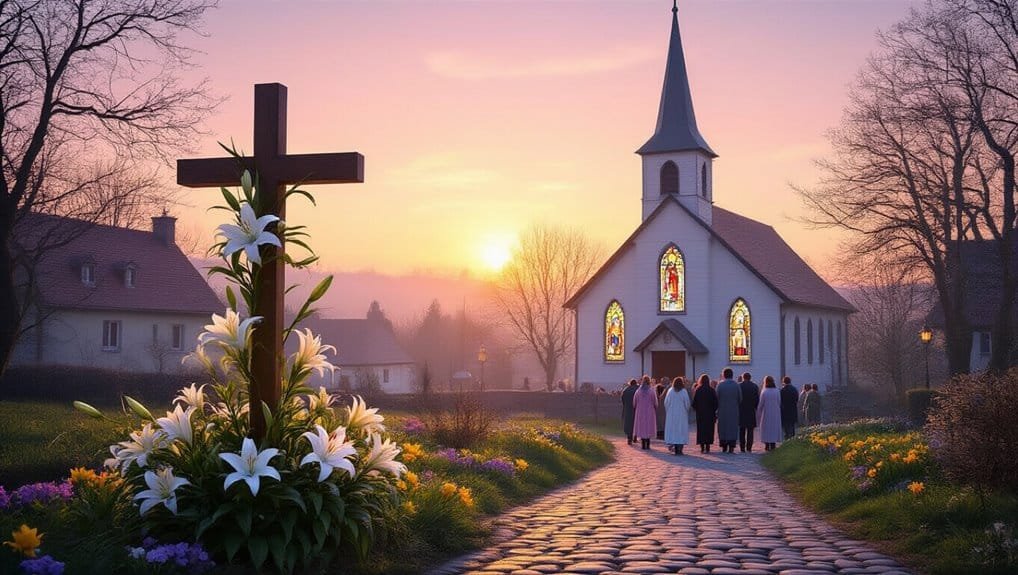
When you examine the Christian liturgical calendar, Easter emerges as the principal feast celebrating Christ’s resurrection from the dead, marking the culmination of the Passion narrative that begins with Jesus’s triumphal entry into Jerusalem.
Easter stands as Christianity’s supreme celebration, culminating the Passion narrative from Palm Sunday through resurrection morning.
You’ll observe that Holy Week encompasses Palm Sunday through Holy Saturday, each day commemorating specific events from Christ’s final week. Maundy Thursday recalls the Last Supper and foot-washing ceremony, while Good Friday solemnizes the crucifixion.
You’ll find Easter traditions vary across denominations and cultures, yet they’re unified by Resurrection symbolism. The Easter Vigil, Christianity’s oldest liturgical observance, features the Paschal candle representing Christ as light conquering darkness.
You’ll notice eggs symbolize new life emerging from the tomb, while white lilies signify purity and rebirth. The greeting “Christ is risen” with its response “He is risen indeed” echoes through churches worldwide, affirming the central tenet of Christian faith that death doesn’t have final victory.
Christmas: The Nativity of Christ and Advent Season
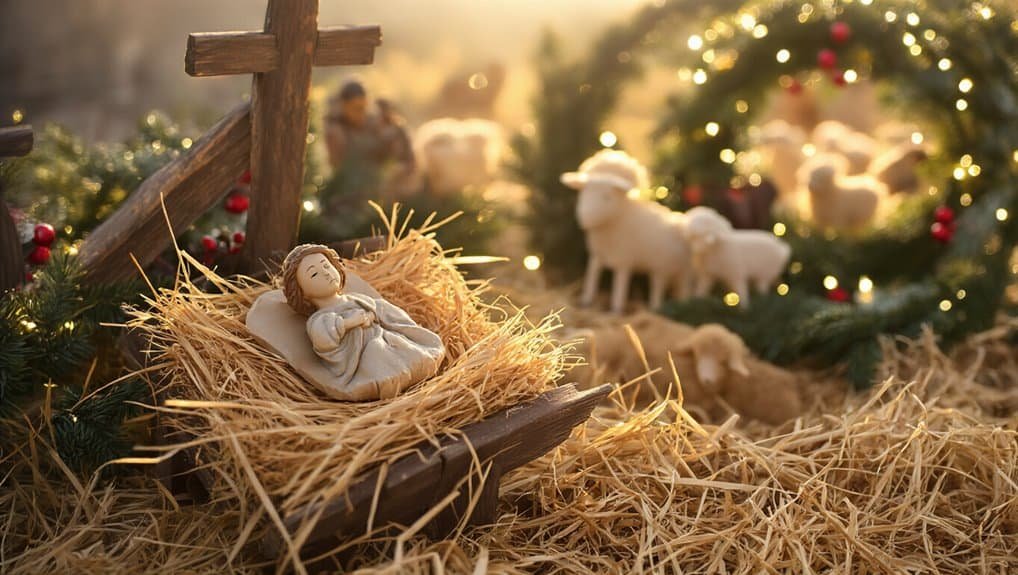
You’ll find Christmas commemorates Christ’s birth in Bethlehem, an event that’s shaped Western civilization’s cultural and religious landscape for two millennia.
You’re observing centuries-old traditions when you open Advent calendar windows during the four-week preparatory period or attend Midnight Mass on December 24th, practices that emerged from medieval European Christianity.
You’re participating in a festival that’s evolved from its early church origins into both a sacred observance of the Incarnation and a global cultural phenomenon marked by distinct liturgical and popular customs.
Birth in Bethlehem
When you examine Luke’s Gospel account, you’ll discover Mary gave birth in a stable because lodgings were occupied.
The manger scene represents divine humility, with God’s incarnation occurring among livestock rather than palaces.
This juxtaposition between heavenly glory and earthly poverty remains central to Christian theology, demonstrating God’s accessibility to humanity’s marginalized populations.
Advent Calendar Traditions
The anticipation of Christ’s birth extends beyond the nativity narrative into structured devotional practices that emerged in 19th-century German Lutheran communities.
You’ll find that advent calendar history traces back to 1851, when Protestant families marked December days with chalk lines or lit candles. Gerhard Lang’s 1908 printed calendar revolutionized the tradition, introducing numbered doors concealing biblical verses and images.
Today’s advent calendar activities reflect both secular and sacred dimensions. You’re engaging with chocolate-filled compartments, toy surprises, or digital countdowns that maintain December’s ritualistic structure.
Religious households preserve devotional elements through scripture readings, prayer cards, and nativity scenes behind each door. This practice transforms waiting into active participation, teaching you patience while building communal excitement for Christmas morning’s theological significance.
Midnight Mass Celebrations
As darkness envelops December 24th, Christian communities worldwide gather for midnight mass, a liturgical celebration rooted in the ancient belief that Christ’s birth occurred at night.
You’ll find this tradition dating to 5th-century Jerusalem, where pilgrims documented midnight rituals at Bethlehem’s Church of the Nativity. Pope Sixtus III later introduced the practice to Rome in 440 CE, establishing three Christmas masses: midnight, dawn, and day.
When you attend these candlelight services, you’re participating in Christianity’s most attended annual worship. The midnight timing symbolizes Christ as light entering darkness, referencing John 1:5.
You’ll observe regional variations: Latin America’s “Misa de Gallo” incorporates indigenous elements, while European cathedrals maintain medieval ceremonial structures.
Protestant denominations adapted the Catholic tradition, emphasizing congregational singing and scripture readings over eucharistic celebration.
Pentecost: The Descent of the Holy Spirit
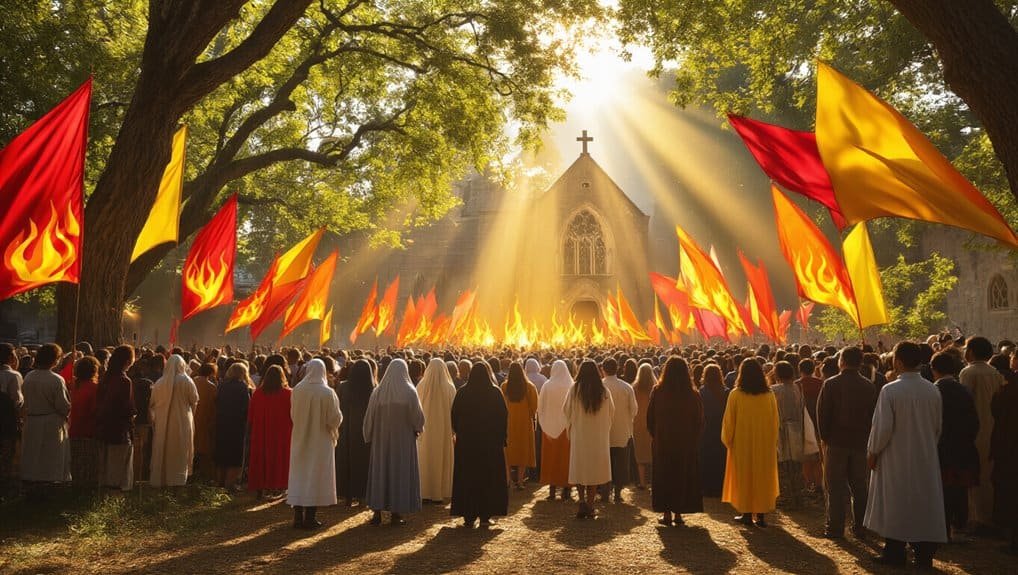
Occurring fifty days after Easter Sunday, Pentecost commemorates the transformative moment when the Holy Spirit descended upon Christ’s apostles in Jerusalem, marking the birth of the Christian Church.
You’ll find this festival’s origins in Acts 2:1-4, where tongues of fire appeared above the apostles’ heads, enabling them to speak in various languages and evangelize to diverse peoples.
When you examine Pentecost’s theological significance, you’re observing Christianity’s foundational teaching about spiritual gifts. The Holy Spirit’s arrival fulfilled Christ’s promise to send a divine advocate, empowering believers with charisms including prophecy, healing, and speaking in tongues.
The Holy Spirit’s arrival fulfilled Christ’s promise, empowering believers with prophecy, healing, and speaking in tongues.
These manifestations weren’t merely historical phenomena but established precedents for ongoing charismatic experiences within Christian communities.
You’ll notice modern Pentecost celebrations incorporate red vestments symbolizing the Spirit’s fire, while liturgical readings emphasize renewal and mission.
The festival’s timing coincides with the Jewish Shavuot, demonstrating Christianity’s continuity with Hebrew traditions while asserting its distinct theological identity.
Epiphany: The Revelation of Christ to the Gentiles
When you trace Epiphany’s origins to January 6th in the Christian calendar, you’re examining one of Christianity’s oldest festivals, predating Christmas celebrations by centuries. This feast commemorates Christ’s epiphany through three pivotal biblical references: the Magi’s visit, Jesus’s baptism, and the Cana miracle.
You’ll find the Gentile revelation particularly significant, as the Magi represented non-Jewish peoples receiving divine manifestation. The theological implications extend beyond mere historical context. You’re observing how early Christians understood universal salvation’s scope through this festival’s spiritual significance.
Eastern and Western liturgical practices diverged over time—while Eastern churches emphasize Christ’s baptism, Western traditions focus on the Magi’s adoration. Cultural observances vary considerably across denominations.
You’ll encounter gift-giving in Spain, king cake traditions in France, and blessing of homes with chalked inscriptions in Germanic regions. These practices reinforce Epiphany’s core message: God’s revelation transcends ethnic and geographical boundaries, establishing Christianity’s universal mission.
Good Friday and the Passion of Christ
You’ll find Good Friday commemorates Christ’s crucifixion through solemn observances that have shaped Christian worship for two millennia.
The Gospel accounts of Jesus’s trial, suffering, and death on the cross form the scriptural foundation for this day’s liturgical practices, which typically include fasting, extended prayer, and the veneration of the cross.
You can observe how different Christian traditions have developed distinct services—from the Catholic Church’s Liturgy of the Passion to Protestant Tenebrae services—yet all maintain the day’s penitential character through stripped altars, darkened sanctuaries, and contemplative silence.
The Crucifixion Story
The crucifixion of Jesus Christ stands as the pivotal event in Christian theology, marking both humanity’s darkest hour and the foundation of redemptive hope that defines the faith.
When you examine the historical context, you’ll find Roman crucifixion served as the empire’s most degrading execution method, reserved for slaves and rebels.
The Gospel accounts detail Christ’s journey to Golgotha, where he’s nailed to the cross between two criminals.
You’ll discover profound crucifixion symbolism throughout: the crown of thorns mocking earthly kingship, the divided garments fulfilling prophecy, and the darkness covering the land.
Christ’s seven last words from the cross reveal forgiveness, compassion, and ultimate surrender.
His death at the ninth hour marks the moment when, Christians believe, humanity’s sins are atoned through divine sacrifice.
Fasting and Prayer
As Christians worldwide observe Good Friday‘s solemn remembrance of Christ’s crucifixion, they’ve traditionally marked this day through rigorous fasting and intensive prayer practices that date back to the early church.
You’ll find that communal fasting serves as a powerful spiritual discipline, strengthening your connection to Christ’s suffering while promoting faith strengthening through shared sacrifice.
Your personal reflection deepens through scriptural meditation and prayer journaling, transforming this observance into meaningful worship enhancement.
You’re engaging in intercessory prayer alongside millions, creating a global tapestry of devotion.
Modern research confirms fasting’s health benefits, validating ancient prayer practices that early Christians intuitively understood.
Through this deliberate abstinence, you’re participating in a two-millennia tradition that transcends denominational boundaries, uniting believers in contemplative remembrance of Christianity’s most pivotal moment.
Church Service Traditions
While fasting and prayer establish the spiritual foundation for Good Friday observance, church service traditions have evolved into distinctive liturgical expressions that commemorate Christ’s Passion through centuries-old rituals and contemporary adaptations.
You’ll find most congregations conduct solemn services between noon and 3 PM, marking Jesus’s crucifixion hours. These worship practices typically include the Veneration of the Cross, where you’ll witness believers approaching a wooden cross for prayer and reflection.
Many churches incorporate the Stations of the Cross, guiding you through fourteen scenes depicting Christ’s journey to Calvary. You’ll hear readings from John’s Passion narrative and participate in intercessory prayers.
Protestant church traditions often feature Tenebrae services, where candles are gradually extinguished, symbolizing darkness overtaking the world at Christ’s death.
Palm Sunday: the Triumphal Entry Into Jerusalem
The triumphal entry fulfilled Old Testament prophecy from Zechariah 9:9, establishing Jesus as the promised Messiah. When you examine the historical context, you’ll notice the Jerusalem celebrations reflected both political and spiritual expectations. The crowds believed Jesus would overthrow Roman rule and restore Israel’s kingdom.
Today, you’ll observe churches recreating this event through palm processions and special liturgies. Worshippers receive blessed palm fronds, which they’ll often fashion into crosses.
The service’s tone shifts from celebration to solemnity, foreshadowing Christ’s passion. You’ll hear readings from the Passion narrative, reminding congregants that the same crowds shouting “Hosanna” would soon cry “Crucify him” just days later.
Ascension Day: Christ’s Return to Heaven
You’ll find the Ascension’s biblical accounts in Luke 24:50-53 and Acts 1:9-11, where Christ physically rises to heaven forty days after His resurrection, fulfilling His own prophecies about returning to the Father.
The event establishes Christ’s present reign at God’s right hand and validates His promise to send the Holy Spirit, marking a pivotal transition from His earthly ministry to His heavenly intercession.
Today’s theological interpretation emphasizes Christ’s ongoing priestly work, His sovereign authority over creation, and the church’s mission to witness until His promised return.
Biblical Accounts and Prophecies
As Luke meticulously records in Acts 1:9-11, the Ascension represents Christ’s physical departure from earth forty days after His resurrection, marking a pivotal transition in salvation history.
You’ll find corroborating testimony in Mark 16:19 and Luke 24:50-51, where witnesses describe Jesus’s bodily ascent into heaven from the Mount of Olives.
Biblical prophecies in ancient texts anticipated this event centuries earlier.
Daniel 7:13-14 depicts the Son of Man approaching the Ancient of Days to receive eternal dominion.
You can trace these messianic expectations through Psalm 110:1, where David prophesies the Messiah’s exaltation at God’s right hand.
The theological significance emerges when you examine how Christ’s ascension fulfills Old Testament typology, particularly Elijah’s assumption into heaven, establishing divine vindication patterns that shaped early Christian understanding.
Theological Meaning Today
Beyond its historical documentation, Christ’s ascension carries profound theological implications that shape contemporary Christian doctrine and worship. You’ll find theological reflections emphasizing Christ’s bodily resurrection’s completion and His priestly intercession at God’s right hand.
The event’s contemporary relevance manifests in worship expressions that celebrate divine sovereignty and humanity’s restored relationship with God.
When examining faith interpretations within historical context, you’ll discover the ascension validates Christ’s victory over death while establishing His cosmic authority. Its spiritual significance extends to communal implications—the church functions as Christ’s earthly body, empowered by His promised Spirit.
Modern practices incorporate ascension themes through liturgical calendars, hymns, and sacramental theology. You’re witnessing how this pivotal event bridges heaven and earth, transforming individual believers and corporate worship alike.
The Feast of the Annunciation
When the angel Gabriel appeared to Mary in Nazareth, announcing she’d conceive the Son of God through the Holy Spirit, this pivotal moment became the foundation for one of Christianity’s most theologically significant celebrations.
You’ll find the Feast of the Annunciation observed annually on March 25, exactly nine months before Christmas, marking the Incarnation’s beginning.
The angelic message delivered to Mary represents God’s direct intervention in human history. You can trace this feast’s origins to the fourth century when Eastern churches first commemorated Gabriel’s announcement.
Mary’s acceptance—her “fiat” or “yes” to God—demonstrates profound faith and obedience that fundamentally altered salvation history.
You’ll notice most liturgical traditions emphasize this feast’s dual nature: it celebrates both Christ’s conception and Mary’s role as Theotokos (God-bearer).
When March 25 falls during Holy Week or Easter, you’ll see churches transfer the celebration to avoid conflicting with these paramount observances.
All Saints’ Day and All Souls’ Day
Following the early church’s practice of honoring martyrs on the anniversaries of their deaths, All Saints’ Day emerged in the fourth century as a universal commemoration for all holy men and women who’d achieved heavenly glory.
You’ll find this solemnity celebrated on November 1st in Western Christianity, while Eastern churches observe it on the first Sunday after Pentecost.
All Souls’ Day follows immediately on November 2nd, establishing a complementary observance. While All Saints honors those in heaven, All Souls focuses on the faithful departed who’re undergoing purification.
You’ll notice this distinction reflects medieval theological developments about purgatory and intercessory prayer.
These twin commemorations create what’s known as Allhallowtide, beginning with All Hallows’ Eve on October 31st.
You’ll observe various cultural practices during this period: visiting graves, offering prayers for the dead, and lighting candles.
The observances demonstrate Christianity’s communal understanding of salvation, linking the church militant, suffering, and triumphant.
Corpus Christi: The Celebration of the Eucharist
The feast’s origins trace to Juliana of Liège’s visions and the Eucharistic miracle of Bolsena in 1263, where a doubting priest witnessed blood emanating from the consecrated host.
You can observe how medieval Christians developed elaborate public devotions, transforming private veneration into communal celebration.
During the Corpus Christi Procession, you’ll see the Blessed Sacrament carried through streets adorned with flowers and altars. This public witness demonstrates belief in Christ’s Real Presence.
Eucharistic Adoration forms the feast’s contemplative dimension, where you’re invited to silent prayer before the exposed host.
These practices reinforced Catholic identity during the Counter-Reformation and continue shaping contemporary devotional life.
Frequently Asked Questions
Which Christian Festivals Are Public Holidays in Different Countries?
You’ll find Christmas and Easter serve as Christian public holidays across most Western nations, though specific observances vary regionally.
In Latin American countries, you’ll encounter Epiphany and Corpus Christi as official holidays.
Orthodox nations celebrate dates according to Julian calendar calculations.
Holiday traditions reflect historical Christian influence on state formation.
You’ll observe Good Friday recognized in countries like Germany, while Assumption Day remains significant in Catholic-majority nations like Poland and Austria.
How Do Orthodox and Western Christian Festival Dates Differ?
You’ll find Orthodox differences in festival dates stem from Calendar variations between Eastern and Western Christianity.
Orthodox churches predominantly follow the Julian calendar, placing Christmas on January 7th and affecting Easter’s calculation through different Paschalion methods.
You’re observing a 13-day discrepancy for fixed feasts, while moveable feasts like Easter can vary by weeks.
This divergence originated from the Gregorian reform of 1582, which Orthodox churches didn’t adopt universally.
What Foods Are Traditionally Associated With Specific Christian Festivals?
You’ll find traditional dishes marking major Christian festivals throughout history.
Christmas brings roasted goose, plum pudding, and festive treats like gingerbread across Germanic regions.
Easter’s celebrated with lamb, symbolizing Christ’s sacrifice, alongside hot cross buns in Anglican traditions.
You’ll observe fish during Good Friday’s fasting customs.
Epiphany features king cake, while harvest festivals incorporate bread and wine, reflecting ancient agricultural cycles merged with Christian theological significance.
Are There Regional Christian Festivals Not Celebrated Worldwide?
You’ll find numerous regional Christian festivals reflecting local traditions across different cultures.
Spain’s Semana Santa processions, Mexico’s Day of the Dead with Catholic influences, and Ethiopia’s Timkat celebration exemplify distinctive regional celebrations.
Ireland’s St. Patrick’s Day, Italy’s feast days for patron saints, and Eastern Europe’s unique Orthodox observances demonstrate how Christianity’s adapted to local customs throughout history, creating festivals that remain geographically specific rather than achieving worldwide recognition.
How Should Non-Christians Respectfully Acknowledge Christian Festivals?
You should acknowledge Christian festivals through cultural sensitivity by understanding their historical significance and religious meaning.
You’ll find interfaith dialogue opportunities during major celebrations like Christmas and Easter, where you can offer respectful greetings without appropriating religious practices.
Historical context shows that acknowledgment patterns vary across societies—you’re encouraged to learn specific customs, avoid commercialization of sacred observances, and recognize these festivals’ theological importance while maintaining your own religious identity.
Conclusion
You’ve explored the major Christian festivals that have shaped religious observance for two millennia. These celebrations don’t merely mark historical events; they’ve structured the liturgical calendar and influenced Western civilization’s temporal rhythms. From Easter’s moveable date calculations to Christmas’s fixed placement, each festival reflects theological developments and cultural adaptations across centuries. Understanding these observances provides insight into Christianity’s evolution from ancient Palestine through medieval Europe to today’s global expressions of faith.










No Comments