

26 Jan Why These 5 Christian Holy Days Are Trending Over Easter
You’re seeing increased interest in these five Christian holy days because 2026’s liturgical calendar creates exceptional circumstances that highlight denominational differences. Western Easter falls on April 5 while Orthodox Pascha occurs April 12, demonstrating the ongoing Gregorian-Julian calendar divide. The Holy Week timeline, Orthodox midnight liturgies, Catholic Easter Vigil traditions, and post-Easter feasts like Ascension Day (May 14) and Pentecost (May 24) showcase distinct theological emphases that capture attention when scheduling anomalies illuminate these contrasts more prominently than usual.
Table of Contents
Key Takeaways
- Orthodox Easter falls later than Western Easter in 2026 due to different calendar calculations and traditional timing requirements.
- Holy Week’s eight-day sequence from Palm Sunday through Easter Monday creates multiple significant celebration opportunities for churches.
- Orthodox Pascha’s dramatic midnight liturgy with candlelight processions offers more visually engaging worship experiences than traditional services.
- Catholic Easter Vigil’s four-part structure provides extended ceremonial elements that appeal to seekers wanting deeper spiritual experiences.
- Post-Easter celebrations like Ascension Day and Pentecost extend the Easter season, giving churches nearly two months of themed programming.
Western Vs Orthodox Easter 2026: Why the Dates Differ by Seven Days
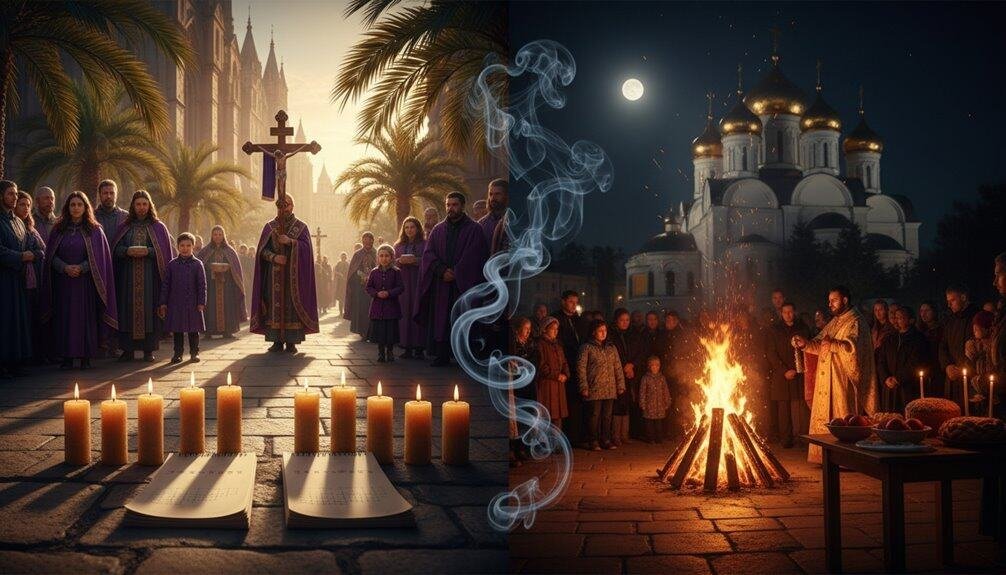
Why do Western and Orthodox churches celebrate Christianity’s most significant holiday on different dates in 2026? You’ll find Western Easter on April 5th while Orthodox Easter falls on April 12th, creating a seven-day gap that reflects centuries-old calculation differences.
The primary cause stems from secular calendars: Western churches use the Gregorian calendar established as the modern standard, while Orthodox churches maintain the Julian calendar from 325 AD, which runs 13 days behind. Both traditions calculate Easter using the spring equinox and first full moon after March 21st, but their different calendar systems produce varying results.
Orthodox churches follow additional requirements that Western churches don’t observe, including positioning Easter after Jewish Passover. This Nicaea Council mandate can push Orthodox dates significantly later. While holiday trends show some Christian communities exploring alternative observances, this 2026 seven-day difference represents relatively close alignment compared to years when the gap exceeds one month. Easter Monday follows each tradition’s Easter Sunday, with Western Easter Monday falling on April 6, 2026.
Holy Week Timeline: From Palm Sunday to Easter Monday 2026
Holy Week unfolds across eight pivotal days in 2026, beginning with Palm Sunday on March 29th and culminating with Easter Monday on April 6th. This Resurrection timeline follows a precise liturgical progression that’s captured global attention among trending Christian observances.
Palm Sunday initiates Holy Week with Jesus’ triumphal entry into Jerusalem, fulfilling Zechariah’s prophecy. The subsequent days intensify dramatically: Holy Monday features the Temple cleansing, Tuesday brings the Olivet Discourse, and Wednesday marks Judas’ betrayal plot. Maundy Thursday commemorates the Last Supper and foot washing ceremony, while Good Friday observes Christ’s crucifixion at Calvary.
Holy Saturday represents the tomb’s silence before Easter Vigil begins that evening. Easter Sunday celebrates the Resurrection on April 5th, followed by Easter Monday on April 6th, extending the celebration. You’ll find this eight-day progression provides comprehensive theological narrative spanning triumph, teaching, betrayal, sacrifice, death, and ultimate victory—explaining why Holy Week consistently trends alongside individual Easter celebrations.
Orthodox Pascha Traditions: Midnight Liturgies and Great Lent Observances
While Western Christianity observes Easter with morning celebrations, Orthodox Pascha transforms the midnight hour into Christianity’s most dramatic liturgical spectacle through an intricate sequence of darkness, flame, and resurrection hymns.
You’ll witness the midnight liturgy beginning in complete darkness as the priest lights a single vigil candle. This flame passes sequentially through the congregation—one to choir, doubling to two, four, ten, twenty—until orange light fills the entire church. The breathless moment arrives when “Christ has Risen from the dead” echoes repeatedly through the sanctuary.
The ceremony includes a procession circling the church building, carrying banners, icons, and the Gospel while the sematron strikes loudly. During Great Lent observances, you’ll stand throughout services, participating actively as somber Byzantine chants create sacramental echoes leading to midnight. The priest removes the epitaphios from its tomb, placing it on the altar for forty days, symbolizing continued resurrection joy.
Catholic Easter Celebrations: Vigil Services and Holy Days of Obligation
How does Catholic tradition transform the Saturday night before Easter into Christianity’s most solemn and joyful liturgical celebration? You’ll witness the Easter Vigil‘s distinctive four-part structure: the lighting of the Paschal candle symbolizing resurrection light, the Liturgy of the Word featuring nine Old Testament readings, baptismal liturgy with renewal of promises, and the Easter Eucharist. This marks Lent’s conclusion and initiates the Easter season.
The celebration connects directly to subsequent Holy Days of Obligation, particularly Ascension, which falls forty days later. You’re required to attend Mass on Ascension Thursday (May 29, 2025; May 14, 2026), though some dioceses transfer this to Sunday. Unlike nonliturgical celebrations that follow secular trends, Catholic Easter observances maintain canonical requirements under Canon 1246, mandating participation equivalent to Sunday Mass. These structured liturgical elements distinguish Catholic Easter traditions from contemporary religious expressions that often adapt to cultural preferences rather than maintaining prescribed sacramental frameworks.
Key Dates After Easter: Ascension Day and Pentecost 2026 Scheduling
Following the Easter Vigil’s liturgical intensity, you’ll encounter two pivotal celebrations that complete Christianity’s spring observance cycle. Ascension scheduling places this commemoration of Jesus’ heavenly ascent on Thursday, May 14, 2026—exactly 39 days after Easter Sunday’s April 5th date. This positioning reflects the biblical forty-day timeline, marking the liturgical year’s 134th day.
Pentecost timing follows ten days later on Sunday, May 24, 2026, completing the fifty-day Easter season. You’ll find this descent of the Holy Spirit celebration occurs during week 22 of the calendar year, maintaining its traditional seventh Sunday after Easter placement.
While the USCCB confirms these dates for American dioceses, you’ll notice denominational variations exist. Some provinces transfer Ascension to the following Sunday, creating alternative observance patterns. The ICCEC offers Ascension Sunday as May 17th option, though Pentecost remains consistently scheduled across Christian traditions.
Frequently Asked Questions
Why Are Christian Holy Days Becoming More Popular Than Easter Celebrations?
You’re observing a misconception rather than a documented trend. Current data doesn’t support claims that Christian holy days are surpassing Easter celebrations. Easter remains Christianity’s second-most celebrated holiday, with 80.7% participation rates. While liturgical shifts occur within denominations, and faithful popups may promote alternative observances, Easter continues driving peak church attendance annually. Any perceived decline likely reflects broader secularization patterns rather than migration toward other Christian holidays.
How Do Modern Christians Choose Between Western and Orthodox Easter Observances?
You’ll typically choose based on your church’s denominational affiliation and liturgical tradition rather than personal preference. Orthodox believers follow Julian calendar calculations, while Western Christians adhere to Gregorian dates. However, calendar disagreements create complexity for mixed marriages and ecumenical communities. Some families practice interfaith observances, celebrating both dates to honor different traditions. Your theological emphasis on maintaining biblical sequence versus civil convenience ultimately determines which Easter you’ll observe.
What Social Media Trends Are Driving Increased Interest in Christian Holidays?
You’re witnessing digital evangelism reshape tradition timing through algorithm-driven content strategies. Churches leverage seasonal hashtags like #ReligiousFreedomDay and #WorldReligionDay to amplify organic reach beyond traditional Easter cycles. You’ll find that Christmas content consistently outperforms Easter due to broader search volumes, while niche observances like Orthodox Christmas gain targeted visibility. User-generated holiday content and interfaith engagement posts create sustained momentum that extends Christian holiday relevance year-round.
Are Younger Generations More Interested in Holy Days Than Traditional Easter?
You’ll find younger generations aren’t necessarily more interested in holy days than traditional Easter, but they’re reshaping engagement patterns. While 40% of Millennials and Gen Z remain religiously unaffiliated, those maintaining faith often seek liturgical diversity beyond Easter’s conventional celebration. New traditions emerge as youth engagement shifts toward authentic spiritual experiences rather than obligatory attendance. This transformation reflects evolving intergenerational faith dynamics rather than increased holy day interest.
How Do Interfaith Families Navigate Multiple Christian Easter Date Conflicts?
You’ll find interfaith family dynamics become particularly complex when Eastern and Western Easter dates diverge, creating calendar synchronization challenges across different Christian traditions. You’re forced to negotiate competing religious obligations when Orthodox families celebrate weeks apart from Catholic relatives. You’ll need to prioritize which celebrations to attend, often splitting time between multiple Easter observances or choosing one tradition over another, requiring careful diplomatic balance within extended family networks.
Conclusion
You’ll observe that these five Christian holy days are gaining prominence due to their distinctive timing and traditions that set them apart from mainstream Easter celebrations. Your understanding of the liturgical calendar deepens when you recognize how Orthodox Pascha’s midnight services, Catholic vigil obligations, and post-Easter observances like Ascension Day create more meaningful spiritual experiences. You’re witnessing a trend toward authentic, contemplative worship practices that contrast sharply with commercialized Easter celebrations.











No Comments