

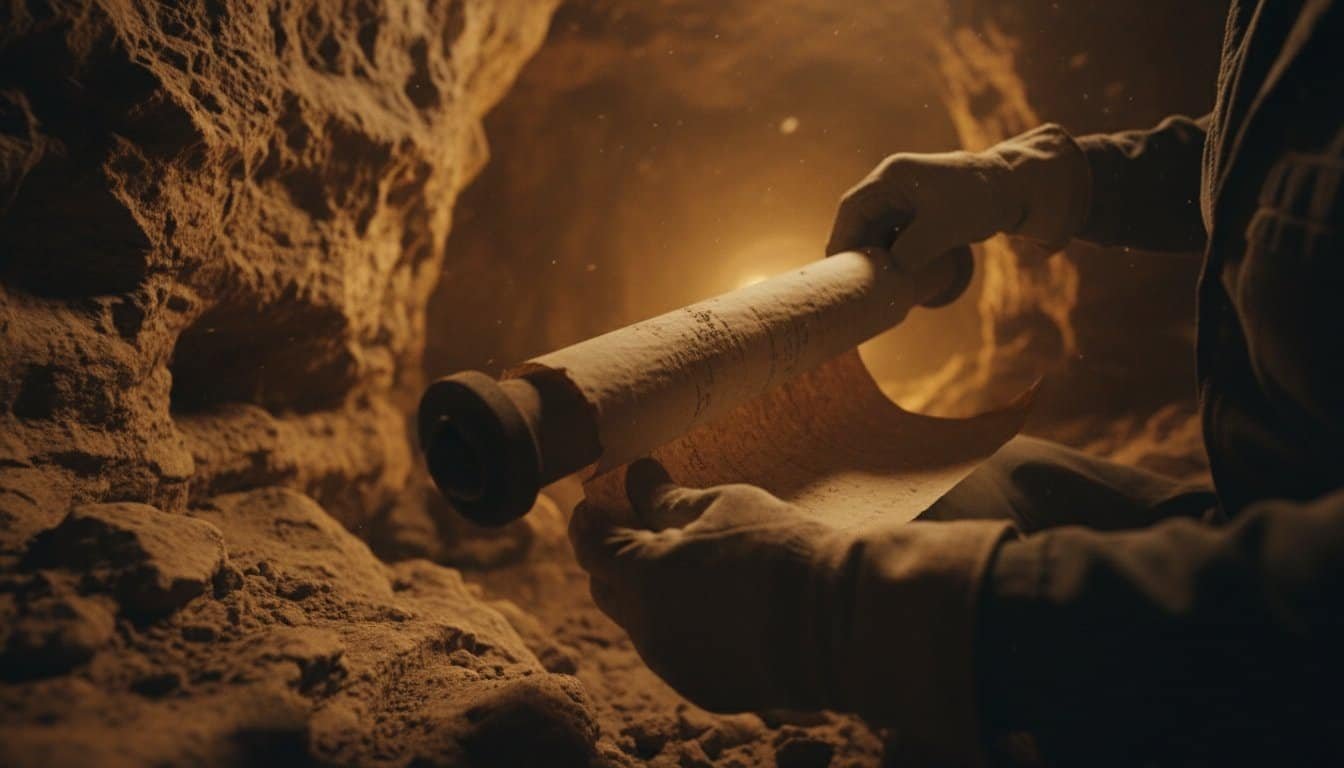
25 Jan Ancient Biblical Scroll Discovery Changes Everything We Thought We Knew
The Dead Sea Scrolls‘ discovery in 1947 revolutionized biblical scholarship by proving ancient texts weren’t corrupted through centuries of copying. When researchers compared the Great Isaiah Scroll from 125 BCE with medieval manuscripts, they found remarkable textual stability across nearly 1,000 years. These findings demolished theories about widespread corruption in Hebrew texts and demonstrated scribes’ extraordinary fidelity to source materials. Recent AI dating methods have now pushed some manuscripts even earlier than previously thought, fundamentally reshaping our understanding of biblical transmission.
Table of Contents
Key Takeaways
- The Dead Sea Scrolls discovery pushed back biblical manuscript dating by over 1,000 years, from medieval to ancient times.
- AI dating methods now achieve ±30-year accuracy, placing some manuscripts centuries earlier than previously thought and reshaping chronologies.
- The Great Isaiah Scroll demonstrated remarkable textual stability across millennia, challenging theories about corruption of ancient Hebrew texts.
- Discoveries revealed sophisticated religious diversity in Second Temple Judaism, influencing understanding of Christian theological development.
- Advanced preservation in sealed jars provided unprecedented access to pre-Christian Jewish texts, transforming biblical scholarship from speculation to evidence-based research.
What The Dead Sea Scrolls Actually Revealed About Biblical History
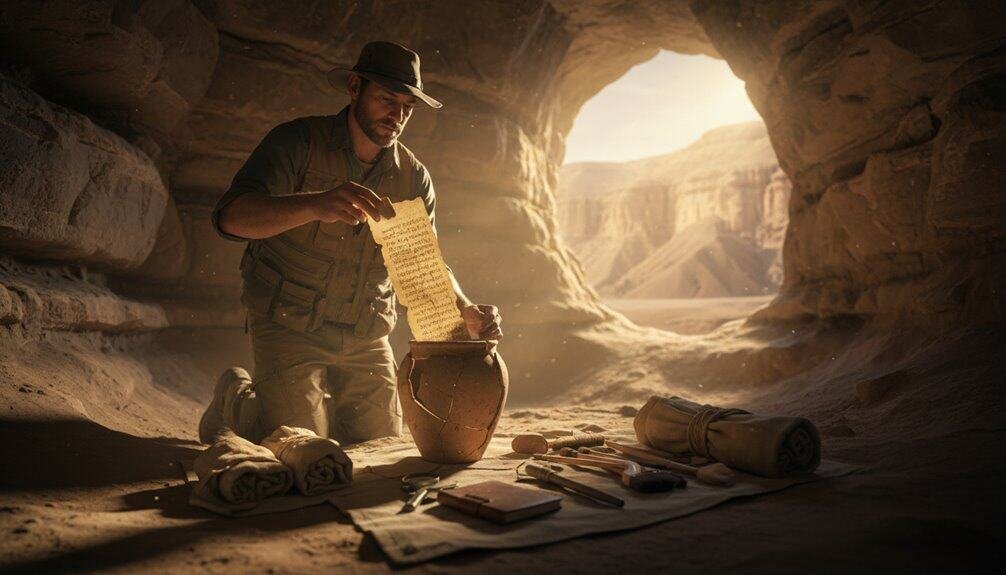
When archaeologists stumbled upon the Dead Sea Scrolls between 1946 and 1956, they didn’t just uncover ancient manuscripts—they revolutionized our understanding of biblical transmission and Second Temple Judaism. You’re looking at evidence that pushed Hebrew Bible manuscripts back over 1,000 years, from the 10th century CE Aleppo Codex to 3rd century BCE fragments.
The scrolls revealed remarkable textual stability. You’ll find the Isaiah Scroll from 120 BCE shows striking continuity with later Masoretic texts, despite minor variations. However, some Exodus and Samuel scrolls preserve passages completely absent from later manuscripts, demonstrating textual development wasn’t uniform.
What’s most significant is the religious diversity these texts expose. You’re witnessing late Second Temple Judaism’s varied landscape—Pharisees, Sadducees, and Essenes—from which both early Christianity and Rabbinic Judaism emerged. The 75% non-biblical content reveals previously unknown compositions and Hebrew versions of books known only in Greek. Recent discoveries at the Cave of Horror continue to yield biblical fragments, demonstrating that these ancient repositories still hold untold treasures.
The Complete Story: How Dead Sea Scrolls Were Discovered And Preserved
How did a shepherd’s search for a missing goat transform into the most significant archaeological discovery of the 20th century?
When Bedouin shepherd Muhammed edh-Dhib threw a stone into a cave near the Dead Sea between November 1946 and February 1947, he shattered pottery jars containing seven ancient scrolls. This accidental discovery sparked two word discussion ideas that would revolutionize biblical scholarship.
You’ll find the scrolls history fascinating: the Bedouin sought buyers throughout 1947, eventually reaching American scholars who authenticated the manuscripts. John Trever’s photographs convinced William Albright of their antiquity, dating them to 100 BCE. Between 1951-1956, systematic excavations uncovered eleven additional caves yielding hundreds of manuscript fragments.
The arid climate and sealed clay jars preserved these texts for nearly two millennia. Written between 250 BCE and 68 CE, they were hidden during the First Jewish Revolt, offering unprecedented insights into ancient Judaism and early Christianity. Among the most significant finds were the Community Rule, the War Scroll, and multiple copies of Isaiah that transformed our understanding of biblical transmission.
Why The Great Isaiah Scroll Changed Everything We Knew About Ancient Texts
Among the treasures recovered from Qumran Cave 1, the Great Isaiah Scroll stands as the crown jewel that fundamentally altered biblical scholarship. When you examine this 734-centimeter manuscript dating to 125 BCE, you’re witnessing evidence that shattered every speculative theory about biblical text corruption over millennia.
Before this discovery, scholars questioned whether ancient Hebrew texts remained faithful to their originals. The scroll’s comparison with Masoretic texts revealed remarkable preservation accuracy across 1,000 years, proving scribes maintained extraordinary fidelity to source materials. You’ll find that Masoretic scribes were actually more conservative than previously assumed, preserving older linguistic forms while the scroll contained updated language variants. Dr. Peter Flint’s editorial work has revealed that the scroll provides evidence for how Isaiah reached its final form.
This wasn’t some unrelated topic to early Christianity—the scroll confirmed hundreds of Messianic prophecies predated Jesus by centuries. Professor William Albright‘s declaration of this as the greatest archaeological find proves warranted, as it transformed biblical studies from speculation into evidence-based scholarship.
How AI Just Redated Dead Sea Scroll Manuscripts By Centuries
You’re witnessing a fundamental shift in archaeological dating methodology as the Enoch AI model has successfully redated Dead Sea Scroll manuscripts with unprecedented precision, achieving ±30-year accuracy that surpasses traditional radiocarbon dating for the 300-50 BCE period.
The revolutionary BiNet neural network analyzed ink-trace patterns from 62 radiocarbon-dated manuscript images, then applied this learning to over 1,000 previously undated scrolls, revealing that many manuscripts are centuries older than palaeographic estimates suggested.
These dramatic corrections have overturned long-held assumptions about script evolution, placing Hasmonean manuscripts significantly earlier and challenging the entire chronological framework that scholars have used to understand ancient Jewish sectarian movements.
Revolutionary Enoch AI Tool
Where traditional paleographic methods relied on subjective human interpretation to date ancient manuscripts, artificial intelligence has now revolutionized the field with unprecedented precision. You’re witnessing the emergence of Enoch, a groundbreaking machine-learning model that’s transformed how scholars approach manuscript dating. This AI system analyzes ink-trace patterns and character shapes through deep neural network technology, achieving remarkable accuracy within 30 years for documents spanning 300-50 BCE.
The discovery implications extend far beyond technical advancement. Enoch’s AI dating capabilities have revealed that many scrolls traditionally attributed to the Qumran community actually predate the site’s settlement, fundamentally challenging established archaeological timelines. With 79% of its predictions deemed “realistic” by paleographic experts, you’re observing a paradigm shift that combines radiocarbon physics with geometric analysis, delivering quantified objectivity to a historically subjective field.
Dramatic Dating Corrections Made
What happens when artificial intelligence challenges centuries of scholarly consensus about biblical manuscript dating? You’re witnessing a fundamental shift in Dead Sea Scroll chronology through AI redating methodologies. The Enoch model’s analysis of 135 non-dated scrolls revealed that 79% aligned with palaeographic evaluations, yet many manuscripts proved significantly older than traditional estimates. You’ll find the Daniel fragment now dated to 230–160 BCE—up to 100 years earlier than previously thought, overlapping its actual composition period. Ecclesiastes has been pushed back to the 3rd century BCE. Through radiocarbon integration with machine learning, researchers refined dating accuracy to ±50 years, systematically aging ‘Hasmonean’ and ‘Herodian’ script emergence periods and reshaping our understanding of ancient Jewish textual development.
Manuscript Origins Challenged Forever
The Enoch AI model has fundamentally disrupted biblical scholarship by systematically redating Dead Sea Scroll manuscripts through machine learning analysis of handwriting patterns invisible to human experts. You’re witnessing a complete rewriting of manuscript origins as several Qumran-associated texts now predate the site’s first settlement period entirely. This challenges long-held assumptions about where these sacred documents originated. The model’s ability to reduce dating uncertainty to ±30 years has revealed that individual manuscripts are consistently older than previous estimates suggested. You must now reconsider fundamental questions about ancient literacy spread and manuscript collection practices. This technological breakthrough raises important AI ethics considerations while enabling scholars to re-evaluate how ideas disseminated throughout the ancient Near East.
New Dead Sea Scrolls Fragments Reveal End Times Prophecies
These fragments demonstrate that Second Temple period communities possessed sophisticated eschatological frameworks, fundamentally reshaping your understanding of ancient Jewish apocalyptic thought and its influence on later Christian theology.
Where You Can See Dead Sea Scrolls Exhibitions In 2025-2026
Where can you witness these groundbreaking discoveries firsthand? Two major museum exhibitions offer unprecedented access to Dead Sea Scrolls during 2025 dates and beyond.
The Ronald Reagan Presidential Library in Simi Valley, California, displays two dozen Dead Sea Scrolls through September 2, 2025. You’ll encounter the Great Psalms Scroll alongside 200 Second Temple period artifacts, including a reconstructed first-century Sea of Galilee boat and Masada ostraca. General admission costs $25.
Beginning November 22, 2025, the Museum of the Bible in Washington, D.C., presents the largest Dead Sea Scrolls exhibition outside Israel/Palestine. Three rotations run through September 7, 2026, featuring fragments from Genesis, Isaiah, Psalms, Community Rule, and Temple Scroll. Exhibition tickets cost $14.99 for non-members, with members receiving complimentary access.
These exhibitions represent the first U.S. showings in nearly a decade, providing scholars and visitors direct access to texts that illuminate biblical formation and Second Temple Judaism.
Frequently Asked Questions
How Much Are Dead Sea Scroll Fragments Worth on the Antiquities Market?
You’ll find individual Dead Sea Scroll fragments commanding well over $100,000 each in private sales, with the total market reaching $35-45 million since 2002.
However, you’re facing serious conservation ethics concerns, as possible funding motivations have driven extensive forgery production. These high prices create stories irrelevant to scholarly value, where authentication becomes crucial since even tiny snippets can exceed six-figure valuations in today’s thriving antiquities market.
What Happened to the Bedouin Shepherds Who First Discovered the Scrolls?
You’ll find that the Bedouin shepherds who made the initial Scrolls discovery largely faded into historical obscurity after their remarkable find. While Muhammed edh-Dhib, Jum’a Muhammed, and Khalil Musa received payments for their scrolls through dealer Kando, their Bedouin origins meant they weren’t extensively documented. John C. Trever later interviewed them to reconstruct the discovery story, but their subsequent lives remain largely unrecorded in scholarly literature.
Are There Any Dead Sea Scrolls Still Being Kept Secret by Scholars?
No evidence suggests scholars are actively keeping Dead Sea Scrolls secret in 2026. You’ll find most scrolls digitally accessible through projects like deadseascrolls.org.il, with recent decipherments publicly announced. While historical publication delays created access restrictions for decades, current transparency addresses past ethical dilemmas regarding scholarly control. However, questions about secret provenance of some fragments and institutional ownership continue influencing accessibility and exhibition decisions.
Why Was the Book of Esther Completely Missing From the Dead Sea Scrolls?
You’ll find scholars propose several theories for Esther’s absence. The book lacks God’s name entirely, making it theologically problematic for the conservative Qumran community. They likely rejected Purim celebrations and disapproved of Esther’s marriage to a Persian king.
Alternative explanations suggest preservation practices favored texts containing divine names, or simple decay destroyed Esther fragments. This scholarly discussion generates two competing viewpoints: deliberate exclusion versus accidental loss.
What Modern Security Measures Protect the Scrolls From Theft or Damage?
You’ll find comprehensive security protocols safeguard the Dead Sea Scrolls through climate-controlled facilities operated by Israel’s Antiquities Authority. Professional artifact handling procedures restrict access to authorized scholars under controlled conditions, while environmental systems prevent deterioration from temperature fluctuations. Security copies exist at California’s Huntington Library, creating redundant protection against loss. Legal frameworks enforce copyright protections and prevent unauthorized reproduction or commercial distribution of materials.
Conclusion
You’ve witnessed how the Dead Sea Scrolls fundamentally transformed biblical scholarship through unprecedented textual evidence spanning centuries. You’ve seen how modern AI analysis continues reshaping our understanding of these ancient manuscripts’ dating and composition. As new fragments emerge and exhibitions make these discoveries accessible worldwide, you’re observing an ongoing revolution in how scholars interpret biblical history. These scrolls didn’t just confirm ancient texts—they’ve rewritten the narrative entirely.








No Comments