

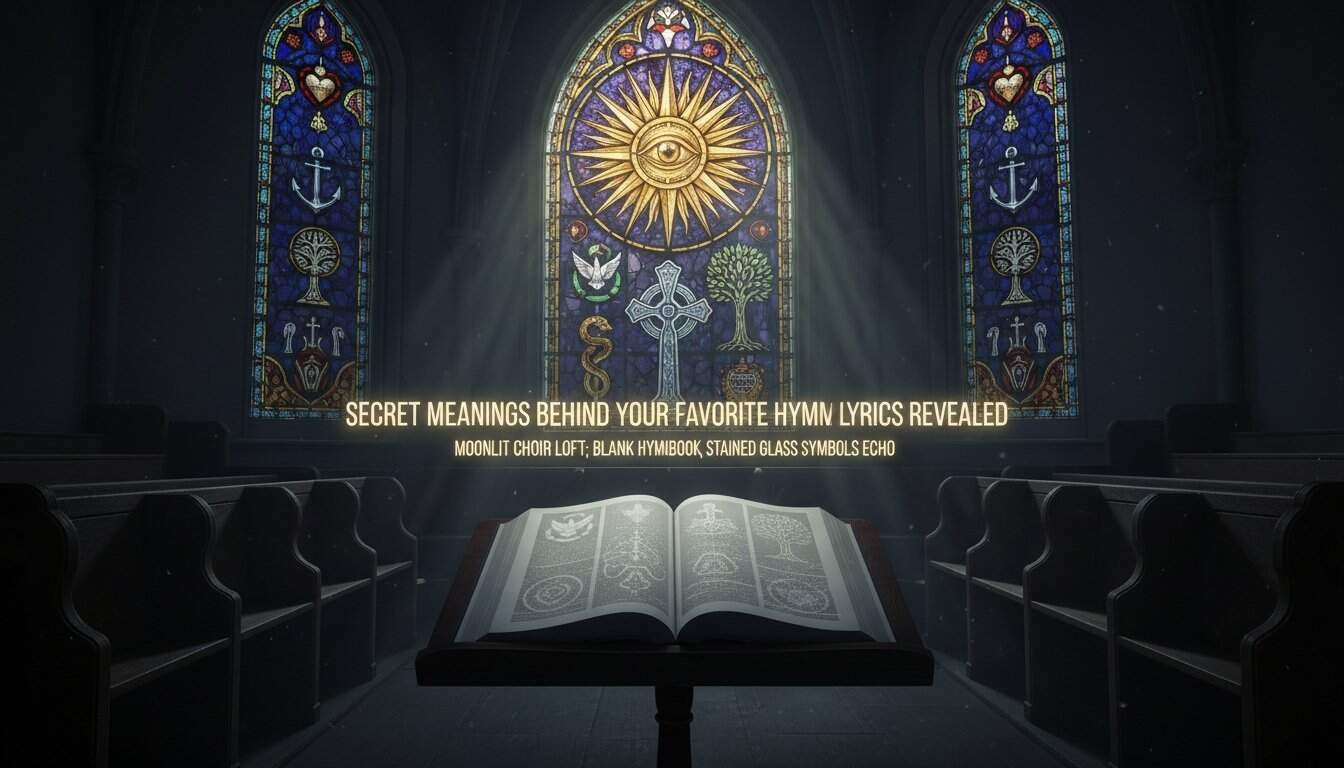
17 Jan Secret Meanings Behind Your Favorite Hymn Lyrics Revealed
Your beloved hymns conceal revolutionary histories beneath their sacred verses. “Amazing Grace” emerged from John Newton’s slave-trading past and spiritual transformation during a violent 1748 storm. Luther’s “A Mighty Fortress” functioned as Protestant battle rhetoric disguised as worship, with “ancient foe” targeting Catholic authority. Civil War anthems like “Battle Hymn of the Republic” fused divine providence with national purpose. Victorian hymns expressed forbidden romantic passion through devotional language, while resistance movements embedded escape routes and political codes within melodies—stories that reveal worship’s hidden power.
Table of Contents
Key Takeaways
- “Amazing Grace” reflects John Newton’s transformation from slave ship captain to abolitionist after a spiritual awakening during a violent 1748 storm.
- Luther’s “A Mighty Fortress” disguised Protestant rebellion against Catholic authority using militant language and biblical metaphors as resistance rhetoric.
- Civil War hymns like “Battle Hymn of the Republic” merged divine providence with national purpose, providing spiritual resilience during wartime trauma.
- Victorian hymns used passionate romantic language disguised as worship, allowing intimate expressions within strict social constraints of the era.
- Underground resistance movements encoded escape routes and refuge locations in hymns like “Swing Low, Sweet Chariot” and “Wade in the Water.”
From Slave Ships to Sanctuaries: The Shocking Story Behind ‘Amazing Grace’

Before John Newton penned the words that would become Christianity’s most beloved hymn, he commanded slave ships across the Atlantic, profiting from human misery while remaining spiritually blind to his complicity in one of history’s greatest atrocities.
You’ll find the grace origins of “Amazing Grace” rooted in Newton’s profound moral awakening during a violent storm at sea in 1748.
This former captain, who’d witnessed countless horrors in the Middle Passage, experienced what he’d later describe as divine intervention.
The irony isn’t lost—the man who’d literally been “lost” in moral darkness found redemption through the same grace he’d denied his human cargo.
Newton’s transformation challenges you to consider how slave narratives shaped this hymn’s enduring power.
His words “I once was lost, but now am found” carry devastating weight when you understand their author once viewed enslaved Africans as mere commodities.
The hymn’s universal message of redemption emerges from Christianity’s darkest contradictions.
The War Hymn Martin Luther Disguised as Worship Music
When Martin Luther composed “Ein feste Burg ist unser Gott” (A Mighty Fortress Is Our God) around 1529, he crafted what would become Protestantism’s battle anthem disguised as devotional worship. You’re singing Lutheran propaganda when you belt out this beloved hymn’s verses.
Luther’s hidden symbolism transforms biblical metaphors into revolutionary rhetoric.
The “mighty fortress” isn’t just God’s protection—it’s Protestant resistance against Catholic authority.
When you sing about “the ancient foe” seeking to “work us woe,” you’re invoking Satan, but Luther’s contemporaries understood this as the Pope and Roman Church.
The hymn’s militant language—”armed with cruel hate,” “doth seek to work us woe,” “his craft and power are great”—reads like a war declaration.
You’re participating in theological warfare disguised as praise.
Luther weaponized worship, creating a rallying cry that united Protestant reformers while appearing innocuously devotional to casual observers.
How America’s Bloodiest War Created Its Most Beloved Sacred Songs
During America’s Civil War (1861-1865), the nation’s most enduring hymns emerged from battlefield trenches and military camps, not church sanctuaries.
You’ll recognize “Battle Hymn of the Republic,” born when Julia Ward Howe witnessed Union troops marching to “John Brown’s Body” in 1861.
She transformed this militant tune into sacred poetry that merged divine providence with national purpose.
These wartime melodies weren’t accidental; they reflected soldiers’ desperate need for spiritual resilience amid unprecedented carnage.
You’re hearing theological responses to trauma when you sing these hymns today.
“Nearer, My God, to Thee” gained popularity after battlefield reports claimed dying soldiers hummed its melody.
“When Peace Like a River” emerged from lawyer Horatio Spafford‘s personal tragedies during this turbulent era.
The war’s 620,000 casualties demanded new expressions of faith that could encompass both mourning and hope.
These hymns became America’s theological soundtrack, offering comfort through suffering while affirming divine sovereignty over national destiny.
The Forbidden Victorian Romances Hidden in Your Hymnal
How could Victorian congregations justify singing passionate love songs disguised as worship?
You’ll find forbidden romances woven throughout your hymnal’s pages, where composers channeled their deepest desires into sacred verse.
“Jesus, Lover of My Soul” by Charles Wesley transforms spiritual devotion into intimate longing, employing language Victorian society reserved for clandestine affairs.
You’re encountering secret correspondences between hymnwriters and their subjects—sometimes earthly beloveds masquerading as divine recipients.
Fanny Crosby’s “I Am Thine, O Lord” pulses with romantic yearning typically forbidden in polite society.
The repeated “draw me nearer” echoes lovers’ pleas rather than theological petitions.
Victorian social constraints forced romantic expression underground, finding outlet through religious metaphor.
You can detect this pattern in hymns describing “sweet communion,” “tender embrace,” and “burning hearts.”
These composers discovered that passionate devotional language provided socially acceptable cover for expressing desires otherwise deemed scandalous.
Your congregation unknowingly sings century-old love letters each Sunday.
When ‘Worship’ Songs Were Actually Underground Resistance Anthems
Beneath Christianity’s sacred veneer, you’ll discover that countless hymns served as encrypted messages for political dissidents,
Sacred melodies concealed revolutionary messages, transforming Christian worship into clandestine communication networks for oppressed communities throughout history.
enslaved communities, and persecuted minorities who couldn’t voice their resistance openly.
During slavery, “Swing Low, Sweet Chariot” wasn’t merely about heavenly salvation—it signaled Underground Railroad escape routes. “Wade in the Water” instructed fugitives to travel through streams, evading bloodhounds tracking their scent. These rebellious hymns transformed worship gatherings into strategic planning sessions.
In Nazi-occupied territories, congregations sang traditional hymns with altered verses expressing anti-fascist sentiments. “A Mighty Fortress Is Our God” became resistance code, with “fortress” representing hidden sanctuaries for Jewish refugees.
Eastern European churches under Soviet oppression embedded secret codes within familiar melodies, communicating meeting locations and smuggling operations. Even “Amazing Grace” carried subversive meanings—”was blind, but now I see” signified political awakening against authoritarian regimes.
You’ve been singing revolution disguised as reverence, unaware these sacred songs once fueled humanity’s fight for freedom.
Frequently Asked Questions
Why Do Some Hymns Use Archaic Language That’s Hard to Understand?
You’ll encounter archaic vocabulary in hymns because many were composed centuries ago when linguistic conventions differed significantly.
Their archaic language reflects historical authenticity and preserves original theological nuances that modern translations might lose.
Textual scholarship reveals that these older forms often carry deeper symbolic meanings and maintain poetic meter essential to musical composition, making direct modernization challenging without compromising interpretive depth.
How Do Different Denominations Interpret the Same Hymn Lyrics Differently?
You’ll find denominational hermeneutics significantly shapes hymn interpretation through distinct theological lenses.
Catholics might emphasize sacramental imagery while Protestants focus on personal salvation themes.
Your liturgical context further influences meaning—Episcopalians may interpret “Lamb of God” through Eucharistic tradition, whereas Baptists emphasize Christ’s substitutionary atonement.
Different denominational priorities regarding scripture, tradition, and ecclesiastical authority create varied interpretive frameworks that transform identical lyrics into denomination-specific spiritual messages.
Which Hymns Were Originally Written in Languages Other Than English?
You’ll find countless hymns originated in non-English languages.
Latin hymns like “Veni Creator Spiritus” and “Te Deum” dominated medieval worship, while Greek hymns such as “Phos Hilaron” trace back to early Christianity.
“Dies Irae,” “Veni Emmanuel,” and “Pange Lingua” represent Latin’s liturgical heritage.
German contributions include Luther’s “Ein feste Burg,” and you’ll discover rich traditions from French, Spanish, and Scandinavian sources that enriched global hymnody through translation.
What Role Did Women Composers Play in Creating Traditional Church Music?
Women composers significantly shaped traditional church music, though you’ll find their authorship influence often minimized by historical documentation practices.
You’re encountering works by figures like Hildegard of Bingen, who created innovative liturgical compositions, and later hymnists like Fanny Crosby, whose prolific output transformed Protestant worship.
Their contributions span from medieval chant to Victorian-era congregational singing, establishing foundational elements you still experience today.
How Has Modern Technology Changed the Way We Sing Hymns Today?
You’re experiencing unprecedented transformation in congregational singing through digital innovation.
Live streams have democratized hymn participation, enabling remote worship communities to sing together across geographical boundaries.
AI accompaniment systems now provide sophisticated musical support, adapting tempo and harmonization to congregation needs.
You’ll find these technologies preserving traditional hymnody while expanding accessibility, creating hybrid worship experiences that blend centuries-old texts with cutting-edge musical delivery systems.
Conclusion
You’ve discovered that hymns aren’t merely spiritual expressions—they’re encoded historical documents. When you sing these familiar melodies, you’re participating in centuries-old conversations about freedom, resistance, and social transformation. Each verse carries layered meanings that transcended their composers’ original intentions. You’re now equipped to recognize how sacred music functions as both worship and witness, preserving stories of struggle within seemingly simple refrains. These songs reveal faith’s complex relationship with power.






No Comments