

21 Dec Christian Spirituals History, Lyrics, and Iconic Recordings
You’ll discover that African American spirituals originated from enslaved communities who brilliantly synthesized West African musical traditions with imposed Christian theology, creating revolutionary art forms that served simultaneously as coded Underground Railroad communications, emotional outlets, and resistance mechanisms. These complex compositions featured polyrhythmic patterns, call-and-response structures, and blue notes that preserved cultural identity while expressing liberation hopes. Legendary performers like Marian Anderson, Paul Robeson, and the Fisk Jubilee Singers transformed these oral traditions into globally recognized masterpieces that fundamentally shaped gospel, blues, and American music. Their profound historical significance extends far beyond these foundational elements.
Key Takeaways
- African American spirituals emerged from enslaved communities blending African musical traditions with Christian theology during antebellum America.
- Spirituals featured coded lyrics like “Follow the Drinking Gourd” that provided secret navigation instructions for Underground Railroad escapees.
- Musical characteristics include call-and-response patterns, blue notes, polyrhythms, and pentatonic scales reflecting West African musical heritage.
- The Fisk Jubilee Singers’ 1871 European tour brought global recognition and legitimacy to the spiritual tradition.
- Legendary performers like Marian Anderson, Paul Robeson, and Mahalia Jackson preserved spirituals through iconic interpretations and recordings.
Origins and Historical Context of African American Spirituals
The forced migration of millions of Africans to North America between the 16th and 19th centuries created the foundational conditions from which African American spirituals emerged as a distinctive musical and cultural form. You’ll find that enslaved communities synthesized African musical traditions with Christian theology, creating songs that served multiple functions within their restricted social framework. These spirituals operated as coded communication systems, emotional outlets, and resistance mechanisms within slave community dynamics.
Antebellum church culture significantly influenced spiritual development, as enslaved people encountered Protestant Christianity through forced conversion and plantation missions. You can observe how they transformed European hymnal structures, infusing them with African rhythmic patterns, call-and-response vocals, and polyrhythmic complexity. The spirituals functioned as vehicles for preserving cultural identity while expressing hope for liberation—both spiritual and physical. They documented lived experiences of oppression while maintaining collective memory and fostering community solidarity through shared musical expression.
Musical Characteristics and African Influences
When examining African American spirituals through a musicological lens, you’ll discover that their distinctive sound emerges from a sophisticated blend of West African musical elements and European harmonic frameworks.
The rhythmic complexity inherent in these compositions reflects polyrhythmic traditions from African musical cultures, where multiple rhythmic layers create intricate temporal relationships that European-derived hymns typically lack.
African American spirituals employ sophisticated polyrhythmic layering that creates complex temporal relationships absent from traditional European hymnal structures.
Call and response patterns constitute perhaps the most recognizable African influence, establishing dynamic musical dialogues between leader and congregation. You’ll notice these antiphonal structures mirror West African ceremonial practices, where collective participation strengthens community bonds through shared musical expression.
Additional African elements include blue notes, melismatic vocal ornaments, and syncopated rhythmic displacement that creates forward momentum. These characteristics transform simple melodic structures into emotionally powerful vehicles for spiritual expression.
The pentatonic scales frequently employed echo African tonal systems, while improvised vocal embellishments demonstrate the tradition’s emphasis on individual creativity within collective frameworks.
Hidden Messages and Underground Railroad Connections
Beyond their musical sophistication, spirituals functioned as sophisticated communication systems that encoded practical information about escape routes, safe houses, and resistance strategies. You’ll discover that coded lyrics transformed seemingly religious songs into detailed maps for freedom seekers. “Follow the Drinking Gourd” directed enslaved people toward the Big Dipper constellation, pointing north to freedom.
“Wade in the Water” instructed escapees to travel through streams, disrupting scent trails that bloodhounds used for tracking.
You can analyze how “Swing Low, Sweet Chariot” signaled Underground Railroad conductors’ arrival, while “Go Down, Moses” drew parallels between biblical liberation and contemporary escape plans. These songs established secret communication networks across plantations, enabling coordinated resistance efforts.
When you examine performance contexts, you’ll notice how tempo changes and vocal emphasis highlighted crucial information. Harriet Tubman herself employed these musical codes during rescue missions, demonstrating how spirituals transcended entertainment to become revolutionary tools for systematic liberation efforts.
Transition From Oral Tradition to Written Form
Documentation efforts in the mid-19th century marked a pivotal transformation as spirituals shifted from exclusively oral preservation to written notation, fundamentally altering their transmission and cultural significance.
You’ll find that early collectors like Lucy McKim Garrison and Thomas Wentworth Higginson faced significant challenges translating these complex vocal traditions into Western musical notation. Their oral transcription techniques couldn’t fully capture the intricate call-and-response patterns, vocal inflections, and rhythmic variations that defined authentic spiritual performance.
Written preservation methods, while democratizing access to these songs, inevitably standardized what had been fluid, improvisational art forms. You’ll notice that published collections like “Slave Songs of the United States” (1867) represent approximations rather than exact replications of original performances.
This transition created both opportunities and losses—broader dissemination occurred alongside the erosion of spontaneous, community-driven musical expression that had characterized spirituals’ oral heritage.
Most Famous Spirituals and Their Meanings
Examination of spirituals’ most enduring compositions reveals sophisticated layers of meaning that transcended their surface religious content, functioning as coded communication systems within enslaved communities.
Enslaved communities embedded secret messages within religious songs, creating dual-purpose compositions that served both worship and resistance.
“Swing Low, Sweet Chariot” employed slave based imagery where the “chariot” represented Underground Railroad conductors, while “home” signified freedom in the North. You’ll find similar coded language in “Follow the Drinking Gourd,” where the Big Dipper constellation provided navigational guidance for escape routes.
“Go Down, Moses” paralleled enslaved Africans’ plight with Hebrew bondage in Egypt, using Moses as a Christ-like liberator figure. The spiritual’s repeated command “Let my people go” became a direct challenge to slaveholders’ authority.
“Wade in the Water” instructed escapees to travel through streams, disrupting bloodhounds’ tracking abilities. “Steal Away to Jesus” served as a clandestine meeting signal, indicating when secret religious gatherings would occur. These compositions demonstrate how enslaved communities transformed biblical narratives into practical survival tools while maintaining plausible religious cover.
Legendary Performers Who Preserved the Tradition
While spirituals originated in enslaved communities during the antebellum period, their survival and global recognition depended on pioneering performers who understood both their sacred origins and artistic potential.
Influential spiritual artists like Marian Anderson transformed concert halls worldwide, bringing dignity to these sacred songs through her impeccable technique and emotional depth. Paul Robeson’s powerful bass-baritone voice carried spirituals across international stages, while Mahalia Jackson’s gospel interpretations sparked spiritual revival movements throughout the twentieth century.
The Fisk Jubilee Singers deserve particular recognition—you can trace their 1871 European tour as the moment spirituals gained global legitimacy. Their careful arrangements preserved authentic musical elements while making them accessible to broader audiences.
Later performers like Roland Hayes, Dorothy Maynor, and Leontyne Price continued this legacy, proving that spirituals could thrive in both sacred and secular contexts. Each artist’s interpretative choices ensured these songs wouldn’t remain historical artifacts but living expressions of faith.
Impact on Gospel, Blues, and American Music
These pioneering performers didn’t simply preserve spirituals in concert halls—they catalyzed their transformation into entirely new musical genres that would define American sound. You’ll find spirituals’ DNA embedded in gospel’s emotional intensity, where call-and-response patterns and melismatic vocals directly descended from plantation worship songs.
The blues borrowed spirituals’ bent notes, vocal slides, and spiritual yearning, secularizing sacred forms into expressions of earthly suffering.
This cultural significance extends beyond musical technique. When you examine jazz, country, and rock ‘n’ roll, you’re witnessing spirituals’ structural innovations: syncopated rhythms, blue notes, and improvisational freedom. The societal impact proved equally profound—spirituals established African American musical expression as America’s foundational sound, challenging racial hierarchies through artistic excellence.
From Mahalia Jackson’s gospel recordings to B.B. King’s blues guitar, you can trace direct lineages to anonymous enslaved composers whose spirituals became America’s most influential musical export, reshaping global popular music.
Modern Interpretations and Contemporary Relevance
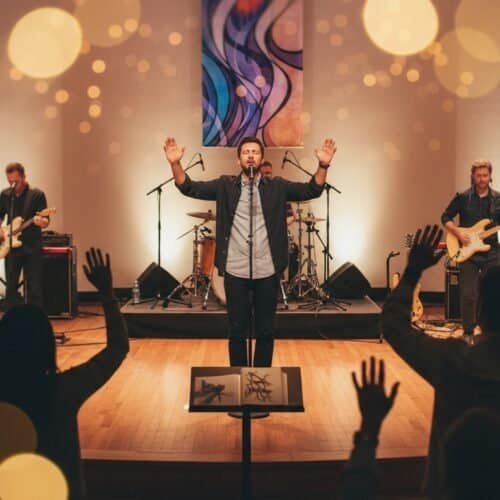
Across twenty-first-century concert halls, recording studios, and streaming platforms, spirituals undergo constant reinvention that reveals their enduring power to address contemporary social concerns. You’ll find artists like Alicia Keys, John Legend, and Rhiannon Giddens incorporating spiritual elements into mainstream compositions, while classical ensembles recontextualize these works for symphony orchestras.
Spirituals continuously evolve across modern venues, as contemporary artists weave these timeless songs into today’s musical landscape.
These new artistic expressions demonstrate how spirituals transcend historical boundaries to speak directly to modern audiences facing systemic injustice, environmental crises, and social fragmentation.
Contemporary interpretations maintain the songs’ original emotional core while expanding their sonic palette through jazz harmonies, electronic production, and cross-cultural instrumentation. You can observe their cultural significance in protest movements, where “We Shall Overcome” continues mobilizing activists worldwide.
Film scores, advertising campaigns, and digital media frequently reference spiritual melodies to evoke authenticity and moral authority. This ongoing transformation ensures spirituals remain living documents of human resilience rather than museum artifacts.
Frequently Asked Questions
How Do I Learn to Sing Spirituals With Proper Vocal Technique?
You’ll develop proper spiritual singing technique through disciplined breath control training and targeted resonance focus exercises. Master diaphragmatic breathing to sustain long melodic phrases characteristic of spirituals’ call-and-response structures.
Practice chest resonance for rich, soulful tones while maintaining clear diction for storytelling lyrics. Study recordings of Mahalia Jackson and Paul Robeson, analyzing their vocal placement and emotional authenticity to understand spirituals’ unique blend of technical precision and heartfelt expression.
What Instruments Are Traditionally Used to Accompany Christian Spirituals?
You’ll find spirituals traditionally employed minimal instrumental accompaniment, emphasizing vocal expression over instrumentation. Hand drums provided rhythmic foundation during field work and gatherings, while call-and-response patterns created natural percussion through clapping and foot-stomping.
Choral accompaniment formed the cornerstone, with overlapping vocal parts creating harmonic complexity. Banjos occasionally appeared, though most spirituals relied on the human voice’s inherent power, reflecting enslaved communities’ limited access to formal instruments.
Are There Regional Variations in How Spirituals Are Performed Today?
You’ll find significant regional variations in contemporary spiritual performances, reflecting distinct cultural context preservation strategies. Southern traditions emphasize call-and-response patterns with raw emotional intensity, while Northern interpretations often incorporate sophisticated harmonies.
West Coast performances blend gospel influences, and Appalachian renditions maintain older modal structures. These regional style influences demonstrate how communities’ve adapted spirituals to reflect their specific historical experiences and contemporary worship practices.
How Can I Find Sheet Music for Lesser-Known Spirituals?
You’ll discover lesser-known spirituals by searching historical archives at universities with strong African American studies programs, particularly those housing WPA Federal Writers’ Project collections from the 1930s.
Start accessing online repositories like the Library of Congress’s American Folklife Center, the Smithsonian’s Center for Folklife and Cultural Heritage, and HathiTrust Digital Library.
Regional historical societies often maintain unpublished manuscripts, while denominational archives preserve congregation-specific arrangements that haven’t achieved widespread circulation.
What’s the Difference Between Spirituals and Hymns in Worship Services?
You’ll find spirituals and hymns differ significantly in liturgical function and musical style. Spirituals emerged from African American oral traditions, featuring call-and-response patterns, syncopated rhythms, and coded liberation messages. They’re typically performed during testimonial moments or special services.
Hymns follow European compositional structures with formal verses, prescribed melodies, and theological doctrine. They’re integrated into regular worship order for congregational singing, prayers, and sacramental accompaniment.
Conclusion
You’ll find that African American spirituals represent far more than religious expression—they’re sophisticated cultural artifacts encoding resistance, survival, and transcendence. When you examine their musical DNA, you’re witnessing the birth of America’s most influential genres. Their coded messages didn’t simply vanish with emancipation; they’ve evolved, infiltrating contemporary consciousness through hip-hop, folk revival, and social justice movements. You can’t understand American music’s trajectory without grasping spirituals‘ foundational role in shaping our cultural identity.









No Comments