

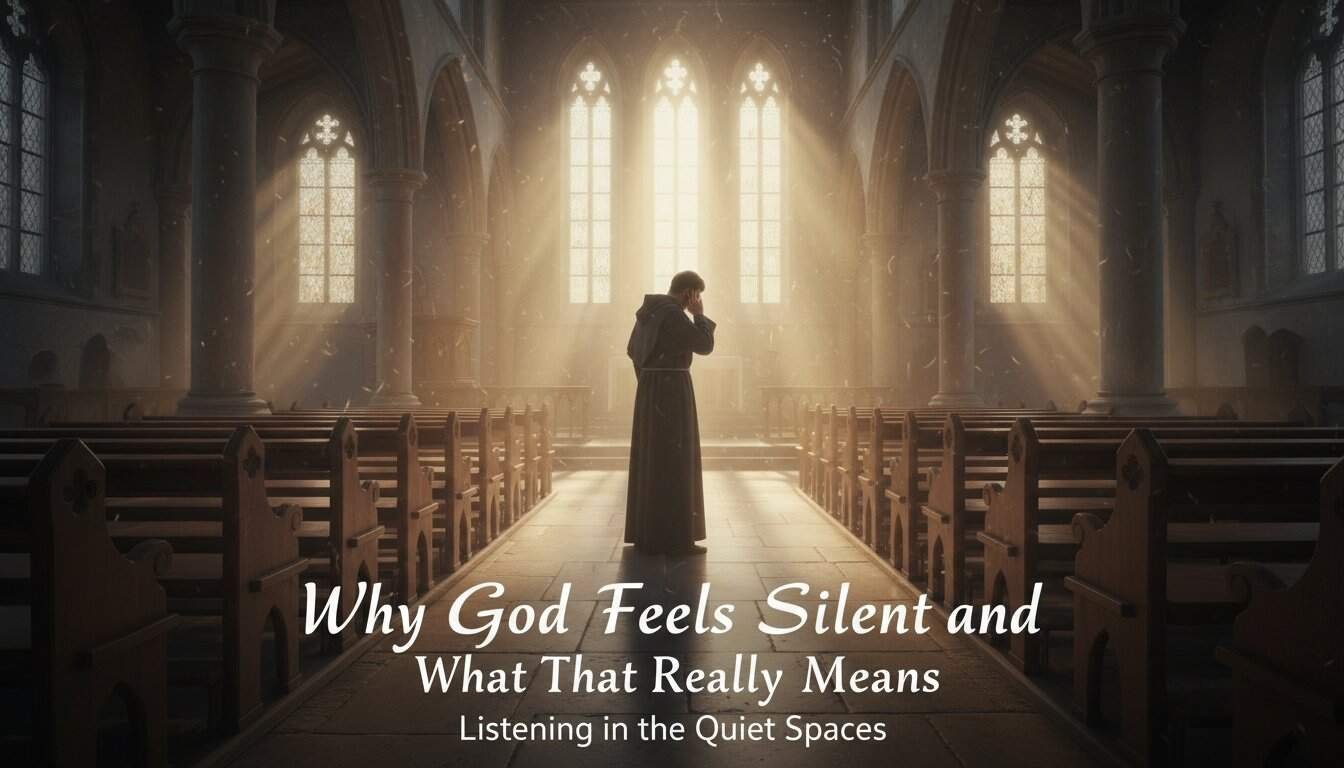
18 Jan Why God Feels Silent and What That Really Means
God’s silence doesn’t indicate His absence but rather His deepest involvement in your spiritual formation. Like Job’s experience (Job 23:8-9) and David’s lament (Psalm 13:1), divine silence operates within God’s eternal patience and sovereignty. You’re called to practice sustained prayer while surrendering outcomes to His timing, as “with the Lord a day is like a thousand years” (2 Peter 3:8). These silent seasons cultivate patience, deepen intimacy with Christ, and strip away superficial spirituality to reveal authentic faith that depends on God’s character rather than feelings or dramatic signs.
Table of Contents
Key Takeaways
- God’s silence often signals His deepest involvement in your life, not His absence or disinterest in your circumstances.
- Divine timing operates on an eternal scale where patience and sovereignty guide responses beyond human expectations.
- Silent seasons are instruments for spiritual growth, developing perseverance, maturity, and deeper dependence on God’s character.
- Expecting dramatic signs or emotional experiences can create spiritual static that blocks hearing God’s gentle whisper.
- Unanswered prayers provide opportunities for honest dialogue with God while surrendering outcomes to His perfect will.
Why God’s Silence Doesn’t Mean God’s Absence

When circumstances overwhelm your prayers with apparent emptiness, you’re encountering a phenomenon that countless biblical figures have faced throughout Scripture. Job wrestled with divine silence during his suffering (Job 23:8-9), while David cried out, “How long, O Lord? Will you forget me forever?” (Psalm 13:1).
This listening paradox reveals God’s profound engagement rather than abandonment.
God’s apparent silence paradoxically signals His deepest involvement in our lives, not His withdrawal from them.
When you can’t hear Him, He’s often orchestrating circumstances beyond your perception.
Divine patience operates on eternal timescales that transcend human understanding, as Peter reminds us: “With the Lord a day is like a thousand years” (2 Peter 3:8).
God’s silence doesn’t indicate His absence but rather His sovereignty working through hiddenness.
Isaiah 55:8-9 declares His thoughts aren’t your thoughts, nor His ways your ways.
What feels like abandonment often represents God’s deepest work in your character, preparing you for greater purpose through refined faith and dependence.
What To Do When Your Prayers Feel Unanswered
Understanding God’s sovereignty in silence naturally leads to practical steps you can take during seasons of seemingly unanswered prayer.
First, implement sustained prayer strategies that align with Scripture’s teaching on persistence (Luke 18:1-8).
Continue interceding while surrendering outcomes to God’s perfect will and timing.
Second, prioritize emotional processing through honest dialogue with God.
The Psalms demonstrate that expressing frustration, doubt, and pain isn’t irreverent—it’s biblical (Psalm 13:1-2).
David’s laments show authentic faith wrestling with divine silence while maintaining trust in God’s character.
Third, examine your requests against God’s revealed will in Scripture.
Sometimes apparent silence reflects prayers that contradict biblical principles or God’s redemptive purposes (1 John 5:14-15).
Finally, seek community support through mature believers who can provide biblical counsel and intercessory prayer.
The body of Christ serves as God’s instrument for encouragement during spiritual drought seasons (Ecclesiastes 4:12).
How God Uses Silent Seasons For Spiritual Growth
Though God’s silence can feel isolating and confusing, these periods serve as divine instruments for profound spiritual development.
God’s silence, though difficult to endure, becomes His purposeful tool for cultivating deeper spiritual maturity and authentic faith.
Scripture reveals how God strategically employs silence to refine your character and deepen your relationship with Him.
During these seasons, patience cultivation becomes essential.
James 1:3-4 teaches that testing produces patience, which leads to spiritual maturity.
You’re compelled to wait on God’s timing rather than demanding immediate answers, developing perseverance that strengthens your faith foundation.
Silent periods also facilitate faith renewal by removing dependence on feelings or circumstances.
When you can’t sense God’s presence, you must rely solely on His promises and character.
This process mirrors Job’s experience, where sustained silence ultimately produced deeper understanding of God’s sovereignty.
These divine silences strip away superficial spirituality, forcing you to examine your motives and desires.
They create space for contemplation, self-reflection, and genuine intimacy with Christ that transcends emotional experiences.
Why Do Our Expectations Block God’s Voice?
Your preconceived notions about how God should communicate create spiritual static that drowns out His authentic voice.
When you expect God to speak through dramatic signs or emotional highs, you’ll miss His gentle whispers in Scripture, circumstances, and quiet moments of prayer.
Expectation bias distorts your spiritual perception.
You filter God’s communication through human preferences rather than biblical precedent.
Elijah discovered this truth when God spoke not in wind, earthquake, or fire, but in “a still small voice” (1 Kings 19:12).
Your assumptions about divine timing, method, and content often contradict God’s sovereign approach.
Effective listening techniques require releasing predetermined outcomes.
Samuel learned to say, “Speak, Lord, for your servant is listening” (1 Samuel 3:9) without dictating the message’s content or delivery method.
When you surrender your expectations and cultivate humble receptivity, God’s voice becomes clearer.
His communication transcends your limited understanding of how divine revelation should occur.
Frequently Asked Questions
How Long Do Periods of God’s Silence Typically Last?
God’s silence doesn’t follow predictable seasonal patterns or universal timelines.
You’ll find individual timelines vary dramatically—from days to decades.
Job endured months of apparent divine silence, while David experienced shorter periods between psalms of despair and praise.
The wilderness wanderings lasted forty years, yet Moses regularly encountered God’s voice.
Your spiritual season doesn’t determine God’s speaking schedule; His sovereignty transcends human expectations and circumstances.
Is God’s Silence a Form of Punishment for Past Sins?
No, God’s silence isn’t necessarily sin’s consequence or divine punishment.
From a covenant perspective, Scripture reveals God’s silence serves multiple purposes beyond retribution.
You’ll find examples like Job’s suffering occurring without preceding sin, while Psalm 13 shows David experiencing divine silence despite his faithfulness.
God’s apparent withdrawal often functions as spiritual refinement, testing faith, or preparing you for greater revelation rather than punishing past transgressions.
Do Certain Personality Types Experience God’s Silence More Than Others?
Temperament differences don’t determine God’s actual communication, but they affect how you perceive His presence.
If you’re naturally introspective or melancholic, you might interpret silence as absence more readily than extroverted personalities.
Your spiritual expectations, shaped by temperament, can create false standards for divine interaction.
Scripture shows God speaking to diverse personalities—from contemplative John to impulsive Peter—demonstrating His communication transcends human psychological categories.
Can Mental Health Issues Affect Our Ability to Hear God?
Mental health conditions can create neural bias that affects your spiritual perception, though they don’t diminish God’s presence or voice.
Depression, anxiety, and trauma can cloud your ability to discern divine communication, as seen when Elijah experienced despair despite God’s faithfulness (1 Kings 19:4).
However, therapy impact often restores spiritual sensitivity by addressing underlying psychological barriers that hinder your communion with the Almighty.
Are There Specific Biblical Examples of God Being Completely Silent?
Yes, Scripture documents periods of Biblical silence when God’s voice wasn’t heard.
You’ll find a four-hundred-year Prophetic drought between Malachi and Christ’s birth, where no prophetic word came.
Additionally, 1 Samuel 3:1 states “the word of the Lord was rare” during Eli’s priesthood.
Even David experienced divine silence, crying “Why do you hide your face?” (Psalm 44:24), demonstrating that God’s apparent withdrawal occurs throughout redemptive history.
Conclusion
You’ll discover that divine silence isn’t abandonment but cultivation. When you can’t hear God’s voice, He’s often deepening your faith through the darkness (Psalm 13:1-2). Don’t confuse unanswered prayers with God’s inattention—His timing transcends your understanding (Isaiah 55:8-9). These quiet seasons aren’t punishment but preparation, refining your character like gold through fire (1 Peter 1:7). Release your preconceptions about how God should speak; He’s already working within your circumstances, developing the very faith you’re questioning.












No Comments