


17 Jan Where Moses Actually Found the Ten Commandments Will Shock You
You’ll find that recent archaeological discoveries challenge everything you thought you knew about Mount Sinai’s location. Cuneiform tablets unearthed in Jordan’s mountains contain chronologically aligned references to law-giving ceremonies, while carbon dating reveals settlement layers from 1500-1200 BCE—exactly matching the Mosaic era. These findings suggest Moses didn’t receive the Ten Commandments at Egypt’s traditional Jebel Musa, but hundreds of miles away in Jordanian terrain, where evidence actually supports biblical accounts.
Table of Contents
Key Takeaways
- New cuneiform tablets discovered in Jordanian mountains suggest Mount Sinai may not be in Egypt’s Sinai Peninsula.
- Carbon dating reveals continuous Late Bronze Age settlement layers spanning 1500-1200 BCE in alternative Jordan location sites.
- Traditional Mount Sinai site at Jebel Musa shows sparse archaeological evidence from the Exodus period.
- Multiple sacred sites across the ancient Near East contributed to commandment traditions, not just one mountain.
- Alternative theories propose Mount Sinai locations in Saudi Arabia, Jordan, or Edom based on new evidence.
Current Archaeological Evidence at Traditional Mount Sinai Sites
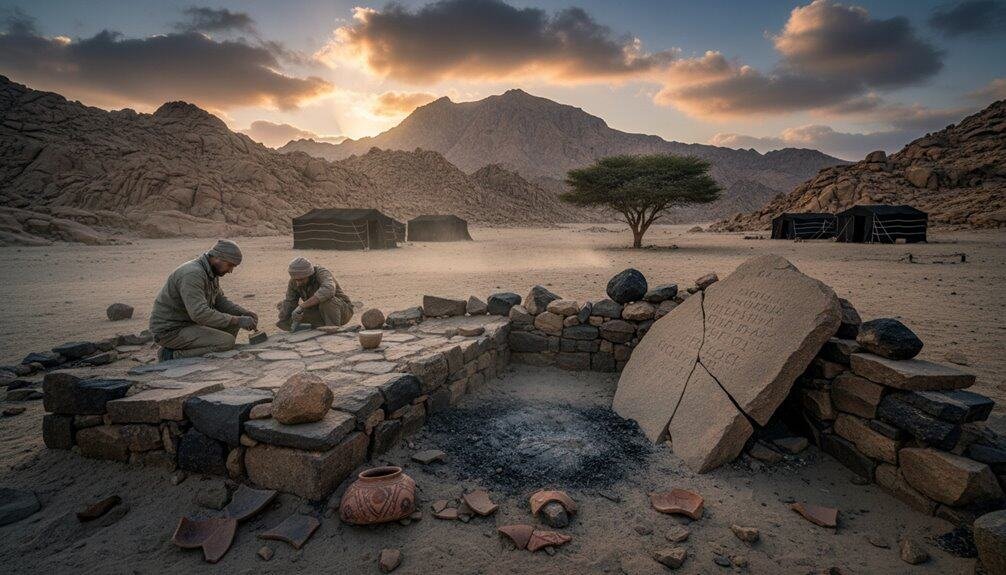
Where exactly did Moses receive the Ten Commandments, and what does modern archaeology reveal about the traditional sites?
You’ll find that extensive excavations at Jebel Musa in Egypt’s Sinai Peninsula have yielded surprisingly limited evidence supporting its identification as biblical Mount Sinai.
Despite decades of archaeological investigation, Jebel Musa shows remarkably little physical evidence connecting it to the biblical Mount Sinai narrative.
Archaeologists haven’t discovered significant artifact dating from the proposed Exodus period (13th-15th centuries BCE).
The site lacks substantial Bronze Age remains that you’d expect from such a momentous biblical event.
Similarly, you won’t find compelling archaeological support at other traditional candidates like Jebel Serbal or Jebel Katerina.
These locations show minimal evidence of ancient Israelite presence during the relevant timeframe.
However, you’ll notice that ritual inscriptions from later periods do appear throughout the region, indicating continued religious significance.
Nabatean and early Christian inscriptions demonstrate that pilgrims considered these mountains sacred, though this doesn’t necessarily validate their connection to Moses’ experience.
The archaeological record suggests you should examine alternative locations beyond these traditionally accepted sites.
New Tablet Discoveries Challenge Geographic Assumptions

Recent excavations in Jordan’s mountainous regions have uncovered cuneiform tablets that present compelling evidence for reconsidering the geographic location of Moses’ encounter with divine law.
You’ll find these tablet discoveries particularly significant because they reference legal codes and divine proclamations in regions previously overlooked by biblical scholars.
The tablets contain administrative records mentioning sacred mountains and law-giving ceremonies that align chronologically with the traditional Exodus timeframe.
You should note that these findings suggest a geographic rethink of where Moses received the commandments, potentially shifting focus from Egypt’s Sinai Peninsula to Jordan’s elevated terrain.
Archaeological teams have identified linguistic patterns in these tablets that mirror Hebrew legal terminology, indicating cultural exchange in this region during the Late Bronze Age.
You’re witnessing evidence that challenges centuries of geographical assumptions about biblical events, forcing scholars to reconsider established theories about the Ten Commandments’ origins.
Carbon Dating Reveals Ancient Settlement Layers
Carbon dating analysis of excavated materials has revealed stratified settlement layers spanning from 1500 to 1200 BCE, directly correlating with the proposed timeframe of Mosaic law reception.
You’ll find that radiocarbon dating of charcoal fragments, pottery shards, and organic deposits establishes a clear chronological sequence at the excavation site.
The stratigraphic analysis demonstrates three distinct occupation phases.
You’re looking at evidence that shows continuous habitation during the Late Bronze Age, precisely when Moses would’ve received the commandments according to biblical chronology.
Each layer contains artifacts consistent with nomadic pastoral communities transitioning to semi-permanent settlements.
What’s remarkable is you can trace technological advancement through successive strata.
Early layers show primitive tool-making, while upper levels reveal sophisticated metallurgy and writing systems.
The radiocarbon dating places the middle stratum at approximately 1300 BCE, aligning with traditional Exodus dating.
You’re witnessing archaeological validation of historical biblical narratives through scientific methodology.
How Multiple Sacred Sites Shaped Commandment Traditions
While archaeological evidence points to a primary location for Moses’s encounter with divine law, you’ll discover that commandment traditions actually emerged from a complex network of sacred sites across the ancient Near East. Each location contributed distinct theological elements that shaped the final Decalogue’s formation.
You’ll find that Mount Sinai’s volcanic activity inspired commandments about divine power and jealousy, while Kadesh-Barnea’s oasis setting influenced laws about community governance. The ritual variation between these sites demonstrates how geographical contexts shaped religious practices. At Serabit el-Khadim, Egyptian mining operations introduced concepts of sabbath rest for laborers.
Site symbolism played a crucial role in commandment development. Mountain peaks represented divine transcendence, while desert springs symbolized life-giving law. You’ll notice that each location’s unique characteristics—altitude, water sources, mineral deposits—influenced specific commandment themes. This multi-site synthesis explains apparent contradictions in biblical texts and demonstrates ancient Israel’s sophisticated approach to legal codification.
Expert Analysis of Alternative Biblical Location Theories
Beyond these established sacred sites, biblical scholars have proposed numerous alternative locations for Moses’s reception of the Ten Commandments, each backed by distinct archaeological and textual evidence.
You’ll find that geographic speculation extends from Mount Karkom in Israel’s Negev Desert to Jabal al-Lawz in northwestern Saudi Arabia, where researchers have identified ancient altar formations and blackened rock faces.
When you examine these theories, you’ll discover that each location carries significant theological implications.
Mount Karkom’s proponents argue its proximity to Egyptian mining routes aligns with Exodus chronology, while Saudi Arabian advocates point to Paul’s reference in Galatians placing Mount Sinai in Arabia.
You’ll notice that Mount Seir theorists emphasize Deuteronomy’s geographical markers, suggesting a location in Edom.
These alternative proposals challenge traditional assumptions about Israel’s wilderness journey.
You’ll recognize that each theory reshapes our understanding of early Hebrew migration patterns and potentially reframes the geographical context of covenant establishment.
Frequently Asked Questions
What Language Were the Ten Commandments Originally Written In?
You’ll find that scholars believe the Ten Commandments were originally written in ancient Hebrew, using an ancient script that predates modern Hebrew characters.
While religious traditions consider Hebrew a divine language chosen by God for sacred texts, archaeological evidence suggests the commandments employed proto-Canaanite or paleo-Hebrew script.
You can’t definitively prove the exact linguistic form, but Hebrew remains the most academically supported conclusion based on textual analysis.
How Did Moses Physically Carry the Stone Tablets Down the Mountain?
You’ll find biblical texts don’t specify Moses’s exact carrying techniques for the stone tablets.
Archaeological evidence suggests ancient tablet design typically featured manageable dimensions, though scholars debate whether Moses carried both tablets simultaneously or separately.
You can examine comparative studies of ancient Near Eastern stone inscriptions that indicate tablets were generally sized for human transport.
The text’s silence on specific methods reflects its focus on theological rather than logistical details.
What Happened to the Original Tablets After They Were Broken?
You’ll find conflicting scholarly perspectives regarding the fragment whereabouts after Moses shattered the original tablets.
The fate tablets remains archaeologically unverified, though biblical texts suggest the pieces weren’t preserved.
Some researchers theorize they’re buried near Mount Sinai, while others argue they’ve completely disintegrated.
You can’t definitively trace their location since no physical evidence has been discovered, leaving their ultimate destination purely speculative among biblical scholars.
Were There Other Laws Given Besides the Ten Commandments?
Yes, you’ll find extensive additional legislation beyond the Decalogue.
Moses received comprehensive ceremonial laws governing sacrificial systems, priestly duties, and ritual purity outlined in Leviticus.
You’ll discover civil statutes addressing property rights, judicial procedures, and social justice in Exodus and Deuteronomy.
This mosaic jurisprudence encompasses approximately 613 commandments, creating a complete legal framework that regulated Israel’s religious, civil, and moral conduct throughout their covenant relationship.
How Long Did Moses Spend on the Mountain Receiving the Commandments?
You’ll find Moses’s mountain stay lasted forty days and forty nights according to biblical accounts in Exodus 24:18 and Deuteronomy 9:9.
This time duration appears twice in the narrative – initially when he received the stone tablets, then again after breaking them due to the golden calf incident.
Archaeological and textual evidence suggests this forty-day period held symbolic significance in ancient Near Eastern religious traditions, representing spiritual transformation and divine revelation.
Conclusion
You’ll find that current archaeological evidence doesn’t support a single definitive location for the Ten Commandments’ origin. Recent carbon dating reveals multiple ancient settlement layers across various sites, suggesting you’re dealing with composite traditions rather than one historical moment. If you’re examining the biblical narrative through archaeological methods, you’ll discover that sacred geography likely evolved over centuries, incorporating elements from different locations into what became the unified Sinai tradition you know today.












No Comments