

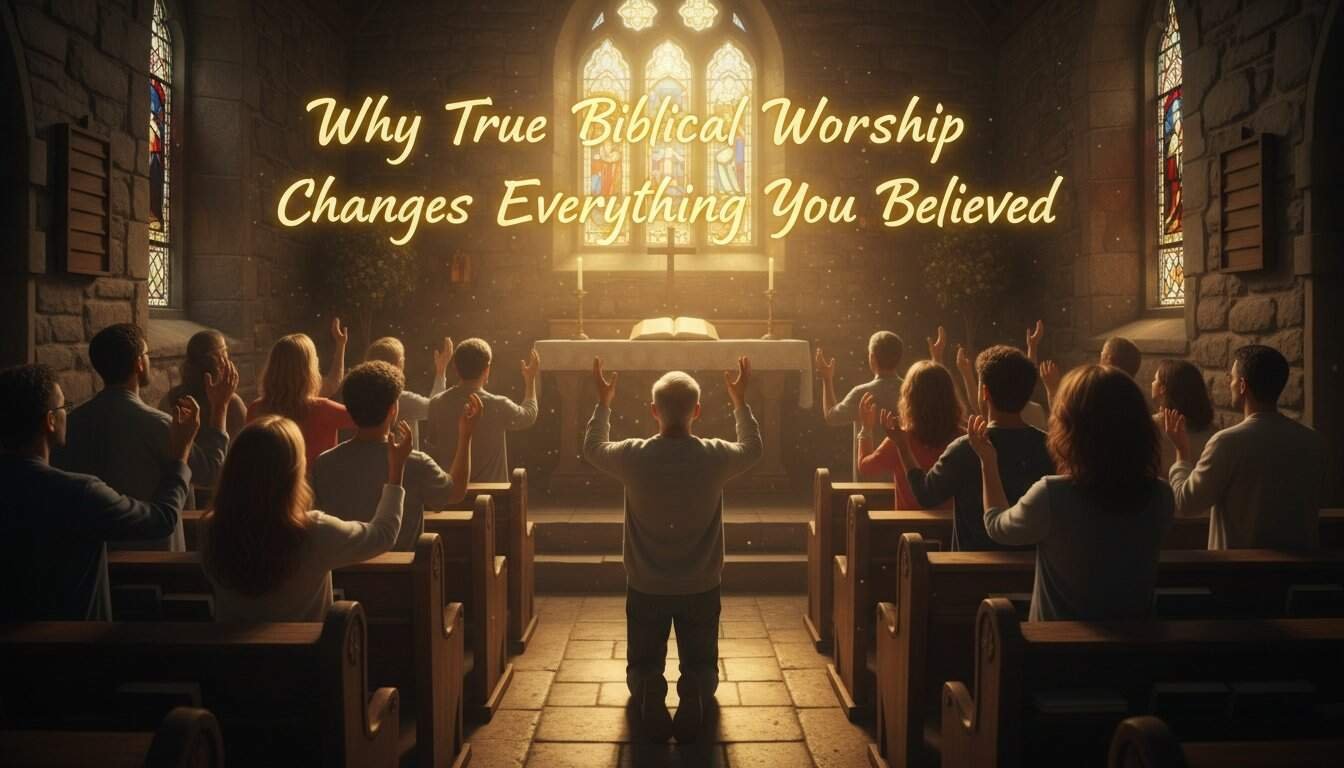
17 Jan Why True Biblical Worship Changes Everything You Believed
True biblical worship transforms your understanding because it’s not performance-based entertainment but complete surrender. The Hebrew *shachah* means prostration, while Greek *proskuneo* indicates intimate reverence requiring physical submission. You’ll discover worship isn’t Sunday-centered but encompasses your entire existence—Romans 12:1 calls for presenting your body as living sacrifice. Biblical examples like David’s Goliath deliverance show worship emerging from authentic encounters with God’s reality, not manufactured emotions or formulas. This foundation reshapes everything you’ve assumed about genuine spiritual expression.
Table of Contents
Key Takeaways
- Biblical worship requires complete physical prostration and surrender, not the entertainment-focused performances common in modern religious settings.
- True worship encompasses your entire daily existence as living sacrifice, not just Sunday services or designated religious moments.
- Authentic worship emerges from genuine encounters with God’s reality and experienced truth, not manufactured emotions or formulas.
- Biblical worship demanded mandatory purification, prescribed rituals, and reverent preparation in sacred spaces with holy fear.
- Worship becomes a continuous lifestyle through ordinary moments like work stewardship, gratitude practice, and conversational prayer throughout each day.
What Biblical Worship Means in Hebrew and Greek

What does the word “worship” actually mean in the original biblical languages? You’ll discover that biblical worship extends far beyond modern church services when you examine its Hebrew roots and Greek terms.
The Hebrew word “shachah” appears 172 times in the Old Testament, literally meaning “to bow down” or “to prostrate oneself.” It describes physical submission before God’s authority.
Biblical worship begins with “shachah”—bowing down in complete physical submission before God’s ultimate authority and sovereignty.
Another key term, “abad,” means “to serve” and emphasizes worship as active service rather than passive observation.
Greek terms in the New Testament reveal additional layers.
“Proskuneo” combines “pros” (toward) and “kuneo” (to kiss), depicting intimate reverence through physical positioning.
“Latreia” specifically refers to service rendered to God, while “leiturgia” describes public religious service.
These original languages demonstrate that biblical worship isn’t merely singing or attending services.
It’s complete surrender—body, mind, and spirit—expressed through humble positioning, devoted service, and intimate reverence toward God’s supreme authority.
How Biblical Worship Differs From Modern Practices
Understanding these original biblical definitions reveals a stark contrast with contemporary worship practices. You’ll discover that biblical worship demanded physical prostration before God’s presence, not comfortable seating arrangements.
Ancient Hebrew and Greek terms emphasized complete surrender and reverent fear, while modern worship often prioritizes entertainment and emotional experience.
These ancient contrasts become evident when examining worship contexts. Biblical worship occurred in designated holy spaces with prescribed rituals, specific offerings, and ceremonial requirements.
You weren’t invited to “come as you are” – purification and preparation were mandatory.
Modern distortions have transformed worship into performance-driven events focused on music quality, lighting effects, and audience engagement.
You’ve likely witnessed worship reduced to sing-alongs rather than sacred encounters with the Almighty.
Biblical worship required sacrifice, submission, and acknowledgment of human unworthiness before God’s holiness.
Today’s practices often emphasize God’s friendship while minimizing His transcendence, fundamentally altering worship’s original purpose and power.
Biblical Worship as a Daily Identity and Lifestyle
Transforming worship from a weekly event into a continuous lifestyle requires recognizing that Scripture presents worship as an identity rather than an activity. Romans 12:1 commands you to “present your bodies as a living sacrifice,” indicating worship encompasses your entire existence, not designated time slots.
Biblical identity formation occurs through consistent daily devotion patterns. When you study Psalms 119:164, you’ll discover David praised God seven times daily, establishing worship as continuous rhythm rather than compartmentalized practice.
This contrasts sharply with modern Christianity’s Sunday-centered approach.
Your worship identity manifests through ordinary moments: gratitude during meals (1 Timothy 4:4-5), stewardship in work (Colossians 3:23), and service to others (Hebrews 13:16). Each action becomes worship when performed with conscious recognition of God’s sovereignty.
Each action becomes worship when performed with conscious recognition of God’s sovereignty.
Scripture demonstrates that authentic worship transforms your perspective on mundane tasks, relationships, and decisions.
You’re not simply attending worship; you’re embodying it as your fundamental identity throughout every moment of daily existence.
Practical Ways to Live Out Biblical Worship
Implementing biblical worship as your daily identity requires specific, measurable practices rooted in Scripture’s explicit commands and examples.
Establish consistent home devotionals following the Berean model (Acts 17:11), examining Scripture daily with systematic study rather than random reading.
Transform your workplace worship through Paul’s directive to “work as unto the Lord” (Colossians 3:23), recognizing every task as service to God rather than mere employment.
Practice continuous prayer as commanded in 1 Thessalonians 5:17, developing conversational dialogue with God throughout ordinary moments.
Implement Sabbath rest according to Exodus 20:8-11, deliberately ceasing work to focus on God’s character and provision.
Express gratitude systematically, following Paul’s instruction to “give thanks in all circumstances” (1 Thessalonians 5:18) through written lists documenting God’s faithfulness.
Engage in corporate worship consistently, heeding Hebrews 10:25‘s warning against abandoning fellowship.
These concrete practices transform abstract worship concepts into measurable lifestyle changes that reshape your identity.
Biblical Examples of Authentic Worship in Action
When examining Scripture’s narrative accounts, you’ll discover that authentic worship consistently emerges from believers’ recognition of God’s character and mighty works rather than from religious obligation or emotional manipulation.
David’s response after defeating Goliath demonstrates this principle.
His worship flowed directly from witnessing God’s deliverance, producing many Davidic psalms that celebrate divine faithfulness.
These compositions reveal worship rooted in experienced truth rather than manufactured emotion.
Similarly, Abraham’s sacrificial offerings on Mount Moriah weren’t mere ritual compliance but responses to God’s covenant promises.
His worship emerged from understanding God’s provision and faithfulness.
The Israelites’ worship at the Red Sea crossing exemplifies authentic response—they sang because they witnessed God’s power firsthand.
Their praise wasn’t programmed but spontaneous recognition of divine intervention.
These examples establish a pattern: biblical worship springs from encountering God’s reality, not from following prescribed formulas or seeking emotional experiences.
Frequently Asked Questions
Can I Worship Biblically if My Church Doesn’t Follow These Practices?
Yes, you can worship biblically regardless of your church’s practices through personal conscience and independent worship.
Scripture shows believers like Daniel maintained faithful worship despite institutional constraints.
You’re responsible for your own spiritual integrity before God.
While corporate worship matters, your individual devotion, prayer life, and adherence to biblical principles aren’t dependent on others’ choices or denominational traditions.
Does Biblical Worship Require Specific Music Styles or Instruments?
No, biblical worship doesn’t mandate specific music styles or require particular instruments.
Scripture shows diverse worship expressions across cultures and eras.
You’ll find psalms mentioning various instruments—from harps to trumpets—while Paul emphasizes heartfelt singing over style preferences.
Your instrument use and musical approach should serve congregational edification and God’s glory rather than conform to rigid stylistic requirements that aren’t biblically prescribed.
How Do I Handle Family Conflicts When Changing My Worship Approach?
Start with open communication boundaries by explaining your biblical convictions without attacking their practices.
Use family negotiations to find common ground during holidays or gatherings.
You’ll need patience as relatives may feel threatened by your changes.
Set clear expectations about your participation while respecting their choices.
Document specific conflicts and address them systematically through scripture-based discussions, allowing time for understanding to develop naturally.
Is It Wrong to Enjoy Contemporary Worship Songs and Services?
No, enjoying contemporary worship isn’t inherently wrong.
You’re navigating moral nuance here—Scripture emphasizes heart posture over musical style.
Taste subjectivity means you’ll naturally prefer certain expressions while others connect differently with God.
Examine whether the lyrics align with biblical truth and whether the service facilitates genuine worship rather than entertainment.
Your enjoyment doesn’t disqualify contemporary worship if it draws you closer to God authentically.
What if Biblical Worship Feels Uncomfortable or Unfamiliar to Me?
Spiritual discomfort during biblical worship indicates you’re encountering authentic transformation rather than familiar religious entertainment.
Mental barriers arise because contemporary practices have conditioned you toward performance-based experiences.
Scripture shows worship involves surrendering preferences for God’s prescribed methods.
You’ll feel uncomfortable initially because biblical worship prioritizes God’s glory over your emotional satisfaction.
This discomfort signals spiritual growth, not wrongness in approach.
Conclusion
You’ve discovered that biblical worship isn’t Sunday performance—it’s daily surrender. The Hebrew *shachah* and Greek *proskuneo* reveal worship as prostrate submission, not musical expression. You can’t compartmentalize authentic worship into weekly services when Scripture demands continuous lifestyle transformation. Start implementing *proskuneo* through daily decisions: your work ethic, relationships, and choices become worship acts. You’ll find that embracing biblical worship’s original meaning fundamentally restructures your entire approach to faith and discipleship.











No Comments