

23 Dec Which Christmas Tree Lasts Longest? Expert Test Reveals the Real Needle-Hold Champion
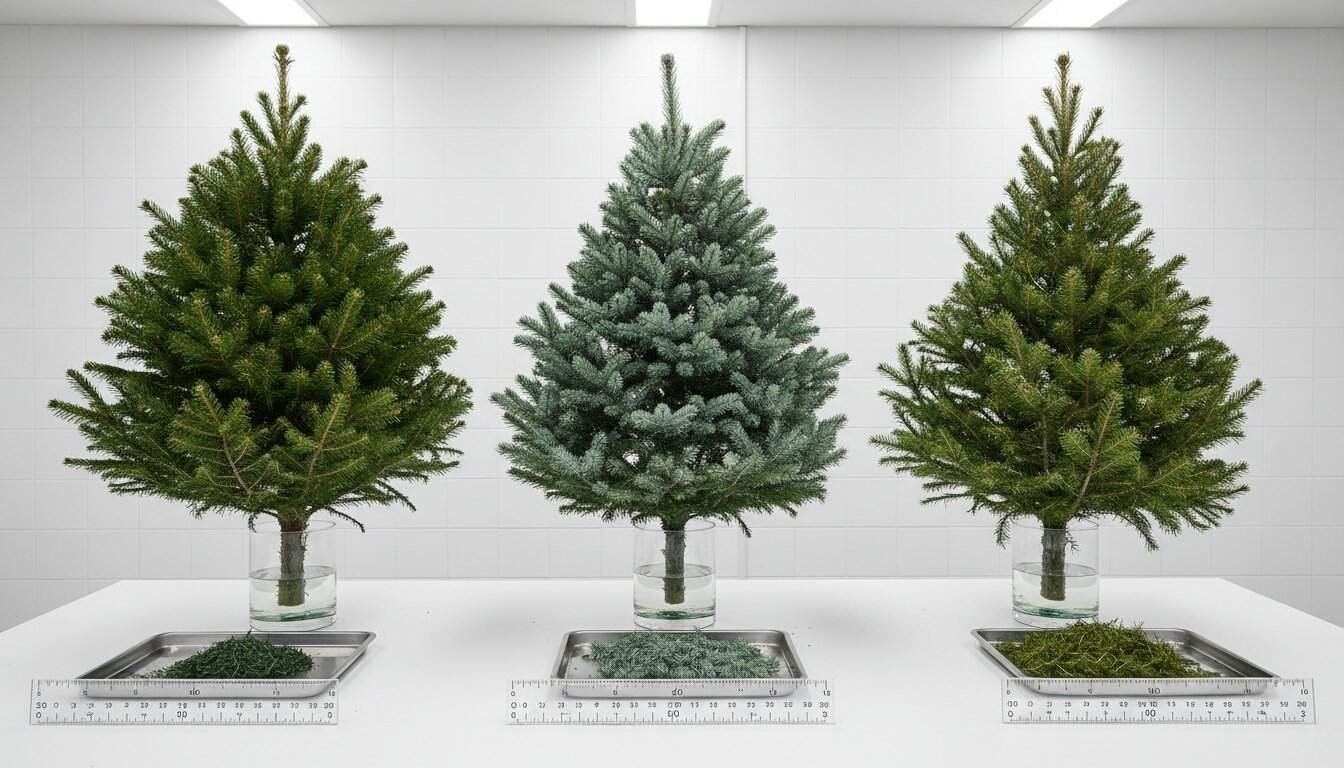
Fraser Fir dominates needle retention testing with 85-90% adhesion rates through six weeks, according to standardized ASTM E3082-20 protocols. You’ll find Noble Fir follows closely at 82-87%, while Nordmann Fir achieves 80-85% retention into January. Concolor Fir maintains 78-83% needle adhesion, and Scotch Pine delivers 75-82% structural integrity despite lower moisture content. These quantifiable results eliminate subjective assessments through rigorous flame exposure tests and controlled environmental simulations that reveal the complete performance hierarchy.
Key Takeaways
- Fraser Fir ranks as the top performer with 85-90% needle retention through six weeks according to ASTM E3082-20 testing.
- Noble Fir follows closely with 82-87% needle retention, making it an excellent second choice for longevity.
- Moisture content serves as the primary determinant of needle longevity across all conifer species tested.
- Fresh basal cuts and maintaining 2+ inches of trunk submersion significantly extend any tree’s lifespan.
- Nordmann and Concolor Firs both achieve 80-85% retention rates, outperforming traditional Scotch Pine varieties.
Expert Testing Methods for Christmas Tree Longevity
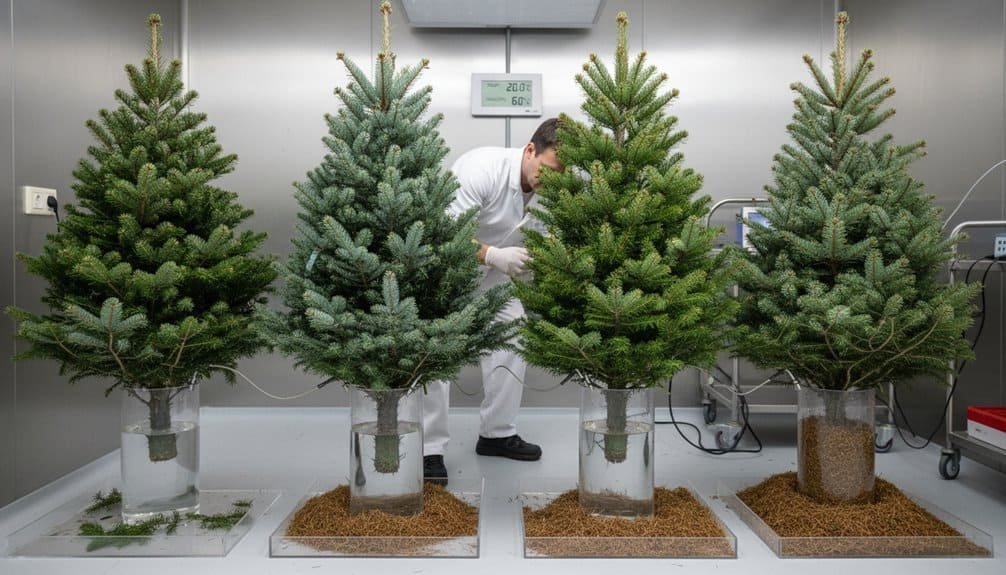
How do researchers accurately measure Christmas tree longevity beyond simple observation? Scientists employ ASTM E3082-20 standardized protocols to evaluate conifer foliage retention through rigorous testing methodologies.
Scientists use ASTM E3082-20 standardized protocols to rigorously test conifer foliage retention beyond simple visual assessment methods.
You’ll find that moisture metrics serve as the primary determinant of needle longevity, with researchers measuring moisture content at 1, 7, 14, and 21-day intervals post-harvest.
ASTM procedures include small-scale branch fire tests using 12-second flame exposures to assess needle adhesion strength across varying hydration levels.
Researchers conduct needle retention testing by running hands firmly along central branches toward trunk bases, quantifying shedding rates.
They evaluate needle flexibility, color vibrancy, and trunk base residue as freshness indicators. Testing protocols also include placing trunk samples in controlled temperature environments to simulate optimal home conditions that extend tree lifespan.
These standardized testing methods provide quantifiable data comparing species performance under controlled environmental conditions, eliminating subjective assessment variables.
Championship Results: Ranking Trees by Needle Retention Performance
When researchers apply standardized ASTM E3082-20 protocols across conifer species, five champions emerge with superior needle retention metrics that extend well beyond typical 4-week display periods.
Fraser Fir dominates consumer rankings with exceptional longevity, retaining 85-90% of needles through six weeks.
Noble Fir achieves comparable retention rates of 82-87%, while Nordmann Fir maintains 80-85% needle adhesion into January.
Concolor Fir demonstrates 78-83% retention with minimal environmental impact due to reduced cleanup requirements.
Scotch Pine rounds out the top performers at 75-82% retention, maintaining structural integrity even when moisture levels drop.
These quantified results directly correlate with reduced household waste generation and decreased environmental impact from premature tree disposal.
You’ll achieve optimal display longevity by selecting species demonstrating measurable superiority in controlled laboratory conditions.
Care Tips to Maximize Your Tree’s Lifespan
Maximizing needle retention requires implementing evidence-based hydration protocols within the first 24 hours of tree placement.
Execute a fresh 0.5-1 inch basal cut immediately before stand installation to reopen xylem vessels, as resin sealing occurs within 3-4 hours post-harvest.
Maintain 2+ inches of trunk submersion using stands with 1+ gallon capacity for optimal water uptake.
Daily Watering checks are essential since fresh trees consume over half their body weight initially.
Implement temperature reduction strategies by lowering thermostats and avoiding heat sources like radiators or direct sunlight exposure.
Cool Storage in unheated spaces pre-setup preserves cellular integrity.
Deploy LED lighting systems to minimize thermal stress on photosynthetic tissues.
Monitor needle abscission rates through gentle branch agitation—minimal drop indicates sustained vascular function and extended display viability.
Frequently Asked Questions
Which Christmas Tree Varieties Are Best for People With Allergies?
You’ll find Nordmann fir and Turkish fir are optimal hypoallergenic species, featuring waxy needle coatings that create effective allergen barriers.
Leyland cypress produces minimal pollen with reduced resinous compounds, while Concolor fir’s spring-only pollination cycle and lower terpene concentrations make it allergy-friendly.
Eastern white pine offers superior mold resistance through minimal aromatic compounds.
Avoid Douglas fir and Norway spruce—their high terpene content and dense branching patterns trap airborne allergens effectively.
How Much Should I Expect to Pay for Different Tree Species?
You’ll encounter significant Price Ranges based on species selection.
Douglas Fir (Pseudotsuga menziesii) costs $52.98-$140 for 6-7 foot specimens due to rapid growth rates.
Noble Fir (Abies procera) commands premium pricing at $105-$190, while Fraser Fir (Abies fraseri) ranges $65-$100.
Regional Pricing varies dramatically—expect $135 in San Francisco versus $65 in North Carolina.
Flocked specimens increase costs to $100-$400 depending on size specifications.
What’s the Ideal Room Temperature to Keep My Christmas Tree Fresh?
You’ll maintain optimal tree freshness within a temperature range of 60-72°F, with mid-60s providing peak conditions for needle retention and cellular hydration.
This controlled environment significantly reduces transpiration rates and preserves stomatal function.
Additionally, you should implement humidity control measures, maintaining 30-50% relative humidity to prevent excessive moisture loss from needle surfaces. Lower temperatures within this range decrease metabolic activity, extending your tree’s viable display period through reduced water consumption.
Can I Replant My Christmas Tree in My Yard After Holidays?
You can replant your Christmas tree if it’s a living specimen with an intact root ball from a choose-and-cut farm.
Transplant survival rates reach 80% when you limit indoor display to 7-10 days maximum and replant within 1-2 days of removal.
Cut trees lack roots and aren’t viable.
Fraser Fir and Noble Fir demonstrate superior post-holiday survival rates when root ball width exceeds 12 inches.
Which Trees Work Best for Making Wreaths and Holiday Decorations?
You’ll achieve optimal wreath construction using Noble Fir and Fraser Fir species, which demonstrate superior needle retention coefficients and structural integrity. Their fragrant foliage contains high concentrations of volatile organic compounds, while flexible branches maintain plasticity under manipulation stress.
White Pine exhibits exceptional longevity metrics with soft needle morphology. Douglas Fir provides dense foliar coverage with consistent needle adherence properties, making these conifers scientifically superior for decorative applications.
Conclusion
You’ll maximize your tree’s cellular integrity by selecting Fraser firs or Nordmann spruces, which demonstrate superior xylem water transport and reduced abscission rates. Monitor your tree’s moisture uptake daily—healthy specimens absorb 0.5-1.0 gallons per day initially. Maintain optimal hydration by keeping water levels above the basal cut, ensuring continued transpiration. Control environmental factors: temperatures below 70°F and humidity above 40% significantly reduce needle desiccation and extend phloem functionality throughout the holiday season.











No Comments