


01 Jan Where the Bible Lists the 10 Commandments: Full Scripture
You’ll find the complete Ten Commandments in two primary biblical passages: Exodus 20:1-17 and Deuteronomy 5:4-21. These foundational moral principles establish God’s covenant relationship with Israel, covering exclusive devotion to God, prohibition of idolatry, reverent use of His name, Sabbath observance, honoring parents, and prohibitions against murder, adultery, theft, false witness, and coveting. Both passages present identical core principles with slight variations in wording, forming the ethical cornerstone of Judeo-Christian civilization that continues shaping contemporary moral discourse.
Key Takeaways
- The Ten Commandments appear in two primary biblical locations: Exodus 20:1-17 and Deuteronomy 5:4-21 with slight variations.
- Exodus 20 presents the original giving of the commandments at Mount Sinai after Israel’s exodus from Egypt.
- Deuteronomy 5 records Moses recounting the commandments to the second generation before entering the Promised Land.
- Both passages contain the complete list from worshiping God alone to prohibiting coveting your neighbor’s possessions.
- Additional references include Exodus 34:28 and Deuteronomy 4:13 which specifically mention the “ten commandments” by name.
The First Commandment: No Other Gods Before Me

When examining the foundational principle of monotheistic worship, the First Commandment establishes God’s exclusive claim to divine authority and human devotion. This commandment appears in Exodus 20:3, where God declares, “You shall have no other gods before me.” The Hebrew term “elohim acherim” (other gods) encompasses any entity that competes for ultimate allegiance.
The prohibition targets idolatry in all forms—material objects, philosophical systems, or personal desires that usurp God’s position. When you examine ancient Near Eastern contexts, Israel’s exclusive monotheism distinguished them from polytheistic neighbors.
You’ll find this commandment reinforced throughout Scripture. Deuteronomy 6:4-5 emphasizes Israel’s monotheism: “Hear, O Israel: The Lord our God, the Lord is one.” This Shema became central to Jewish identity and worship practices.
Jesus reaffirmed this principle in Matthew 4:10, declaring, “You shall worship the Lord your God and him only shall you serve,” demonstrating continuity between Old and New Testament theology.
The Second Commandment: No Graven Images or Idols
This commandment targets idolatrous worship practices prevalent in ancient Near Eastern cultures, where deities were represented through physical images (Deuteronomy 4:15-19). You’re commanded not to “bow down” or “serve” these images, indicating that the prohibition extends beyond mere creation to veneration itself.
The rationale appears in God’s declaration of being “jealous” (*qanna*), demanding exclusive devotion (Exodus 34:14). This commandment doesn’t prohibit all artistic representation but specifically forbids creating objects that become focal points for worship, redirecting devotion from the invisible God to visible substitutes.
The Third Commandment: Do Not Take the Lord’s Name in Vain
Revering God’s name requires understanding that ancient Hebrew culture viewed names as containing divine essence and power. When you invoke God’s name frivolously or deceptively, you’re trivializing sacred authority (Leviticus 19:12). The commandment prohibits using divine titles for personal gain, making false oaths, or claiming divine endorsement for human agendas.
Avoiding misuse means recognizing that violations include empty religious formalism and insincere worship practices. Jesus reinforced this principle by condemning those who honor God with their lips while their hearts remain distant (Matthew 15:8-9). The commandment ultimately demands authentic reverence in both speech and conduct.
The Fourth Commandment: Remember the Sabbath Day
The Fourth Commandment establishes the Sabbath as both a divine ordinance and human necessity, commanding you to “remember the Sabbath day, to keep it holy” (Exodus 20:8, ESV). This commandment uniquely encompasses both cessation from labor and dedication to worship, reflecting God’s own pattern of creation and rest (Genesis 2:2-3).
You’ll find that the Sabbath serves as a covenant sign between God and His people, distinguishing sacred time from ordinary pursuits while providing physical restoration and spiritual renewal.
Sabbath’s Sacred Purpose
Why did God establish a day of rest as one of His fundamental commandments to humanity? The Sabbath’s sacred purpose extends beyond mere physical rest to encompass spiritual renewal and divine relationship. In Exodus 20:11, God connects the weekly observance to His creation pattern: “For in six days the Lord made the heavens and the earth, the sea, and all that’s in them, but he rested on the seventh day.” This establishes the Sabbath as both commemorative and restorative.
Deuteronomy 5:15 reveals an additional dimension: “Remember that you were slaves in Egypt and that the Lord your God brought you out of there with a mighty hand.” Here, the Sabbath becomes a reminder of liberation and God’s covenant faithfulness, transforming weekly observance into sacred remembrance.
Rest and Worship
Beyond its commemorative and covenantal significance, the fourth commandment establishes a rhythm of rest and worship that reflects God’s own creative pattern. You’ll find this divine template in Genesis 2:2-3, where God blessed and sanctified the seventh day after completing creation.
The commandment’s dual emphasis on ceasing work and gathering for weekly worship creates what scholars call “sacred rest”—a consecrated time distinct from mere leisure (Leviticus 23:3). This weekly cycle serves multiple purposes: physical restoration, spiritual renewal, and community formation through corporate worship.
The Hebrew word “shabath” implies complete cessation, emphasizing that sacred rest isn’t partial but total withdrawal from labor. Through this rhythm, you participate in God’s creative order while acknowledging His sovereignty over time itself.
The Fifth Commandment: Honor Your Father and Mother
The Fifth Commandment, found in Exodus 20:12 and Deuteronomy 5:16, establishes the fundamental principle of honoring one’s father and mother within the covenant community of Israel. You’ll discover that the Hebrew word “kabbed” (honor) carries connotations of giving weight, respect, and reverence to parental authority, extending beyond mere obedience to include care and support throughout their lives (Merrill, 1994).
This commandment’s application spans from childhood obedience to adult responsibility for aging parents, creating a framework for family relationships that reflects God’s own parental relationship with His people.
Biblical Text and Context
Familial respect forms the cornerstone of the Fifth Commandment, which appears in both Exodus 20:12 and Deuteronomy 5:16 with the directive to “honor your father and your mother.” Ancient Near Eastern cultures consistently emphasized parental authority and filial obligation, making this commandment particularly resonant within its historical context (Kitchen, 2003).
In ancient context, honoring parents extended beyond emotional respect to include material provision and social deference throughout their lifetime. The Hebrew term “kabbed” implies weightiness or gravity, suggesting substantial obligation rather than mere sentiment (Brown, Driver & Briggs, 1996).
The commandment’s modern relevance transcends cultural boundaries, establishing intergenerational responsibility that strengthens societal foundations. You’ll notice the accompanying promise of longevity connects personal obedience with communal stability, reflecting divine wisdom about human relationships.
Meaning of Honor
When examining the Hebrew concept of honor in the Fifth Commandment, scholars recognize that “kabbed” encompasses far more than contemporary Western notions of respect or politeness. The term derives from the root meaning “heavy” or “weighty,” suggesting substance and gravity (Brown-Driver-Briggs Hebrew Lexicon).
You’ll find that biblical honor involves tangible actions: providing physical care, financial support, and emotional sustenance throughout your parents’ lives. This duty extends beyond childhood obedience into adult responsibility. Deuteronomy 27:16 reinforces this principle by cursing those who “dishonor” parents. The Septuagint translates “kabbed” as “timao,” emphasizing value and worth. Thus, honoring parents isn’t merely showing respect through words, but demonstrating their intrinsic value through sustained, meaningful action that acknowledges their fundamental role in your existence and development.
Modern Application Examples
Understanding this weighty biblical concept of honor requires examining how modern believers can practically fulfill the Fifth Commandment across different life circumstances and cultural contexts.
You’re called to demonstrate honor through active listening, seeking parental wisdom in major decisions, and providing financial or emotional support during their aging years.
Contemporary applications extend beyond traditional caregiving—you might honor aging parents by making thoughtful choices about ethical consumption that reflect values they instilled, or adopting a sustainable lifestyle that preserves creation for future generations as they taught you stewardship principles.
Honor also manifests through maintaining family traditions, respecting parental sacrifices, and acknowledging their formative influence on your character development, even when you disagree with specific viewpoints or past decisions.
The Sixth Commandment: You Shall Not Murder

Scripture expands this principle beyond physical violence. Jesus taught that anger and hatred constitute violations of this commandment’s spirit (Matthew 5:21-22).
John reinforces this understanding, stating that “everyone who hates his brother is a murderer” (1 John 3:15). You’re called to protect and preserve life, reflecting God’s creative image within humanity.
The Seventh Commandment: You Shall Not Commit Adultery
While the sixth commandment protects physical life, the seventh commandment safeguards the sacred covenant of marriage. “You shan’t commit adultery” (Exodus 20:14) establishes God’s design for marital fidelity as fundamental to both individual relationships and societal stability.
Divine covenant of marriage stands as cornerstone for both intimate relationships and broader community flourishing through sacred fidelity.
The Hebrew term *na’aph* encompasses both physical unfaithfulness and covenant violation. Jesus expanded this understanding in Matthew 5:27-28, revealing that adultery begins in the heart: “But I tell you that anyone who looks at a woman lustfully has already committed adultery with her in his heart.”
The emotional consequences of adultery extend beyond immediate participants, devastating families and communities. Proverbs 6:32 warns that “whoever commits adultery with a woman lacks understanding; he who does so destroys his own soul.”
The spiritual significance lies in marriage representing Christ’s relationship with the church (Ephesians 5:25-32). Adultery therefore violates both human covenant and divine symbolism, undermining trust that forms civilization’s foundation.
The Eighth Commandment: You Shall Not Steal
You’ll find the eighth commandment’s prohibition against theft in Exodus 20:15 and Deuteronomy 5:19, where the Hebrew word “ganab” encompasses not only material theft but also deceptive practices that deprive others of their rightful possessions (Strong, 2001).
This commandment establishes foundational principles of property rights and economic justice that extend beyond simple stealing to include fraud, exploitation, and withholding wages from workers (Leviticus 19:13).
You must recognize that contemporary applications involve complex scenarios such as intellectual property theft, tax evasion, and corporate embezzlement that challenge modern believers to apply ancient wisdom to today’s economic realities.
Biblical Foundation and Context
The ancient tablets Moses received at Mount Sinai contained God’s eighth commandment, “You shan’t steal” (Exodus 20:15, ESV), establishing a foundational principle that transcends mere property protection to encompass the broader concept of justice and respect for others’ God-given rights. The biblical significance of this commandment extends beyond material possessions to include time, reputation, and dignity.
Within its historical context, ancient Near Eastern societies struggled with theft and economic exploitation, making this divine directive particularly relevant. The Hebrew term “ganab” encompasses various forms of taking what belongs to another, including kidnapping (Exodus 21:16). You’ll find this commandment reinforced throughout Scripture, from Leviticus 19:11 to Ephesians 4:28, demonstrating its enduring relevance across both Testaments and establishing theft as fundamentally contrary to God’s character and covenant community standards.
Modern Applications and Implications
Although ancient societies faced different economic structures, today’s complex global economy presents unprecedented opportunities for violating the eighth commandment through digital piracy, intellectual property theft, tax evasion, and corporate embezzlement. You’re challenged to examine your personal convictions regarding ownership, honesty, and stewardship in contemporary contexts (Leviticus 19:11; 1 Thessalonians 4:11-12).
Modern applications extend beyond physical theft to include time theft from employers, plagiarism in academic settings, and fraudulent insurance claims. Your daily practices must reflect biblical integrity through transparent business dealings, accurate reporting, and respect for others’ property rights. The commandment’s essence demands you consider whether your financial decisions honor God’s standard of righteousness and demonstrate love for your neighbor (Romans 13:9-10).
The Ninth Commandment: You Shall Not Bear False Witness

When examining the ninth commandment found in Exodus 20:16, “You shan’t bear false witness against your neighbor,” scholars recognize this directive as fundamentally concerned with judicial integrity and community trust rather than merely prohibiting all forms of lying. The Hebrew term “ed sheqer” specifically refers to false testimony in legal proceedings, emphasizing the covenant community’s need for truthful testimony in matters of justice (Hamilton, 2006).
This commandment’s scope extends beyond courtrooms to encompass all forms of deceptive speech that damage relationships. Proverbs 19:5 reinforces this principle: “A false witness won’t go unpunished, and whoever pours out lies won’t go free.” The emphasis on integrity in speaking reflects God’s own character as truth (John 14:6).
Contemporary applications include honest communication in business dealings, accurate reporting in media, and faithful representation of others’ words and actions, maintaining the biblical standard of truthfulness in all interpersonal relationships.
The Tenth Commandment: You Shall Not Covet
Covetousness represents the internal root from which external transgressions spring, making the tenth commandment in Exodus 20:17 fundamentally different from its predecessors. While previous commandments address outward actions, this prohibition targets the heart’s desires that precede sinful behavior. The Hebrew term “chamad” encompasses intense longing and desire for what belongs to others.
You’ll notice the commandment specifically addresses coveting your neighbor’s house, wife, servants, livestock, and possessions (Exodus 20:17). This comprehensive list demonstrates that coveting wealth and coveting possessions violates God’s design for contentment. Deuteronomy 5:21 reinforces this prohibition, emphasizing that desire itself—not merely action—constitutes transgression.
Paul’s understanding in Romans 7:7 reveals covetousness as sin’s catalyst, showing how internal desires manifest as external violations. When you allow envious thoughts toward others’ prosperity to take root, you’re violating God’s standard before any physical action occurs, making this commandment uniquely preventative rather than reactive.
Frequently Asked Questions
Are There Different Versions of the Ten Commandments in Different Religions?
Yes, you’ll find different religious interpretations of the Ten Commandments across Judaism, Christianity, and Islam. While the core principles remain consistent, you’ll encounter varying cultural applications in numbering, emphasis, and theological understanding.
Jewish tradition focuses on covenant relationship, while Christian denominations differ on graven images versus idolatry. Islamic parallels appear in Quranic moral imperatives, though they’re not formally called “commandments” (Exodus 20:1-17; Deuteronomy 5:4-21).
Where Exactly in the Bible Are the Ten Commandments First Mentioned?
You’ll find the Ten Commandments first mentioned in Exodus 20:1-17, immediately following Israel’s departure from Egypt. This passage establishes the foundational covenant between God and His people at Mount Sinai.
The theological significance of commandments emerges here as divine law given directly by God. Deuteronomy 5:4-21 provides a second account, demonstrating how different biblical authors offered varying interpretation of commandments within canonical Scripture.
Did Jesus Replace the Ten Commandments With New Teachings?
You’ll find Jesus didn’t replace the commandments but emphasized commandment fulfillment through love (Matthew 5:17). His commandment interpretation expanded their moral scope—transforming external compliance into heart transformation.
Christ declared he came to fulfill, not abolish the law (Matthew 5:17-20). Paul’s writings confirm this continuity, showing how Jesus’s teachings deepen rather than discard Mosaic commands, establishing love as the commandments’ ultimate expression (Romans 13:8-10).
Why Do Some Churches Number the Commandments Differently Than Others?
You’ll find historical variations stem from Augustine’s grouping versus Philo’s division of Exodus 20:1-17. Denominational interpretations differ: Catholics and Lutherans follow Augustine’s system, combining verses 3-6 as one commandment, while Protestants and Orthodox churches separate idolatry prohibitions.
Reformed traditions emphasize Deuteronomy 5:4-21’s structure. These numbering systems reflect theological emphases—Catholic focus on covetousness versus Protestant distinction between false worship and image-making (Westminster Confession, chapter 21).
What Punishments Were Given for Breaking Each Commandment in Biblical Times?
Consequences for breaking commandments varied significantly in biblical times. You’ll find that enforcement of commandments in biblical times ranged from death penalties for idolatry, adultery, and Sabbath violation (Exodus 31:14-15, Leviticus 20:10) to restitution for theft (Exodus 22:1-4).
However, you should note that scholars debate whether these punishments were consistently applied, as biblical texts often prescribe theoretical rather than practical judicial outcomes in ancient Israel.
Conclusion
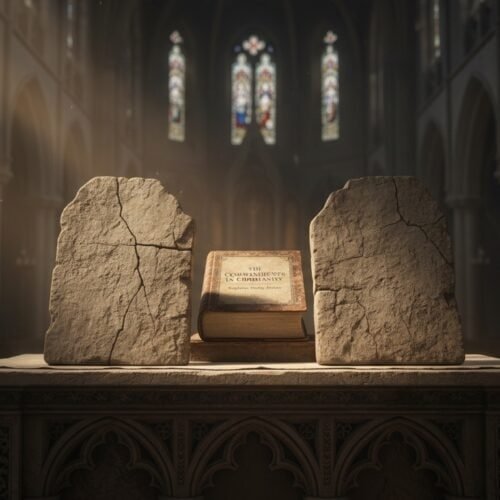
You’ll notice the Decalogue appears twice in Scripture—Exodus 20:1-17 and Deuteronomy 5:4-21—with slight variations reflecting different emphases (Childs, 1974). These commandments establish both vertical relationship with God (commands 1-4) and horizontal relationships with others (commands 5-10). You’re encountering foundational ethical principles that’ve shaped Judeo-Christian moral framework for millennia. The tablet arrangement traditionally divides into two categories: duties toward God and duties toward neighbor, reflecting Jesus’s summary in Matthew 22:37-39.











No Comments