

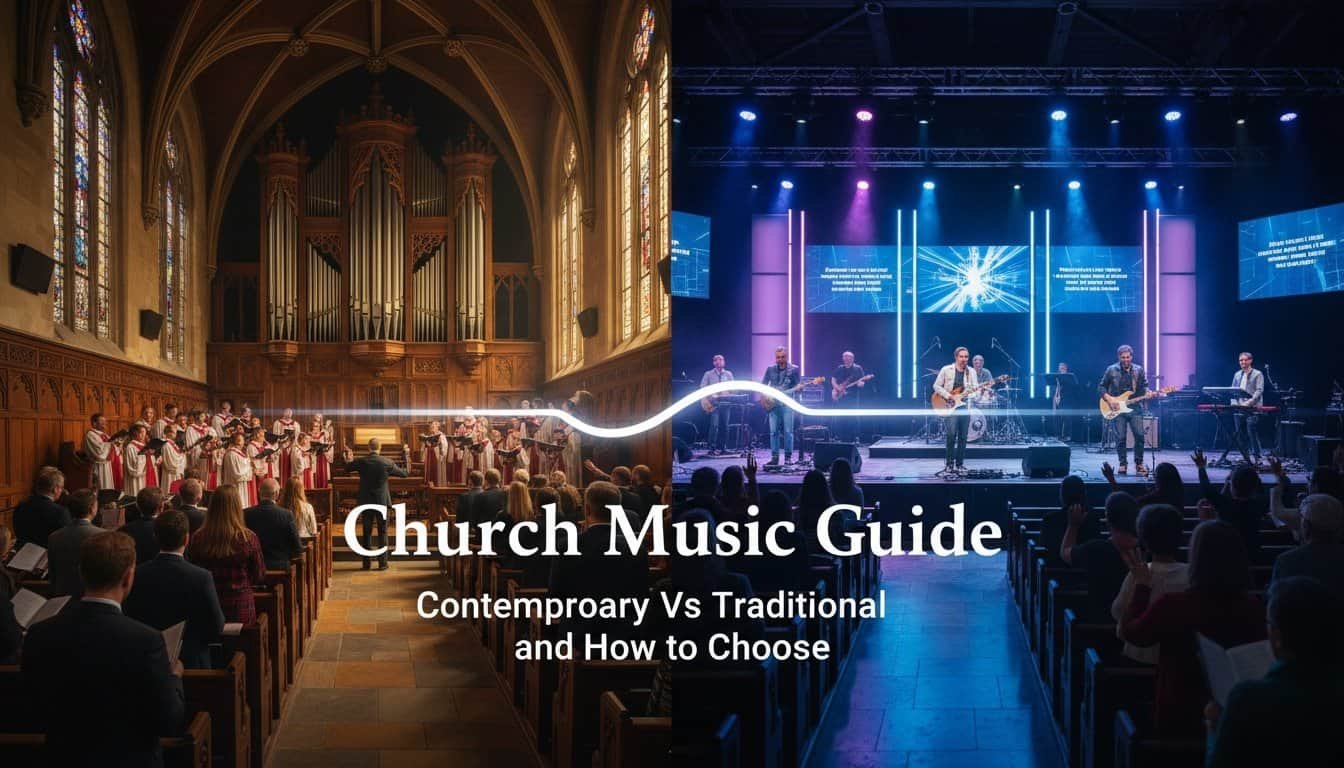
16 Dec Church Music Guide Contemporary Vs Traditional and How to Choose
You’ll need to evaluate your congregation’s demographics, musical resources, and worship goals to determine whether traditional hymns, contemporary praise songs, or a blended approach best serves your church’s spiritual mission. Traditional music offers theological depth and classical sophistication, while contemporary styles provide accessibility and emotional connection for younger generations. Conduct surveys to assess preferences, document your musical talent pool, and evaluate budget constraints. The following comprehensive framework will guide your strategic implementation process.
Key Takeaways
- Traditional church music offers theological depth and musical sophistication through hymns, organ accompaniment, and classical arrangements spanning fifteen centuries.
- Contemporary worship incorporates modern instruments, accessible language, and popular music styles to create immediate emotional connections with congregations.
- Assess your congregation’s demographics, musical preferences, and generational diversity through surveys and focus groups to guide style selection.
- Evaluate available resources including musical talent, budget constraints, volunteer availability, and existing infrastructure before choosing a direction.
- Consider creating a blended worship experience that strategically combines both traditional and contemporary elements for broader congregational appeal.
Understanding Traditional Church Music: History and Characteristics
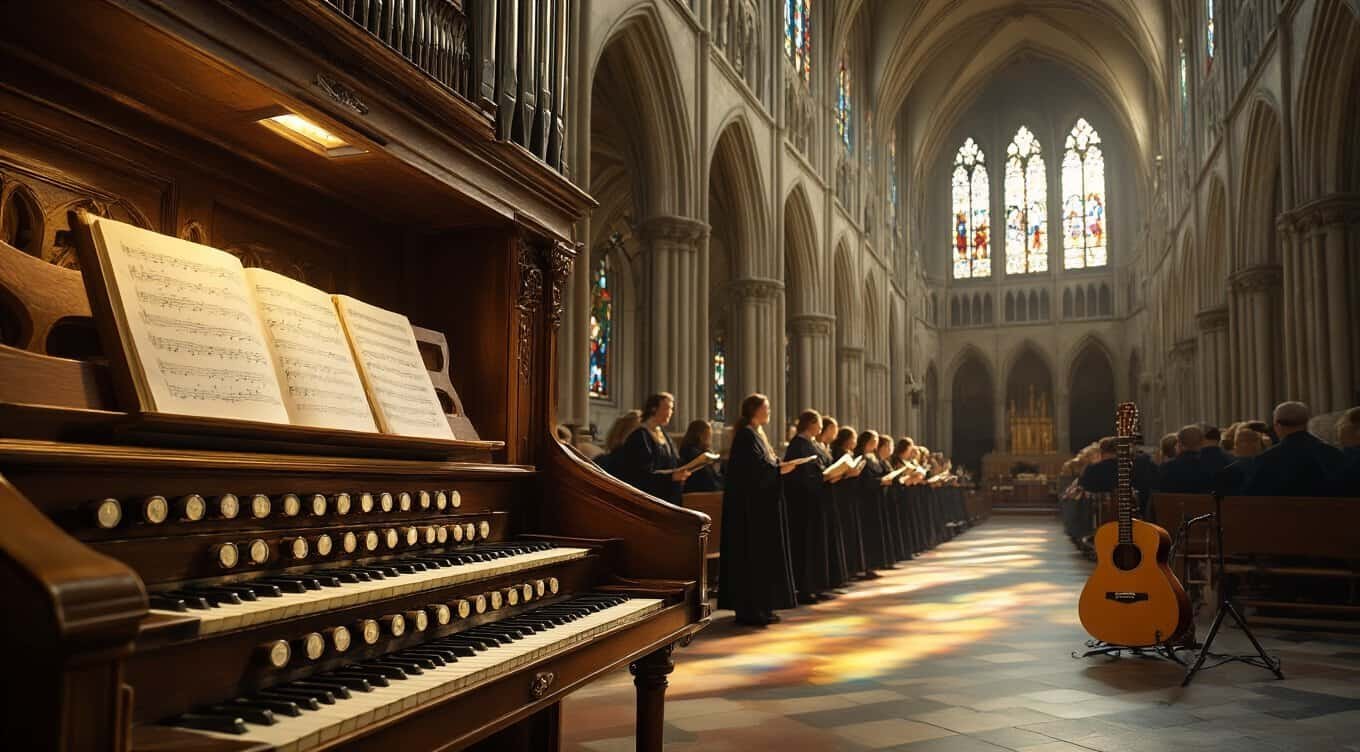
When you explore traditional church music, you’re encountering a rich tapestry that spans over fifteen centuries of Christian worship. This musical tradition emerged from ancient Jewish temple practices and evolved through Gregorian chant, Renaissance polyphony, and Protestant hymns.
Traditional church music follows established liturgical structure, with specific songs designated for different worship segments—call to worship, confession, communion, and benediction. You’ll recognize characteristics like formal arrangements, organ accompaniment, and choir-led congregational singing. The melodies often derive from classical composers like Bach, Wesley, or Watts, featuring complex harmonies and theological depth.
Understanding the historical context reveals how these songs shaped doctrinal understanding across generations. Traditional pieces typically emphasize reverence, majesty, and contemplative worship. They’re written in formal language, often archaic, reflecting their origins in medieval and reformation periods. This musical foundation provides stability, continuity, and connection to Christianity’s historical roots.
Contemporary Worship Music: Evolution and Key Elements
Since the 1960s, contemporary worship music has revolutionized church services by incorporating modern musical styles, instruments, and accessible language that connects with today’s congregations. You’ll find this genre draws from rock, pop, folk, and electronic music, creating an immediate emotional connection through familiar sounds.
Key elements include electric guitars, synthesizers, drum kits, and praise bands replacing traditional choirs and organs. Musical technology advancements have enabled churches to integrate digital sound systems, projection screens displaying lyrics, and live streaming capabilities that enhance worship experiences.
Contemporary songs feature repetitive, scripture-based lyrics designed for congregation participation rather than performance observation. Modern worship trends emphasize authentic expression, with raised hands, swaying, and vocal participation becoming standard practices.
You’ll notice verse-chorus structures dominating this style, making songs easier to learn and remember. The focus shifts from formal liturgy to personal relationship themes, creating accessible worship experiences that resonate with diverse age groups and cultural backgrounds.
Benefits of Traditional Hymns and Classical Arrangements
While contemporary worship music emphasizes accessibility and modern appeal, traditional hymns and classical arrangements offer distinct advantages rooted in centuries of theological depth and musical sophistication. You’ll find that timeless melodies like “Amazing Grace” and “How Great Thou Art” carry profound doctrinal content that’s been refined through generations of church practice.
Traditional arrangements provide structural stability and harmonic complexity that trains your congregation’s musical ear. These compositions often feature sophisticated voice-leading and counterpoint that contemporary songs typically lack. You’re accessing centuries of proven worship material when you incorporate hymns into your services.
The memorability factor can’t be overlooked—these timeless melodies stick with congregants throughout their lives, creating lasting spiritual associations. Traditional hymns also offer liturgical versatility, adapting seamlessly to various worship contexts from intimate services to grand celebrations. Their theological precision and poetic craftsmanship provide substantive content for meditation and reflection.
Advantages of Modern Worship Songs and Contemporary Styles
Modern worship songs bring immediate accessibility and emotional connection that traditional hymns often struggle to achieve in today’s cultural context. You’ll find contemporary styles use familiar musical language that resonates with younger generations and unchurched visitors.
Engaging lyrics in modern worship focus on personal relationship themes rather than theological complexity. This creates instant relatability for newcomers who might feel intimidated by archaic language or doctrinal concepts. You can expect simplified chord progressions and repetitive choruses that encourage congregation participation without requiring musical literacy.
Enhanced presentation becomes possible through contemporary arrangements. You’ll benefit from dynamic instrumentation, professional sound systems, and visual elements like projection screens. These tools create immersive worship experiences that compete effectively with secular entertainment standards.
Contemporary worship also offers flexibility in service timing and flow. You can adjust song lengths, modify keys for vocalists, and incorporate spontaneous moments of reflection or prayer that traditional liturgical structures don’t accommodate as easily.
Assessing Your Congregation’s Musical Preferences and Demographics
Understanding your congregation’s musical preferences requires systematic data collection rather than assumptions based on visible demographics alone. You’ll need to conduct surveys that capture specific musical preferences across age groups, examining generational dynamics that influence worship expectations. Baby Boomers often prefer traditional hymns, while Millennials and Gen Z typically gravitate toward contemporary styles with modern instrumentation.
Effective worship planning demands actual survey data about musical preferences across generations, not assumptions based on congregation demographics.
Don’t overlook cultural diversity within your congregation. Ethnic backgrounds, socioeconomic factors, and regional influences significantly impact musical preferences. Hispanic members might appreciate bilingual worship songs, while African American congregants may prefer gospel elements.
Implement focus groups representing different demographic segments. Ask specific questions about tempo preferences, instrument choices, and lyrical styles. Analyze attendance patterns during services featuring different musical approaches. Track engagement levels through participation observation.
Consider seasonal surveys to monitor evolving preferences. Document feedback from newcomers versus long-term members. This data-driven approach ensures your musical choices reflect your congregation’s authentic preferences rather than leadership assumptions.
Evaluating Your Church’s Resources and Musical Capabilities
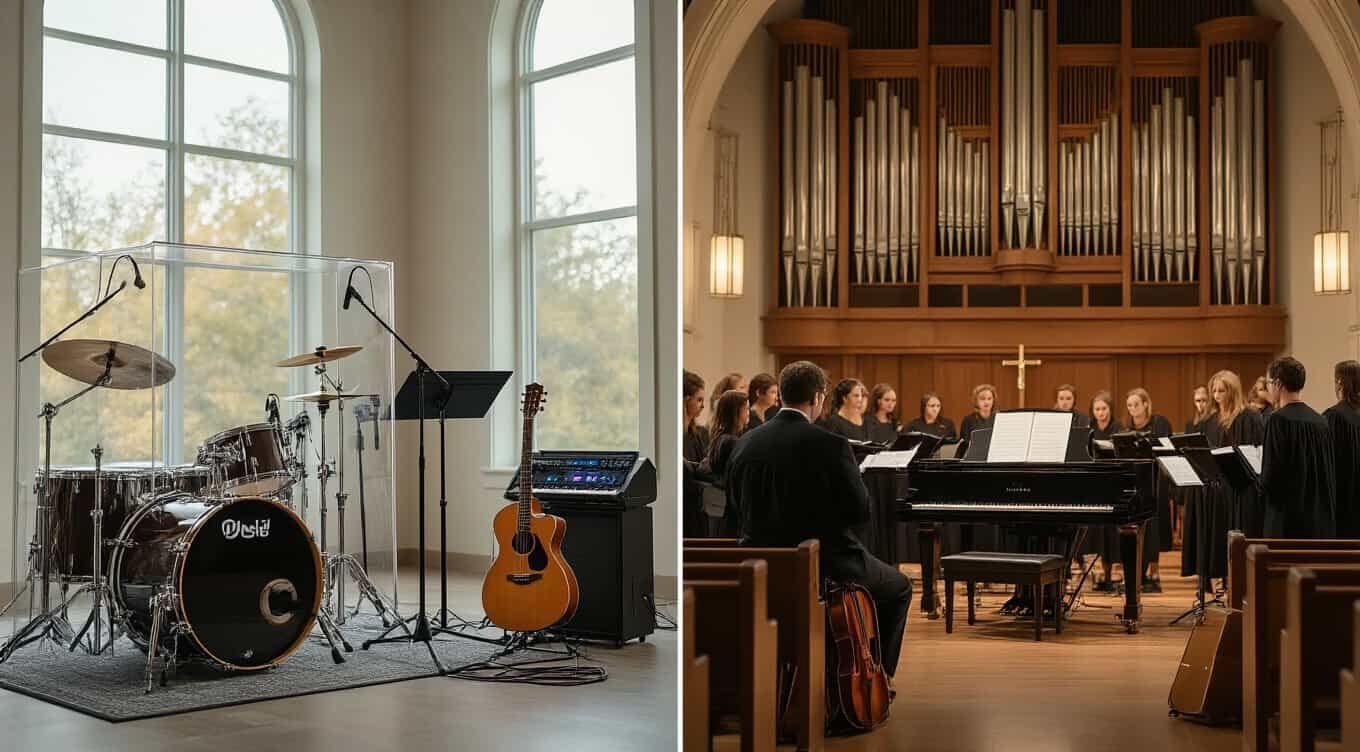
You must conduct a thorough audit of your church’s existing musical infrastructure before committing to either contemporary or traditional worship styles. Start by cataloging your current musical talent pool, including instrumentalists, vocalists, and technical operators, then evaluate your available budget for equipment purchases, maintenance, and potential staff additions.
Finally, assess the realistic availability and long-term commitment levels of your volunteer musicians, as this will directly impact your ability to sustain your chosen musical direction.
Assessing Current Musical Talent
Before implementing any musical direction, conducting a thorough inventory of your church’s existing musical resources establishes the foundation for informed decision-making. Begin your musical talent assessment by cataloging instrumentalists, vocalists, and their skill levels. Document each member’s proficiency, preferred styles, and availability for rehearsals and services. Evaluate technical capabilities including sight-reading abilities, experience with different musical genres, and leadership potential.
Your congregation evaluation should extend beyond the music team to identify untapped talent within the broader membership. Survey attendees about musical backgrounds, instruments played, and willingness to participate. Consider age demographics, as younger members often gravitate toward contemporary styles while older congregants may prefer traditional approaches. This comprehensive assessment reveals whether your current talent pool naturally supports contemporary, traditional, or hybrid musical programming, directly informing your strategic direction.
Budget and Equipment Needs
Musical talent represents only half of the equation for successful church music programming. Your music budget allocation directly impacts which style you can realistically support. Traditional programs typically require acoustic piano maintenance, organ repairs, and printed music purchases. Contemporary worship demands sound systems, electric instruments, amplifiers, and software licensing fees.
Calculate ongoing equipment maintenance needs before committing to either direction. Contemporary setups require regular equipment servicing, cable replacements, and technology updates. Traditional instruments need periodic tuning, mechanical repairs, and climate control considerations.
Don’t overlook hidden costs: contemporary worship often requires sound technicians, while traditional may need accompanist payments. Evaluate your facility’s acoustics—some spaces favor traditional instruments naturally, while others need amplification systems regardless of style choice.
Volunteer Availability and Commitment
Most worship teams collapse within eighteen months due to volunteer burnout rather than musical incompetence. You’ll need consistent, committed musicians who can handle weekly rehearsals and services.
Contemporary worship requires dedicated band members for guitar, bass, drums, keyboards, and vocals. Traditional music needs choir members, organists, and potentially brass or string players.
Assess your limited volunteer pool realistically. Contemporary styles demand fewer people but require specialized skills and equipment knowledge. Traditional formats accommodate more volunteers with varying skill levels but need larger groups for impact.
Address scheduling conflicts proactively by establishing clear expectations upfront. Create rotation schedules allowing volunteers time off without compromising service quality. Consider hybrid approaches if you can’t sustain either style consistently year-round.
Creating a Blended Worship Experience That Honors Both Styles
Three foundational principles drive successful blended worship: intentional song selection, strategic musical transitions, and unified pastoral leadership. You’ll accommodate diverse musical preferences while maintaining a cohesive worship atmosphere through careful planning and execution.
Select songs that complement each other thematically rather than stylistically. Pair a contemporary chorus with a traditional hymn sharing the same scriptural foundation. Use transitional elements like instrumental bridges or spoken prayers between contrasting musical styles to smooth jarring shifts.
Train your musicians in both genres. Your organist should understand contemporary rhythms, while your contemporary team needs exposure to traditional harmonic structures. This cross-training enables seamless collaboration.
Establish clear communication protocols between worship leaders. You can’t create unity without unified leadership vision. Brief your team on song keys, tempos, and transition cues before each service.
Position different musical styles throughout your service strategically, creating natural flow rather than forced contrast that disrupts congregational engagement.
Implementing Your Musical Direction: Practical Steps for Worship Leaders
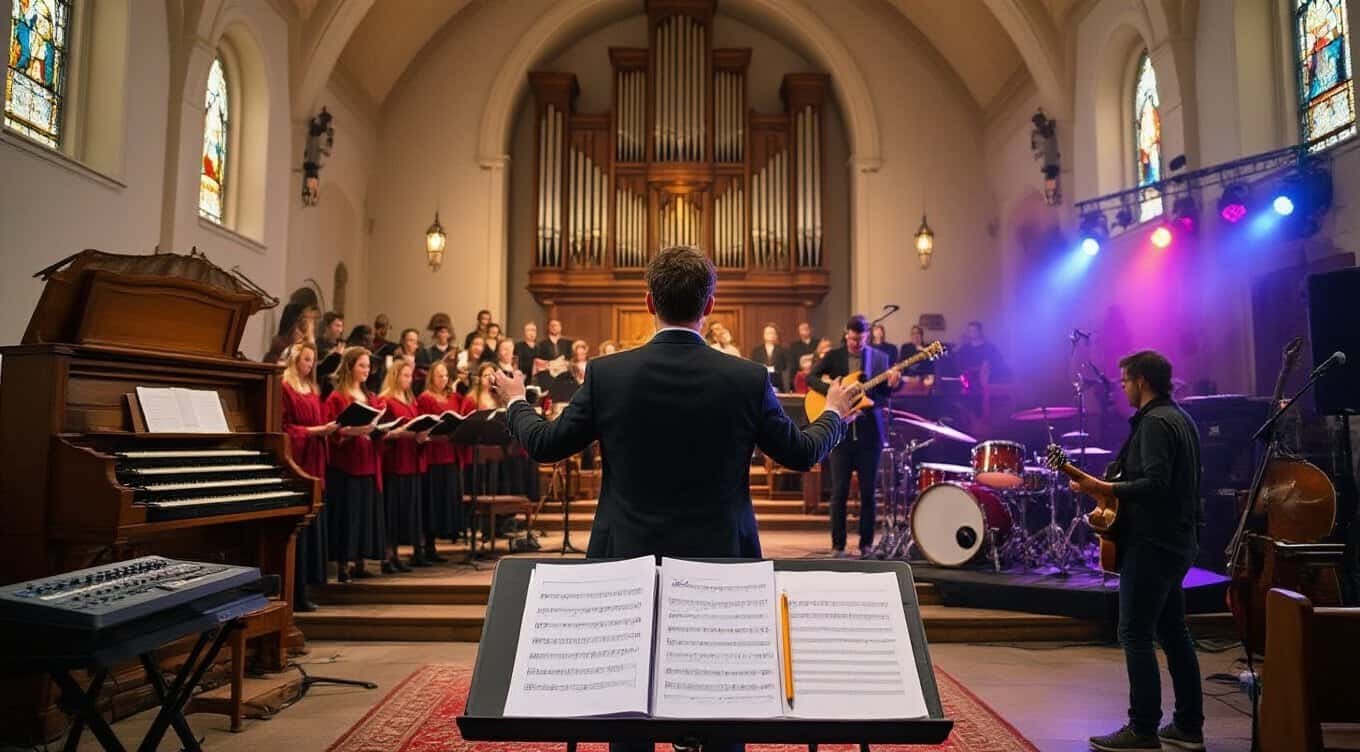
Once you’ve determined your church’s musical direction, you must execute a strategic implementation plan that addresses three critical components.
You’ll need to systematically build a comprehensive song library that aligns with your chosen style, develop your worship team’s technical and theological competencies, and manage any stylistic transitions through carefully planned phases.
These foundational steps ensure your musical vision translates into effective congregational worship rather than remaining an abstract concept.
Building Your Song Library
Building an effective song library requires strategic selection that aligns with your congregation’s worship style, musical capabilities, and spiritual needs. You’ll need to balance familiar repertoire with fresh material, ensuring theological soundness and musical accessibility for your team.
Start by cataloging your current collection, identifying gaps in tempo, themes, and seasonal content. When broadening musical scope, consider your musicians’ skill levels and vocal ranges. Gradually introduce new songs through rehearsals before incorporating them into services.
Focus on increasing genre diversity while maintaining congregational engagement. Include hymn arrangements, contemporary worship songs, and culturally relevant pieces that reflect your community’s demographics. Create seasonal rotations and maintain a core set of frequently-used songs. Document keys, arrangements, and performance notes for consistent execution across different worship leaders.
Training Worship Team Members
How effectively you train your worship team directly determines your congregation’s worship experience and musical consistency. Establish clear musical training protocols that address technical skills, song arrangements, and performance standards.
Schedule regular rehearsals focusing on chord progressions, vocal harmonies, and instrumental techniques specific to your chosen style—whether contemporary or traditional.
Prioritize team communication through structured feedback sessions and clear musical direction. Create standardized charts, chord sheets, and lead sheets that match your musical approach. Implement mentorship programs pairing experienced musicians with newer team members to accelerate skill development.
Develop consistent rehearsal schedules that accommodate volunteer availability while maintaining performance quality. Use recording technology to review performances and identify improvement areas. Establish clear expectations for preparation, punctuality, and spiritual readiness to ensure seamless worship experiences.
Transitioning Musical Styles Gradually
Musical transitions require strategic planning and patience to avoid alienating your congregation while moving toward your desired worship style. You’ll need gradual schedule changes that introduce new elements incrementally rather than implementing wholesale shifts overnight. Start by incorporating one contemporary song per service if you’re traditionally-oriented, or add hymn arrangements if you’re moving toward classical worship.
Your thoughtful communication strategy should explain the reasoning behind changes well before implementation. Announce upcoming transitions during services, send detailed newsletters, and host informal Q&A sessions. Monitor congregational feedback through surveys and personal conversations to gauge acceptance levels.
Test new arrangements during rehearsals first, then introduce them during less formal services before incorporating them into main worship times. This methodical approach ensures smoother acceptance.
Frequently Asked Questions
How Do Copyright Laws Differ Between Traditional Hymns and Contemporary Worship Songs?
Traditional hymns typically have expired copyrights, meaning you can use them without royalty payments since their copyright duration has ended. Contemporary worship songs remain under active copyright protection, requiring you to pay licensing fees and royalties for usage.
You’ll need CCLI licenses or direct publisher permissions for modern songs, while traditional hymns written before 1928 are generally in the public domain.
What Should Churches Do When Musicians Resist Changing From Their Preferred Style?
Address musician resistance by facilitating open dialogue about congregational worship goals. You’ll need to discuss flexible approaches that blend both styles rather than complete replacement. Prioritize congregational needs while acknowledging musicians’ expertise and concerns.
Create transition timelines that allow gradual style integration. Consider forming committees with both musicians and congregation members to develop compromise solutions that serve your church’s worship mission effectively.
How Can Small Churches Afford Licensing Fees for Contemporary Worship Music?
You’ll need strategic budget planning to manage licensing costs effectively. Purchase annual CCLI or similar licenses that cover multiple songs rather than individual track fees.
Train volunteer musicians to lead simpler arrangements that don’t require complex backing tracks. Consider free worship resources from churches that release songs under Creative Commons.
Pool resources with nearby small churches to share licensing expenses and reduce individual costs significantly.
Should Guest Musicians Be Required to Adapt to Our Established Worship Style?
Yes, you should require guest musician flexibility to align with your established worship style. However, consider church style compromise when their expertise could enhance your service.
Communicate your musical expectations, key signatures, and arrangement preferences beforehand. Provide charts, chord progressions, and tempo guidelines.
While maintaining your worship identity is crucial, occasional stylistic variations from skilled guests can enrich your congregation’s experience without compromising your core musical vision.
How Do We Handle Requests for Secular Songs During Worship Services?
You should establish clear criteria for evaluating secular song requests before they arise.
Create a committee that reviews lyrics for theological compatibility and worship appropriateness. When welcoming guest requests, consider congregational preferences and your church’s mission statement. Develop alternative approaches like suggesting similar Christian songs or incorporating secular melodies with sacred lyrics. Always communicate your decision-making process transparently to maintain trust and understanding.
Conclusion
You’ve now got the framework to make informed decisions about your church’s musical direction. Don’t rush the process—carefully assess your congregation’s needs, available resources, and spiritual goals. Whether you choose traditional, contemporary, or blended worship, ensure your selection serves your community’s worship experience. Start implementing changes gradually, gather feedback from your congregation, and remain flexible as you develop your church’s unique musical identity that honors both tradition and innovation.









No Comments