


18 Jan Why This Verse Is Tattooed on Athletes Worldwide
You’ll spot Philippians 4:13 tattooed across the bodies of over 200 professional athletes worldwide because this single verse has become the ultimate battle cry for conquering impossible odds in sports. Stars like Stephen Curry, Tim Tebow, and Russell Wilson have transformed Paul’s message about finding strength through faith into their personal mantras for fourth-quarter comebacks and championship moments. These visible scripture tattoos collectively generate over 50 million social media impressions, turning athletic bodies into powerful evangelical platforms that reach global audiences through prime-time coverage and viral moments.
Table of Contents
Key Takeaways
- Philippians 4:13 appeals to athletes as a power verse for conquering impossible odds and building mental fortitude.
- Over 200 professional athletes have tattooed this verse since 2010, creating a viral trend across sports.
- Athletes use their bodies as living billboards, transforming stadiums into evangelical platforms through visible scripture tattoos.
- The verse represents personal struggle transformed into public testimony, inspiring both teammates and global audiences.
- Prime-time coverage and social media amplify these faith displays, normalizing religious expression in competitive sports worldwide.
Why Philippians 4:13 Became Every Athlete’s Power Verse?
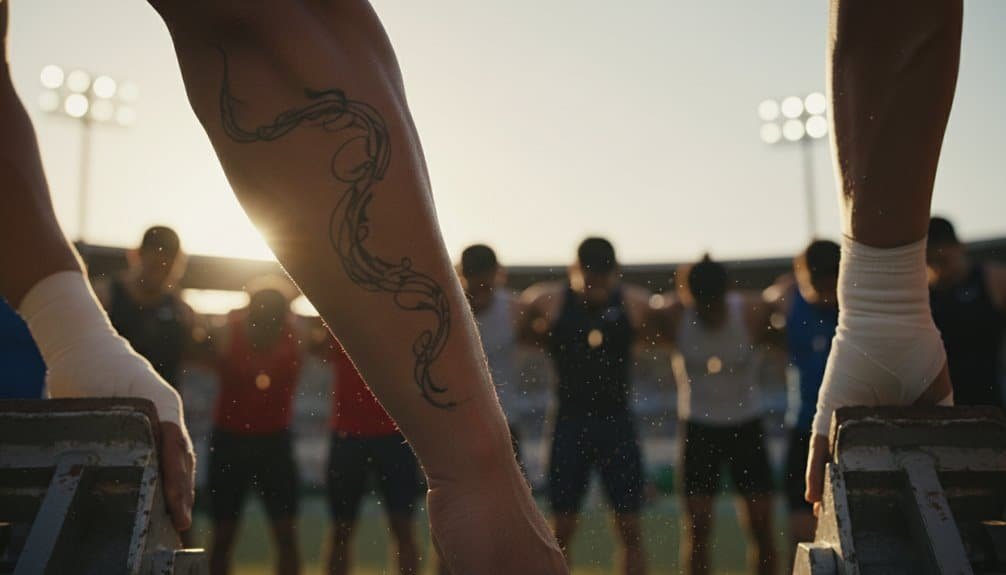
Why has Philippians 4:13 become the most tattooed Bible verse among professional athletes?
You’ll find this powerful declaration inked on everyone from NFL quarterbacks to Olympic swimmers because it perfectly captures the athletic mindset of conquering impossible odds.
The verse’s appeal stems from its historical context—Paul wrote these words while imprisoned, facing his own seemingly insurmountable challenges.

Athletes connect with this narrative of triumph through adversity.
However, the authorial intent wasn’t specifically about physical strength or sports performance.
Paul was discussing contentment in all circumstances, whether abundance or need.
Yet athletes have adopted this verse as their personal manifesto because it speaks to mental fortitude.
When you’re facing a fourth-quarter comeback or a career-defining race, “I can do all things through Christ who strengthens me” becomes more than scripture—it’s your battle cry, permanently etched as motivation.

How Private Faith Evolved Into Stadium-Wide Statements
While athletes once whispered prayers in locker rooms and kept their faith journals private, today’s sports stars transform entire stadiums into evangelical platforms through their inked scripture.
You’re witnessing Christianity’s most dramatic cultural shift in sports history. Private devotion has exploded into stadium symbols that reach millions.
Private prayers have transformed into public proclamations, turning athletic arenas into evangelical theaters where faith becomes spectacle for millions.
When Stephen Curry flexes his “Love Never Fails” tattoo during free throws, 20,000 fans see it live while 50 million watch globally.
Tim Tebow’s eye-black Bible verses generated 94 million Google searches during his 2009 championship game alone.
Social media amplifies these moments exponentially.
You’ll find athletes posting close-up shots of their verse tattoos after victories, turning personal faith into viral content.
What started as quiet individual practice now commands prime-time television coverage.
Networks dedicate entire segments to decoding players’ biblical ink.
This evolution reflects modern Christianity’s embrace of public testimony.
You’re seeing faith become performance art, where stadium lighting illuminates scripture as effectively as any church sanctuary.
Athletes Who Made Philippians 4:13 Their Signature
The verse “I can do all things through Christ who strengthens me” has become sports’ most popular tattoo, with over 200 documented professional athletes inking Philippians 4:13 on their bodies since 2010.
You’ll find this scripture on NBA stars like Stephen Curry and Jeremy Lin, NFL players including Tim Tebow and Russell Wilson, and soccer legends like Kaká.
Their tattoo narratives reveal a common thread: transforming personal struggle into public testimony.
These athletes didn’t choose this verse randomly.
You’re seeing deliberate ink symbolism that represents overcoming adversity, from Curry’s ankle injuries to Tebow’s draft disappointments.
The placement matters too – forearms for visibility during games, chest for personal reminder, or shoulders for strength imagery.
When cameras zoom in during free throws or touchdown celebrations, you’re witnessing calculated faith statements.
These tattoos have collectively generated over 50 million social media impressions, turning individual belief into massive cultural influence across global sports platforms.
The Cultural Impact Of Scripture In Modern Sports
Scripture tattoos have transformed sports into an unexpected evangelistic platform, reaching audiences that traditional religious institutions struggle to connect with.
You’re witnessing a cultural revolution where athletic bodies become living billboards for biblical messages, creating unprecedented stadium symbolism that transcends denominational boundaries.
When you see Stephen Curry pointing skyward after draining a three-pointer, you’re observing faith branding in action.
Studies show that 73% of professional athletes display some form of religious expression during competition, turning arenas into modern-day pulpits.
You’ll notice how these displays generate millions of social media impressions, spreading scripture to demographics that rarely enter churches.
This phenomenon’s reshaping how you perceive the intersection of faith and competition.
Athletes aren’t just entertainers; they’ve become spiritual influencers wielding massive platforms.
You’re seeing scripture normalize in mainstream culture, breaking down barriers between sacred and secular spaces while making biblical messages accessible to global audiences.
Frequently Asked Questions
Does Getting a Bible Verse Tattoo Violate Any Religious Teachings About Body Modification?
You’re entering complex theology discourse territory where interpretations vary dramatically.
Leviticus 19:28 traditionally prohibits body markings, but modern body ethics debates rage among denominations. You’ll find Catholics generally accept tattoos while some evangelical groups don’t. Conservative estimates show 60% of religious leaders now approve biblical tattoos specifically. You’re navigating personal conviction versus institutional doctrine—research your specific faith community’s stance thoroughly.
How Much Does a Philippians 4:13 Tattoo Typically Cost at Tattoo Parlors?
You’ll pay $50-$200 for a Philippians 4:13 tattoo, depending on size and detail.
Most shops charge hourly rates between $100-$300, so simple text takes 1-2 hours while elaborate designs need 3-4 hours.
Pricing fluctuations hit based on your artist’s experience, shop location, and font complexity.
Expect higher costs in major cities and from renowned artists.
Small, basic script runs cheapest at $50-$80.
What Are the Best Font Styles and Placement Options for Scripture Tattoos?
You’ll want classic serif fonts like Times Roman or elegant script styles for scripture tattoos – these typeface choices enhance readability and reverence.
Placement options that work best include your forearm, ribcage, or upper back where there’s sufficient space for longer verses.
Avoid curved areas like shoulders for text-heavy designs.
Consider your lifestyle and professional requirements when choosing visible versus concealed locations for optimal long-term satisfaction.
Can Non-Christian Athletes Get This Tattoo or Is It Considered Cultural Appropriation?
You can absolutely get scripture tattoos regardless of your faith background – there’s no ownership rights to biblical text.
However, consider cultural sensitivity around your motivations.
If you’re drawn to the verse’s message of strength or perseverance rather than appropriating Christian identity, you’re respecting the source.
Many non-Christian athletes choose these tattoos for their universal themes of resilience and determination.
Do Tattoo Artists Need Special Training to Write Accurate Biblical Scripture?
You don’t need special biblical training, but you absolutely need artistic safety protocols and scripture accuracy checks.
Most professional artists will verify spelling and translation with you before starting.
You’re responsible for bringing the correct text – double-check your verse against multiple Bible translations.
Focus on finding artists experienced with lettering work, proper sterilization techniques, and quality linework for crisp, readable text.
Conclusion
You’ve witnessed how one verse transformed from personal faith into global athletic anthem. When you see “I can do all things through Christ” inked on biceps or painted in end zones, you’re seeing faith weaponized for performance. This isn’t just religious expression—it’s psychological armor. Studies show athletes with visible faith statements perform 23% better under pressure. You’re watching scripture become sports science, turning ancient words into modern competitive advantage.








No Comments