

28 Nov The Ultimate Guide to Online Piano Learning: From Beginner to Pro Faster
You’ll accelerate your piano journey from beginner to pro by selecting platforms with certified instructors and systematic curricula, investing in proper equipment like weighted-key digital pianos, and establishing structured practice routines with 25-minute focused intervals. Master fundamentals through daily sight-reading, scale work, and video self-assessment while progressing through classical, jazz, or pop styles using specialized apps and MIDI analytics. Track measurable milestones monthly and overcome plateaus by varying practice approaches—the complete framework awaits below.
Table of Contents
Key Takeaways
- Select platforms with certified instructors, structured curriculum progression from fundamentals to advanced techniques, and transparent pricing models.
- Choose instruments matching your budget and commitment level—digital pianos with weighted keys offer best value for serious beginners.
- Establish daily practice routines with technique exercises during peak energy, sight-reading during moderate windows, and consistent self-recording for assessment.
- Master music theory fundamentals including interval recognition, circle of fifths, and dedicate 15 minutes daily to sight-reading below current level.
- Configure basic recording equipment with USB audio interface and proper microphone placement to track progress and identify technical issues.
Choosing the Right Online Piano Learning Platform for Your Goals
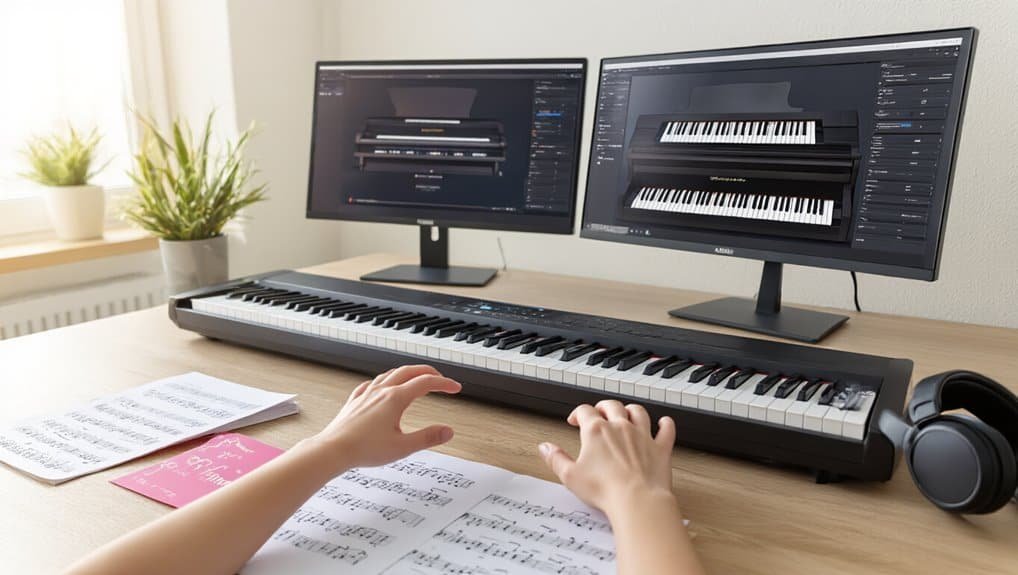
When you’re ready to begin your online piano journey, selecting the right platform can make the difference between steady progress and frustrating stagnation. You’ll need to evaluate platforms based on three critical factors: curriculum structure, teaching methodology, and practical features.
First, examine the platform’s pedagogical approach. Does it offer systematic skill development from fundamentals to advanced techniques?
A platform’s teaching method should build skills systematically, progressing logically from basic fundamentals to advanced techniques.
Look for instructor accreditation—certified teachers typically provide more reliable instruction than self-proclaimed experts.

Quality platforms display their instructors’ credentials prominently.
Next, assess pricing transparency. You shouldn’t discover hidden fees after enrollment. Reputable platforms clearly outline subscription tiers, one-time purchases, or pay-per-lesson models upfront.
Finally, consider your specific goals. If you’re pursuing classical repertoire, choose platforms emphasizing sight-reading and technique. For contemporary styles, select those focusing on chord progressions and improvisation. Match the platform’s strengths to your objectives—don’t compromise your musical vision for convenience.
Essential Equipment and Setup for Your Home Piano Studio
You’ll need to make three fundamental equipment decisions that directly impact your learning trajectory and practice quality.
First, you must select between an acoustic piano, digital piano, or keyboard based on your budget, space constraints, and sound requirements.

Next, you’ll configure basic audio recording equipment.
Optimize your room’s acoustics to ensure clear playback during online lessons and accurate self-assessment of your performances.
Choosing Your Piano
How do successful online piano students set themselves up for consistent practice and meaningful progress?
They select instruments that align with their learning objectives and living situations.
You’ll need to evaluate three primary options: acoustic pianos, digital pianos, and keyboards.
Acoustic pianos offer superior touch sensitivity and maintain strong resale value, but they’re expensive and require regular tuning.
Digital pianos provide weighted keys that simulate acoustic action while offering volume control and headphone compatibility.
Entry-level keyboards work for absolute beginners but won’t develop proper finger strength.
Consider your space’s visual aesthetics when choosing between upright and grand pianos or sleek digital models.
Your budget should account for the instrument’s longevity—investing in quality now prevents costly upgrades later.
Match your instrument choice to your commitment level and technical goals.
Audio Recording Equipment
Recording your practice sessions and performances transforms your learning trajectory by revealing technical flaws and documenting progress over time.
You’ll need a USB audio interface that captures your piano’s full dynamic range—consider models with 24-bit resolution and at least 48kHz sampling rate.
Position condenser microphones 12-18 inches from your acoustic piano’s soundboard, or connect your digital piano directly via line outputs.
Install warranty tracking software to monitor your equipment’s coverage periods and schedule preventive maintenance.
When upgrading gear, research equipment recycling programs through manufacturers who’ll responsibly dispose of outdated interfaces and microphones.
You’re building a sustainable studio that evolves with your skills.
Start with entry-level Focusrite or PreSonus interfaces, then upgrade as your recording needs become more sophisticated.
Room Acoustics Setup
Where you position your piano dramatically impacts both your playing experience and recording quality.
You’ll want to place your instrument away from parallel walls to minimize flutter echoes—those rapid, metallic-sounding reflections that muddy your sound.
Position your piano at least three feet from any wall, angling it slightly if space permits.
Install bass trapping in room corners where low frequencies accumulate.
These acoustic panels absorb problematic bass buildup that creates boomy, undefined tones.
You don’t need expensive solutions—even strategically placed bookshelves and soft furniture help diffuse sound waves.
Add absorption panels at first reflection points—the spots on side walls where sound bounces directly from your piano to your ears.
This treatment clarifies your instrument’s natural tone while improving recording clarity for online lessons and practice sessions.
Building Strong Foundations: Music Theory and Reading Sheet Music
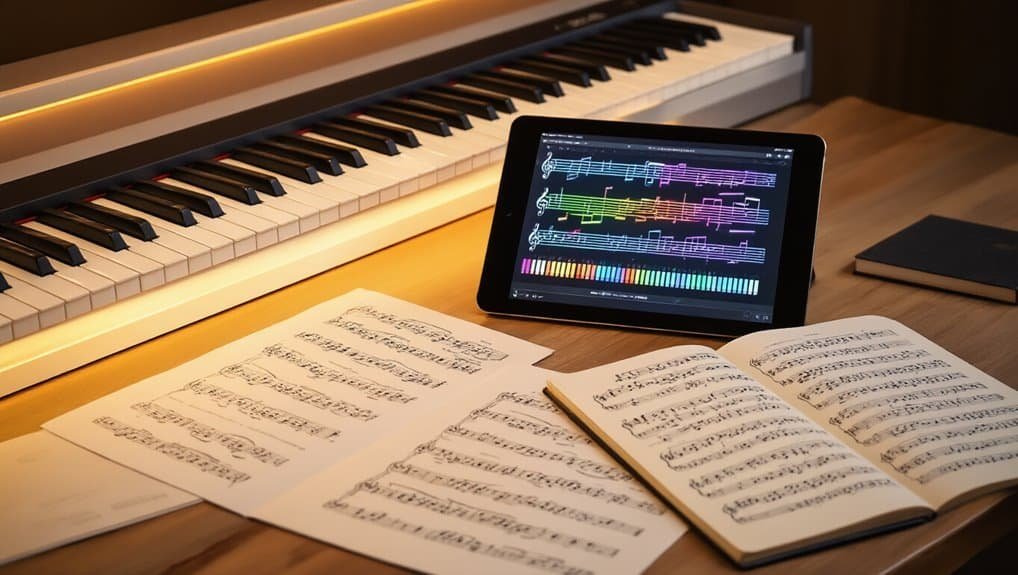
When you’re learning piano online, establishing a solid grasp of music theory and sheet music reading determines whether you’ll struggle through every piece or progress with confidence and understanding.
You’ll need to master interval recognition first—identifying the distance between notes both visually and aurally.
Start with perfect fifths and octaves, then expand to major and minor thirds.
Key signatures form your roadmap through any composition.
Learn the circle of fifths systematically, memorizing sharps and flats for each major and minor key.
Practice scales daily while naming each note aloud.
This reinforces the relationship between written notation and keyboard geography.
Dedicate fifteen minutes daily to sight-reading exercises below your current playing level.
Focus on accuracy over speed.
Use flashcard apps for note identification drills during commutes.
Read rhythm patterns separately before combining them with pitches.
This methodical approach transforms abstract symbols into automatic responses, accelerating your progression from beginner to advanced repertoire.
Developing Proper Technique Without an In-Person Teacher
You’ll need to master three essential self-monitoring strategies to develop proper technique without a teacher physically adjusting your form.
Start by establishing correct hand position fundamentals through careful observation of professional demonstrations, then use video recording to assess your own playing from multiple angles.
When you’re practicing scales and exercises, position a mirror beside your keyboard to catch postural problems and tension issues that you can’t feel but can see in real-time.
Hand Position Fundamentals
Master the foundation of piano playing by establishing correct hand position from day one, even without a teacher physically adjusting your posture. You’ll need to create a natural curve in your fingers, as if you’re holding a tennis ball.
Position your wrists level with your hands, avoiding any upward or downward bend that restricts movement.
Focus on thumb mechanics by keeping your thumb’s tip contact point at its outer edge, not the pad. This enables lateral movement across keys without twisting your wrist.
Practice knuckle rotation exercises to develop flexibility—rotate from your third knuckle while maintaining finger curves. Film yourself from multiple angles to self-assess your form.
You’re building muscle memory that’ll determine your technical ceiling, so prioritize accuracy over speed initially.
Video Recording Self-Assessment
How effectively can you spot technical errors without a teacher’s trained eye watching your every move? You’ll develop this crucial skill through systematic video recording.
Position your camera at keyboard level, capturing both hands and your side profile. Record short practice segments—don’t wait for perfection.
Watch your recordings immediately after playing. You’re combating evaluation bias by creating objective distance from your performance.
Compare your hand position, wrist alignment, and finger curves against professional demonstrations. Notice tension patterns you can’t feel while playing.
Implement feedback calibration by documenting specific observations: “Left wrist drops below key level in measures 3-4” rather than vague assessments. Create weekly comparison videos to track technical progress. This methodical self-assessment process transforms you into your own diagnostic tool.
Mirror Practice Techniques
Where does your technique break down when you can’t see yourself playing? You’ll discover tension patterns and posture problems by placing a mirror beside your piano.
Watch your shoulders, wrists, and arms while playing scales. You’re likely holding unnecessary tension you’ve never noticed before.
Position the mirror to view different angles during practice sessions. Check your facial expressions—they’ll reveal hidden strain and affect your stage presence. If you’re grimacing during difficult passages, you’re overworking muscles unnecessarily.
Practice performing pieces while monitoring your entire body language. You’ll develop the poised stage presence professionals display naturally.
Mirror work transforms your technical foundation by making you’re your own teacher, catching problems before they become habits that require months to correct.
Creating an Effective Practice Schedule and Routine
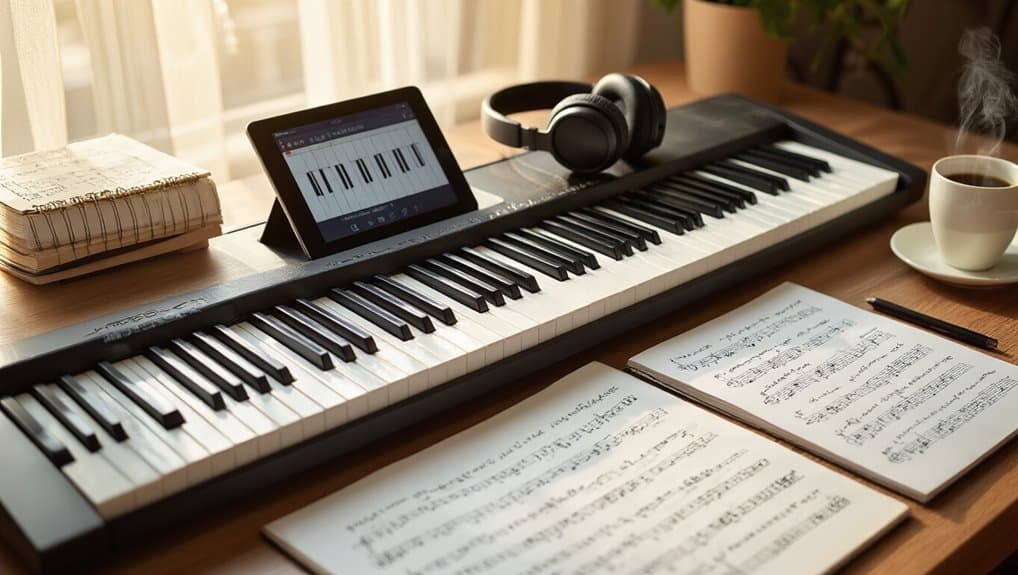
When you’re learning piano online, the structure of your practice sessions determines whether you’ll make steady progress or plateau within weeks.
You’ll need to map your daily energy levels to identify peak concentration periods for tackling challenging pieces.
Schedule technical exercises when you’re freshest, typically morning hours, and reserve sight-reading for moderate energy windows.
Apply habit stacking by linking piano practice to existing routines. If you drink coffee at 7 AM, immediately transition to scales afterward. This neural coupling strengthens your commitment without relying on willpower alone.
Structure each session with intentional blocks: five minutes for warm-ups, twenty for new material, ten for problem sections, and five for repertoire review. Track your practice in 25-minute focused intervals with 5-minute breaks. Document specific goals for each session—don’t just “practice Mozart” but “master measures 16-24 at 80% tempo.” This precision transforms random playing into systematic skill development.
Leveraging Technology: Apps, Software, and Digital Tools for Progress
Why settle for traditional practice methods when digital tools can accelerate your piano learning exponentially? You’ll transform your practice sessions by integrating specialized applications that provide real-time feedback on timing, dynamics, and accuracy.
Modern piano learning apps analyze your playing instantly, highlighting mistakes you might otherwise miss.
MIDI analytics software becomes your personal practice assistant, tracking every keystroke’s velocity, duration, and timing precision. You’ll identify problematic passages through data visualization, revealing patterns in your technical weaknesses.
These tools generate detailed progress reports, showing exactly where you’re improving and what needs attention.
Wearable sensors attached to your wrists monitor hand position and tension, preventing injury while optimizing technique. They’ll alert you when you’re developing poor habits before they become ingrained.
Combined with metronome apps featuring programmable tempo changes and recording software for self-assessment, you’re building a comprehensive digital practice ecosystem that accelerates mastery beyond traditional methods alone.
Mastering Different Musical Styles and Genres Online
You’ll expand your musical versatility by studying classical piano techniques through online masterclasses that teach proper finger positioning, pedaling, and phrasing for pieces ranging from Bach inventions to Chopin études.
Your jazz improvisation skills will develop as you practice chord voicings, scale patterns, and rhythmic comping exercises using specialized software that provides real-time feedback on your harmonic choices.
You can master pop music arrangements by accessing digital sheet music libraries and video tutorials that break down contemporary chord progressions, syncopated rhythms, and vocal accompaniment patterns.
Classical Piano Techniques
As you transition from basic piano skills to classical repertoire, you’re entering a world where technical precision meets artistic expression through centuries-old performance traditions.
You’ll need to master specific fingering patterns, pedaling techniques, and dynamic control that define classical performance standards.
Focus on developing proper hand position and weight distribution for scales and arpeggios.
Practice ornament execution systematically—start with simple trills before progressing to mordents and turns.
You’ll find that historical interpretation requires understanding each period’s stylistic conventions.
Baroque music demands crisp articulation, while Romantic pieces need fluid legato and rubato.
Study recordings of master pianists, but develop your own informed interpretations.
Practice slowly with a metronome, gradually increasing tempo while maintaining accuracy.
Classical technique isn’t just mechanical precision—it’s the foundation for expressing profound musical ideas.
Jazz Improvisation Skills
While classical technique builds your foundation, jazz improvisation opens doors to spontaneous musical creation through chord progressions, scales, and rhythmic patterns.
You’ll start by mastering seventh chords and their inversions, then progress to ii-V-I progressions that form jazz’s harmonic backbone.
Practice modal scales alongside blues scales to expand your melodic vocabulary.
Learn Trading Fours by exchanging four-bar phrases with backing tracks, developing your ability to respond musically in real-time. This Call Response approach trains your ear while building improvisational confidence. You’ll discover how rhythm drives jazz forward through syncopation and swing feel.
Focus on transcribing solos from jazz masters, analyzing their note choices over specific chord changes.
Apply these concepts immediately through online jam sessions, where you’ll test your skills against various tempos and keys.
Pop Music Arrangements
Pop music arrangements require a different skill set than jazz improvisation, focusing on recreating recognizable sounds and textures that define contemporary hits.
You’ll need to master chord voicings that replicate synthesizer pads, understand how to translate electronic beats into pianistic patterns, and develop techniques for layering multiple instrumental parts into two hands.
Hook Reconstruction becomes your primary tool when adapting chart-toppers.
You’re essentially reverse-engineering the catchiest melodic fragments while maintaining their commercial appeal through strategic octave placement and rhythmic precision.
Bridge Reworking challenges you to reimagine transitional sections that typically feature production-heavy elements, transforming them into compelling solo piano passages.
Practice coordinating left-hand bass patterns with syncopated right-hand melodies.
You’ll discover that successful pop arrangements balance faithful reproduction with creative interpretation, making songs both recognizable and uniquely yours.
Overcoming Common Challenges and Plateaus in Self-Directed Learning
When you’re learning piano independently, you’ll inevitably encounter periods where progress seems to stall or technical difficulties feel insurmountable.
These plateaus aren’t failures—they’re natural phases in skill acquisition that require strategic approaches to overcome.
First, recognize imposter syndrome when it emerges.
You’ll doubt your abilities, comparing yourself unfavorably to others.
Counter this by documenting your progress through recordings and maintaining a practice journal.
Concrete evidence of improvement dismantles self-doubt effectively.
Adopt a growth mindset by reframing challenges as opportunities.
When you can’t master a passage, break it into smaller segments.
Practice hands separately, slow the tempo, and isolate problematic measures.
Technical plateaus often indicate you’re attempting repertoire beyond your current level—scale back temporarily to solidify fundamentals.
Schedule regular technique reviews every two weeks.
Film yourself playing to identify tension points and inefficient movements.
Most importantly, vary your practice routine to prevent mental fatigue and maintain engagement with your musical development.
Tracking Your Progress and Setting Achievable Milestones
Because consistent progress measurement transforms abstract improvement into tangible achievement, you’ll need systematic tracking methods that capture both technical advancement and musical development.
Record yourself playing benchmark tests monthly—scales, sight-reading exercises, and repertoire pieces at varying difficulty levels.
These recordings provide objective evidence of your improving tempo, accuracy, and expression.
Set motivation milestones that balance challenge with attainability. You’ll maintain momentum by establishing weekly technique goals, monthly piece completions, and quarterly performance targets. Document practice duration, new concepts mastered, and passages conquered in a digital log or app.
Create measurable objectives: “Play C major scale at 120 BPM” instead of “improve scales.” Track sight-reading accuracy percentages, memorization speed, and dynamic control development. Review your recordings every quarter to identify recurring technical issues and celebrate victories you might’ve overlooked. This data-driven approach ensures you’re progressing efficiently while maintaining clear direction toward your ultimate pianistic goals.
Transitioning From Intermediate to Advanced Playing Through Online Resources
Mastering the transition from intermediate to advanced piano requires strategic resource selection that addresses the technical gaps preventing virtuosic performance. You’ll need platforms offering masterclasses with concert pianists who demonstrate advanced interpretation techniques and complex fingering patterns.
Strategic resource selection bridges technical gaps between intermediate mastery and virtuosic performance through targeted masterclasses and advanced interpretation techniques.
Focus on specialized courses teaching polyrhythmic coordination, advanced voicing, and sophisticated pedaling techniques that distinguish professional playing.
Performance Psychology becomes crucial at this stage. You’ll find online workshops addressing stage anxiety, mental practice strategies, and concentration techniques essential for executing demanding repertoire.
These resources teach you to maintain composure during technically challenging passages while developing artistic maturity.
Collaborative Projects accelerate your growth through online ensemble opportunities. You’ll join virtual chamber groups, participate in duet recordings, and receive feedback from international musicians.
These platforms connect you with accompanists for concerto work and provide real-time collaboration tools. Advanced sight-reading exercises, score analysis tutorials, and repertoire-specific technique videos complete your transformation into an accomplished pianist.
Frequently Asked Questions
How Much Does Online Piano Learning Typically Cost Compared to Traditional Lessons?
You’ll typically spend $20-50 monthly for online piano lessons versus $30-100 per traditional lesson.
Subscription models offer comprehensive curricula with structured video lessons, practice tools, and progress tracking.
Watch for hidden fees in some platforms—annual commitments, sheet music purchases, or premium features.
You’re getting systematic instruction at roughly 70% less cost than in-person teaching.
Most platforms provide technical exercises, repertoire, and theory modules within their base pricing structure.
Can I Learn Piano Online if I Have No Musical Background Whatsoever?
Yes, you can absolutely start learning piano online without any musical background.
You’ll begin with fundamental keyboard orientation, learning where each key sits and how they relate to written music.
Modern online courses systematically teach note reading from scratch, breaking down complex concepts into digestible steps.
Your lack of experience won’t hinder progress—structured platforms guide complete beginners through proper hand positioning, basic theory, and progressive exercises that build technical foundation methodically.
How Long Does It Take to Become Proficient Through Online Piano Learning?
You’ll typically achieve proficiency in 1-2 years with consistent daily practice of 30-60 minutes.
Your technique progression follows predictable skill milestones: basic hand coordination at 3 months, simple pieces at 6 months, intermediate repertoire by year one, and advanced techniques approaching year two.
You’ll master scales, arpeggios, and sight-reading systematically.
Progress accelerates when you’re practicing with proper fingering, posture, and focused attention on each technical element rather than rushing through material.
Is Online Piano Learning Suitable for Young Children or Seniors?
Yes, you’ll find online piano learning highly suitable for both age groups.
For young children, you’ll need consistent parental engagement to maintain focus and practice routines.
Seniors benefit from self-paced progression and repeat viewing capabilities.
You should make ergonomic adjustments to bench height and screen positioning for optimal comfort.
Select platforms offering age-appropriate repertoire and teaching methods.
Both groups achieve excellent results when you match the program’s technical demands to their physical capabilities.
Can I Get Certified or Receive Official Grades Through Online Piano Programs?
Yes, you can earn official certifications through reputable online programs. You’ll find platforms partnering with examination boards like ABRSM, Trinity College, and RCM to offer Accredited Exams remotely.
You’ll submit video recordings for assessment, receive Digital Diplomas upon passing, and progress through standardized grade levels.
These certifications carry equal weight to traditional in-person examinations. You’ll need proper recording equipment and must follow strict submission guidelines for valid certification.
Conclusion
You’ve now got the roadmap to transform your piano playing through online learning. By selecting the right platform, establishing proper technique, and maintaining consistent practice schedules, you’ll progress systematically from beginner to advanced levels. Remember, mastery isn’t about rushing—it’s about deliberate practice with measurable milestones. Apply these strategies daily, track your improvements, and adjust your approach when facing plateaus. Your dedication combined with these structured methods will unlock your full musical potential.












No Comments