

21 Nov Classic Christmas Songs List You Will Never Get Tired of
You’re drawn to these classics because they’ve mastered the rare alchemy of timeless melody and universal emotion. From Bing Crosby’s wartime “White Christmas” selling 50 million copies to “Silent Night’s” translation into 300 languages, these songs endure through their perfect marriage of accessible melodies and profound meaning. Whether it’s Nat King Cole‘s warmth, Judy Garland’s vulnerability, or the sacred grandeur of “O Holy Night,” each captures something essential about the season that modern compositions can’t replicate.
Table of Contents
Key Takeaways
- “White Christmas” by Bing Crosby remains the best-selling physical single with over 50 million copies sold since 1942.
- Nat King Cole’s “The Christmas Song” achieves approximately 100 million plays annually during the holiday season on streaming platforms.
- “Silent Night” has been translated into over 300 languages, making it the most globally recognized Christmas carol.
- “Let It Snow!” became a Christmas standard despite never mentioning Christmas, offering inclusive winter romance since 1945.
- These classics endure through simple, memorable melodies paired with universal themes of peace, warmth, and togetherness.
White Christmas by Bing Crosby – The Best-Selling Single of All Time
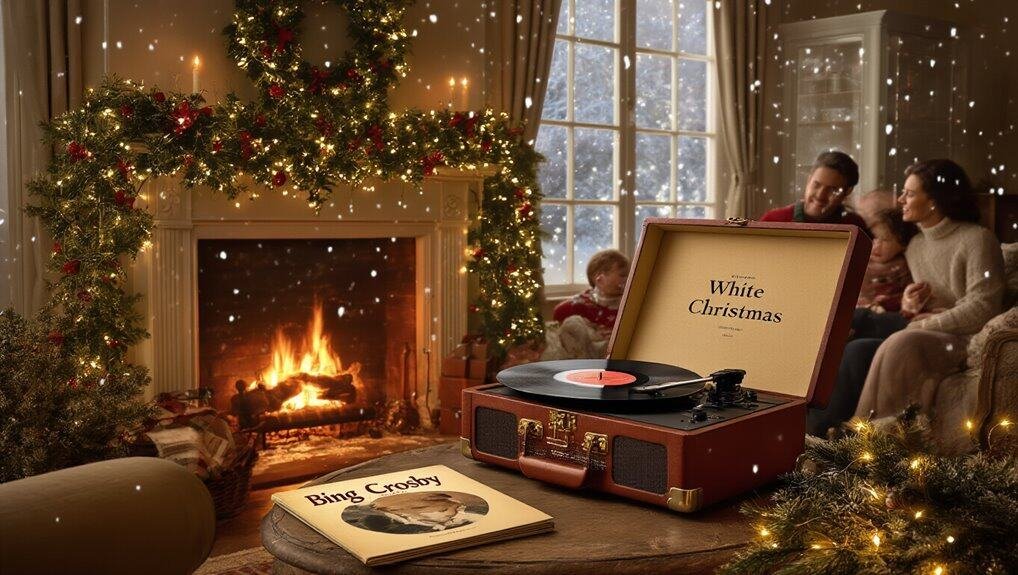
No single recording has defined the sound of Christmas more profoundly than Bing Crosby’s 1942 rendition of “White Christmas.” Written by Irving Berlin and recorded for Decca Records, this three-minute masterpiece didn’t just become a holiday standard—it transformed into the best-selling physical single in music history, with estimated sales exceeding 50 million copies worldwide.
You’ll find Crosby’s baritone delivery stripped of unnecessary ornamentation, allowing Berlin’s melancholic lyrics to resonate with wartime audiences yearning for home. The arrangement’s understated orchestration—featuring subtle strings and choral backing—created a template that’s influenced every Christmas recording since.
Record sales peaked annually throughout the 1940s and ’50s, while radio airplay remains consistent eight decades later. You’re hearing more than nostalgia when this song plays; you’re experiencing a cultural touchstone that captured America’s complex relationship with memory, loss, and celebration during World War II’s darkest days.
The Christmas Song (Chestnuts Roasting on an Open Fire) by Nat King Cole
You’ll recognize “The Christmas Song” from its opening line about chestnuts roasting, penned in 1945 by Bob Tormé and Robert Wells during a sweltering Los Angeles summer as they imagined cooler times.
Nat King Cole’s 1946 recording transformed this wistful composition into America’s gold standard for holiday nostalgia, with his velvet vocals establishing the template that hundreds of artists have since attempted to match.
Today, you can’t escape its influence—the song’s imagery defines the American Christmas aesthetic, from department store displays to film soundtracks, making it the second most-performed holiday standard after “White Christmas.
Origins and History
When Bob Wells and Mel Tormé penned “The Christmas Song” during a sweltering Los Angeles heat wave in July 1945, they couldn’t have predicted they’d create the most-performed holiday standard in ASCAP’s catalog.
You’ll find the carol authorship story fascinating: Wells wrote the lyrics to cool himself mentally, while Tormé crafted the melody in just forty-five minutes. Unlike traditional hymn adaptations, they composed entirely original music without folk influences—a rarity in Christmas repertoire.
The melody evolution occurred through Nat King Cole’s interpretations. You’re hearing his third recording from 1961 when it plays today, not his original 1946 version.
Cole’s smooth delivery transformed what could’ve been another seasonal novelty into America’s definitive Christmas sound, establishing the template every artist since has followed.
Cultural Impact Today
Cole’s definitive 1961 recording remains the sonic blueprint that shapes how Americans experience Christmas, with streaming numbers reaching 100 million plays annually during the holiday season.
You’ll find this version anchoring holiday playlists across every major platform, its warm orchestration setting the standard for contemporary Christmas music production.
The song’s gentle swing rhythm and Cole’s velvet vocals have transcended their mid-century origins, becoming essential to multicultural traditions that weren’t part of 1940s American life.
You’re hearing its influence in R&B Christmas albums, jazz reinterpretations, and pop covers that dominate December charts.
Its lyrics’ emphasis on universal warmth rather than religious specificity has made it adaptable across diverse communities, establishing Cole’s interpretation as America’s secular Christmas anthem that unites listeners regardless of background.
Silent Night – A 200-Year-Old Treasure That Still Moves Hearts
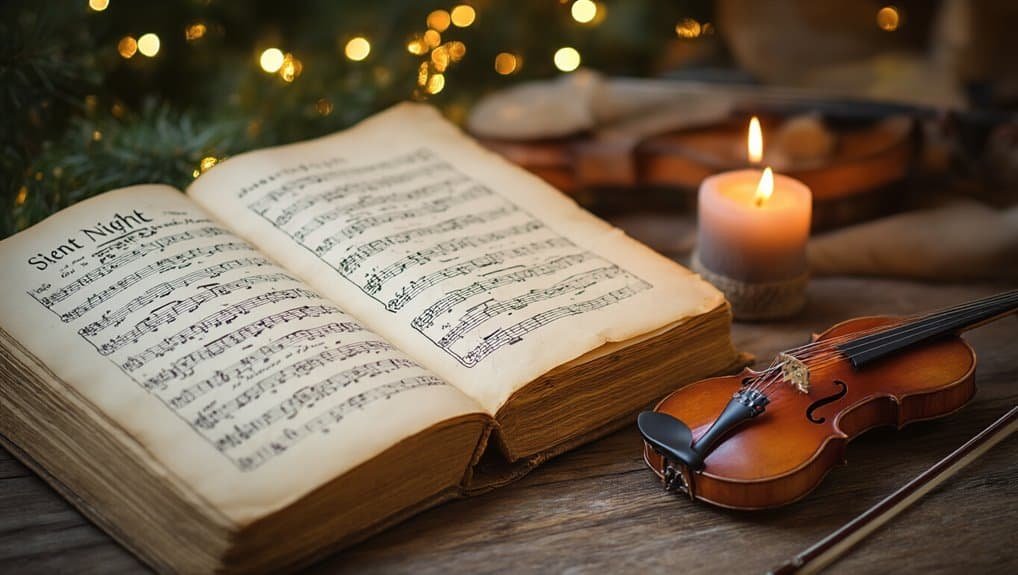
You’ll find “Silent Night” originated in 1818 when Austrian priest Joseph Mohr and composer Franz Gruber created what would become the world’s most translated Christmas carol, now sung in over 300 languages.
The song’s simple melody and message of heavenly peace transformed it into a powerful wartime symbol, most famously during the 1914 Christmas Truce when German and British soldiers sang it together across enemy lines.
Its enduring appeal lies not in complex harmonies but in its ability to transcend cultural boundaries and evoke universal yearning for tranquility during humanity’s darkest moments.
Origins in Austria
Though countless Christmas carols fill the air each December, few possess the profound simplicity and enduring power of “Silent Night,” which emerged from a small Austrian village on Christmas Eve 1818.
You’ll discover its creation story began when Father Joseph Mohr needed music for his poem in Oberndorf. Franz Xaver Gruber, the local schoolteacher and organist, composed the melody in mere hours.
The song’s structure reflects Alpine folkways—its gentle waltz tempo mirrors traditional Austrian folk dances you’d hear in mountain villages. Originally written for guitar accompaniment due to the church’s broken organ, it appeared in early Austrian carolbooks by the 1830s.
You can’t separate its musical DNA from Austria’s cultural landscape: the melody’s simplicity ensures anyone can sing it, embodying the democratic spirit of folk tradition.
Global Translation Legacy
From its humble beginnings in that Austrian village, “Silent Night” has achieved what few songs ever accomplish—translation into more than 300 languages and dialects, making it the most translated Christmas carol in history. You’ll find each version reflects unique cultural adaptation while maintaining the song’s essential message of peace and wonder.
Translators haven’t simply converted words; they’ve preserved emotional resonance across linguistic boundaries. When you hear “Noche de Paz” in Spanish or “Stille Nacht” in German, you’re witnessing linguistic preservation at its finest.
The carol’s simple melody and universal themes of hope enable seamless translation without losing meaning. Each culture’s interpretation adds layers to the song’s global tapestry, proving that authentic emotion transcends language barriers and connects humanity through shared spiritual expression.
Wartime Peace Symbol
Silence itself became a weapon of peace during World War I’s Christmas Truce of 1914, when German and British soldiers spontaneously ceased fire and sang “Silent Night” across no man’s land.
You can’t understand this carol’s power without recognizing how it transformed into humanity’s universal peace symbolism during warfare’s darkest hour.
The wartime truce wasn’t orchestrated—it emerged because soldiers recognized the melody drifting from enemy trenches.
They’d grown up with the same song, despite speaking different languages.
You’re witnessing music’s ability to transcend political boundaries when human connection matters most.
This moment crystallized “Silent Night” as more than a carol.
It’s become protest music, diplomatic bridge, and remembrance hymn.
Whenever you hear those opening notes, you’re participating in a tradition that literally stopped bullets with melody.
O Holy Night – The Carol That Captures Christmas Eve’s Sacred Magic
When you hear those opening notes of “O Holy Night” drift through a candlelit church on Christmas Eve, you’re experiencing a piece of music that almost never existed. French poet Placide Cappeau penned the lyrics in 1843, but the Catholic Church initially banned Adolphe Adam‘s composition for its “lack of musical taste.” The carol’s operatic structure broke conventional hymn patterns, featuring dramatic leaps that challenge even trained vocalists.
You’ll notice how Adam crafted the melody to mirror the text’s spiritual journey—starting hushed and reverent during “O holy night,” then soaring triumphantly at “O night divine.” This dynamic range creates that sacred atmosphere essential to midnight vigil services. The song’s technical demands serve its theology: those challenging high notes on “divine” force singers to literally reach heavenward. It’s this marriage of musical ambition and devotional text that transforms “O Holy Night” from mere carol into transcendent experience.
Have Yourself a Merry Little Christmas by Judy Garland
The sacred grandeur of “O Holy Night” gives way to something more intimate—a carol born from Hollywood’s golden age that carries wartime melancholy beneath its gentle melody. When you hear Judy Garland’s 1944 rendition of “Have Yourself a Merry Little Christmas,” you’re experiencing a defining moment in holiday music history.
Her film performance in “Meet Me in St. Louis” transformed what could’ve been a simple movie number into an enduring masterpiece.
Garland’s emotional depth elevates every phrase, turning Hugh Martin’s bittersweet lyrics into a prayer for better times. You’ll notice how her vocals evolution from child star to mature artist serves this song perfectly—there’s vulnerability in her restraint, hope threading through her melancholy tone.
Originally written with darker lyrics deemed too depressing, the revised version still maintains its wistful core. That’s what makes Garland’s interpretation irreplaceable: she captures both the ache of separation and the promise of reunion.
Silver Bells – The Urban Christmas Classic That Rings Through Decades
Away from the intimate parlors and family gatherings that frame most Christmas carols, “Silver Bells” stakes its claim as the quintessential city Christmas song. You’ll recognize Jay Livingston and Ray Evans‘s 1950 composition as a deliberate departure from rural Christmas imagery, crafting urban nostalgia through sidewalk Santas, bustling shoppers, and metropolitan streetlights.
The bell symbolism operates on multiple levels—you’re hearing literal street corner bells from charity collectors, church towers marking the season, and metaphorical chimes of communal celebration. Bob Hope’s original performance in “The Lemon Drop Kid” launched what became Bing Crosby’s signature recording, establishing the song’s cinematic pedigree.
You’ll notice how the waltz tempo mirrors pedestrian movement through crowded streets, while the simple melodic structure ensures instant memorability. The lyrics’ present-tense urgency (“City sidewalks, busy sidewalks”) creates immediacy that transcends decades, making each performance feel contemporary despite its seventy-year heritage.
Let It Snow! Let It Snow! Let It Snow! – Winter’s Perfect Non-Religious Anthem
You’ll find that “Let It Snow! Let It Snow! Let It Snow!” succeeds where many holiday songs falter—it captures winter’s romance without mentioning Christmas, God, or Santa, making it the season’s most inclusive standard since its 1945 debut.
Sammy Cahn and Jule Styne crafted lyrics that transform a snowstorm into an intimate refuge, using the weather as metaphor for staying close to someone special rather than celebrating any particular holiday.
The song’s genius lies in how it makes you feel festive through pure atmospheric storytelling: the fire’s crackling, the corn’s popping, and the snow’s creating a perfect excuse to avoid goodbye.
Cozy Winter Atmosphere
Throughout the golden age of American popular music, few winter standards have achieved the secular appeal of “Let It Snow!” You’ll find its genius lies in transforming a snowstorm into an invitation for romance. Sammy Cahn and Jule Styne crafted this masterpiece during a Hollywood heatwave in 1945, proving that authentic winter atmosphere doesn’t require firsthand experience.
The song’s cozy imagery—flickering fireplaces casting shadows while lovers huddle under woolen blankets—captures quintessential winter comfort without mentioning Christmas once. You’re transported to a scene where weather becomes irrelevant when warmth exists indoors. This universal appeal explains why you’ll hear it across diverse settings, from department stores to jazz clubs.
The lyrics’ simplicity masks sophisticated songwriting that balances yearning with contentment, making it timelessly relatable.
Timeless Lyrical Charm
Beyond its atmospheric brilliance, the song’s enduring power stems from Cahn’s masterful wordplay and rhythmic repetition that mirrors falling snow itself. You’ll notice how the triple “Let it snow!” creates an incantatory effect, transforming weather observation into pure celebration. The lyrics’ poetic imagery—”the fire is so delightful,” “lights turned way down low”—paints intimate scenes without resorting to holiday clichés.
What’s remarkable is how Cahn avoided religious or seasonal specifics, crafting universal winter romance that transcends December. You’re hearing melodic nostalgia at its finest when lines like “How I’ll hate going out in the storm” pivot to “But if you’ll really hold me tight.” This emotional arc, from reluctance to surrender, captures love’s transformative power. The song’s linguistic economy proves that sometimes the simplest words create the most lasting magic.
Universal Holiday Appeal
Remarkably, “Let It Snow!” achieves something rare in holiday music—it’s become a Christmas staple without mentioning Christmas at all.
You’ll find this 1945 composition by Sammy Cahn and Jule Styne transcends religious boundaries through its celebration of winter’s simple pleasures. The song’s genius lies in what it doesn’t say—there’s no Santa, no nativity, just universal longing for warmth and companionship during cold weather.
You can’t underestimate how this neutrality drives cross cultural celebrations worldwide. Jewish, Muslim, and secular families embrace it alongside Christian households because it captures seasonal joy without doctrinal specificity.
Dean Martin’s definitive 1959 recording solidified its place in the holiday canon, proving you don’t need religious imagery to create lasting December magic. That’s why it remains essential programming from Tokyo to Toronto.
I’ll Be Home for Christmas – The Wartime Ballad That Became Timeless
Longing permeates every note of “I’ll Be Home for Christmas,” the 1943 ballad that captured the ache of separation during World War II. You’ll hear Bing Crosby’s original recording differently once you understand its wartime context—millions of soldiers stationed overseas, families gathered around radio broadcasts, hoping for reunion.
The song’s power lies in its bittersweet twist. You’re promised a homecoming filled with snow, mistletoe, and presents under the tree, only to discover it’s “only in my dreams.” This emotional gut-punch resonated with veterans’ memories long after armistice. Kim Gannon’s lyrics underwent several lyrical revisions before achieving their perfect balance of hope and heartache.
You can’t separate this song from its historical moment, yet it transcends its origins. Every generation finds meaning in its theme of distance and desire. Whether you’re experiencing military deployment, pandemic isolation, or simple geographic separation, you’ll recognize that universal wartime longing for home.
Hark! The Herald Angels Sing – Victorian Elegance Meets Modern Joy
When Charles Wesley penned this hymn in 1739, he couldn’t have imagined how Felix Mendelssohn‘s secular cantata melody would transform his words into the triumphant carol you know today. You’re hearing the perfect marriage of theology and artistry when those Victorian harmonies soar through “Glory to the newborn King!” Mendelssohn’s 1840 composition, originally celebrating Gutenberg’s printing press, found its sacred purpose when William H. Cummings paired it with Wesley’s text in 1855.
You’ll notice how the ascending melodic lines mirror the angels’ heavenly proclamation, while the rhythmic urgency drives home the announcement’s importance. Modern festive reinterpretations haven’t diminished its power—whether you’re listening to Nat King Cole’s smooth delivery or Pentatonix’s layered vocals, the hymn’s architectural brilliance remains intact. Its four-part harmony structure lets you appreciate both congregational accessibility and sophisticated musical craft, explaining why it’s anchored Christmas services for over 160 years.
The First Noel – Ancient Beauty That Never Grows Old
Tracing “The First Noel” back through centuries reveals a carol whose exact origins remain tantalizingly obscure, though you’ll find its earliest printed versions appearing in England during the 1820s.
The medieval melody you’re hearing predates its documentation by potentially hundreds of years, carrying the distinctive modal characteristics of pre-Renaissance music that set it apart from later compositions.
You’ll notice the carol’s unusual structure—its verses tell the nativity story sequentially while the refrain creates a hypnotic circularity that reinforces its contemplative nature.
The carol origins likely stem from Cornwall or western England, where oral tradition preserved it through generations of shepherds and farmers before Victorian collectors finally transcribed it.
What you’re experiencing when hearing “The First Noel” isn’t mere nostalgia but the power of genuine folk artistry.
Its pentatonic foundation and repetitive phrasing create an almost trance-like quality that modern arrangements can’t diminish, explaining why it’s survived where countless contemporary carols have vanished.
Frequently Asked Questions
Which Classic Christmas Songs Are Best for Children’s Holiday Parties?
You’ll find “Rudolph the Red-Nosed Reindeer” and “Frosty the Snowman” perfect for Santa Singalongs at children’s parties. These post-WWII compositions revolutionized holiday music by prioritizing narrative simplicity over religious themes.
“Jingle Bells” remains essential for Reindeer Games activities, while “Santa Claus Is Coming to Town” effectively manages crowd energy. Gene Autry’s 1949 recording style established the playful vocal approach you’re hearing in today’s children’s holiday entertainment standards.
How Can I Create the Perfect Playlist Mixing These Classics?
You’ll craft the perfect playlist by strategically arranging songs for optimal tempo flow and seamless mood transitions.
Start with mid-tempo classics like “Silver Bells,” then build energy with “Jingle Bell Rock.
Place ballads like “Silent Night” between upbeat numbers to create breathing room.
Consider each song’s historical recording style—Crosby’s warmth contrasts beautifully with Ronstadt’s brightness.
You’re essentially conducting an emotional journey, alternating nostalgic moments with celebratory peaks throughout.
What Modern Artists Have Successfully Covered These Timeless Christmas Songs?
You’ll find modern artists breathing new life into holiday standards through masterful interpretations.
Adele covers showcase her powerhouse vocals on tracks like “Make You Feel My Love” reimagined for winter, while Josh Groban renditions transform “O Holy Night” into contemporary classics.
Michael Bublé’s swing-influenced arrangements revolutionized traditional carols, Pentatonix‘s a cappella versions attract younger audiences, and Kelly Clarkson’s soulful approach proves these timeless melodies transcend generations when artists honor their essence.
Which Classic Christmas Songs Work Best as Background Dinner Music?
You’ll find soft instrumentals like “The Christmas Song” and “White Christmas” create perfect dinner ambiance without overwhelming conversation.
Gentle carols such as “Silent Night” and “O Holy Night” work beautifully when arranged with minimal orchestration.
Perry Como’s “It’s Beginning to Look a Lot Like Christmas” and Bing Crosby’s mellower recordings established the template for dining-appropriate holiday music.
These selections maintain festive spirit while allowing guests to converse comfortably throughout your meal.
Are There Copyright Restrictions When Using These Songs Publicly?
Yes, you’ll face copyright restrictions when playing these classics publicly. You’ll need public performance licenses from PROs like ASCAP or BMI for live venues, while mechanical licensing applies if you’re recording covers.
Songs published before 1929 are public domain, but most beloved standards from the 1940s-60s remain protected. You’re looking at significant fees for commercial use, though many venues already carry blanket licenses that’ll cover your holiday playlist needs.
Conclusion
You’ve discovered why these nine classics endure through decades of December playlists. They’re not just songs—they’re cultural touchstones that merge sacred tradition with secular celebration, wartime longing with peacetime joy. From Crosby’s record-breaking nostalgia to ancient carols that’ve survived centuries, you’re witnessing music history’s most successful seasonal anthology. These compositions don’t merely soundtrack your holidays; they’ve fundamentally shaped how Western culture experiences Christmas, proving that true artistry transcends generational boundaries and technological revolutions.





No Comments