

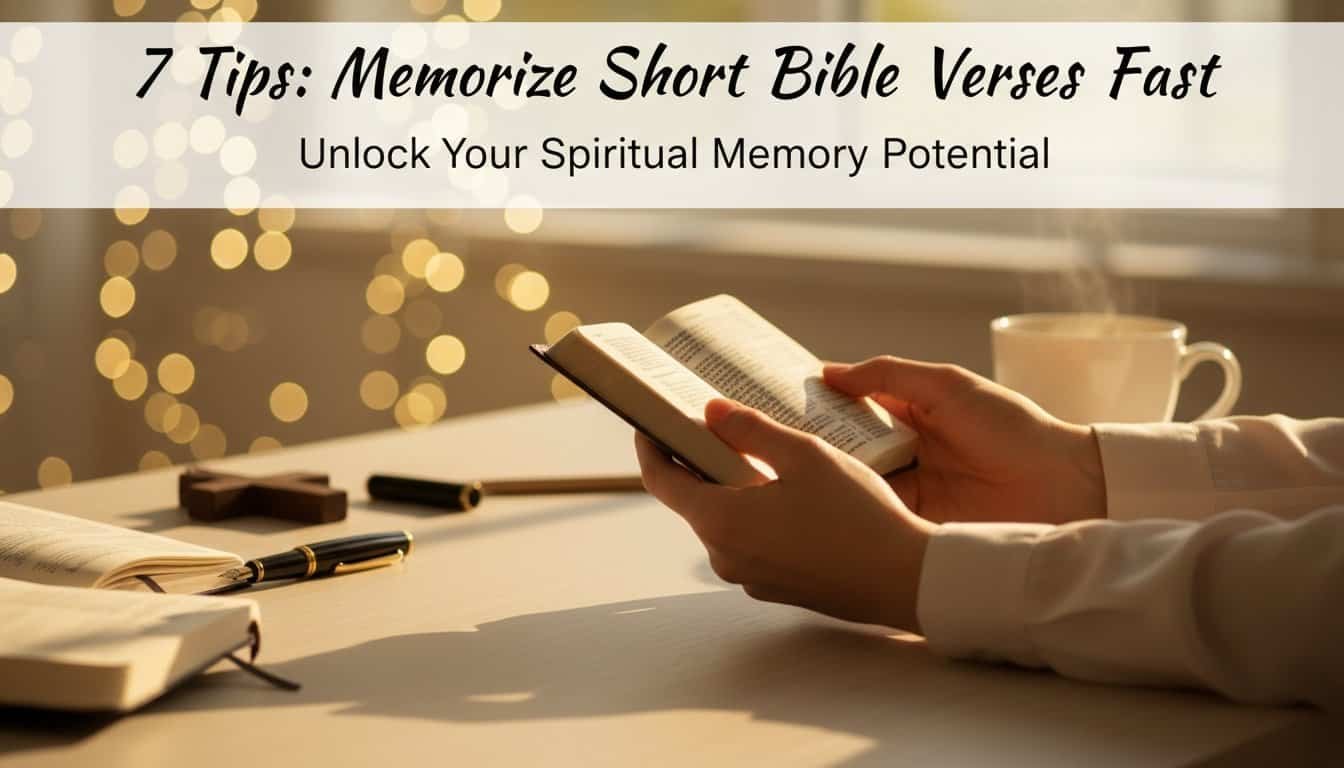
11 Feb 7 Tips: Memorize Short Bible Verses Fast
You can memorize short Bible verses fast by breaking them into keyword chunks and natural phrases, then creating vivid mental images that connect each concept. Write verses by hand to activate multiple brain pathways, and use spaced repetition starting within 12 hours, then after two, four, and seven days. Set up daily 10-15 minute recitation routines, turn verses into songs using familiar melodies, and build memory palaces in familiar locations. These techniques will unlock deeper Scripture retention strategies ahead.
Table of Contents
Key Takeaways
- Break verses into natural phrases and identify keyword anchors to serve as mental stepping stones for easier recall.
- Write verses by hand repeatedly to activate multiple neural pathways and engage visual, motor, and speech centers simultaneously.
- Use spaced repetition by reviewing within 12 hours, then after 2 days, 4 days, and 1 week intervals.
- Read the verse aloud 10 times, then recite from memory 10 times in daily 10-15 minute sessions.
- Transform verse words into vivid mental images and place them in familiar locations using memory palace technique.
Break Bible Verses Into Chunks Using Keywords and Phrases

When you encounter a lengthy Bible verse that seems impossible to memorize, breaking it into manageable chunks transforms an overwhelming task into an achievable goal. These chunking strategies work because your brain naturally recalls patterns and associations better than isolated words.
Start by identifying keyword anchors within each verse—these powerful words serve as retrieval cues that help you remember complete passages. Extract the most meaningful terms and use them as mental stepping stones through the verse. Highlight these keywords in your printed Bible or study materials to create visual focus points.
Next, organize the verse into natural phrases that flow logically together. Read each phrase aloud repeatedly, connecting them progressively until you’ve reconstructed the full verse. This phrase-based approach prevents overwhelming your memory while building cumulative recall. Remember that memorizing requires commitment more than skill, so maintain consistent practice with these chunking techniques rather than worrying about natural memorization ability.

Practice reciting these chunks without looking at the text, then layer new chunks while reinforcing previously memorized sections for lasting retention.
Create Mental Images That Connect Bible Verse Concepts
Your brain processes visual information 60,000 times faster than text, making mental imagery your most powerful weapon for scripture memorization.
Transform abstract biblical concepts into concrete, vivid imagery that sticks. When memorizing “The Lord is my shepherd,” picture yourself as a sheep following Jesus through green pastures. For “faith without works is dead,” visualize a withered tree next to a flourishing one bearing fruit.
Build a memory palace by mentally placing each verse segment in familiar locations throughout your home. Walk through your house and assign specific words to objects—your kitchen table holds “daily bread,” while your bedroom door represents “entering His rest.” Highlighting names in yellow and underlining places in orange creates visual roadmaps that enhance your mental imagery system.
Create interactive imagery between consecutive words to form narrative chains. Let theological concepts come alive through creative visualization—an elephant kneeling represents humility, a lion symbolizes courage. These mental pictures eliminate your reliance on written text, enabling confident recitation anywhere. Your visual associations become permanent anchors for God’s Word.

Use Spaced Repetition to Lock Bible Verses in Long-Term Memory
Scientists have proven that your brain follows a predictable forgetting curve, losing up to 80% of newly memorized scripture within just 24 hours unless you strategically combat this natural decay. Spaced repetition creates an ecology of memory that strengthens neural pathways through strategic timing intervals.
Start by reviewing your verse within 12 hours of initial memorization, then again after two days, four days, and one week. This progressive spacing flattens the forgetting curve and embeds God’s Word deeper into your long-term memory.
Integrate quiz sessions where you recite verses without looking at the text. When you make mistakes, immediately correct them and repeat the accurate version multiple times to prevent false encoding.
After establishing your foundation through daily practice for the first week, transition to weekly reviews for months, then monthly maintenance. This proven system transforms temporary memorization into permanent scripture retention that’ll serve your spiritual growth for life.
Write Bible Verses by Hand to Boost Retention Speed
Three powerful neurological processes activate simultaneously when you write Bible verses by hand: your visual cortex processes each letter, your motor cortex creates muscle memory, and your speech centers engage as you internally vocalize God’s Word.
These handwriting benefits dramatically accelerate memorization compared to typing or digital methods. Your Reticular Activating System enhances focus while your motor cortex builds lasting neural pathways through repetitive hand movements. This memory activation creates multiple retrieval routes for each verse.
Writing forces you to slow down, allowing deeper meditation on scripture’s meaning. You’ll naturally filter and process God’s Word rather than mindlessly copying text. Your brain’s frontal attention centers engage more intensely, strengthening recall pathways.
Studies consistently show handwriting outperforms typing for retention. The physical act triggers cognitive processes that embed verses deeper into long-term memory. As you develop muscle memory through consistent practice, your dexterity and memorization speed improve simultaneously, making scripture recall effortless.
Set Up Daily Bible Verse Recitation Routines That Stick
Why do some believers effortlessly recall dozens of Bible verses while others struggle to remember even their favorite passage? The difference lies in establishing consistent daily recitation routines that actually stick.
Start with a simple 10-15 minute daily commitment. Read your target verse aloud ten times while looking at the text, then recite it ten times from memory. This dual approach fixes Scripture in your brain through both visual and auditory reinforcement.
Reading aloud ten times, then reciting from memory ten times creates powerful visual and auditory reinforcement for Scripture retention.
Build progressively by adding one verse daily while reviewing all previous verses. Day one focuses on verse one, day two reviews verse one then adds verse two, and so forth. This creates lasting retention through repeated exposure.
Implement spaced review using index cards rotated through daily, weekly, and monthly cycles. Each card gets reviewed consistently but at increasing intervals.
Establish daily accountability with a memorization partner or small group. Share your goals, check progress weekly, and review verses together. Community support transforms sporadic efforts into lasting habits that honor God’s Word.
Turn Bible Verses Into Songs for Effortless Memorization
You’ll discover that setting Bible verses to simple, repetitive melodies transforms memorization from struggle into joy.
Choose uncomplicated musical patterns that repeat naturally, then commit to singing your chosen verses daily until the words flow effortlessly from your heart.
Test your retention after several weeks by singing without looking—you’ll be amazed how deeply Scripture has taken root through this musical approach.
Choose Simple Melody Patterns
How can you transform challenging Bible verses into unforgettable melodies that stick in your mind for decades? Start with simple melodies that use basic three-chord patterns—the same foundations that’ve made pop songs memorable for generations. Keep your tunes within octave limits of one to 1.5 octaves so they fit most vocal ranges comfortably.
You don’t need fancy equipment or deep musical knowledge. Focus on super simple structures using four-chord patterns with basic grooves. These fundamental approaches create listenable results while maximizing your memorization success.
When you choose uncomplicated melody patterns, you’re freeing your mental energy to concentrate on learning the actual scripture text. This strategic simplicity ensures your Bible verses become as unforgettable as your favorite songs, creating lasting spiritual impact through effortless recall.
Repeat Musical Phrases Daily
When you repeat musical phrases daily, you’re tapping into your brain’s natural cataloging system that uses timing, rhythms, and melody as powerful memory pegs for God’s Word. This breakthrough study approach requires less concentrated effort than traditional memorization methods, making Scripture retention feel effortless.
Singing while driving builds retention as your mouth moves with familiar melodies. Daily exposure transforms verses into long-term recall through consistent musical repetition. You’ll achieve fluid recitation faster than other techniques by incorporating these memory cues into your routine.
Listen multiple times until verses stick, then sing along for weeks. The beauty lies in simplicity—you don’t need musical mastery. Even off-key melodies work effectively. Daily musical phrases turn Scripture meanings, connections, and structure into permanent memory.
Test Retention After Weeks
After weeks of musical memorization, scientific research proves your song-based approach delivers superior long-term retention compared to traditional methods. A 12-week study with kindergarten students demonstrated that verse-to-song memorization significantly outperformed conventional techniques during retention testing.
You’ll want to implement systematic weekly assessments to measure your progress. Test yourself on verses learned three weeks prior without musical cues first, then with the melody if needed. This approach mirrors the research methodology that proved songs’ effectiveness.
Build a Memory Palace System for Multiple Bible Verses
You’ll transform your Bible memorization by creating a memory palace system that anchors God’s Word in familiar spaces you know intimately. Start by selecting a well-known location like your childhood home or current house, then establish a clear path through specific points of interest such as the front door, hallway, and each room. At every station along this path, you’ll place vivid, exaggerated images that represent key words from your target verses, creating powerful mental anchors that make Scripture retrieval effortless and precise.
Familiar Location Path Setup
Where will you house dozens of Bible verses so they’re instantly accessible in your mind? Your childhood home becomes the perfect memory palace foundation. You’ll transform familiar rooms into verse storage locations, with each numbered space holding specific Scripture passages.
Start with your house layout, creating twenty numbered locations from your balcony to conservatory. This real estate becomes your mental walk-through path for loci assignment. Match each verse number to its corresponding location—James 1:12 goes in locus 12, maintaining perfect order.
Your familiar spaces outperform imagined structures because you’ve already got established neural pathways. You’ll naturally navigate these remembered rooms without effort, making verse retrieval instant, sequential arrangement ensures you’ll recall verses in proper order during your mental journey through God’s Word.
Vivid Imagery Station Placement
Now you’ll populate each numbered location with striking mental images that transform abstract verses into unforgettable sensory experiences. Your memory palace becomes powerful through deliberate sensory encoding that engages sight, sound, smell, touch, and movement simultaneously.
Create ridiculous, colorful scenarios that connect meaningfully to your verse content. For Philippians 4:13‘s “I can do all things through Christ,” visualize yourself lifting enormous weights while golden light streams from heaven, accompanied by triumphant music and the scent of victory. Make images emotional and unusual rather than mundane.
Apply the rendering pipeline approach: establish your background scene, place key objects, add vivid colors, incorporate lighting effects, then animate the action. Include temperature, textures, and sounds. These multi-sensory associations create magnetic neural pathways that make Scripture recall automatic and permanent.
Frequently Asked Questions
How Long Does It Typically Take to Memorize a Single Bible Verse?
You’ll typically memorize a single Bible verse in 15-30 minutes of focused practice. Your memorization pace depends on verse length and complexity—shorter verses require less time than lengthy passages. Translation choices significantly impact difficulty; simpler translations like NIV memorize faster than complex ones like ESV. With consistent daily practice, you’ll retain verses permanently. Start with familiar passages, repeat each phrase ten times, then recite the complete verse until it’s solidly embedded in your heart and mind.
What Should I Do if I Keep Forgetting Verses I Memorized Weeks Ago?
When you’re forgetting verses memorized weeks ago, implement regular spaced repetition review sessions using memory drills. Write forgotten verses on index cards and practice them daily using the five-day method. Focus on your struggle areas with targeted practice sessions. Remember Deuteronomy 11:18’s command to fix God’s words in your heart. Don’t get discouraged—consistent review prevents forgetting and strengthens long-term retention of Scripture.
Is It Better to Memorize From One Bible Translation or Multiple Versions?
You’ll memorize more effectively using one primary translation. Stick with your chosen version to build consistent recall and avoid confusing different phrasings. However, use translations comparison during study time to deepen understanding. Multiple versions offer valuable two word discussion ideas and reveal nuances, but they’ll hinder memorization if you’re constantly switching. Choose one faithful translation for memorizing, then explore others for enriched comprehension.
How Many Bible Verses Should a Beginner Try to Memorize per Week?
You should start with one verse per week as your beginner memorization pace. This proven rhythm gives you seven full days to read, practice, and internalize each passage without overwhelming yourself.
How many verses per week you tackle depends on your capacity, but one verse weekly builds consistency while preventing burnout. You’ll memorize approximately fifty-two verses annually, creating a strong foundation for lifelong Scripture memory success.
Can Children Use the Same Memorization Techniques as Adults Effectively?
Children shouldn’t use the same memorization techniques as adults because their brains work differently. While adults rely on analytical methods, children techniques like Total Physical Response with hand motions and facial expressions prove far more effective. You’ll see children absorb verses effortlessly through simple repetition and creative engagement. Their sponge-like minds achieve superior adult efficiency when you use age-appropriate methods that harness their natural learning advantages for Scripture memorization.
Conclusion
You’ve equipped yourself with powerful memorization techniques that’ll transform your Scripture meditation. Don’t just read these tips—implement them consistently. Start with one method that resonates with you, then gradually incorporate others. Remember, you’re not just memorizing words; you’re hiding God’s truth in your heart where it’ll guide, comfort, and strengthen you. Your commitment to Scripture memory is an investment in spiritual growth that’ll yield eternal dividends. Begin today.










No Comments