

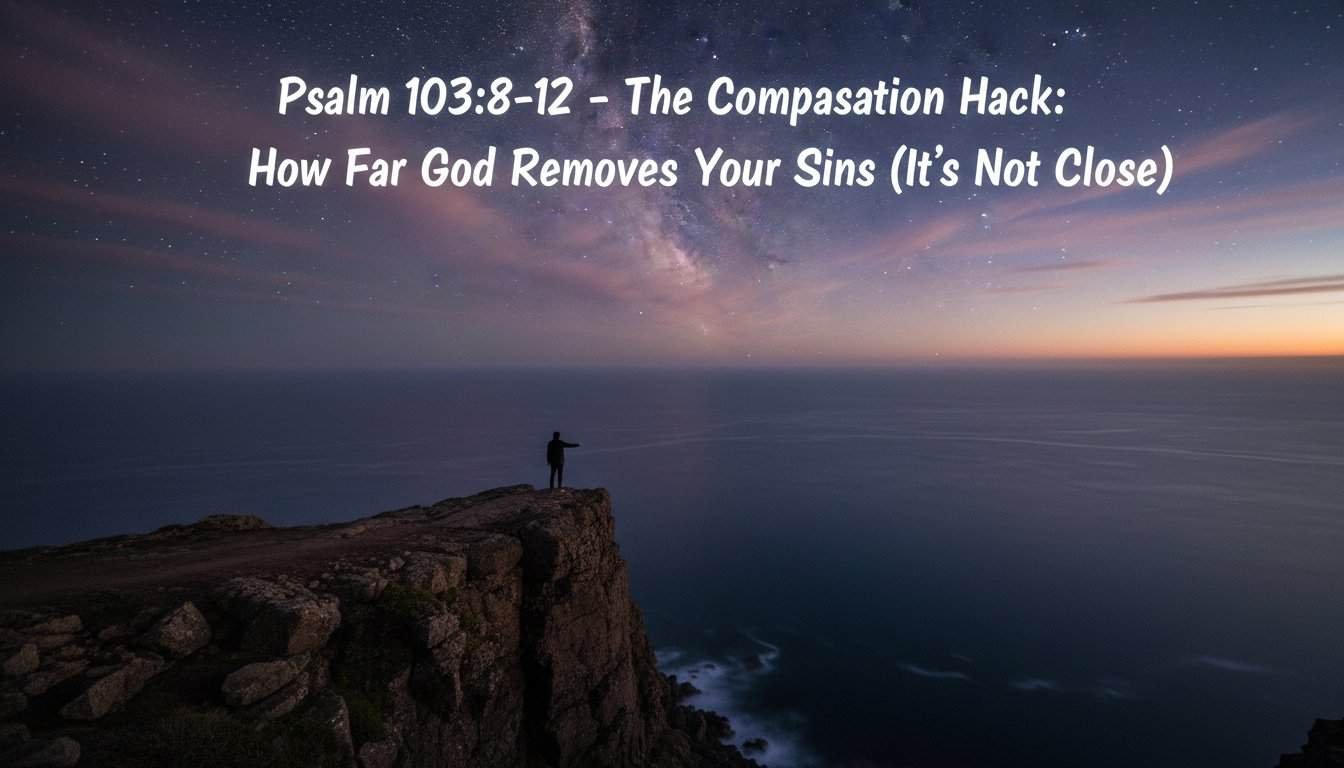
04 Feb Psalm 103:8-12 – The Compassion Hack: How Far God Removes Your Sins (It’s Not Close)
God’s compassion runs deeper than your deepest failure. In Psalm 103:8-12, you discover He’s “slow to anger and abounding in steadfast love,” choosing patience over wrath. When you confess and turn to Him, He doesn’t just cover your sins—He removes them completely, placing them “as far as the east is from the west.” This infinite separation means your failures can never return to condemn you, and exploring these verses further reveals the full scope of His transformative mercy.
Key Takeaways
- God is slow to anger and abounding in steadfast love, showing divine patience rather than quick judgment.
- Divine forgiveness completely erases sin’s condemnation through Christ’s substitutionary atonement, not partial removal.
- “East from west” represents infinite, endless separation—sins are removed beyond any possibility of return.
- Unlike north and south which have endpoints, east and west create permanent, immeasurable distance from believers.
- Mercy extends to all repentant believers regardless of past failures, flowing from God’s compassionate nature.
God’s Merciful Character: Why He’s Slow to Anger

How often do you find yourself losing patience with others, only to marvel at God’s incredible restraint toward humanity’s rebellion? Psalm 103:8 reveals that the Lord is “slow to anger and abounding in steadfast love” – a two word description that captures God’s merciful character perfectly.
Unlike human anger that flares up quickly, God’s wrath operates differently. His anger isn’t capricious or emotional but serves as a just response to evil and oppression. When you study Scripture’s discussion topics about divine patience, you’ll discover God provides countless opportunities for repentance before expressing judgment.
Remember the golden calf incident at Mount Sinai? God could’ve destroyed Israel instantly, yet He showed remarkable restraint. His slowness to anger demonstrates divine power through self-control, not weakness. This patience stems from His compassionate nature and loyal love, creating space for your redemption rather than rushing toward condemnation. The Hebrew term literally means slow nostril, emphasizing how anger is viewed in facial expression and God’s deliberate restraint of His wrath.
What It Means When God Forgives Our Sins
What does it actually mean when God forgives your sins? It’s far more profound than you might imagine. When God forgives, He completely lifts the sentence of condemnation hanging over you. Through substitutionary atonement, Christ took your guilt and suffered the punishment you deserved, satisfying divine justice perfectly.
This isn’t partial forgiveness—God erases the entire record. The biblical word for forgiveness literally means “send away,” and that’s exactly what happens. Your sins are removed so completely that God refuses to remember them anymore. There’s no divine list of your wrongs tucked away somewhere.
However, this forgiveness comes through confession faith requirement. You must confess your sins and trust Jesus as your Savior. When you do, God becomes faithful and just to forgive and cleanse all unrighteousness. Your slate isn’t just wiped clean—it’s destroyed entirely, covering past, present, and future sins without limit. This forgiveness should inspire rejoicing and praise as believers respond with grateful acknowledgment of God’s mercy and grace.
The Complete Removal: East From West Explained
When David penned “as far as the east is from the west,” he chose the most profound metaphor available to describe God’s complete removal of your sins.
Unlike north and south, which meet at the poles, east and west represent infinite distance on our globe.
Unlike the finite boundaries of north and south, east and west stretch endlessly across our world, never converging.
You can travel east forever and never reach west—emphasizing the endless separation God creates between you and your transgressions.
This east west removal means your sins aren’t just forgiven; they’re placed at an unreachable point beyond recall.
The Hebrew phrasing translates to “as far as sunrise from sunset,” highlighting this vast separation that’s beyond human calculation.
God’s compassion ensures your sins are gone forever, never to return or haunt you.
This infinite distance parallels the immeasurable height of heavens mentioned in the previous verse, demonstrating that His mercy operates on a scale incomprehensible to our finite minds.
Who Receives God’s Mercy And Compassion?
God’s infinite removal of your sins naturally raises the question of who receives such extraordinary mercy and compassion. The beautiful truth is that you’re among the mercy recipients, regardless of your past failures or current struggles.
Scripture reveals several two word ideas about who qualifies for God’s compassion. As undeserving recipients, you don’t earn this mercy through good works—it flows from God’s inherent nature (Exodus 34:6-7). If you’re a repentant sinner who confesses and turns from wrongdoing, you’ll find God prefers showing mercy over judgment (James 3:2). Even when you stumble, His patience remains steadfast.
God’s mercy extends to covenant people throughout generations, as demonstrated with Israel after the golden calf incident. Most remarkably, His compassion reaches all humanity because He “desires salvation for every person.” You’re not disqualified by your unworthiness—you’re precisely the kind of person God delights to show mercy.
Frequently Asked Questions
Does God’s Slowness to Anger Mean He Never Gets Angry at Sin?
No, God’s slowness to anger doesn’t mean He never gets angry at sin. His patience reflects divine mercy limits—He restrains His wrath to allow forgiveness timelines for repentance. Psalm 7:11 reveals God “feels indignation every day” toward evil. His delayed judgment demonstrates mercy, not indifference. You’re experiencing His gracious restraint right now, giving you opportunity to turn from sin and receive His compassionate forgiveness through Christ.
Can Someone Lose God’s Forgiveness After Receiving It?
No, you can’t lose God’s forgiveness once you’ve received it. The forgiveness permanence flows from Christ’s complete payment for all your sins at the cross. As Psalm 103:12 declares, He removes your transgressions “as far as the east is from the west.” This means God has no sin remembrance against you—your slate is permanently clean through Jesus’s finished work.
How Do We Know Our Specific Sins Are Actually Forgiven by God?
You’ll find forgiveness assurance through God’s faithful promises in Scripture. When you confess your sins with genuine repentance, 1 John 1:9 guarantees He’s “faithful and just to forgive” and cleanse you completely. Your faith in Christ’s blood demonstrates His righteousness covers every specific transgression. Sin restoration isn’t based on feelings but God’s unchanging Word. Trust His declaration over doubt—He’s already separated your sins infinitely far from you.
What’s the Difference Between God’s Mercy and His Grace in Practice?
God’s mercy stops you from receiving hell’s punishment you deserve, while His grace gives you heaven’s blessings you don’t earn. When understanding mercy vs. grace in divine forgiveness, think of it this way: mercy cancels your debt of sin, but grace deposits unmerited favor into your account. You’re not just rescued from judgment—you’re lavishly blessed beyond what you could ever deserve through Christ.
Why Does the Psalm Emphasize “Those Who Fear Him” Receiving Mercy?
The psalm emphasizes “those who fear Him” because fear equals mercy in God’s covenant design. You can’t separate mercy vs forgiveness from reverent relationship with Him. God’s limitless compassion isn’t universally distributed—it flows specifically to those who respect His authority and keep His commands. When you fear God properly, you’re positioned to receive His everlasting mercy that extends from generation to generation through covenant faithfulness.
Conclusion
You’ve discovered the breathtaking truth of Psalm 103:8-12—God’s mercy isn’t measured in inches but in infinite distances. When you confess your sins, He doesn’t just cover them; He removes them as far as east is from west. That’s immeasurable grace! Don’t let guilt whisper lies about your past. God’s compassion is new every morning, and His forgiveness is complete. You’re not defined by your failures but by His faithful love.











No Comments