


03 Feb Why Goliath’s Real Height Will Shock You More Than Expected
You’ve probably imagined Goliath as a supernatural ten-foot giant, but the Dead Sea Scrolls and Septuagint manuscripts suggest he stood closer to six feet six inches—still towering over ancient Hebrews who averaged five feet four inches. While the Masoretic Text records “six cubits and a span” (about nine and a half feet), earlier textual evidence supports the shorter measurement of “four cubits and a span.” This reveals how manuscript traditions evolved over centuries, transforming an already formidable warrior into an increasingly mythical figure.
Table of Contents
Key Takeaways
- Ancient manuscripts disagree dramatically, with some showing Goliath at only six feet tall versus nine feet six inches.
- The Dead Sea Scrolls and earliest Greek translations support a much shorter Goliath than most Bibles claim.
- At six feet nine inches, Goliath would still tower over ancient Hebrews who averaged five feet four inches.
- Modern translations follow different manuscript traditions, creating a three-foot height difference between Bible versions.
- Goliath’s 200-pound bronze armor was more intimidating than his height, making him a walking fortress.
How Ancient Manuscripts Show Different Heights for Goliath
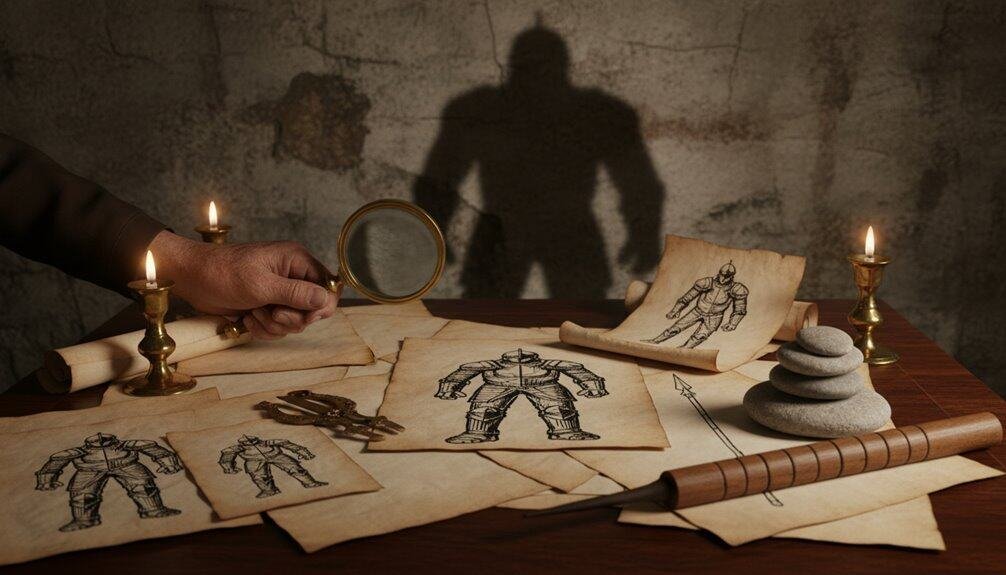
When you examine the ancient manuscripts containing the account of David and Goliath, you’ll discover a surprising discrepancy that has puzzled biblical scholars for centuries. The Masoretic Text records Goliath’s height as “six cubits and a span,” while the Septuagint manuscripts report “four cubits and a span.” This two-foot difference creates substantial scholarly discussion.
The Dead Sea Scrolls support the shorter measurement, as does Josephus’s Antiquities. However, the Vulgate, Peshitta, and Targum translations align with the taller reading. You’ll find that most English Bible translations follow the Masoretic Text’s six-cubit measurement, though the ESV includes a footnote acknowledging this variance.
These textual variants represent more than simple copying errors—they reflect different manuscript traditions preserved across centuries. The discussion ideas surrounding these discrepancies continue to influence modern biblical scholarship and translation decisions. Scholarly calculations using different cubit measurements range from approximately 6’9″ to 10’9″ depending on which ancient measurement standards are applied.

Why the Dead Sea Scrolls Suggest a Shorter Giant
How significantly might the Dead Sea Scrolls alter our understanding of Goliath’s actual size? You’ll find that fragment 4QSam-b records Goliath’s height as four cubits and a span—approximately six feet—rather than the Masoretic Text’s nine feet six inches. This isn’t subtopic irrelevance; it’s a fundamental challenge to traditional interpretations.
These scrolls predate the Masoretic Text by centuries, suggesting they preserve an earlier tradition. The shorter measurement aligns with the Septuagint’s Greek translation, creating compelling evidence for accuracy. While six feet still positioned Goliath as formidable compared to ancient Hebrew males averaging five feet six inches, it questions supernatural giant interpretations.
Scholarly two word discussion ideas center on manuscript reliability versus later exaggeration. The NET Bible adopts this shorter height, estimating close to seven feet. Goliath’s Nephilim ancestry through the Anakites may explain his imposing stature even at the reduced height measurements. You’re witnessing how archaeology reshapes biblical understanding, proving that older doesn’t always mean bigger.
Historical Evidence That Supports Goliath at 6’6
Multiple ancient sources converge on a remarkably consistent measurement that places Goliath’s height at approximately six feet nine inches rather than the towering nine-plus feet commonly depicted. The Septuagint, Dead Sea Scrolls, and first-century historian Josephus all record “four cubits and a span,” supporting this shorter stature. This isn’t speculation only—it’s based on substantial manuscript evidence that predates the Masoretic Text tradition.
You’ll find this measurement particularly compelling when considering ancient average heights. Men typically stood between five feet three inches and five feet five inches, making Goliath’s six-foot-nine frame tower more than a foot above contemporaries. Even Saul, described as exceptionally tall at six to six-and-a-half feet, would’ve appeared shorter than this Philistine champion.

Textual criticism analysis reveals that the best manuscript evidence favors this measurement, making discussions of an unrelated topic unnecessary when such consistent historical documentation exists.
Goliath’s Massive Armor and Weapons Arsenal
Beyond Goliath’s imposing physical stature, his military equipment transformed him into an ancient equivalent of a walking fortress. You’re looking at approximately 160-200 pounds of bronze weaponry that would’ve made any opponent reconsider their discussion ideas about engaging this Philistine champion.
Goliath’s 160-200 pounds of bronze weaponry created a walking fortress that made enemies think twice before engaging.
His scale armor coat alone weighed 125-150 pounds, constructed from overlapping bronze scales that shimmered intimidatingly while deflecting arrows and sword strikes. The bronze helmet, greaves, and javelin added another 20+ pounds, showcasing advanced Philistine metallurgy that surpassed typical infantry equipment.
Most striking was his spear—its iron head weighed fifteen pounds with a shaft thick as a weaver’s beam. This two word description, “weaver’s beam,” emphasizes the weapon’s massive dimensions. Archaeological findings at Kfar Monash support such equipment existed.
A shield bearer preceded Goliath, completing this mobile armory. This wasn’t standard soldier gear—it was champion-level equipment designed for psychological warfare as much as physical protection.
Frequently Asked Questions
Was Goliath’s Height Exaggerated Over Time by Ancient Scribes?
You’ll find compelling evidence that Goliath’s height was exaggerated over time by ancient scribes. Earlier sources like the Septuagint and Dead Sea Scrolls record four cubits and a span (6’9″), while later Masoretic texts claim six cubits (9’9″).
Scholars suggest scribal values influenced transmission, as modern vs ancient stature differences made the shorter height still formidable.
Greater battlefield mobility at 6’9″ actually makes more tactical sense than the towering version.
How Does Goliath’s Height Compare to Modern NBA Players?
You’ll find Goliath height myths crumble when compared to modern NBA players. If you accept the Septuagint’s 6’9″ reading, he’d match today’s average center height rather than tower over ancient stadiums as traditionally imagined.
However, the Masoretic Text’s 9’9″ estimate would make him surpass even the NBA’s tallest players by over two feet, creating an unprecedented giant that exceeds all recorded human heights.
Could Someone Goliath’s Size Actually Move Effectively in Battle?
You’d find that giant physiology severely limited Goliath’s battlefield mobility.
Carrying 125-150 pounds of bronze armor while standing 6’6″ to 9’9″ tall would’ve restricted his speed and agility significantly.
The 30-pound helmet alone affected balance, while the massive spear hindered quick reactions.
Ancient battlefield tactics favored agility over brute strength, making Goliath’s imposing size both his greatest asset and vulnerability against nimbler opponents.
What Medical Conditions Might Explain Goliath’s Exceptional Height?
You’ll find gigantism and acromegaly overview reveals two primary medical explanations for Goliath’s exceptional stature. If you examine the atherophysiology and dwarfism examination literature, gigantism from pituitary tumors before puberty produces heights exceeding seven feet, while acromegaly after puberty enlarges bones and soft tissues. Both conditions stem from growth hormone excess, creating the disproportionate strength and imposing physical presence that biblical accounts describe.
Did Other Ancient Cultures Have Similarly Tall Warriors?
You’ll find ancient warrior tallness across multiple cultures, though cultural height myths often exaggerated reality. Rome’s Emperor Maximinus reached over eight feet, while Mesoamerica’s Tlahuicole wielded weapons others couldn’t lift. Viking Thorkell the Tall earned his epithet despite likely being under six feet. These warriors’ exceptional stature provided military advantages, but archaeological evidence suggests many “giant” descriptions were symbolic rather than literal measurements.
Conclusion
You’ll find that manuscript evidence consistently points toward a more modest stature for Goliath than popular imagination suggests. When you examine the Dead Sea Scrolls alongside the Septuagint, you’re looking at approximately 6’6” rather than the traditional 9’9″. You can’t ignore the archaeological context either—his bronze armor and iron spearhead, while impressive, align with equipment designed for a large but human-proportioned warrior, not a mythological giant.












No Comments