

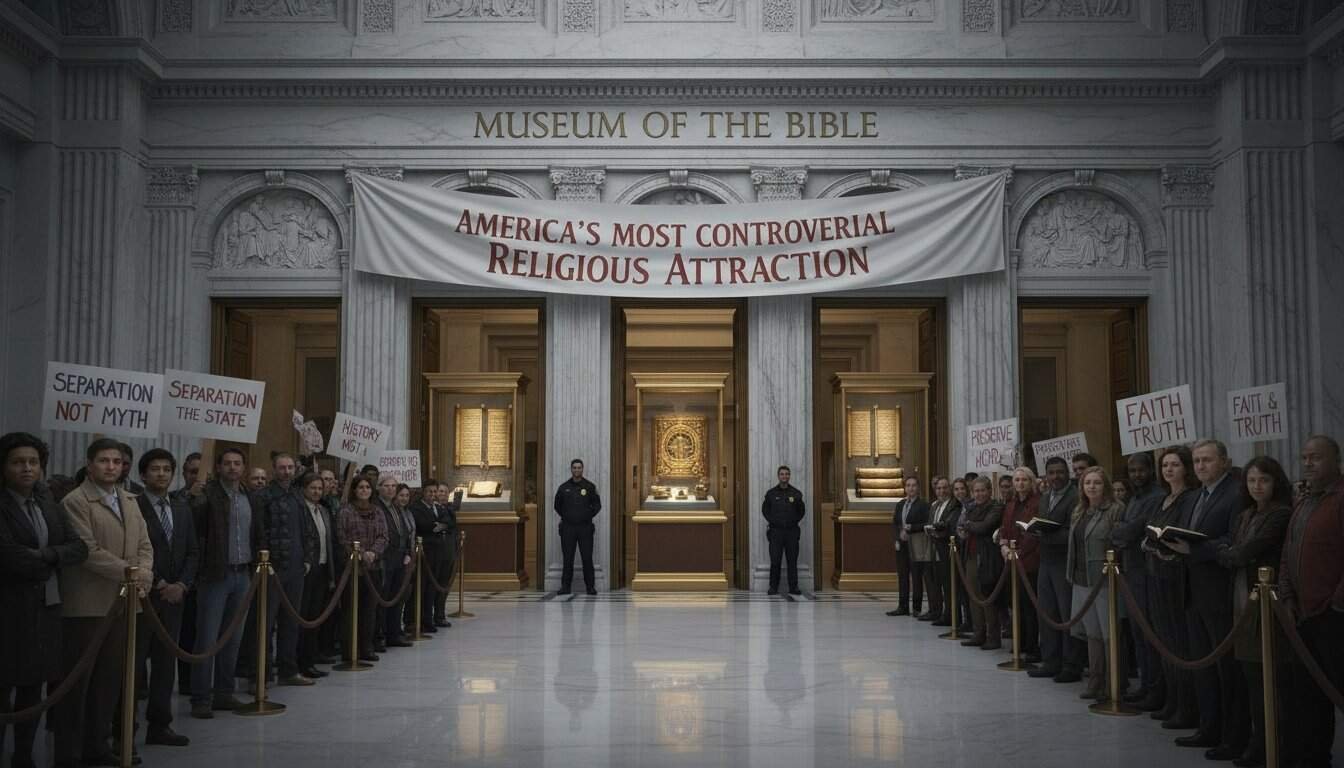
03 Feb Why Dc’s Bible Museum Is America’s Most Controversial Religious Attraction
You’ll find that Washington D.C.’s Museum of the Bible has become America’s most controversial religious attraction due to systematic cultural heritage crimes. The institution paid $3 million in federal fines for smuggling over 5,500 cuneiform tablets from Iraq, disguised as “ceramic tiles” from Turkey. All sixteen displayed Dead Sea Scroll fragments were revealed as sophisticated forgeries, while investigations uncovered stolen manuscripts traced to monasteries and universities worldwide. These scandals illuminate deeper institutional credibility issues worth examining.
Table of Contents
Key Takeaways
- The museum’s founders paid $3 million in federal settlements after smuggling over 5,500 cuneiform tablets from Iraq.
- All 16 displayed Dead Sea Scroll fragments were exposed as sophisticated forgeries through forensic analysis in 2020.
- Over 12,000 artifacts were repatriated to Iraq, revealing the massive scale of questionable acquisitions and cultural property theft.
- Multiple stolen manuscripts were discovered in the collection, including items looted from Greek and Bulgarian monasteries.
- Academic publishers retracted scholarly volumes due to widespread forgeries, damaging the institution’s credibility among researchers.
The $3 Million Smuggling Fine That Started Everything
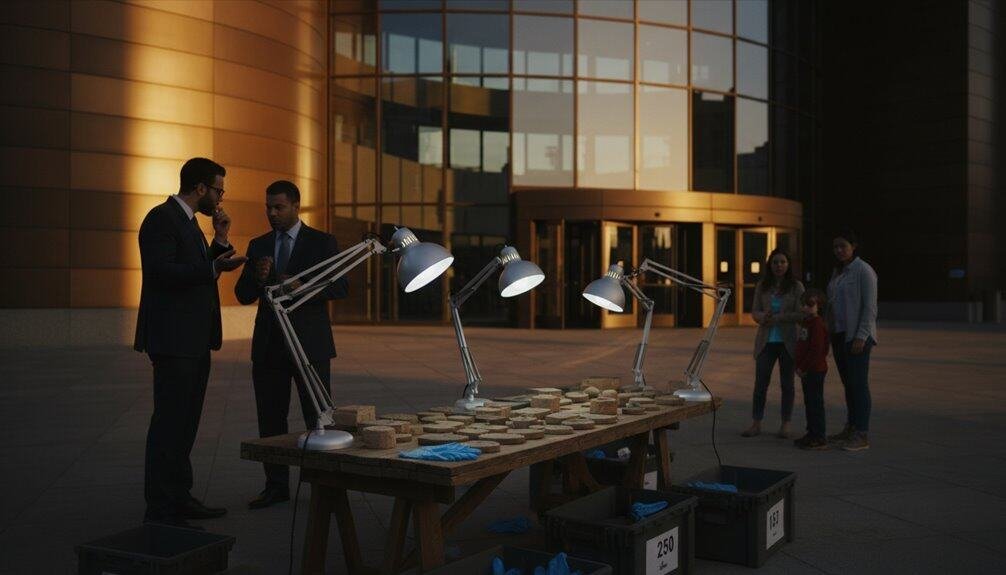
How does a retail craft store chain become entangled in international artifact smuggling that ultimately sparks one of America’s most heated museum controversies? You’ll find the answer in Hobby Lobby’s July 2017 settlement with federal prosecutors, which exposed systematic provenance concerns surrounding ancient Iraqi artifacts.
The company paid $3 million and forfeited over 5,500 smuggled cuneiform tablets despite receiving explicit warnings from cultural property expert Patty Gerstenblith about the risks of acquiring Iraqi items. You can see the deliberate framing corruption in their methods: artifacts shipped through Israel and UAE, packages deceptively labeled as “ceramic tiles” from Turkey, and payments wired to seven different accounts rather than the primary dealer.
These weren’t accidental oversights but calculated decisions to circumvent cultural property laws. The settlement’s civil nature avoided criminal charges, yet revealed acquisition practices that experts had criticized since 2009, setting the stage for ongoing controversies. By 2021, the 12,000 items returned to Iraq highlighted the massive scale of the repatriation effort that followed.

Why Every Dead Sea Scroll Fragment Turned Out Fake?
The Hobby Lobby smuggling scandal represented just the beginning of the Museum of the Bible’s authenticity problems. You’ll discover that all 16 Dead Sea Scroll fragments displayed were sophisticated modern forgeries. Colette Loll’s comprehensive 2020 investigation revealed deliberate manipulation designed to deceive scholars and collectors.
Forensic analysis exposed critical flaws: ink pooled unnaturally in weathered leather cracks, indicating text was written on previously aged material rather than ancient parchment. The fragments exhibited waxy sheens from artificial amber substances, likely animal-skin glue. Most tellingly, forgers used ancient leather—possibly from shoes or sandals—instead of the tanned parchment authentic dead sea scrolls employed.
These forgery patterns extend beyond the museum, affecting the Schøyen Collection and multiple universities. The scandal forced Brill publishers to retract academic volumes and highlighted a broader epidemic plaguing private collections. Advanced chemical analysis now represents the standard for authentication, as visual inspection proves insufficient after two millennia of aging. However, Emanuel Tov questions the certainty of fakes beyond doubt, citing insufficient baseline data for comparison with authentic scrolls.
Museum Of The Bible Forced To Return Stolen Ancient Texts
When authorities began investigating the Museum of the Bible’s collection practices, they uncovered a systematic pattern of stolen artifacts that forced unprecedented repatriations across multiple countries. You’ll find that the provenance controversy extends beyond the Dead Sea Scroll forgeries to encompass thousands of authentic ancient texts with questionable origins.
The museum returned a medieval New Testament manuscript from the 1100s to the University of Athens after discovering its theft from Greek institutions. Similarly, investigators traced a centuries-old Gospel manuscript back to Bulgaria’s Kosinitza Monastery, looted by partisans in 1917. The evidence included distinctive initials “M.K.” penciled on manuscripts, matching other stolen items.

Most significantly, Oxford professor Dirk Obbink had stolen thirteen ancient Bible fragments from Egypt’s archaeological collections, selling them to Hobby Lobby. The theft aftermath culminated in 5,000 Egyptian artifacts being repatriated through U.S. Homeland Security coordination, representing one of America’s largest cultural property returns.
What These Scandals Mean For Museum Credibility Today
Beyond these individual repatriation cases lies a broader question about whether the Museum of the Bible can recover its scholarly reputation and public trust.
The institution’s path to redemption hinges on whether transparency and reformed practices can overcome deep-seated credibility concerns.
You’ll find that the institution’s credibility faces significant challenges despite remediation efforts.
Academic critics question whether evangelical agenda continues to influence ethics and scholarly objectivity, particularly given the museum’s promotion of specific religious viewpoints over critical scholarship.
The museum’s provenance reforms demonstrate transparency through public announcements of forgeries and returns.
These internal investigations post-Hobby Lobby prosecution show commitment to verification protocols that some praise as stronger than national institutions.
However, you can’t ignore how the scandals fundamentally damaged academic credibility.
The Green family’s admission of collecting inexperience while pouring millions into legal and illegal antiquities markets raises ongoing concerns.
Whether stricter acquisition protocols and scholarly transparency can restore institutional trust remains uncertain, as media continues portraying the museum’s turbulent rise amid looted treasures and authenticity controversies.
Frequently Asked Questions
Is the Museum of the Bible Actually Closing Down Permanently?
You’ll find no evidence supporting permanent closure of the Museum of the Bible. Despite ongoing controversies surrounding artifact provenance and ethical collecting practices, the institution continues operating with regular hours through 2025. You can observe their commitment through scheduled exhibitions extending into 2026, including major displays like the Dead Sea Scrolls and Megiddo Mosaic. The museum’s trajectory indicates sustained operations rather than imminent closure.
How Much Did the Green Family Spend on Fake Artifacts?
You can’t determine exactly how much the Green family spent on fake artifacts from available records. While Hobby Lobby paid $3 million in fines for smuggled Iraqi artifacts and authentic Dead Sea Scroll fragments sold for over $1 million each, the specific purchase amounts for the sixteen forged Dead Sea Scroll fragments remain undisclosed. Tax deduction claims for these fake artifacts also aren’t publicly documented.
Does the Museum Promote Evangelical Christianity Despite Claiming to Be Non-Sectarian?
You’ll find the museum does promote evangelical Christianity through evangelical framing despite non-sectarian claims. The all-Protestant board reinforces white evangelical scriptural interpretations while positioning the Green family as biblical authorities in political spheres. Though they’ve included Hebrew Bible sections for scholarly credibility, critics identify clear sectarian messaging that advances fundamentalist theological and political viewpoints through what appears as objective biblical scholarship.
Why Did the Federal Government Allow the Museum to Open?
The federal government couldn’t prevent the museum’s opening because it’s entirely privately funded and operates as a legitimate 501(c)(3) nonprofit. You’ll find that constitutional protections guarantee religious freedom, while the museum met all legal requirements including local zoning approvals and federal architectural reviews.
Despite concerns about misleading acquisitions and funding transparency, no laws prohibited its establishment since it required no congressional authorization or government support.
How Many Total Artifacts Has the Museum Been Forced to Return?
You’ll find the museum has returned approximately 13,000 artifacts due to artifact controversies surrounding questionable acquisitions. The repatriations included roughly 5,000 Egyptian items and 8,000 Iraqi clay objects, all lacking proper exhibit provenance documentation. These returns stemmed from federal investigations that revealed insufficient provenance information and unethical acquisition practices. The museum’s collection faced scrutiny because objects were obtained without reliable documentation proving legal ownership.
Conclusion
You’ve witnessed how the Museum of the Bible’s legitimacy crumbles under scrutiny. You can’t ignore that smuggling fines, forged Dead Sea Scrolls, and stolen artifacts represent systematic failures in acquisition practices. You’re observing an institution that’s compromised its scholarly credibility through repeated ethical violations. You shouldn’t expect public trust to recover easily when foundational collections prove fraudulent. You’re seeing why this museum’s controversies extend beyond individual scandals to institutional integrity questions.








No Comments