

24 Jan Matthew 21 Palm Sunday Scripture: The Story Everyone Knows
You’ve likely read Matthew 21’s Palm Sunday account countless times, yet its unique theological details reveal deliberate narrative choices that expose explosive political tensions. Matthew alone mentions two animals fulfilling Zechariah’s prophecy, emphasizing Jesus’s peaceful kingship versus the crowds’ revolutionary expectations. The “Hosanna to the Son of David” cries reflect messianic hopes for political liberation from Rome, while Jesus’s donkey choice signals servant leadership. This tension explains why celebration turned to crucifixion demands within five days, as different crowd compositions and unmet political expectations created the perfect storm that would define Christianity’s foundational week.
Table of Contents
Key Takeaways
- Matthew uniquely mentions both a donkey and her colt, explicitly citing Zechariah 9:9 to fulfill messianic prophecy.
- Jesus chose a donkey to symbolize peaceful kingship rather than military conquest, redefining messianic expectations through humility.
- Crowds shouted “Hosanna to the Son of David” with palm branches, anticipating immediate political liberation from Rome.
- The shift from Sunday’s praise to Friday’s crucifixion demands involved different crowds and unmet political expectations.
- Matthew’s account emphasizes prophetic fulfillment and Davidic messiahship specifically for his Jewish audience’s understanding.
Matthew 21’s Unique Details Other Gospels Don’t Include
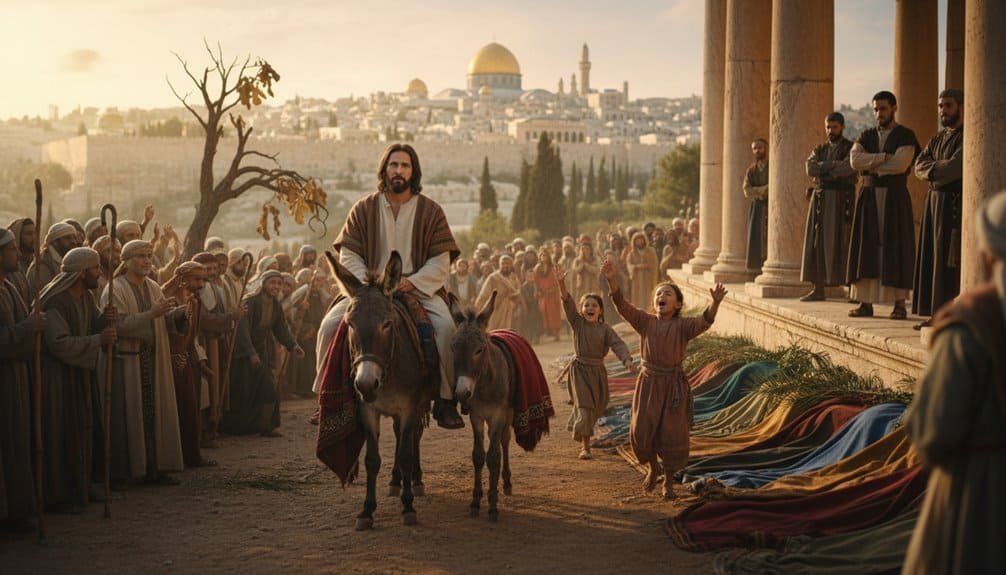
What distinguishes Matthew’s account of Jesus’s triumphal entry from Mark, Luke, and John’s versions reveals the evangelist’s theological priorities and his intended audience. You’ll notice Matthew uniquely mentions two animals—both a donkey and her colt—fulfilling his explicit citation of Zechariah 9:9. This detail contrasts with other Gospel writers who reference only one animal, creating narrative gaps when comparing accounts.
Matthew’s inclusion of “Hosanna to the Son of David” emphasizes Jesus’s Messianic lineage specifically for Jewish readers. You’ll find that reliable sources confirm Matthew alone records the Pharisees’ complaint about the children’s proclamations in the temple. His account also uniquely shows Jesus’s response defending the children’s praise through Psalm 8:2.
Furthermore, Matthew’s geographical precision regarding “the city” being stirred distinguishes his narrative. These distinctive elements aren’t contradictions but reflect Matthew’s particular theological emphasis on Jesus as the promised Davidic Messiah fulfilling Hebrew Scripture.

The Zechariah Prophecy That Explains Jesus’s Donkey Choice
The donkey symbolism carries profound theological weight within Jewish messianic expectations. Unlike horses, which represented military conquest and political power, donkeys symbolized peace, humility, and legitimate kingship. You’re witnessing Jesus’s intentional subversion of popular messianic expectations that anticipated a warrior-messiah arriving triumphantly on horseback.
Matthew’s theological precision demonstrates that Jesus’s entry fulfills ancient prophecy while redefining messianic categories. The donkey choice wasn’t circumstantial—it was prophetically predetermined, signaling a king whose kingdom operates through servant leadership rather than military dominance, fundamentally challenging contemporary assumptions about divine authority.
Why Matthew 21 Shows the Crowds Expected a Political Revolution
How dramatically the crowds’ enthusiastic reception reveals their fundamental misunderstanding of Jesus’s mission becomes evident through their charged political language and revolutionary fervor. Their cry “Hosanna to the Son of David” carries unmistakable messianic overtones rooted in Israel’s royal lineage, while “Blessed is he who comes in the name of the Lord” echoes Psalm 118’s victory song celebrating God’s deliverance.
You’ll notice the crowd expectations weren’t merely spiritual—they anticipated immediate political liberation from Roman occupation. The term “Hosanna” itself means “save now,” reflecting their urgent desire for national restoration. Their palm branches historically symbolized Jewish independence, recalling the Maccabean revolt’s triumphant moments.
The crowds envisioned Jesus establishing David’s earthly throne, overthrowingforeign oppression through political revolution. Yet Jesus rode humbly on a donkey, signaling peace rather than military conquest. This stark contrast between the people’s revolutionary expectations and Christ’s actual mission creates Matthew 21’s central tension.

Why the Same Voices Shouted “Crucify Him” Five Days Later?
Why did Jerusalem‘s cheering multitudes transform into a bloodthirsty mob demanding Christ’s execution within mere days? You’ll discover this wasn’t necessarily the same crowd through careful exegetical analysis.
Matthew 21’s palm-waving supporters likely represented Galilean pilgrims and Jesus’s followers who’d journeyed to Jerusalem for Passover. However, Friday’s crucifixion crowd consisted primarily of Jerusalem’s religious establishment and their sympathizers. Gospel harmonies reveal distinct geographical and social compositions between these groups.
Catholic critique emphasizes how religious leaders deliberately stirred up opposition among Jerusalem’s residents, exploiting their disappointment when Jesus failed to fulfill political messianic expectations. You must understand that ancient Jerusalem housed diverse factions with competing interests.
The crowd dynamics shifted because Jesus’s temple cleansing and prophetic pronouncements threatened established religious authority. When he didn’t overthrow Roman rule as anticipated, popular support evaporated. Friday’s mob reflected orchestrated religious opposition rather than the same enthusiastic pilgrims who’d celebrated his entry.
Frequently Asked Questions
What Did Jesus Do Immediately After Entering Jerusalem on Palm Sunday?
You’ll find Jesus proceeded directly to the temple complex where he expelled merchants and money changers, overturning their tables in righteous indignation. His temple actions demonstrated messianic authority over sacred space, fulfilling prophetic expectations. Rather than calming crowds, he intensified religious tension by challenging established commercial practices within God’s house. This bold confrontation with temple authorities marked his decisive claim to divine authority immediately following his triumphal entry.
How Did the Religious Leaders React When They Witnessed the Triumphal Entry?
You’ll find the religious leaders reacted with increasing alarm and indignation to Jesus’s triumphal entry.
Their established temple politics faced direct challenge as crowds proclaimed Jesus as Messiah.
The leaders’ ambition for maintaining religious authority conflicted sharply with this populist movement.
Matthew doesn’t explicitly record their immediate response during the procession, but you can trace their mounting opposition through subsequent confrontations, revealing their threatened position within Jerusalem’s power structure.
What Happened to the Donkey and Colt After Jesus Finished Riding Them?
You won’t find Scripture addressing the donkey fate or colt’s destiny after Jesus’s entry. Matthew 21 doesn’t record their return to the owners who permitted their use. The narrative’s focus shifts immediately to temple events, leaving these animals’ subsequent circumstances unmentioned. You’re encountering typical biblical economy—authors include necessary details for theological purposes while omitting practical aftermath that doesn’t serve the text’s christological emphasis.
Did Jesus Plan the Palm Sunday Procession or Was It Spontaneous?
You’ll find Jesus clearly planned this procession through careful preparation. He’d predetermined the donkey’s location and arranged recognition signals with the owners (Matthew 21:2-3).
This wasn’t spontaneous—it’s deliberate messianic theater fulfilling Zechariah 9:9. While you can see the audience reception appeared spontaneous with crowds spreading cloaks and branches, Jesus orchestrated the symbolic entry. The preparation vs. spontaneity tension reveals intentional prophetic fulfillment meeting genuine popular enthusiasm.
What Specific Palm Branches Were Used and What Was Their Symbolic Meaning?
You’ll find Matthew doesn’t specify palm varieties, but John’s Gospel mentions “palm branches” (Greek: baion phoinikon).
These were likely date palm fronds, abundant in Jerusalem’s region.
The palm meanings included victory, triumph, and royal honor in ancient Jewish culture.
Branch symbolism represented peace, prosperity, and messianic expectation.
You’re seeing deliberate theological imagery—palms weren’t random vegetation but carried profound symbolic weight recognizing Jesus’s kingship and anticipated deliverance.
Conclusion
You’ve witnessed Matthew’s careful documentation of Christ’s fulfillment of Zechariah’s prophecy through his donkey selection—a deliberate rejection of military conquest. You’ve seen how the crowds’ messianic expectations centered on political liberation, not spiritual redemption. Their “Hosanna” quickly transformed to “Crucify” because Jesus didn’t meet their revolutionary agenda. Matthew’s account reveals the tragic irony: Israel’s Messiah arrived exactly as prophesied, yet they rejected him for failing their earthly expectations.








No Comments