

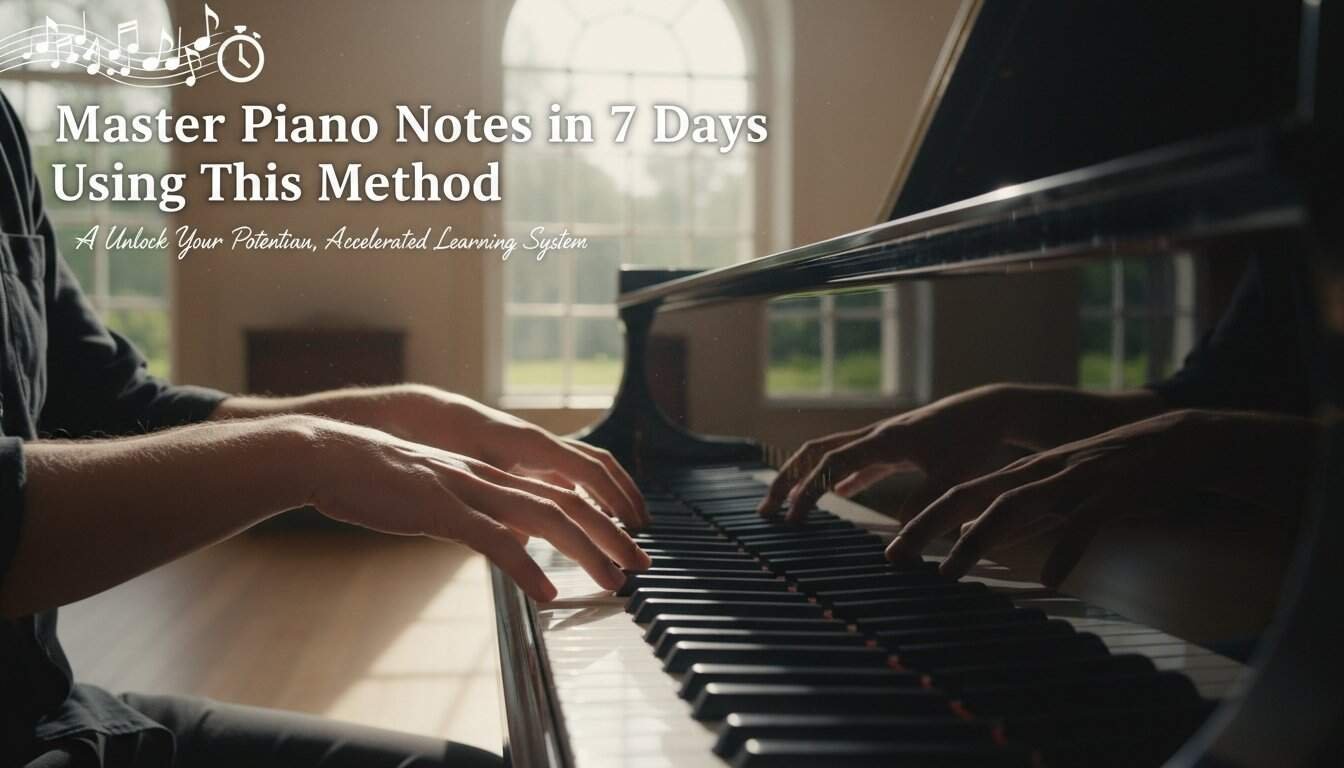
23 Jan Master Piano Notes in 7 Days Using This Method
You’ll master piano notes in seven days through structured daily practice starting with proper posture and hand positioning on Day 1, progressing to C major scales with correct fingering on Day 2, then learning staff notation and rhythm on Day 3. Continue building hand coordination, basic chords, and melody-harmony connections through Days 4-6, culminating in confident performance on Day 7. This systematic approach combines technical fundamentals with practical application, ensuring you’ll develop solid note recognition and playing skills that unlock advanced techniques ahead.
Table of Contents
Key Takeaways
- Start with proper posture, curved fingers, and natural hand weight while positioning thumbs on Middle C for foundational technique.
- Practice five-finger scales using 1-2-3-1-2-3-4-5 fingering for right hand and 5-4-3-2-1-3-2-1 for left hand.
- Learn staff notation basics: five lines, four spaces, with higher positions indicating higher pitches and noteheads centered properly.
- Master whole, half, quarter, and eighth note values within 4/4 time signatures for proper rhythm and timing.
- Combine hands gradually after separate practice, focusing on synchronization points and smooth thumb-under finger transitions.
Day 1: Position Your Hands and Play Your First Piano Notes

The foundation of piano mastery begins with proper hand positioning and posture—get this right on Day 1, and you’ll accelerate your progress while preventing injury.
Start by centering yourself on the front half of your piano bench, feet flat on the floor. Adjust the bench height until your elbows align nearly level with the keyboard. Keep your spine erect with relaxed shoulders.
Locate Middle C to the left of the two-black-key group. Place your right thumb on Middle C, with each finger resting on consecutive white keys up to your pinky on the fifth key. Your hand posture should form a natural C-shape, like you’re holding a wine glass.
Curve your fingers gently—imagine holding an egg in your palm. Keep fingertips firm on the keys while maintaining flexible wrists. This positioning develops finger independence, essential for playing complex pieces. Practice lifting each finger individually while keeping others relaxed on their keys.
If your hands feel tense or strained, shake out the stress and lift your arms to feel their natural weight before returning to the keys.
Day 2: Master the C Major Scale With Proper Piano Fingering
Now that you’ve established basic hand positioning, you’ll build upon yesterday’s foundation by mastering the C major scale using proper fingering techniques.
Today’s focus centers on five-finger scale patterns that create the structural framework for all future piano playing, requiring precise finger sequences that optimize hand efficiency and movement flow.
You’ll discover how correct hand position fundamentals directly impact your ability to execute smooth scale passages while developing the muscle memory essential for advanced technique.
Five-Finger Scale Patterns
Building upon yesterday’s foundation, you’ll master the C major scale through proper fingering patterns that form the backbone of piano technique.
The C major scale’s unique structure—containing no sharps or flats—makes it perfect for developing fundamental scale theory understanding.
You’ll use the ascending sequence 1-2-3-1-2-3-4-5 for your right hand, with your thumb crossing under finger three at the critical transition point.
Your left hand mirrors this pattern with 5-4-3-2-1-3-2-1 ascending.
Focus on fingering ergonomics by keeping thumb movements small and controlled, preventing unnecessary elbow elevation.
Practice synchronization points where both hands align—first on E and A using third fingers, then on F and G forming the “crab claw” position.
Master each hand separately before combining them for optimal coordination and muscle memory development.
Hand Position Fundamentals
Proper hand positioning creates the foundation for executing C major scales with technical accuracy and musical fluency. Your fingers should maintain a slightly curved, relaxed position while resting on white keys only. Since your thumb’s the shortest finger and your pinky’s shorter than fingers 2-4, you’ll need to adjust your hand posture accordingly for optimal white key contact.
Position your hands one octave apart, starting low to accommodate multiple octaves upward. This fingering ergonomics approach minimizes unnecessary hand movement while maximizing control. Focus on the syncopation points at F-G transitions, where your 1st and 2nd fingers create mirror positions for enhanced stability. Remember, your thumb moves under during ascent while your longer fingers cross over your thumb during descent, maintaining smooth continuity throughout your scale execution.
Day 3: Read Basic Piano Sheet Music and Note Values
Now that you’ve mastered the C major scale fingering, you’re ready to connect those physical movements to written music on the staff. Today you’ll learn how staff lines and spaces translate directly to piano keys, transforming those black dots on paper into precise finger positions. You’ll also master note values and rhythm patterns that control how long each key is held, giving your playing proper timing and musical flow.
Staff Lines and Spaces
The foundation of reading piano music rests on understanding the staff‘s five horizontal lines and four spaces between them. You’ll place notes directly on staff lines or within the spaces patterns, with each position representing a specific pitch.
When positioning notes on lines, center the notehead so it intersects the line completely. For spaces patterns, place noteheads between lines without crossing them. Remember that higher positions on the staff indicate higher-pitched notes.
The staff’s systematic arrangement creates a reliable framework for note identification. Each line and space follows a predetermined sequence, making pattern recognition essential for quick reading. You’ll notice that notes alternate between lines and spaces as they ascend or descend, creating the fundamental structure that supports all piano music notation.
Rhythm and Time Values
Understanding where notes sit on the staff gives you pitch information, but rhythm and time values determine how long you’ll hold each note. Start with whole notes—empty circles lasting four beats that fill an entire 4/4 measure. Half notes, with stems attached, last two beats each. Quarter notes feature filled circles with stems and represent one beat, serving as your standard reference point.
Eighth notes have flags and last half a beat, connecting with beams in groups for faster rhythm patterns. Time signatures guide everything: 4/4 means four quarter-note beats per measure, while 3/4 indicates three quarter-note beats. Master these fundamentals first, then practice combining different note values. This foundation prepares you for tempo variations and complex rhythmic combinations you’ll encounter in actual piano pieces.
Day 4: Build Piano Hand Coordination With Simple Rhythms
Why do many pianists struggle with playing different rhythms in each hand simultaneously? Your brain naturally wants both hands to mirror each other, creating coordination conflicts that disrupt musical flow.
Start building hand coordination through alternating patterns. Practice simple left-right sequences (LH RH LH RH) with a metronome at 60 BPM. Master this foundation before advancing to complex rhythms.
Focus on rhythmic basics by holding sustained left-hand notes for four beats while your right hand plays quarter note patterns. This develops independent hand control essential for piano mastery. Try single note and chord combinations—left hand plays C while right hand plays the CEG chord simultaneously.
Dedicate 10 minutes daily to these coordination exercises. Practice hand isolation first: complete all right-hand patterns, then add left-hand parts. Gradually increase tempo only after achieving clean execution at slower speeds. Within seven days, you’ll notice significant improvement in your rhythmic coordination abilities.
Day 5: Play Easy Piano Songs Using Basic Chords
Progress to the Big 4 chords—C, G, Am, and F—which unlock hundreds of popular songs.
“Let It Be” by The Beatles offers smooth chord transitions, while “Someone Like You” by Adele demonstrates how four basic chords create compelling music across genres.
Choose songs using only white keys initially. This eliminates black key complexity, allowing faster progression to richer material while reinforcing your foundational chord-building skills.
Day 6: Connect Piano Melodies and Chords Smoothly
How do you transform isolated chords and melodies into flowing, professional-sounding music? You’ll master smooth connections by identifying your key signature first, then matching chord tones to melody notes. Apply one chord per measure initially, selecting inversions based on your melody’s top note.
Master smooth musical connections by identifying your key signature first, then strategically match chord tones to melody notes for professional flow.
Start with root position chords, then progress to first and second inversions for smoother voice leading. Your left hand anchors the harmonic foundation while your right hand maintains the melodic line on top. Use your pinky to establish root note placement, minimizing finger movement between chord changes.
Develop contrapuntal rhythm by playing independent rhythmic patterns between hands. This creates sophisticated musical texture while maintaining harmonic clarity. Master pedal techniques to sustain chord tones while melody notes change above.
Practice IV-V-I and ii-V-I progressions with chromatic bass motion. Focus on melody-guided inversion selection and simultaneous chord-melody playing. You’ll create professional arrangements that preserve the original tune while adding rich harmonic support.
Day 7: Perform Complete Piano Pieces With Confidence

Seven critical elements separate confident performers from hesitant beginners when executing complete piano pieces. You’ll achieve mindful performance by combining mental preparation with physical readiness. Begin with 15-minute technique warm-ups including scales, chords, and pedal practice to establish instrument familiarity. Arrive 15 minutes early to avoid rushed preparation.
Your mental preparation involves visualization techniques where you’ll mentally rehearse each piece, constructing detailed mental models of ideal sound and fluid movements. Practice breath awareness through diaphragmatic breathing and meditation in the final 10 minutes before performing. This shifts nervous energy into optimal performance states.
During execution, focus on strong opening bars—they establish confidence for the entire piece. Play with passion and joy, reframing performance as gift-giving rather than self-evaluation. Combine muscle memory from accurate repetitive practice with auditory memory from repeated listening. Relax facial muscles while maintaining controlled breathing throughout your performance.
Frequently Asked Questions
What if I Don’t Have a Metronome for Practicing Rhythm?
You don’t need a metronome for effective rhythm training. Use metronome alternatives like actively listening to music while identifying tempo, counting out loud consistently, and tapping your feet or nodding your head.
Practice hand coordination exercises by playing on-beat patterns in one hand while alternating off-beat patterns in the other.
Start with extremely slow practice, counting steadily, then gradually increase speed. Two minutes daily builds strong internal rhythm within days.
How Long Should I Practice Each Day to See Progress?
You’ll see excellent progress with 15-45 minutes of daily practice duration, depending on your skill level. Beginners should start with 15-20 minutes consistently, while intermediate players benefit from 30-45 minutes. You’ll hit progression milestones faster through consistent short sessions rather than sporadic long ones.
Even five minutes daily outperforms irregular practice. Focus on quality over quantity—your brain needs rest periods to consolidate learning effectively.
Can I Learn Piano Effectively on a Keyboard Instead of Acoustic Piano?
Yes, you’ll learn effectively on a weighted-key keyboard that mimics acoustic piano feel. Keyboard ergonomics matter significantly—choose models with 88 weighted keys for proper finger development. Your practice consistency determines progress more than instrument type. While acoustic pianos offer superior tonal expression, quality digital pianos provide 95% of learning benefits. Focus on weighted keys, proper posture, and daily practice. You’ll transition seamlessly to acoustic pianos later.
What Should I Do if My Fingers Feel Stiff or Sore?
Stop playing immediately when you feel stiffness or soreness. Apply gentle stretches to your fingers and hands, focusing on fingertip relief through light massage. Perform wrist warmups using circular motions and flexion exercises. Use heat therapy with warm water to relax muscles. Resume with soft practice at reduced intensity, taking frequent breaks. If discomfort persists, rest completely until symptoms resolve before continuing your piano practice sessions.
Is It Normal to Make Mistakes When Playing Hands Together?
Yes, making mistakes while playing hands together is completely normal and expected. Your brain must coordinate two independent movement patterns simultaneously, which challenges even experienced players. These coordination errors indicate you’re developing proprioception and kinematic individuation.
Start with small chunks at slow tempos, master each hand separately first, then gradually combine them. Mistakes while learning hands coordination actually signal healthy neurological adaptation occurring.
Conclusion
You’ve systematically built your piano foundation from basic hand positioning to complete performances. Each day’s technical progression has developed your muscle memory, sight-reading abilities, and coordination skills. Now you’re equipped with proper fingering technique, rhythmic understanding, and chord-melody integration. Don’t stop here—continue practicing these fundamentals daily. Your seven-day journey has created the essential building blocks for advanced piano playing. Keep building on this structured foundation, and you’ll achieve remarkable musical growth.












No Comments