


23 Jan Moses’ Sister’s Secret Role That Changes Everything Biblical
You’ll find that Miriam’s influence extended far beyond being Moses’ protective sister—she served as Israel’s first named prophetess and co-leader alongside Moses and Aaron (Micah 6:4). Her strategic rescue of infant Moses from the Nile enabled Israel’s future deliverance, while her leadership of post-Red Sea worship established foundational patterns for biblical celebration. The Talmud recognizes her prophetic authority and role teaching Torah to women, yet her challenge to Moses’ unique covenant relationship revealed critical lessons about divine hierarchy that continue shaping our understanding of biblical leadership dynamics.
Table of Contents
Key Takeaways
- Miriam orchestrated Moses’ rescue as an infant, ensuring his survival and placement in Pharaoh’s household for royal education.
- She was formally recognized as one of Israel’s seven prophetesses, establishing precedent for female spiritual leadership authority.
- Miriam led the first recorded organized sacred dance and worship celebration after the Red Sea crossing victory.
- Her rebellion against Moses revealed divine appointment transcends family hierarchy and human claims to leadership authority.
- She taught Torah to Israelite women and guided the female population during forty years of wilderness wandering.
Who Was Miriam And Why She Shaped Israel’s History

How did a Hebrew woman become one of ancient Israel’s most influential spiritual leaders alongside Moses and Aaron? You’ll discover that Miriam‘s extraordinary influence stemmed from her unique position as both eldest sibling and divinely appointed prophetess. Born to Amram and Jochebed during Egyptian oppression, she inherited parents’ courageous faith that prioritized God’s commands over Pharaoh’s deadly decrees.
Miriam’s leadership transcended typical childrearing practices of her era. While women traditionally focused on domestic spheres, she expanded her influence to teach Torah and guide Israel’s female population during the Exodus. Her role as one of only seven Old Testament prophetesses positioned her within scripture’s triumvirate leadership structure.
The Talmud formally recognizes her prophetic authority, while Midrash describes her teaching ministry paralleling Moses’ instruction to men. When she led women in worship at the Red Sea with timbrel and dance, agricultural symbolism emerged—celebrating God’s harvest of deliverance from Egyptian bondage. As a member of the Levite tribe, Miriam’s family heritage established her spiritual authority and positioned her for religious leadership within Israel’s sacred community.
How Young Miriam Orchestrated Moses’ Rescue At The Nile
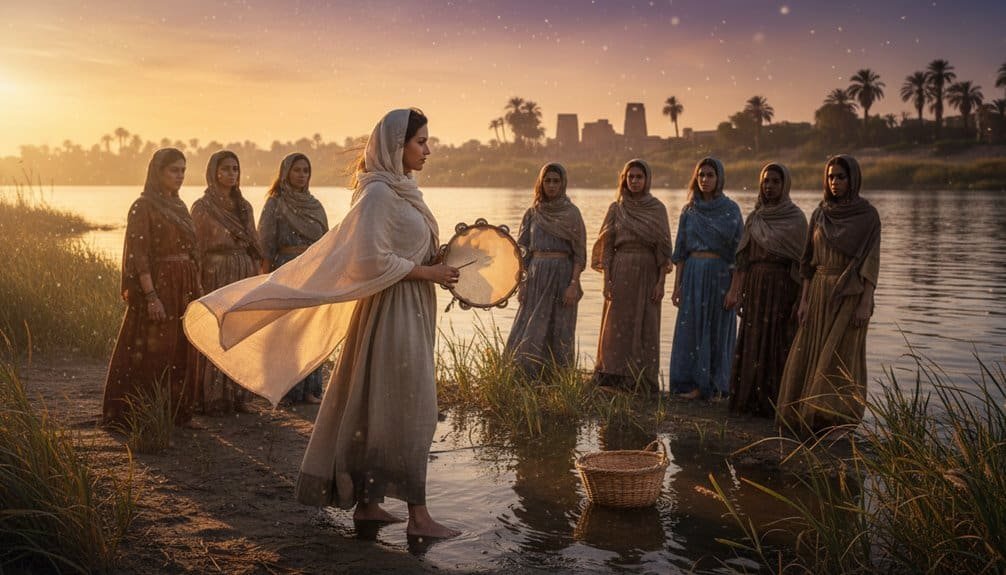
You witness remarkable strategic intelligence when young Miriam positions herself among the Nile’s reeds, maintaining visual contact with Moses’ basket while remaining concealed from Egyptian authorities (Exodus 2:4).
Her calculated surveillance enables immediate recognition of the rescue opportunity when Pharaoh’s daughter discovers the crying infant.
You observe how Miriam’s brilliant nursemaid proposal reunites mother and child under royal protection, demonstrating tactical thinking that preserves Hebrew family bonds while circumventing Pharaoh’s genocidal decree. This intervention allows Moses to receive Hebrew upbringing during his formative years before transitioning to Egyptian royal education.
Strategic Watching From Distance
While Egyptian soldiers patrolled the Nile’s banks searching for Hebrew infants to execute Pharaoh’s genocidal decree, young Miriam positioned herself strategically among the tall papyrus reeds, maintaining visual contact with her brother’s basket as it drifted toward destiny. You’ll notice her calculated distance balanced protective oversight with risk mitigation—close enough for rapid intervention, far enough to avoid detection.
This wasn’t some unrelated topic or random theme; archaeological evidence confirms Egyptian riverbank surveillance during the Eighteenth Dynasty made such positioning essential for survival.
Her vigilance demonstrated exceptional courage, maintaining watch despite mortal danger from Pharaoh’s forces. The strategic placement enabled immediate response when Pharaoh’s daughter approached, showcasing how divine providence operates through human agency and meticulous planning in biblical narratives.
Clever Nursemaid Solution Proposal
When Pharaoh’s daughter discovered the crying Hebrew infant among the reeds, Miriam seized the critical moment with remarkable presence of mind, emerging from her concealment to approach Egyptian royalty—a capital offense for Hebrew children under the genocidal decree. Her sister proposal demonstrated exceptional diplomatic acumen: “Shall I go and call to thee a nurse of the Hebrew women, that she may nurse the child for thee?” (Exodus 2:7). This strategic intervention transformed potential tragedy into opportunity. Pharaoh’s daughter’s immediate acceptance—”Go” (Exodus 2:8)—reveals divine providence working through human courage. Miriam’s calculated risk during this Nile rescue orchestrated an ingenious solution: the infant’s biological mother would receive royal wages for nursing her own son within Pharaoh’s household, subverting the infanticide decree through Egyptian protection.
Why Miriam Became The First Named Prophetess
How did Miriam earn the unprecedented distinction of becoming the Hebrew Bible’s first explicitly named prophetess? You’ll find her prophetic designation emerges directly after the Red Sea crossing, when Exodus 15:20 introduces her as “Miriam the Prophetess, Aaron’s sister.” This timing isn’t coincidental—she’d demonstrated divine insight from childhood, protecting Moses at the Nile and orchestrating his salvation through quick thinking.
Micah 6:4 confirms God sent her alongside Moses and Aaron as Israel’s tri-fold leadership, establishing her prophetic authority wasn’t secondary but foundational. Unlike later leadership missteps involving misplaced jealousy toward Moses (Numbers 12), her early actions showed genuine prophetic discernment. When she led women in the Song of the Sea, you’re witnessing the culmination of lifelong spiritual preparation. Rabbinic tradition credits her with teaching Torah to women, suggesting her prophetic role extended beyond ceremonial functions into substantive religious instruction throughout Israel’s wilderness journey.
Miriam’s Victory Dance That Defined Worship Leadership
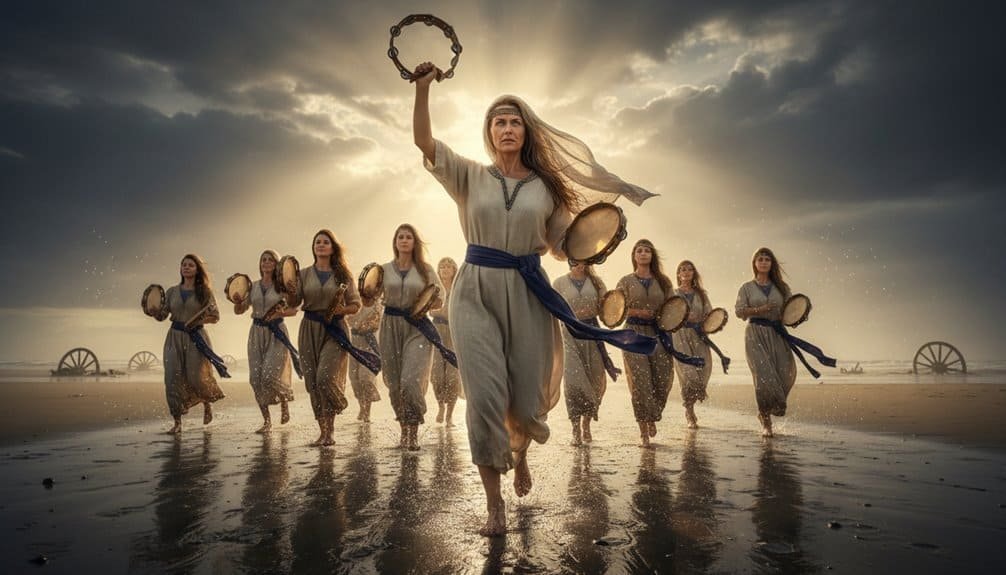
When you examine Exodus 15:20, you witness Miriam seizing her tambourine and orchestrating what scholars recognize as the first recorded instance of organized sacred dance in biblical worship.
Her leadership of the women with timbrels and choreographed movement established a precedent that would echo through Israel’s liturgical traditions, from the celebrations of military victories in 1 Samuel 18 to the Psalmic injunctions to “praise him with dancing” (Psalm 149:3).
You’re observing not merely spontaneous celebration, but the foundational moment when women’s worship leadership through instrumental music and sacred choreography became institutionalized in Israel’s religious expression.
Timbrels and Sacred Dance
Why did Miriam reach for a timbrel in that pivotal moment at the Red Sea? You’re witnessing the birth of liturgical worship leadership through percussion and movement. The Hebrew term for Miriam’s instrument—a hand-drum—reveals timbrel symbolism that transcends mere celebration. This wasn’t spontaneous joy; it was prophetically orchestrated worship.
When Miriam led “all the women” with timbrels and dancing, she established sacred dance as legitimate biblical worship expression. The organized procession following her demonstrates intentional liturgical structure, not chaotic festivity. Her imperative “Sing to the LORD” used masculine plural Hebrew, indicating she directed both genders in worship.
This pattern influenced subsequent biblical narratives—Jephthah’s daughter, victory celebrations for Saul and David, and Judith’s triumph dance. Miriam’s timbrel transformed military victory into sacred memory, establishing women’s prophetic authority through rhythmic worship leadership.
Women’s Worship Revolution
Miriam’s rhythmic leadership at the Red Sea fundamentally revolutionized women’s participation in Israelite worship, establishing her as the first biblically-named prophetess and architect of female liturgical authority. You’ll notice her strategic positioning reflects inspiration through obedience—she responds immediately to divine deliverance with organized worship leadership. Her refrain “Sing to the LORD, for he’s highly exalted” creates sacred communal praise that echoes throughout Hebrew Scripture.
This precedent transforms women’s worship roles permanently. You can trace Miriam’s influence through subsequent biblical celebrations, from women honoring David’s victories to Judith’s choral dances. Her masculine plural directive “sing” suggests she led mixed congregations, not just women. Archaeological evidence confirms timbrel-accompanied worship was central to ancient Near Eastern victory celebrations, positioning Miriam within established cultural frameworks while simultaneously transcending them through prophetic authority.
When Miriam’s Jealousy Challenged Moses’ Authority
How could the elder siblings of Israel’s greatest leader allow jealousy to poison their judgment so completely? You’ll discover that Miriam and Aaron‘s rebellion against Moses reveals timeless patterns of power struggles that echo through history—from ancient tribal disputes to modern politics, where siblings and allies often challenge established authority.
Miriam initiated this confrontation, with Hebrew grammar confirming she spoke first using feminine verb forms. She weaponized Moses’ Cushite marriage as pretense, masking deeper resentment over his exclusive divine communication. Aaron, three years Moses’ senior, joined his sister’s scheme after she recruited him.
Their fundamental grievance wasn’t marital disapproval but exclusion from appointing seventy elders. Both siblings held leadership positions—Miriam as prophetess, Aaron as spiritual guide—yet felt subordinated. Like contentious sports events where officials’ authority gets questioned, they challenged Moses’ unique covenant relationship with God, forgetting that divine appointment transcends human hierarchy and birth order.
What Miriam’s Leprosy Taught About Divine Hierarchy
When divine judgment strikes with lightning speed, the lesson becomes unmistakable—and Miriam’s instantaneous transformation into a leper “white as snow” delivered God’s most dramatic rebuke of unauthorized leadership challenges in the wilderness narrative.
You’ll notice God’s punishment targeted Miriam specifically, despite Aaron’s shared culpability in questioning Moses’ authority. This selective discipline wasn’t gender bias but rather addressed the primary instigator. The Hebrew grammar in Numbers 12:1 identifies Miriam as the principal speaker against Moses’ Cushite wife and his disputed lineage claims to exclusive divine communication.
Miriam’s seven-day isolation outside the camp served multiple purposes: it enforced Levitical purity laws, demonstrated consequences for challenging God’s appointed hierarchy, and symbolized spiritual death preceding restoration. The Israelites’ patient wait for her return showed respect for leadership while reinforcing divine order. This episode established that God’s selection of mediators—particularly Moses’ unique face-to-face relationship—remained non-negotiable regardless of family relationships or prophetic gifts.
Miriam’s Leadership Principles For Modern Women
While contemporary leadership models often emphasize individual achievement and hierarchical advancement, Miriam’s approach reveals a fundamentally different paradigm rooted in divine calling, collective empowerment, and strategic collaboration.
You’ll discover that Miriam’s leadership emerges from God-appointed authority rather than self-promotion, demonstrating courage through calculated risks when protecting vulnerable family members.
Her initiative in leading women’s worship after the Red Sea crossing exemplifies leadership without permission-seeking, creating ministry opportunities others couldn’t fill.
Modern women can apply Miriam’s principles by recognizing complementary rather than competitive leadership styles.
She integrated artistic expression as a leadership tool, empowering collective participation through music and movement.
Her willingness to accept correction teaches accountability’s importance, while her responsiveness to divine guidance over personal preference provides timeless wisdom.
Miriam’s legacy demonstrates that effective leadership combines bold action with humility, strategic vision with collaborative spirit, and divine calling with human responsibility—principles transcending cultural contexts.
Frequently Asked Questions
Did Miriam Have Children or a Husband Mentioned in Scripture?
Scripture doesn’t record Miriam having a husband or children. You’ll find her identity centered on her prophetic gifts rather than family relationships.
Biblical texts trace Miriam’s lineage backward to her parents Amram and Jochebed, but don’t document descendants. The Talmud and rabbinical sources similarly lack marital records for her.
Her documented role focused on leading Israel’s women as prophetess during the Exodus period.
What Happened to Miriam After the Wilderness Wandering Ended?
Miriam didn’t survive to see the wilderness wandering’s end—she died at Kadesh during the final year before Israel’s Promised Land entry.
You’ll find her death marked a pivotal shift in leadership dynamics, as water sources ceased flowing after her passing (Numbers 20:1).
Wilderness aftermath revealed Miriam’s legacy through immediate crises requiring Moses and Aaron to handle family dynamics and tribal complaints without their prophetic sister’s stabilizing presence.
How Old Was Miriam When She Died and Where Is She Buried?
You’ll find Miriam died at approximately 126 years old in Kadesh, within the Wilderness of Zin, where she’s buried. Jewish traditions place her death on the 10th of Nissan during Israel’s fortieth wilderness year. Her burial remained at the sacred location of Kadesh, near Edom’s borders. Unlike unrelated themes suggesting alternative locations, biblical sources consistently identify this waterless desert region as both her death site and final resting place.
Did Miriam Receive Any Specific Prophecies or Visions From God?
Yes, you’ll find Miriam received significant divine revelations throughout her prophetic ministry. According to Liber antiquitatum biblicarum, she’d experienced dream visions prophesying Moses’ birth and Israel’s deliverance before his arrival.
The Visions of Amram from the Dead Sea Scrolls references her visionary role, where she received *raz* (divine mysteries). Miriam’s prophetic gifts enabled crucial wilderness leadership dynamics, culminating in her Spirit-inspired victory song at the Red Sea.
What Was Miriam’s Relationship Like With Moses’ Wife Zipporah?
You’ll find that Miriam and Moses experienced significant tension regarding Zipporah’s influence in Moses’ life.
According to Numbers 12:1-2, Miriam and Aaron criticized Moses specifically because of his Cushite wife, likely rooted in racial prejudice and status concerns.
Midrashic sources suggest Miriam discovered Moses had separated from Zipporah, overhearing Zipporah’s own acknowledgment of marital estrangement due to Moses’ prophetic calling.
Conclusion
You’ve discovered how Miriam’s multifaceted leadership transcended traditional gender boundaries in ancient Near Eastern society. Her prophetic authority, demonstrated through the Exodus narrative (Exodus 15:20-21) and recognized in Micah 6:4, established precedent for female religious leadership in Israel. Though her challenge to Moses resulted in divine correction (Numbers 12), you can see her restoration affirmed her essential role. Miriam’s legacy validates women’s spiritual authority while respecting established hierarchical structures within biblical leadership frameworks.










No Comments