


26 Jan Complete Beginner Plays Piano in Just 30 Days
You can achieve basic piano proficiency in 30 days with structured practice, but don’t expect concert-level performance. Focus 15-30 minutes daily on proper posture, hand positioning, and C major scale with correct fingering patterns. Master simple melodies like “Happy Birthday” while building coordination between hands using a metronome at 60-70 BPM. Your first month establishes fundamental technique and keyboard familiarity—essential building blocks for advancing to intermediate repertoire and complex musical concepts.
Table of Contents
Key Takeaways
- Practice 15-30 minutes daily to establish measurable progress and basic keyboard layout understanding within one month.
- Focus on achievable benchmarks like note recognition and simple melodies rather than unrealistic concert-level performance expectations.
- Start with proper posture, hand position, and C major scale using correct fingering patterns during the first week.
- Use essential equipment including 88-key weighted digital piano, proper bench, sustain pedal, and metronome for effective practice.
- Master basic chord shapes in C major (C-E-G, F-A-C, G-B-D) and understand staff notation with treble and bass clefs.
Why Learning Piano in 30 Days Requires Realistic Goals
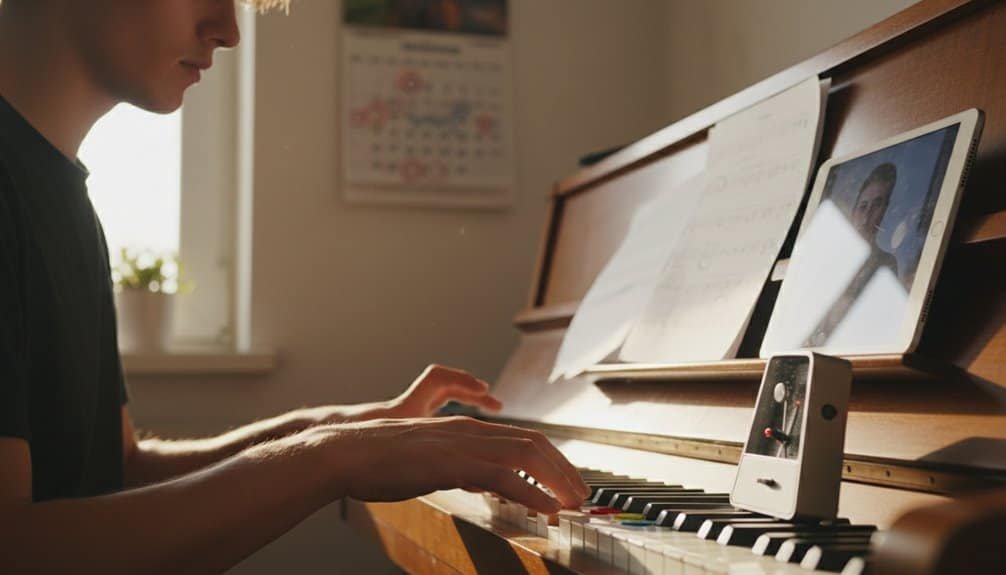
How quickly can you realistically expect to play piano after starting from scratch? One month of consistent practice allows you to reach basic proficiency—playing simple melodies and understanding keyboard layout. However, expecting concert-level performance creates an irrelevant focus that derails progress.
Your 30-day ceiling involves simple tunes with daily practice. Mastery requires years, not weeks, with intermediate proficiency demanding 4-5 years of consistent study. Adult learners need 10 years of three-hour daily sessions for advanced competency.
Minimum 15-30 minutes of focused daily practice establishes measurable progress. Ten minutes daily equals 60 hours annually, while 30 minutes reaches 180 hours yearly. Your progress depends heavily on time commitment, technical abilities, and predetermined objectives.

Natural musical ear allows faster progression, but combined demands of physical movement, reading, coordination, and musicality slow learning regardless of practice duration. Progress particularly varies with age group, as younger students ages 4-6 develop more slowly due to the abstract nature of musical concepts, while teenagers can reach personally motivating repertoire within the first year. Avoid theme shift toward unrealistic expectations—focus on note recognition and keyboard familiarity as achievable 30-day benchmarks.
Essential Piano Equipment for Home Practice Success
Your 30-day piano journey depends entirely on selecting the right instrument and creating an optimized practice environment. You’ll need an 88-key digital piano with weighted keys and a sustain pedal as your foundation, plus proper seating and stand setup to maintain correct posture throughout extended sessions. These equipment decisions directly impact your technique development and practice efficiency, making careful selection crucial before you begin your accelerated learning program.
Piano Selection Guide
Selecting the right piano equipment forms the foundation of your 30-day learning journey and directly impacts your practice effectiveness. For beginners, 66-key keyboards provide sufficient range, while 72-key instruments handle most musical pieces successfully. However, 88-key keyboards with weighted keys offer the best traditional piano experience for serious learners.
Weighted keys mimic acoustic piano action, essential for developing proper technique. Unweighted keys suit electronic music production but won’t prepare you for acoustic pianos. Your practice motivation increases significantly when studio acoustics allow silent sessions through headphone jacks, preventing disruption to others.
Essential accessories include keyboard stands for ergonomic positioning, piano benches without armrests for unrestricted movement, and responsive sustain pedals. Computer connectivity enables future DAW integration, while built-in speakers eliminate immediate amplifier needs.

Practice Room Setup
Once you’ve secured your piano equipment, transforming your practice space into an optimized learning environment determines whether you’ll maintain consistent daily sessions throughout your 30-day journey.
Select a quiet room with natural light from large windows, positioning your piano away from high-traffic areas to minimize distractions.
Your space layout requires sufficient room for arm movement—place upright pianos against walls while allowing grand pianos breathing space around the instrument.
Position your bench at the correct distance for free elbow movement without obstruction.
Lighting optimization involves combining natural daylight with adjustable lamps for evening sessions.
Install clip-on lights specifically for sheet music readability.
Keep essential accessories nearby: metronome, pencils, music folders, and a clock for session management.
Your First Week: Proper Posture and Hand Position
Before you can play a single note effectively, you must establish the physical foundation that supports every aspect of piano technique. Center your bench to the keyboard’s width and sit on the front half with feet flat on the ground. Keep your weight centered on your buttocks while maintaining a straight back and relaxed shoulders.
Position your elbows almost level with the keyboard—never much lower. Your right hand belongs on white keys near Middle C, which sits left of two black keys in the keyboard’s center. Assign each finger to consecutive white keys, starting with your thumb.
Curve your fingers as if holding an egg under your palm. Keep your thumb straight but relaxed, touching keys with its side edge. Maintain posture consistency throughout practice sessions while focusing on wrist relaxation. Your wrists should stay parallel to the ground, never resting on the keyboard or dipping below key level.
Mastering C Major Scale With Correct Fingering
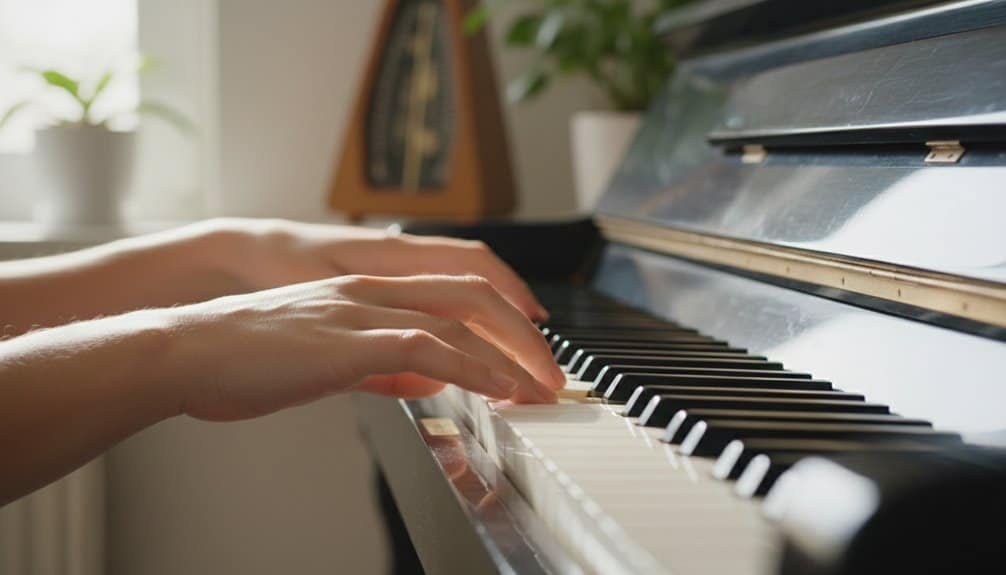
The C major scale represents your gateway to understanding piano fundamentals because it contains no sharps or flats—only the white keys from one C to the next.
Master the right-hand fingering pattern first: 1-2-3-1-2-3-4-5. Start with your thumb on middle C, cross under at the third finger, then continue smoothly. Your left hand follows 5-4-3-2-1-3-2-1, beginning with your pinky on C and crossing over with the third finger.
Focus on proper thumb placement—tuck it underneath your hand without raising your elbow. Practice each hand separately until you’ve developed muscle memory, then gradually combine them. Start slowly and maintain steady rhythm practice to build coordination.
This foundational scale connects directly to music theory concepts you’ll encounter later. The finger patterns you’re learning will transfer to other major scales, making your progression more efficient. Dedicate fifteen minutes daily to ascending and descending practice—consistent repetition builds the technical precision essential for advanced pieces.
Adding G Major and D Major to Your Foundation
Why progress from C major to G and D major scales specifically? These scales build systematically on your C major foundation. G major introduces one sharp (F#), while D major adds a second sharp (C#). This methodical progression develops your scales mastery through manageable complexity.
For G major, your right hand uses thumb under to C, continuing to F#. Left hand starts with pinky on G below middle C, middle finger crosses to E and F#. Practice the cadence rhythm slowly, focusing on smooth finger transitions.
D major requires precise thumb positioning. Right hand: thumb under from F# to G ascending, third finger over thumb when descending. Left hand: third finger crosses over thumb from A to B ascending, reverses descending.
Master the chord progressions: G major (G-B-D) and D major (D-F#-A). Practice G-C-D progressions in root position. Start with quarter notes, gradually increase tempo while maintaining finger accuracy and consistent cadence rhythm.
The 6-Minute Daily Scale Practice Routine
You’ll dedicate exactly 6 minutes daily to mastering C major, G major, and D major scales using a structured hand practice allocation system.
Practice each scale hands separately for 45 seconds, then hands together for 30 seconds, cycling through all three keys within your time limit.
This methodical approach builds proper fingering habits while establishing realistic expectations for technical development during your first month.
Three Essential Scales
While countless scales exist in music theory, mastering just three essential scales will establish your foundational technique and unlock hundreds of songs within your first month.
Start with C Major—no sharps or flats, using only white keys. Your scale practice begins here because it’s the simplest pattern to memorize. Use right-hand fingering 1-2-3-1-2-3-4-5 and left-hand 5-4-3-2-1-3-2-1.
Next, tackle G Major with one sharp (F#). The fingering consistency remains identical to C Major, making the transition seamless while introducing accidentals.
Finally, learn F Major with one flat (B♭). Right-hand fingering changes to 1-2-3-4-1-2-3-4, but left-hand stays the same.
These three scales form the foundation for countless popular songs and prepare you for advanced technique development.
Hand Practice Allocation
Learning these three scales becomes manageable when you break practice into focused, time-efficient segments. Allocate six minutes daily: two minutes per scale with methodical progression from single hands to hand unity.
Start each scale at 70 BPM, right hand only, ascending and descending one octave. Master this before advancing your left hand with the same tempo and range. Once both hands demonstrate individual control, integrate them together while maintaining that steady 70 BPM foundation.
Focus on evenness over speed during these brief sessions. Your rhythm focus should emphasize consistent eighth notes rather than rushing through passages. Gradually increase tempo by five BPM increments only after achieving smooth execution. This structured approach ensures solid technical development within your 30-day timeline while building sustainable practice habits.
Reading Basic Piano Notation and Staff Lines
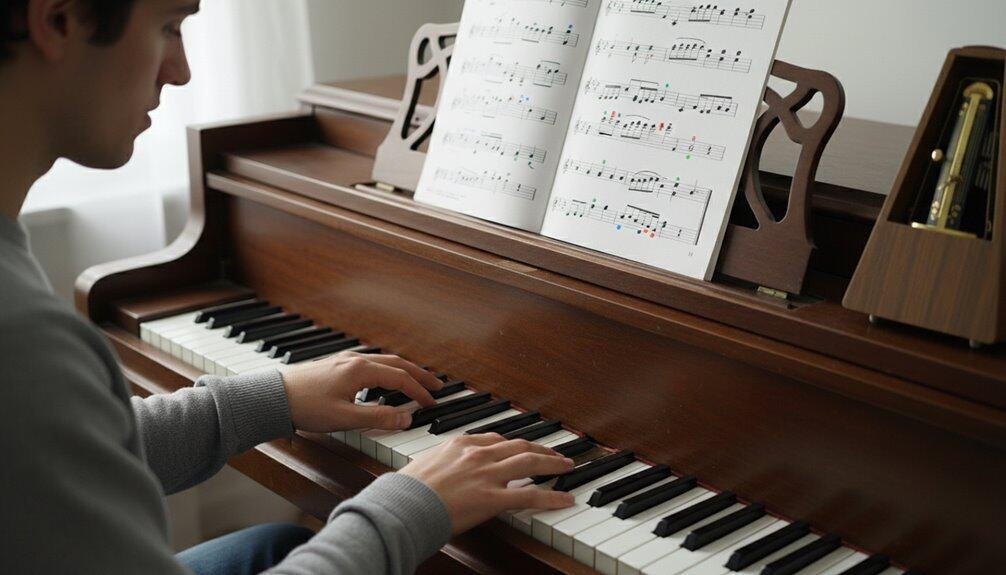
How does a pianist instantly know which key to press when looking at a musical score? You’ll master this through understanding the grand staff structure, which consists of treble and bass clefs connected by Middle C as your primary reference point.
Start with treble clef line notes: E, G, B, D, F (“Every Good Boy Deserves Fries”). Space notes spell “FACE.” Bass clef follows the same seven-letter system, with its top line representing A. Middle C sits between both clefs, serving as your central anchor point.
You’ll recognize patterns quickly once you identify anchor notes. Scales appear as alternating line-to-space movements, while triads stack three notes together. When encountering ledger lines above or below the staff, locate a familiar anchor note first, then count up or down using the same letter pattern. This methodical approach transforms overwhelming notation into manageable, predictable patterns you’ll read fluently within weeks.
Understanding Sharps, Flats, and Key Signatures
Key signatures organize these accidentals systematically. Sharps follow this order: F#, C#, G#, D#, A#, E#, B#. To identify major keys with sharps, find the last sharp and go up a half step.
Flats follow the reverse order: Bb, Eb, Ab, Db, Gb, Cb, Fb. With flats, the second-to-last flat names the key.
You’ll encounter theoretical enharmonics—notes that sound identical but have different names, like F# and Gb. Understanding key signatures becomes crucial when you explore relative minors, which share the same accidentals as their major counterparts.
Master this foundation now; it’ll streamline your sight-reading and music theory comprehension significantly.
Learning Happy Birthday by Memory Step-by-Step
Why start with Happy Birthday when countless songs exist? This familiar melody provides the perfect foundation for developing Birthday memory while establishing essential fingering patterns that’ll serve you throughout your piano journey.
Position your right hand with thumb on middle C, fingers spanning C-D-E-F-G. You’ll start on G using finger 4 for “Ha-ppy,” then navigate the C to F interval on “to you.” The fourth phrase requires precise finger 4 placement on F, followed by the E-C-D-C sequence for “Birthday to you.”
Your left hand maintains its starting position throughout, practicing the C-B-A-G-F descending pattern. Watch for B flat in bar 6—it’s crucial you don’t accidentally play B natural.
Break the learning into manageable phrases: master right hand fingering patterns first, add left hand accompaniment, then combine both hands. This methodical approach builds Birthday memory while training your fingers for more complex pieces ahead.
Beginning Minuet in G Major: Your First Real Piece
Where Happy Birthday established your finger patterns, Minuet in G Major BWV Anh. 114 transforms you into a classical pianist with your first complete baroque piece. This beginner-friendly composition requires limited hand spans and focuses on right-hand melody development, making it accessible for developing finger strength.
Start with melody-only practice during weeks one and two, dedicating 15-20 minutes daily to note naming exercises. The G Major key utilizes natural notes with minimal accidentals, reducing navigation complexity. Color-coded sheet music versions mark individual notes with visual identifiers, enabling reading without traditional notation literacy.
The moderate tempo marking establishes controlled pacing for hand coordination development. Once you’ve mastered the melody, introduce tempo variation to explore musical expression. The piece’s repetitive melodic phrases reinforce muscle memory while rhythmic simplicity relies on quarter and half notes.
This solo performance-ready composition represents your transition from exercises to legitimate repertoire, building confidence for increasingly complex classical pieces.
Separating Hands for Faster Piano Learning
You’ll accelerate your learning by practicing each hand separately before attempting to combine them. Start with your right hand to establish proper melody fingering and note accuracy at a slow, comfortable tempo. Once you’ve mastered the right-hand passage, shift your focus to isolating the left-hand accompaniment pattern with the same methodical approach.
Right Hand First
How can you master complex piano pieces without overwhelming your brain’s processing capacity? Start with your right hand during hand separation practice. Since melodic content typically occupies the right hand in most compositions, you’ll develop the primary musical material first. This approach reduces cognitive load by focusing your attention on the most prominent musical elements.
Your right hand naturally receives more development in beginner-level pieces, as composers intentionally limit left-hand complexity to avoid overshadowing melodies. Practice each small section with your right hand first, achieving 100% accuracy through multiple repetitions. Master individual bars before expanding to larger sections.
This methodical progression builds automatic muscle memory for melodic lines, establishing the foundation you’ll need when adding your left hand coordination later.
Left Hand Isolation
Why does your left hand feel clumsy and unresponsive when you attempt complex passages? Your non-dominant hand lacks the neural pathways that make your right hand naturally agile. Left hand isolation addresses this fundamental weakness through targeted practice.
Start with this techniques overview: practice your left hand as if it’s the complete piece, focusing on every musical detail. Play melodies two octaves higher to avoid muddy bass sounds. Use rounded fingers positioned on key edges for better control.
Master rhythm articulation by counting aloud while practicing isolated left-hand sections for 1-2 minutes daily. Practice scales and arpeggios musically, shaping them like miniature compositions. Mirror your right-hand movements in your left hand to build coordination and finger strength through methodical repetition.
Combining Left and Right Hand Parts Smoothly
The coordination between your left and right hands represents the most challenging technical hurdle you’ll face as a beginning pianist. Start with foundational exercises: play single notes in your right hand while holding a C chord in your left. Keep that left hand chord pressed down for the entire measure while your right hand plays multiple notes. This builds essential left hand independence.
Master your right hand rhythm on all four beats before adding left hand patterns. Use metronome discipline at the slowest settings—this temporal reference prevents rushing and establishes clean coordination. Practice the 6-4-1-5 chord progression in C Major, keeping your right hand positioning static while your left hand shifts between chords.
Combine hands gradually, starting with left hand entries on beats two and four only. Progress slowly through broken chord patterns in one hand while maintaining solid chords in the other. Speed increases only after you’ve mastered the technique at slower tempos.
Basic Chord Shapes Every Piano Beginner Needs
Which chord shapes should you prioritize during your first weeks at the piano? Start with the three primary chords in C major: C (C-E-G), F (F-A-C), and G (G-B-D). These fundamental triads form the backbone of countless songs and provide essential music theory foundations.
Master major chord construction first: root note, major third (four half steps up), and perfect fifth (three more half steps). Then tackle minor chords by flattening the third interval to three half steps. Practice Dm (D-F-A) and Am (A-C-E) alongside your major shapes.
Don’t rush into chord inversions yet. Focus on root position triads until your fingers develop muscle memory for basic shapes. Each chord requires precise finger placement—use fingers 1, 3, and 5 for consistent hand positioning.
Once you’ve solidified these six essential chords, you’ll possess the harmonic vocabulary to play hundreds of popular songs while building toward more advanced techniques.
Playing Simple Songs by Ear From Day One
You’ll begin ear training by focusing on simple melodies rather than complex chord progressions, as single-note patterns provide the clearest pathway to developing your musical intuition. Start with familiar tunes like “Happy Birthday” or “Mary Had a Little Lamb”—songs you already know internally—then match those mental sounds to individual piano keys through systematic trial and correction. This methodical approach builds the fundamental ear-to-finger connection that transforms hearing music in your head into accurate keyboard execution.
Start With Melodies
Beginning pianists often assume they must master scales and theory before attempting real songs, but starting with simple melodies produces faster results and stronger motivation. You’ll build confidence by playing recognizable nursery rhymes like “Twinkle Twinkle Little Star” within your first week. These melodies stay within one octave, eliminating hand position changes while you focus on note recognition.
Start with right-hand-only execution at 60-70 BPM using a metronome. Familiar tunes create immediate audience engagement through storytelling techniques—you’re not just pressing keys, you’re communicating recognizable musical ideas. By day four, introduce simple left-hand root notes on C and G. Practice 4-8 bar phrases before attempting complete songs. This methodical progression from melody to basic harmony builds proper coordination while maintaining realistic expectations for rapid skill development.
Develop Musical Intuition
How can you accelerate your piano learning by trusting your ears instead of relying solely on sheet music? You’ll develop musical intuition through pattern recognition, starting with melodic contour recognition rather than note-by-note memorization. Train yourself to identify intervallic relationships between notes, making transposition intuitive from the beginning.
Focus on chord fluency by learning all 12 major and minor chords using the chord ladder technique. Practice harmonic progressions actively at the keyboard, making theory hands-on rather than abstract. This develops your ability to recognize common chord sequences in pieces you encounter.
Strengthen your inner keyboard through relative interval listening without initial note knowledge. Begin improvisation from your first lessons, creating structured flexibility that builds confidence. This combination of pattern recognition and chord fluency transforms musical learning from mechanical repetition into intuitive understanding.
Using a Metronome to Build Steady Piano Rhythm
Once you’ve grasped basic finger positioning and can play simple melodies, a metronome becomes your most reliable practice partner for developing consistent rhythm. Start with a range of 10-200 beats per minute, beginning with monotone settings where all beats sound uniform. This metronome consistency eliminates the common problem of playing forte passages faster and piano sections slower without deliberate control.
Set your metronome to match composer-specified tempos in your method books. Begin slowly, focusing on tempo shaping through gradual increases rather than attempting full speed immediately. The metronome will pinpoint problem areas where you lose the beat and reveal inconsistent patterns where you rush familiar sections.
For sight-reading development, maintain forward momentum even when mistakes occur. The steady beat provides time between notes for visual preparation of upcoming passages. Document your tempo increases in a practice diary to track measurable progress and establish clear objectives for future sessions.
The 2 BPM Method for Gradual Speed Increases
The most effective approach for building speed centers on incremental increases of just 2 beats per minute during each practice session. This tempo pacing method prevents overwhelming your motor coordination while maintaining accuracy focus throughout development.
Start each exercise at a comfortable speed where you’ll achieve perfect note synchronization. Once you’ve completed three consecutive error-free repetitions, increase your metronome by exactly 2 BPM. If mistakes occur, immediately return to the previous tempo and consolidate your control before advancing again.
Practice small musical chunks—typically four to eight measures—rather than entire pieces. This targeted approach allows you to identify coordination weaknesses and address them systematically. Layer your elements sequentially: master the notes first, then add rhythmic precision, finally incorporate speed increases.
Expect gradual but consistent progress. You’ll typically gain 10-20 BPM per practice session using this methodical progression. The key lies in never sacrificing accuracy for speed, ensuring each tempo increase builds upon solid technical foundations.
How Piano Practice Mistakes Slow Your Progress
Even with the 2 BPM method in place, you’ll sabotage your 30-day progress if you repeat incorrect patterns without deliberate correction strategies. Your timing becomes erratic when you ignore metronome discipline, creating rhythmic inconsistencies that compound daily.
Professional techniques like proper hand positioning and structured fingering patterns aren’t optional shortcuts—they’re foundational elements that prevent you from embedding permanent errors into your muscle memory.
Repetition Without Strategy
Mindless repetition becomes your worst enemy when learning piano, transforming what should be skill-building into a counterproductive cycle that ingrains errors deeper with each thoughtless pass. When you repeat passages without variation, your brain disengages, allowing careless mistakes to slip by unnoticed. Each successive unchanged repetition reinforces bad habits while missing crucial reflective pauses between attempts.
Without strategy, you’re practicing mistakes rather than eliminating them. You’ll achieve better results by analyzing errors between trials, varying elements like rhythm or dynamics, and focusing on correct execution percentage rather than total repetition count. Block practice sessions lead to cognitive fatigue and habituation. Instead, interleave different segments and adjust your approach until errors vanish completely through targeted correction.
Ignoring Metronome Timing
Why do countless piano students struggle with timing issues that persist for months or even years? The answer lies in ignoring metronome practice during crucial developmental stages.
When you skip metronome training, tempo instability becomes your constant companion. Your internal pulse wavers during performance, making syncopation and triplets unmanageable. Audiences immediately detect timing inconsist inconsist with your playing.
Without structured beat guidance, challenging passages remain perpetually unpolished. You’ll rush through difficult sections, reinforcing problematic habits that become harder to correct later. Your rhythm sense fails to develop systematically, undermining fundamental musicianship skills.
The metronome provides essential calibration for measuring musical progress. By maintaining steady reference beats, you can gradually increase tempo while preserving accuracy, ultimately achieving the precision necessary for reliable performance.
Skipping Professional Techniques
How often do pianists unknowingly sabotage their progress by bypassing fundamental professional techniques? You’re likely developing unhelpful techniques when you jump directly into songs without proper finger training. Skipping scales, arpeggios, and basic chord exercises weakens your foundation for advanced pieces. This unsafe practice creates technical gaps that compound over time.
Neglecting left hand development creates imbalance in your playing ability. Focusing only on difficult material while ignoring fundamentals prevents proper technique development. Professional pianists understand that foundational exercises provide essential knowledge required for complex pieces.
Your finger independence suffers without deliberate training. Every shortcut you take now extends your overall learning timeline. Master the basics methodically—scales train finger patterns, arpeggios develop fluid motion, and chord exercises build strength. These aren’t obstacles; they’re building blocks.
Essential Finger Exercises for Piano Technique
Develop finger independence through individual finger activation exercises. Press each finger while keeping others stationary, progressing from thumb through all five digits. Hanon exercises provide structured finger strengthening specifically designed for accuracy and precision.
Build finger dexterity through table exercises—place hands flat and lift each finger individually while others remain stationary. Repeat ten times per hand. Practice scales at slow tempos before progressing to complex keys and arpeggios.
Incorporate wrist extension exercises by gently bending wrists back and forth with relaxed fingers, repeating fifteen times per wrist for optimal flexibility.
The 40-Repetition Rule for Difficult Piano Passages
Once you’ve established proper finger mechanics and flexibility, mastering challenging piano passages requires systematic repetition that goes far beyond casual practice attempts. Your brain needs approximately 10 consecutive perfect repetitions at 98% accuracy to establish lasting muscle memory. Single or double attempts won’t create the neural pathways necessary for reliable performance.
Start with tempo planning—practice difficult sections at half your target speed using a metronome. Execute each passage 10 times without errors before increasing tempo. Hand relaxation remains crucial throughout this process; tension will sabotage your repetition work and create inconsistent results.
Focus on accuracy over speed during initial repetitions. Your fingers must hover directly over keys while maintaining curved positioning. Each repetition builds motor skill pathways that engage finger, wrist, and arm coordination simultaneously. This methodical approach transforms challenging passages into reliable, automated movements you’ll execute confidently during performance situations.
Structuring Your 36-Minute Daily Piano Session
Your 36-minute session breaks into three essential components that’ll accelerate your progress when executed consistently.
You’ll spend the first segment on warm-up scale practice to prepare your fingers, followed by focused work on your main piece using targeted repetition techniques.
The final segment concentrates on technique building drills that address specific weaknesses you’ve identified during passage work.
Warm-Up Scale Practice
Effective warm-up scale practice forms the foundation of your daily 36-minute piano session, targeting finger dexterity, hand coordination, and technical precision through systematic exercises. Begin your warm up with right-hand C scale ascents, emphasizing standard fingering patterns while maintaining loose fingers. Don’t rush—technique trumps speed during this scale focus phase. Switch to left-hand practice, adjusting fingering patterns while keeping identical notes and consistent technique.
Progress to octave coordination exercises, alternating hand roles as one holds octaves while the other bounces between notes. Complete your warm-up with five-finger pattern drills in G position, playing hands together slowly with matched volume. Focus on rounded hand positioning using fingertips, avoiding flat hands. This methodical progression develops finger independence, coordination, and balanced hand weight within one efficient minute.
Main Piece Focus
How do you transform scattered practice time into meaningful musical progress? Allocate 20-30 minutes to your primary piece using slow practice methodology. Break complex sections into manageable segments, focusing on proper finger positioning before increasing speed. Practice difficult passages in 5-minute blocks to prevent obsessive repetition and maintain mental freshness.
Start each section at half-tempo, emphasizing breath control between phrases to develop musical phrasing. Your tempo pacing should progress gradually—establish foundational accuracy before attempting full speed. Use interleaving technique by alternating between different sections like second subjects and codas to enhance retention.
Isolate challenging runs and chord changes within the piece context. This targeted approach builds muscle memory while preventing the frustration that comes from attempting entire pieces too quickly. Consistency trumps duration.
Technique Building Drills
Why do professional pianists dedicate hours to technical exercises when they could simply practice repertoire? Because foundational drills create the automatic finger patterns essential for piece performance. You’ll spend 8 minutes of your session building this technical foundation.
Start with five-finger scale exercises, placing your right thumb on middle C. Focus on hand symmetry by maintaining identical finger positions in both hands. Practice contrary motion scales once comfortable—both thumbs begin on middle C, moving in opposite directions simultaneously.
Develop pedal independence through four-note arpeggios while maintaining steady left-hand fifth patterns. Use the Pivot Exercise to expand intervals gradually from seconds through fifths. Check constantly for tension in your forearms and shoulders. If you detect stiffness, reduce tempo immediately. These controlled repetitions reduce cognitive load during actual music performance.
When to Move From Scales to Piano Songs
When should you transition from practicing scales to learning actual piano songs? You’re ready when you can play two-octave scales with consistent control and fluidity at a comfortable tempo. This foundation ensures proper hand alignment and delivers crucial posture benefits that’ll support your song performance.
Focus on mastering one to three scales completely rather than rushing through many poorly. Start with C, G, and D major scales before attempting more challenging patterns. Practice hands separately first, then combine them only after achieving steady, even playing without errors.
You’ll know you’re prepared when you can maintain consistent weight transfer, proper elbow position, and smooth thumb transitions throughout two octaves. Use a metronome to verify your tempo stability—begin around 75 BPM and gradually increase to 100 BPM while maintaining accuracy.
Once you’ve achieved this technical foundation, transition directly into repertoire that contains familiar scale patterns, connecting your mechanical practice to musical expression.
Measuring Real Piano Progress After 30 Days
What concrete evidence proves you’ve genuinely progressed after 30 days of piano practice? Video recordings reveal the most objective data. Compare your initial hand position and sitting posture against current technique—you’ll spot corrections to posture pitfalls that initially compromised your playing. Record yourself playing scales at specific tempos, then measure BPM improvements using consistent metronome tracking.
Document note accuracy through standardized pieces, counting errors per attempt. Your sight-reading level should advance measurably within ABRSM or RCM frameworks. Track how quickly you identify intervals from landmark notes compared to day one.
Metronome neglect undermines tempo progression, so maintain detailed logs showing clean articulation speeds for scales and exercises. Your practice recordings should demonstrate improved finger independence and thumb technique. Error correction speed indicates developing musical instincts.
These tangible measurements—not subjective feelings—provide concrete proof of genuine 30-day advancement through methodical assessment protocols.
Maintaining Practice Motivation and Consistency
You’ll sustain momentum through your 30-day journey by establishing specific daily practice targets that align with your current skill level rather than overwhelming yourself with unrealistic expectations. Track your progress using measurable milestones—such as mastering individual measures or achieving consistent tempo—to maintain clear evidence of your advancement and prevent motivational plateaus. Build practice sessions around activities you genuinely enjoy, whether that’s learning contemporary pieces or focusing on techniques that feel rewarding, since intrinsic motivation proves more effective than external pressure for long-term consistency.
Setting Realistic Daily Goals
How much practice time should you commit to each day during your 30-day piano journey? Start with 20-30 minutes daily, matching your attention span as a beginner. This duration allows focused work on decoding notes and rhythms without overwhelming your developing concentration. You’ll accomplish more through consistent, structured sessions than sporadic longer attempts.
Build your routine gradually. Week one focuses on 15-20 minutes of basic technique. By week three, extend to 30-45 minutes, incorporating sight-reading and hands-together coordination. Include varied activities like creative decor for your practice space and simple group piano duets with friends to maintain engagement.
Track your daily sessions to foster ownership of your progress. Morning practice often leverages peak concentration, though consistency matters more than timing. Quality trumps quantity—focused practice yields faster results than unfocused extended sessions.
Tracking Progress Milestones
Why does documenting your piano progress matter more than simply practicing? Recording your journey transforms subjective feelings into objective data, creating a practice perspective that reveals actual advancement versus perceived stagnation.
Record yourself weekly playing current pieces, capturing isolated sections for note accuracy and rhythm comparison. Use benchmark songs for scales and arpeggios, tracking clean execution speed with a metronome. Document beats per minute once you’ve achieved proper articulation, then increase tempo incrementally.
Maintain a simple log noting repertoire completion dates, practice sessions, and specific skills mastered. Progress psychology shows that visual evidence of improvement maintains motivation during challenging phases. Compare recordings from week one to week four—you’ll hear tangible differences that daily practice sessions can’t reveal.
Building Enjoyable Practice Habits
When does piano practice shift from obligation to anticipation? You’ll discover this transformation by establishing structured routines from day one. Start with 5-10 minutes daily, creating automatic habits that feel natural rather than forced.
Your practice sessions need varied activities to maintain engagement. Even 15 minutes covers 2-3 activities like scales and new material. Include daily pillars: technique, theory, sight-reading, and enjoyable tunes. This balance prevents monotony while building comprehensive skills.
Create an ergonomic setup that supports comfortable, focused sessions. Queue inspiring playlists for active listening between practice times. This background exposure maintains motivation and musical connection.
Incorporate mindful reflection after each session, noting small victories and progress markers. Shift from time-based goals to achievement-oriented tasks like “play correctly five times.” This approach transforms practice into purposeful, rewarding experiences.
Common Piano Beginner Mistakes to Avoid
What separates successful piano students from those who struggle isn’t talent—it’s avoiding the predictable pitfalls that derail progress.
Inconsistent practice scheduling kills momentum faster than any other factor. You’ll achieve better results with daily 10-15 minute sessions than sporadic hour-long marathons. Skipping days allows muscle memory to deteriorate, forcing you to relearn previously mastered skills.
Your ergonomic setup and hand posture determine long-term success. Avoid “key-jabbing” and raised pinkies—these habits become increasingly difficult to correct. Maintain curved fingers and relaxed wrists from day one.
Don’t rush through material or rely on finger numbers instead of reading actual notes. This shortcuts your music theory foundation and creates reading dependencies that limit advancement.
Break pieces into small segments rather than playing through entire sections repeatedly. Practice at slower tempos until accuracy is perfect, then gradually increase speed. Set specific objectives for each session—fixing left-hand technique or improving dynamics—rather than mindlessly repeating pieces.
Transitioning From Beginner to Intermediate Piano
How do you know you’re ready to leave beginner territory behind? You’ll demonstrate comfortable foundational knowledge through basic theory, scales, and simple repertoire without struggling. This transition requires 2-4 years typically, reaching Grade 3 piano proficiency before attempting intermediate material.
Your practice mindset must shift toward segmented approaches, breaking complex pieces into manageable sections. You’ll need solid technical proficiency with major scales, arpeggios, and blocked chords before tackling increased technique demands. Hand coordination and finger independence become crucial as musical density expands significantly.
Master fundamental techniques completely before advancing—solid scales, arpeggios, and hand coordination form the foundation for tackling denser, more demanding intermediate repertoire.
Beginner fatigue often signals readiness for new challenges, but don’t rush advancement. You must master basic theory including intervals, scales, and chord fundamentals first. Intermediate stage introduces minor keys, sonatina repertoire, and pedal technique requirements.
Focus on slow-motion rehearsals and hands-together coordination. If foundational deficiencies persist—inconsistent counting, rhythm problems, or poor finger independence—continue beginner work. Progression depends on practice quality, not calendar months.
Building Long-Term Piano Practice Habits
Your 30-day foundation requires consistent daily practice habits to sustain long-term piano development beyond the initial learning period. You’ll establish routine through fixed practice times and systematic progress tracking that transforms sporadic sessions into reliable skill-building momentum. This structured approach ensures you’ll maintain the technical gains achieved during your first month while building toward intermediate proficiency.
Daily Practice Consistency
Five fundamental principles separate successful piano learners from those who abandon their musical journey within the first month. First, you’ll establish non-negotiable daily practice sessions—frequency trumps duration every time.
Second, you’ll create consistent environmental conditions using ergonomic furniture and proper piano bench height to eliminate practice barriers.
Third, you’ll track your consistency rather than perfection, celebrating each completed session regardless of mistakes.
Fourth, you’ll prioritize short, focused sessions over sporadic marathon practices—ten minutes daily equals sixty annual hours of skill development.
Fifth, you’ll schedule practice at identical times each day, transforming piano work from optional activity into automatic habit. These principles create the foundation for sustainable progress within your thirty-day timeline.
Progress Tracking Methods
What separates pianists who reach intermediate level from those who plateau after six months isn’t talent—it’s systematic progress tracking that transforms sporadic practice into measurable skill development.
You’ll need three tracking methods for practice accountability. First, maintain a digital spreadsheet logging weekly metronome tempos, completed exercises, and repertoire milestones. Record specific metrics like scale speeds and sight-reading accuracy improvements. Second, create audio recordings every three weeks to objectively assess your progress—you’ll hear improvements that feel invisible during daily practice. Third, implement structured sheet music organization by documenting completed pieces, current skill level, and target goals.
Track technique-specific metrics including interval identification accuracy and note recognition speed. Log fundamental improvements like forearm rotation and coordination exercises. This methodical approach ensures consistent advancement toward intermediate-level proficiency within your thirty-day framework.
Setting Achievable Piano Goals for Month Two
After completing your first month of piano fundamentals, you’ll need to establish concrete objectives that bridge basic skills with intermediate technique. Focus on mastering the G major scale at 120 BPM with both hands across two octaves—this scales practicality extends beyond finger exercises into real musical application.
Set your memorization target on one intermediate piece, breaking it into four weekly sections. Start with Debussy’s Clair de Lune, learning the first two pages hands separately at 80 BPM. This methodical approach prevents overwhelming yourself while building solid foundations.
Dedicate fifteen minutes daily to sight-reading using graded collections. These sight reading bonuses accelerate your ability to tackle new repertoire independently. Additionally, analyze four pieces monthly, identifying key signatures, modulations, and cadences.
Maintain your thirty-minute daily practice schedule, incorporating weekly technique focus areas. Track progress through recorded sessions and celebrate each milestone. These realistic expectations ensure steady advancement without burnout, positioning you for continued growth beyond month two.
Finding Piano Songs at Your Current Skill Level
How do you identify piano pieces that match your developing abilities without frustrating yourself with overly complex material? Focus on technical elements that determine difficulty: note range, hand positions, key signatures, and rhythm patterns. Select pieces in C major with simple melodies, steady 4/4 meter, and minimal hand coordination requirements.
Avoid pieces with an unrelated topic to your current skill level—advanced classical works will create irrelevant focus when you need foundational development. Instead, choose songs with consistent texture, stepwise movement, and repetitive patterns. Mozart’s early pieces, Haydn’s accessible sonatas, and traditional melodies like “Mary Had a Little Lamb” provide appropriate challenges.
Prioritize familiar songs that offer emotional appeal and musical beauty. Pieces with lots of repetition between sections aid retention and build confidence. Start with single-note melodies, progress to melody-with-bass-notes, then introduce broken chord figures as your coordination develops systematically.
How Daily Piano Practice Transforms Your Brain
Beyond selecting appropriate repertoire, you’ll discover that consistent piano practice creates measurable changes in your brain’s structure and function. Daily practice for just one hour develops increased gray matter in regions controlling fine motor skills and coordination. Your brain’s neural plasticity responds by strengthening pathways between hemispheres, creating larger, more connected networks in memory and attention areas.
Within four months, you’ll experience enhanced working memory, improved verbal recall, and sharper spatial reasoning abilities. Piano practice activates regions responsible for mathematical thinking while simultaneously engaging both brain hemispheres. This builds cognitive resilience against age-related decline.
Your executive function improves measurably through memorizing notes, chords, and rhythmic patterns. The Stroop Test reveals enhanced selective processing and inhibitory control. Additionally, piano learning reduces depression symptoms while activating reward centers, promoting better emotional regulation. These neurological adaptations create lasting cognitive benefits that extend far beyond musical ability.
Sustaining Piano Learning Beyond the First Month
What determines whether you’ll continue progressing after your initial month of piano learning? Your ability to establish sustainable practice habits and set realistic goals that align with actual learning timelines.
After mastering your first pieces, intermediate level requires 4-5 years of consistent practice. Don’t expect concert-level skills—that demands 20+ years. Instead, focus on achievable milestones: completing one piece monthly with 15-45 minute daily sessions.
Equipment essentials support long-term success. A digital piano with weighted keys and headphones enables morning practice before work. You’ll maintain consistency without disturbing others.
Structure prevents burnout. Allocate 10 minutes for scales, 10 for sight-reading, and focus remaining time on one repertoire piece. Weekly lessons with qualified teachers prevent bad habits while accelerating progress through proper technique guidance.
Remember: 10 minutes daily equals 60 annual hours. Consistent short sessions build muscle memory more effectively than sporadic long practices. Patience and methodical progression sustain motivation beyond initial enthusiasm.
Frequently Asked Questions
What Happens if I Miss Several Practice Days During the 30-Day Program?
Missing several practice days disrupts your neural pathway development and causes short-term memory loss of recently learned techniques. You’ll need a structured recovery plan: restart with 15-minute sessions focusing on scales first, then isolate specific mistake sections rather than restarting entire pieces. Break practice into 10-15 minute increments to rebuild your attention span and momentum without overwhelming yourself during recovery.
Can I Learn Piano in 30 Days if I Have Small Hands?
Yes, you can learn piano in 30 days with small hands by implementing specific hand size adjustments. You’ll tackle short reaches through strategic finger positioning, using key edges for extended range, and splitting wide chords between hands. Focus on octave techniques with curved hand shapes, wrist movement for arpeggios, and pedal bridging for unreachable spans. Small hands actually enable faster, lighter playing with proper adaptations.
Should I Buy an Acoustic Piano or Is a Keyboard Sufficient?
For acoustic vs keyboard instrument selection as a beginner, you’ll need weighted keys to develop proper finger strength and technique. A digital piano with 88 weighted keys ($700-$3,000) provides essential touch sensitivity while offering volume control and no maintenance requirements.
Basic keyboards with non-weighted keys won’t prepare you for real piano playing. You don’t need a full acoustic piano initially—prioritize weighted action over authentic sound production.
What if I Can’t Afford Private Piano Lessons During This Program?
You can absolutely succeed using affordable resources instead of private lessons. Start with PianoNanny’s free 35-minute structured lessons or Hoffman Academy’s complete beginner course. YouTube channels like Piano Roadmap and Pianote offer systematic freemium lessons with downloadable worksheets. ZebraKeys provides 50+ free lessons covering theory and technique. If you need more structure, consider Flowkey’s app or Pianote’s $25 monthly membership after their free trial.
Is 30 Days Realistic if I’m Over 50 Years Old?
Yes, 30 days is realistic for overcoming age barriers at 50+. You’ll actually learn faster than children through focused practice and superior analytical skills. Realistic milestones include playing chord-based songs within weeks, not complex classical pieces. Your emotional depth enhances musical expression while life experience accelerates pattern recognition. Commit to 15-30 minutes daily using structured, chord-focused methods designed specifically for adult learners rather than traditional approaches.
Conclusion
You’ve established fundamental piano skills through methodical daily practice, proper technique, and realistic goal-setting. Your muscle memory now recognizes basic hand positions, and you’ve internalized three major scales with correct fingering patterns. Don’t expect virtuoso-level performance yet—you’re building neural pathways that require months to solidify. Continue structured practice sessions, gradually increase complexity, and maintain consistent technique standards. Your 30-day foundation supports systematic skill development, but sustained progress demands patience and disciplined repetition.











No Comments