

20 Feb Good Friday Meaning and History
Good Friday commemorates Jesus Christ’s crucifixion and sacrificial death, which Christians believe secured humanity’s redemption from sin. The term “good” derives from Middle English meaning “holy” or “sacred,” first appearing around 1300 as “goude friday.” You’ll find this solemn observance traces to second-century Church Fathers like Ignatius and Tertullian, who established Friday as Christ’s crucifixion day. The commemoration connects directly to Passover week, as Paul identified Christ as “our Passover lamb.” Further exploration reveals rich liturgical traditions across denominations.
Key Takeaways
- Good Friday commemorates Jesus Christ’s crucifixion and death, observed by Christians as a solemn holy day of atonement.
- The term “Good Friday” originated around 1300 from Middle English “goude friday,” where “good” meant holy or sacred.
- Early Christian observance traces to the second century, with Church Fathers like Ignatius and Barnabas establishing Friday crucifixion chronology.
- The day’s timing links to Passover week, with Jesus viewed as the sacrificial lamb who died on preparation day.
- Modern liturgical practices include fasting, cross veneration, and the Three Hours Service from noon to three o’clock.
What Is Good Friday and Why Is It Called “Good”?
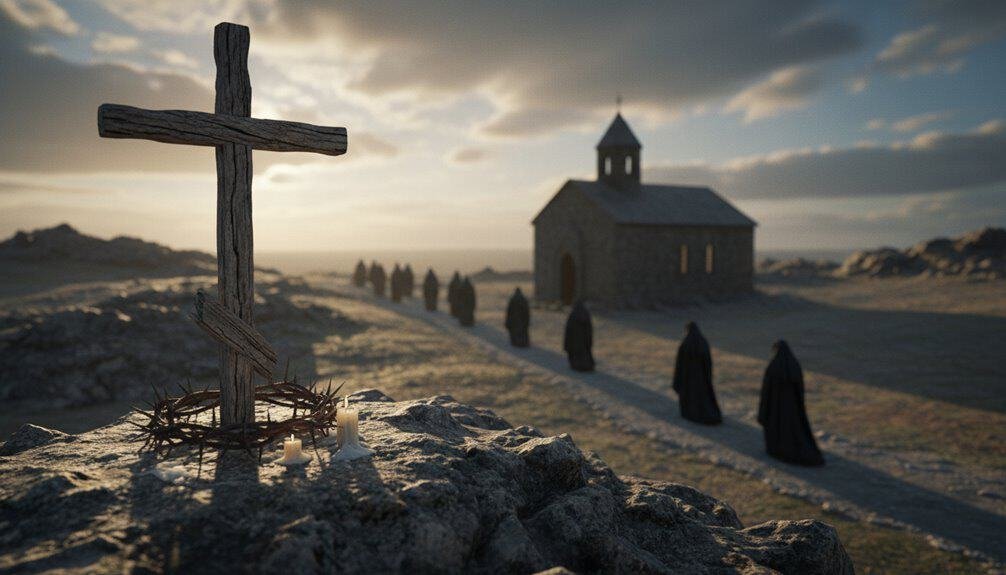
Why do Christians call the day commemorating Christ’s crucifixion “Good Friday” when it marks humanity’s darkest moment of rejecting the Son of God? You’ll find the answer lies in the term’s Middle English origins, where “good” meant “holy” or “sacred” rather than expressing modern positivity. Dating to around 1300, “goude friday” designated this as a holy observance day, similar to how Christians referenced other sacred occasions.
The designation proves theologically fitting because Christ’s crucifixion accomplishes humanity’s ultimate good—salvation through sacrificial atonement. You’re witnessing God’s redemptive plan where apparent defeat becomes victory over sin and death. This paradox resonates through modern poetry and social media posts that capture the day’s bittersweet significance.
English and Dutch uniquely preserve this “Good Friday” terminology, while most languages use “Holy Friday.” Whether derived from “God’s Friday” or maintaining the medieval sense of “holy,” you’re observing Christianity’s most pivotal day—when divine love conquered through apparent loss. Historical usage shows similar applications of good to Christmas and other religious holidays, demonstrating how medieval English consistently applied this sacred meaning across the Christian calendar.
The Biblical Story of Jesus’ Crucifixion
How does the biblical narrative unfold during history’s most consequential day? The crucifixion account presents a carefully structured sequence beginning with Pilate’s reluctant sentencing after the Sanhedrin trial. You’ll find the Roman governor declaring no legal basis for charges yet yielding to crowd demands for Barabbas’s release instead.
Pilate’s reluctant verdict reveals the political pressure that superseded Roman justice on history’s most pivotal morning.
The soldiers’ mockery—purple robe, crown of thorns, sarcastic “King of the Jews” proclamations—establishes crucial theological irony. Jesus initially carried his cross before Simon of Cyrene assumed this burden on the path to Golgotha.
The crucifixion itself involves nails through hands and feet, refused wine mixed with myrrh, and placement between two criminals. Jesus’s seven recorded sayings include “Father, forgive them” and promises of paradise. The spear thrust yielding blood and water occurs after death, with legs remaining unbroken.
When examining theology vs history, secular perspectives often focus on crucifixion’s historical brutality while missing the narrative’s soteriological significance within Christian doctrine. The crown of thorns symbolized Jesus bearing humanity’s sin, connecting to the curse of thorns following Adam’s transgression in Genesis.
Good Friday’s Theological Significance for Christians
When you examine Good Friday’s theological significance, you encounter Christianity’s central doctrine that Christ’s sacrificial death provides substitutionary atonement for humanity’s sin debt before God.
You’ll find that Scripture presents Jesus’ crucifixion as the ultimate sacrifice that satisfies divine justice while demonstrating God’s love, as Romans 5:8 declares that “God demonstrates his own love for us in this: While we were still sinners, Christ died for us.”
You must understand that this pivotal event establishes the foundation for salvation and eternal life, as Christ’s death conquers sin’s power and opens the pathway to reconciliation with the Father. The crucifixion sets the stage for the resurrection celebrated on Easter Sunday, creating the complete narrative of redemption that defines Christian hope.
Ultimate Sacrifice for Atonement
What distinguishes Good Friday‘s theological significance lies in Christianity’s central doctrine of atonement—Christ’s ultimate sacrifice that reconciles humanity to God through expiation and propitiation.
Understanding expiation vs propitiation reveals complementary dimensions: expiation removes your guilt through Christ bearing the law’s curse, while propitiation absorbs God’s wrath toward sin.
This substitutionary vs relational atonement framework demonstrates how Christ’s death satisfies divine justice while restoring interpersonal relationship.
You’ll find biblical support in 2 Corinthians 5:21, where God made the sinless Christ sin for humanity, and Galatians 3:13, where Christ became the curse for redemption.
Good Friday fulfills Leviticus 16’s Yom Kippur typology, establishing Jesus as eternal High Priest whose blood provides once-for-all forgiveness, turning divine mercy toward you. The completed atonement ensures divine double jeopardy is impossible, as God cannot condemn those whose guilt has been permanently removed through Christ’s sacrifice.
Victory Over Death
Where despair might seem the natural response to crucifixion’s brutality, Christian theology proclaims Good Friday’s cross as God’s decisive victory over sin and death itself.
You’ll discover that Christ’s sacrifice doesn’t merely represent suffering but symbolizes triumph over humanity’s greatest enemies.
Through his perfect obedience, Jesus transforms death from curse into blessing, opening pathways to heavenly hope for all believers.
Scripture declares death’s sting removed through Christ’s victory (1 Corinthians 15:55-57).
When you die in Christ’s grace, death loses its power over you, becoming instead a passage to new life.
This threefold victory—accomplished through crucifixion, resurrection, and Christ’s promised return—provides sacramental grace that unites you with God eternally, answering humanity’s deepest anxieties about mortality. As John 15:13 teaches, greater love has no one than this, to lay down one’s life for one’s friends, demonstrating the depths of divine love through Christ’s ultimate sacrifice.
Good Friday’s Connection to Passover and Easter
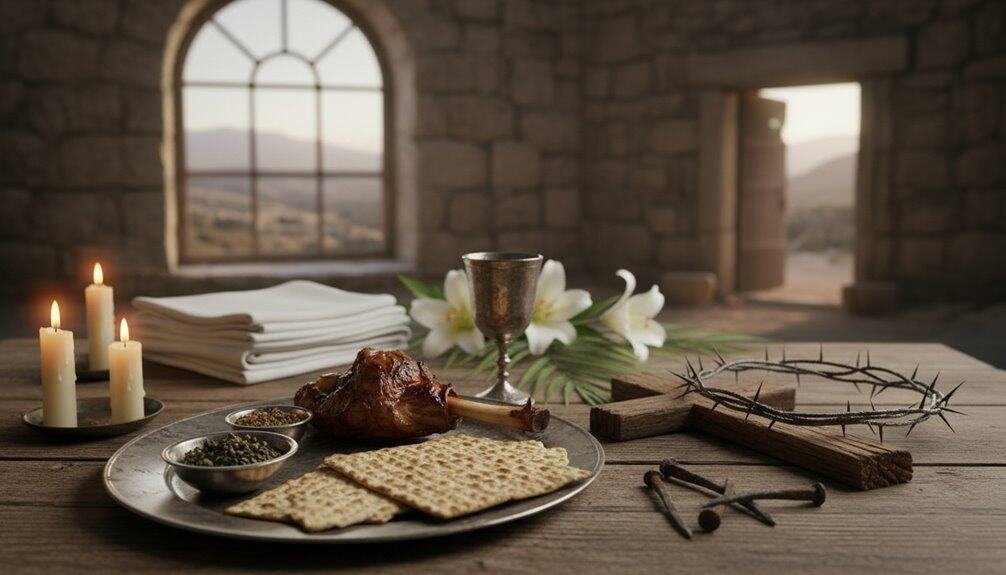
How did the ancient Jewish Passover festival become inextricably linked with Christianity’s most solemn observance? You’ll discover that Good Friday‘s timing directly corresponds to Christ’s crucifixion during Passover week, when Jesus died as the ultimate sacrificial lamb. The Gospels record His arrest following the Last Supper—a Passover meal—and His death on preparation day.
Early Christians calculated Easter based on Jewish liturgical calendars, maintaining this Passover connection until the Council of Nicaea in 325 AD established independent dating. Yet the theological bond remained unbroken: Paul explicitly called Christ “our Passover lamb,” emphasizing how His sacrifice fulfills Exodus symbolism while transcending it through resurrection.
Modern Holy Week preserves these connections through Palm Sunday’s triumphant entry, Maundy Thursday’s commemorative meal, and Good Friday’s sacrificial death. Even secular traditions reflect this heritage—Easter’s very name derives from “Pesach” in multiple languages, and lamb remains traditional Easter fare, honoring Christianity’s Passover roots.
When Christians First Observed Good Friday
When did Christians begin formally commemorating Christ’s crucifixion on Friday? You’ll find the earliest evidence traces to the second century, with Church Fathers like Ignatius (105 AD) and Barnabas (120 AD) affirming Friday’s crucifixion chronology. Irenaeus and Tertullian referenced Friday as the day of Pasch, establishing this observance decades before Constantine’s birth around 272 AD.
Unlike modern politics where practices shift with leadership changes, Good Friday‘s origins weren’t imperial mandates but emerged from early church tradition. This isn’t non theology—it’s doctrinally grounded in Gospel accounts placing Christ’s death before the Passover Sabbath.
The fourth century brought formalization. Egeria’s pilgrimage accounts describe structured Good Friday celebrations, while post-325 AD councils separated Easter’s combined commemorations. Until then, Last Supper, crucifixion, and Resurrection were observed together on Easter eve. Though termed “Good Friday” officially in 692 AD, you’re seeing observance patterns established centuries earlier through consistent Church Father consensus.
Catholic vs. Protestant vs. Orthodox Good Friday Traditions
While all Christian denominations commemorate Christ’s passion on Good Friday, you’ll encounter distinct liturgical expressions that reflect centuries of theological development and ecclesiastical tradition. Catholic practices center on structured fasting, prostration during the 3pm Liturgy of the Passion, and veneration of the Cross through kissing, while Protestant traditions emphasize scriptural meditation and solemn reflection without mandatory ritual observances. Orthodox ceremonies distinguish themselves through elaborate triple adorations, gender-separated processional veneration, and the symbolic covering of the Cross with white veils representing Christ’s entombment.
Catholic Liturgical Practices
Where liturgical traditions diverge most dramatically across Christian denominations becomes evident on Good Friday, as Catholic, Protestant, and Orthodox churches each express their commemoration of Christ’s passion through distinct ceremonial frameworks.
You’ll find Catholic observance centers on the solemn Liturgy of the Passion at 3pm, featuring prostration, cross veneration, and Great Intercessions. The church’s lighting design creates stark solemnity—candles extinguished, altars stripped bare from Holy Thursday. Modern adaptations include children’s liturgies while preserving ancient elements like wooden clappers replacing bells and progressive cross unveiling.
Protestant traditions emphasize preaching and communal prayer over elaborate ceremony. Orthodox churches conduct the Royal Hours and Vespers of Deposition, incorporating Byzantine chanting and iconographic veneration, demonstrating each tradition’s theological emphases through liturgical expression.
Protestant Worship Variations
How fundamentally do Protestant traditions reshape Good Friday observance compared to their Catholic and Orthodox counterparts? You’ll find Protestant worship emphasizes radical simplicity over elaborate ritual. Unlike Catholic Stations of the Cross or Orthodox epitaphios processions, Protestant services prioritize preaching and biblical proclamation. You won’t encounter full prostrations, ornate decorations, or Tenebrae combined with communion—practices deemed inappropriate for Good Friday’s solemnity.
Protestant theology rejects what some consider chaos theology inherent in non-biblical traditions like Lent, focusing instead on Christian liberty in devotional practices. You’ll notice Protestant services avoid secular symbolism, concentrating on Christ’s victory through the Christus Victor motif rather than ritualistic suffering. This theological precision creates distinctly Reformed worship patterns that emphasize Gospel proclamation over liturgical ceremony, fundamentally distinguishing Protestant Good Friday observance.
Orthodox Ceremonial Differences
What distinguishes Orthodox Good Friday observance most dramatically from Western traditions isn’t simply liturgical preference—it’s an entirely different theological approach to Christ’s passion and death.
You’ll encounter the Epitaphios procession, where clergy carry a shroud icon representing Christ’s tomb around the church, incorporating profound iconography symbolism absent in Catholic veneration of wooden crucifixes.
Orthodox services demand extensive prostrations throughout lengthy evening liturgies, contrasting sharply with shorter, predominantly seated Western formats.
The Julian calendar timing, preserved in monastic calendars since Nicea, creates date divergences from Catholic observance.
While Catholics limit fasting to modified meals without meat, you’ll find Orthodox practitioners maintaining strict vegan restrictions throughout Great Lent’s continuation, emphasizing ascetic discipline over Western liturgical accommodation.
Good Friday Observances: Fasting, Prayer, and Worship
When Good Friday arrives each year, Catholics worldwide enter into solemn observance through three primary disciplines: fasting, abstinence from meat, and intensified prayer and worship.
Unlike modern secular observances that focus on unrelated topics, Good Friday demands rigorous spiritual commitment rooted in Canon Law 1251.
You’re required to fast if you’re between 18-59 and in reasonable health, consuming one full meal and two smaller meals that together don’t equal a normal meal.
If you’re 14 or older, you must abstain from all meat except fish, which symbolizes Christ.
No exceptions exist for Good Friday’s meat prohibition, distinguishing it from other Lenten Fridays.
This paschal fast ideally continues through Easter Vigil, preparing you to celebrate Christ’s Resurrection more fully.
Good Friday stands as one of only two obligatory days requiring both fasting and abstinence simultaneously, connecting you to early Christian traditions of rigorous pre-Easter discipline.
The Three Hours Service and Seven Last Words Tradition
Why does the period from noon to three o’clock on Good Friday hold such profound significance in Christian liturgical tradition? You’re encountering the Three Hours service, a devotional practice originating from Jesuit priest Alphonsus Messia in eighteenth-century Lima, Peru. This observance commemorates Christ’s crucifixion during the biblical darkness that covered the land from the sixth to ninth hour.
The service centers on meditation of Jesus’s Seven Last Words from the cross, establishing direct connection between Gospel accounts and contemporary worship. You’ll find this tradition practiced across Roman Catholic, Lutheran, Anglican, Methodist, and Reformed churches worldwide, reflecting universal Christian commemoration of Christ’s sacrifice.
The liturgy incorporates solemn Passion readings, contemplative silence, and cross adoration. Pope Pius VII’s 1815 decree granting plenary indulgence underscored its theological importance. When you participate, you’re engaging Christianity’s most sacred hours, experiencing the profound mystery of Christ’s redemptive suffering through structured prayer and meditation.
Frequently Asked Questions
Is Good Friday a Federal Holiday in the United States?
No, Good Friday isn’t a federal holiday in the United States. You’ll find that only Christmas Day among religious observances receives federal recognition. While ten states designate Good Friday as a state holiday, affecting school closures in those jurisdictions, federal offices remain open nationwide. You won’t receive federal employee benefits or postal service suspension, as Congress hasn’t included Good Friday in Title V designations.
What Foods Are Traditionally Eaten or Avoided on Good Friday?
You’ll traditionally observe meat abstinence on Good Friday, avoiding beef, pork, and poultry while embracing fish and seafood alternatives like salmon, shrimp scampi, or Italian savory pies with anchovies. Many Christians practice traditional fasting, consuming only one full meal. You might enjoy meatless dishes such as escarole pie, vegetable gumbo z’herbes, or zucchini preparations. Seasonal desserts include hot cross buns, historically sold exclusively on Good Friday in various Christian traditions.
Are Businesses and Schools Typically Closed on Good Friday?
You’ll find that business hours and school closures vary significantly on Good Friday. Twelve states recognize it as a state holiday, resulting in public school closures and government office shutdowns. However, most banks, postal services, and retail establishments remain open, though stock markets close completely. Catholic and Christian private schools typically observe closures, while public schools in non-holiday states operate normally unless coinciding with spring break schedules.
How Do Different Countries Around the World Observe Good Friday?
World wide observances of Good Friday reveal striking cultural variations in Christian devotion. You’ll find Europe’s solemn church services and Spain’s elaborate processions contrasting with the Philippines’ dramatic reenactments and voluntary crucifixions. Africa incorporates indigenous drumming into liturgical worship, while Latin America creates intricate sawdust carpets and massive street processions. These diverse expressions maintain doctrinal fidelity to Christ’s Passion while reflecting each culture’s unique theological interpretation.
Can Christians Get Married or Have Celebrations on Good Friday?
You’ll find marital considerations vary significantly across Christian denominations regarding Good Friday weddings. Catholic and Eastern Orthodox churches explicitly prohibit marriages during this solemn day, viewing it as liturgically inappropriate. However, you can marry in Anglican churches if your vicar consents, though many decline due to the day’s somber nature. For celebrations during Easter weekend, you’ll need denominational approval and should expect subdued festivities respecting Christ’s passion.
Conclusion
You’ll find that Good Friday represents Christianity’s most solemn commemoration, marking Christ’s atoning sacrifice on Calvary. As you reflect on its historical development from early Christian observance to contemporary liturgical practice, you’re engaging with the theological core of redemptive history. Whether you’re participating in Catholic Tenebrae, Protestant reflection services, or Orthodox worship traditions, you’re connecting with centuries of faithful witness to the salvific significance of Jesus’ crucifixion and its eschatological implications.









No Comments