


31 Jan Come Holy Spirit: The Prayer Millennials Are Rediscovering
You’re witnessing a remarkable spiritual renaissance as millennials increasingly turn to the ancient “Come Holy Spirit” prayer, seeking authentic divine encounter beyond digital worship formats. Research shows you’re part of a generation attending church 1.8 times monthly—more than Gen X—while embracing traditional practices like Eucharistic adoration alongside contemporary mindfulness. Your cohort’s 19% growth in Jesus commitment since 2019 reflects deeper hunger for embodied community and incarnational faith. This liturgical rediscovery signals broader transformations reshaping modern Christian practice.
Table of Contents
Key Takeaways
- Millennials attend church 1.8 times monthly in 2025, showing increased engagement with traditional liturgical prayers including Holy Spirit invocations.
- Bible usage among Millennials rose from 30% to 39% in 2025, indicating renewed interest in scriptural prayers and spiritual practices.
- Commitment to Jesus grew 19% among Millennials between 2019-2025, with men showing particularly strong increases in faith engagement.
- In-person worship preferences over digital services reflect Millennials’ desire for embodied spiritual experiences including communal prayer traditions.
- Small groups provide accountability for 69% of praying Christians, creating spaces where ancient prayers like “Come Holy Spirit” gain relevance.
What Recent Data Shows About Millennial Prayer Habits and Church Attendance
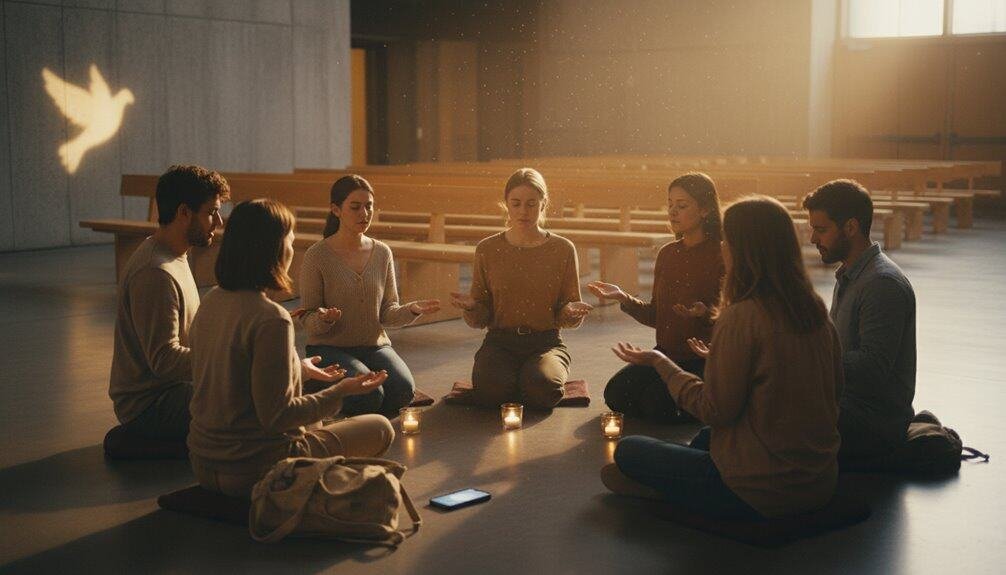
A demographic revolution quietly unfolds within America’s houses of worship as Millennials—once dismissed as spiritually disengaged—demonstrate unprecedented levels of religious participation. You’re witnessing a remarkable transformation where millennial prayer habits and church attendance patterns have fundamentally shifted the religious landscape.
Current data reveals Millennials now attend church 1.8 times monthly, representing 22 services annually—a dramatic increase from just over once monthly in 2020. This frequency surpasses Gen X’s 1.6 monthly attendance rate, marking a generational reversal where young adults lead religious engagement. Among 18-34-year-olds, only 5% converted to Christianity after not being raised in the faith, while 26% left Christianity after being raised in it.
Regarding millennial prayer practices, 46% of adults maintain daily prayer habits, with Millennials showing steady participation levels. Their commitment to Jesus grew 19% between 2019 and 2025, with Millennial men experiencing a particularly striking 19 percentage point spike. Simultaneously, Bible usage among Millennials rose from 30% to 39% in 2025, indicating deepening spiritual engagement beyond mere attendance metrics.

Why Young Adults Are Choosing In-Person Worship Over Digital Services
Why have digital worship services, once heralded as the future of religious engagement, failed to capture the sustained attention of younger believers? Post-pandemic evaluation reveals you’re increasingly favoring in person worship over virtual alternatives, driven by profound theological and social needs that screens simply can’t fulfill.
Your generation’s shift toward physical gathering represents more than preference—it’s digital burnout meeting ancient spiritual hunger. When you attend nearly twice monthly, you’re seeking embodied community that transcends technological mediation. The incarnational nature of Christian faith demands tangible presence, something virtual platforms fundamentally can’t provide.
Your desire for authentic connection pairs with social justice attunement, creating weekday engagement patterns that extend beyond Sunday services. This spiritual curiosity demands live touchpoints where you experience belonging through shared physical space. The quadrupling of UK attendance among your peers signals that digital convenience can’t substitute for the irreplaceable human elements of worship, prayer, and communal spiritual formation.
How Millennials Compare to Previous Generations in Daily Prayer Practices
Beyond collective worship patterns lies a more intimate spiritual landscape where millennials’ prayer practices reveal striking departures from generational precedent. You’re witnessing a profound generational decline in traditional prayer habits, with only 30% of young adults born 1995-2002 praying daily compared to 59% of oldest Americans. This represents a 14-point drop in daily prayer since 2007, affecting all demographic groups.
However, you’ll find millennials aren’t abandoning spirituality entirely—they’re redefining it. The tension between daily prayer vs. mindfulness becomes evident as 39% of Americans practice meditation, with millennials and Gen Z leading this shift toward contemplative alternatives. While women ages 18-29 show particularly steep declines in weekly personal prayer (53% to 38% from 2016-2024), these generations favor mindfulness practices over traditional prayer more than their predecessors, suggesting a fundamental reimagining of personal spiritual engagement.

Where Young Christians Are Finding Community Beyond Sunday Services
Where are young Christians cultivating spiritual community when traditional Sunday services no longer suffice? You’ll find them embracing diverse gathering models that transcend conventional parish boundaries. Small groups have become essential touchstones, with young adults seeking belonging through increased spiritual encounters beyond weekend worship. These intimate settings foster the accountability partnerships that 69% of praying Christians utilize when interceding for friends and family.
Digital sanctuaries play a crucial role, as 40% of Gen Z adults attend church primarily online while maintaining smartphone-enabled virtual faith connections. Yet you’re also witnessing a hunger for tangible spiritual experiences—Eucharistic adoration and confession rates have elevated among 18-29 Catholics.
Weekday disciplines flourish in home churches and alternative gatherings, where younger Christians discover rest and truth amid cultural dissatisfaction. This fragmented yet intentional approach reflects their spiritual curiosity, driving frequent engagements that supplement rather than replace traditional worship, creating multifaceted communities that address contemporary spiritual longings.
What’s Driving the Unexpected Rise in Gen Z Spiritual Engagement
How can we explain Gen Z‘s remarkable spiritual resurgence when conventional wisdom predicted their wholesale exodus from faith? You’re witnessing a generation that’s redefining spiritual engagement through authentic seeking rather than inherited tradition.
Gen Z doubts don’t diminish their faith—they intensify it. With 72% questioning God’s existence while simultaneously showing increased church attendance, you’re observing a generation that values intellectual honesty over blind acceptance. Their spiritual journey embraces uncertainty as a pathway to deeper understanding.
Their attraction to churches addressing mental health (74%) and helping the poor (78%) reveals pragmatic spirituality. You’ll find them drawn to faith communities that demonstrate tangible impact rather than empty ritual.
The proliferation of spiritual practices among 51% of UK young adults indicates hunger for transcendent experience. They’re discovering contemplative traditions, ancient prayers, and mystical encounters that previous generations overlooked. This isn’t rebellion against faith—it’s reformation through genuine spiritual exploration.
Frequently Asked Questions
What Specific Prayers Are Millennials Using Beyond Traditional Catholic Mass Prayers?
You’re witnessing millennials embrace devotional practices that integrate mindful breathing techniques with traditional Catholic prayers, particularly the Rosary and Liturgy of the Hours accessed through digital platforms. They’re combining gratitude journaling with structured liturgical prayers, creating hybrid spiritual practices. You’ll find them using prayer apps for daily devotions, engaging virtual prayer groups, and drawing from saints like Blessed Carlo Acutis for contemporary spiritual guidance and authentic holiness.
How Long Do Typical Millennial Prayer Sessions Last Compared to Older Generations?
You’ll find limited research specifically documenting millennial prayer duration compared to older generations. Available data suggests millennials engage in shorter, need-focused sessions, with 19% praying primarily at bedtime. While older generations demonstrate higher daily prayer frequencies (50% versus 31%), duration studies focus on formal settings rather than personal practices. Contemporary millennial spiritual disciplines increasingly integrate brief, intentional prayer with broader fasting practices and contemplative traditions.
Are Millennials Praying Alone or in Groups More Frequently?
You’ll find that comprehensive data on millennial prayer communities versus solo prayer patterns remains limited in current research. However, emerging studies suggest you’re witnessing a paradoxical trend: while millennials demonstrate increased engagement with contemplative solo prayer practices, they’re simultaneously seeking authentic millennial prayer communities that emphasize vulnerability and shared spiritual exploration. This generation appears to value both intimate personal prayer and meaningful communal worship experiences.
Which Life Events Most Commonly Trigger Increased Prayer Habits Among Young Adults?
Life transitions and career pressures most commonly trigger increased prayer habits among young adults. You’ll find that 56% of 18-34 year-olds have prayed compared to 41% of those 55+, with transitional seasons driving this phenomenon. Career uncertainties, relational changes, and the pursuit of meaning in an unstable environment create spiritual seeking behaviors. These formative experiences establish prayer as a coping mechanism during developmental challenges.
Do Millennials Prefer Structured Liturgical Prayers or Spontaneous Personal Prayer Styles?
You’ll find millennials gravitating toward spontaneous prayer rather than structured liturgy, reflecting broader institutional skepticism. While they’re returning to church attendance, you’re witnessing selective engagement patterns where personal spiritual practices dominate. Spontaneous prayer aligns with their preference for authentic, individualized experiences over inherited forms. However, you shouldn’t discount structured liturgy entirely—some millennials appreciate traditional elements within personalized frameworks, creating hybrid approaches.
Conclusion
You’re witnessing a profound generational shift that challenges secular predictions about declining religiosity. While you might’ve expected digital natives to embrace virtual worship, they’re actively seeking embodied spiritual experiences that previous generations took for granted. Your generation’s approach to prayer reflects broader theological questions about authenticity, community, and transcendence in an increasingly fragmented world. This resurgence suggests you’re not abandoning faith but reconstructing it through distinctly contemporary spiritual practices.









No Comments