


02 Dec Bible Story Lazarus 4 Days Dead – What Happened Next Will Leave You Speechless
When Jesus learned His friend Lazarus was dying in Bethany, He deliberately waited two more days in Perea—ensuring Lazarus would be four days dead, beyond Jewish beliefs about resuscitation. You’re witnessing calculated timing: Martha confronted Jesus outside the village while Mary collapsed at His feet in grief. After weeping at the tomb, Jesus commanded the stone’s removal despite Martha’s protests about decay. His authoritative cry “Lazarus, come out!” brought forth the bound corpse, triggering both belief and the Sanhedrin’s death plot that would accelerate Jesus’ path to crucifixion.
Table of Contents
Key Takeaways
- Jesus deliberately waited four days, ensuring Lazarus was undeniably dead according to Jewish beliefs about souls lingering three days.
- Jesus commanded “Lazarus, come out!” without touching the tomb, demonstrating resurrection power through His word alone.
- Lazarus emerged still wrapped in grave clothes, creating a public spectacle that caused many witnesses to believe.
- The miracle triggered an immediate plot by religious authorities to kill both Jesus and Lazarus.
- This resurrection accelerated Jesus’ path to crucifixion, with Caiaphas declaring “one man should die for the people.”
The Devastating News Reaches Jesus in Perea
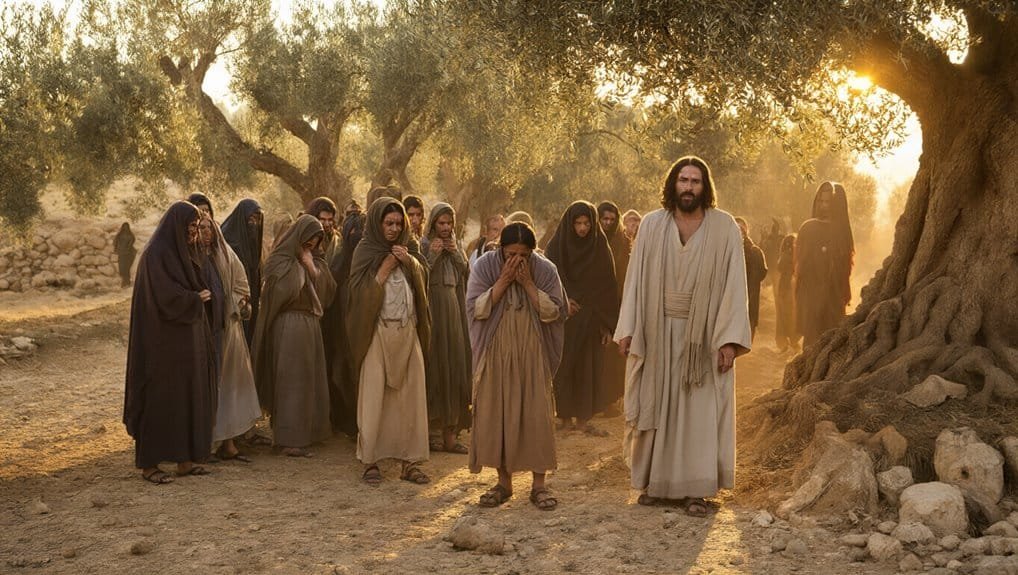
The Perean context proves significant for understanding Jesus’s deliberate delay.
Perea represented a strategic withdrawal from Judean authorities who’d recently attempted to stone him in Jerusalem. John’s Gospel emphasizes this geographical tension—Jesus had retreated precisely because the religious leaders sought his death. You’re witnessing a calculated risk: returning to Judea meant endangering not only Jesus but his disciples.
The two-day delay wasn’t indifference but divine timing.
Ancient Jewish burial practices and beliefs about the soul’s departure after three days would make the fourth-day resurrection undeniably miraculous, eliminating any possibility of resuscitation claims.
Why Jesus Deliberately Waited Two More Days
You’ll notice Jesus’s counterintuitive response to Lazarus’s illness reveals a deliberate theological strategy rooted in first-century Jewish messianic expectations.
His two-day delay wasn’t passive indifference but an active choice to orchestrate circumstances that would transcend mere healing and instead demonstrate resurrection power—the ultimate sign of divine authority. This calculated waiting period would test the disciples’ understanding of his identity while positioning the forthcoming miracle as irrefutable evidence of God’s glory breaking into human mortality.
Testing Their Faith
Why would Jesus deliberately delay His journey to Bethany when He knew Lazarus was dying?
You’ll find the answer reveals profound theological strategy.
John 11:6 explicitly states Jesus “stayed two more days” after hearing Lazarus was sick, creating deliberate tension in the narrative.
This delay wasn’t negligence but calculated testing.
The Doubt Dynamics among His disciples intensified as they questioned His Crisis Response to urgent news.
Martha’s later statement, “Lord, if you’d been here,” exposes the faith struggle His timing provoked.
Ancient Jewish belief held that souls lingered near bodies for three days; by arriving on day four, Jesus ensured Lazarus was undeniably dead, eliminating skepticism about mere resuscitation.
You’re witnessing Jesus orchestrate circumstances where only divine intervention could explain the outcome.
Displaying Divine Glory
Beyond testing faith, Jesus’s two-day delay served a greater purpose explicitly stated in John 11:4: “This sickness won’t end in death. No, it’s for God’s glory.”
You’ll notice Christ’s deliberate timing wasn’t arbitrary—it ensured Lazarus would be undeniably dead for four days, surpassing Jewish beliefs that the soul lingered three days near the body.
This calculated wait transformed a healing into resurrection, establishing Jesus’s authority over death itself.
The miraculous radiance of divine power wouldn’t merely cure illness but conquer mortality.
Martha and Mary’s grief became the stage for unprecedented revelation.
You’re witnessing strategic theology: Christ positioned himself as heavenly witness to his own deity, declaring “I am the resurrection and the life” before demonstrating this truth through Lazarus’s emergence from the tomb.
The Dangerous Journey Back to Judea
When Jesus announced his intention to return to Judea, the disciples’ immediate reaction reveals the genuine peril they faced in making this journey. You’ll notice Thomas’s stark response in John 11:16—”Let us also go, that we may die with him”—wasn’t hyperbole but reflected real threats. The Jerusalem authorities had recently attempted stoning Jesus (John 10:31), making any return potentially fatal.
You’d encounter multiple dangers traveling from Perea to Bethany. Roman patrols monitored the Jordan Valley roads, scrutinizing religious movements that might spark unrest. Bandit threats plagued the wilderness routes between Jericho and Jerusalem, where rocky terrain provided perfect ambush spots. The political climate intensified these risks—Passover approached, when Roman vigilance peaked and Jewish nationalism surged.
Yet you’ll observe Jesus’s deliberate choice to walk into danger. He wasn’t reckless; he understood divine timing superseded human safety concerns. This journey demonstrates how following God’s will sometimes means accepting calculated risks despite legitimate fears.
Martha Runs to Meet Jesus Outside the Village
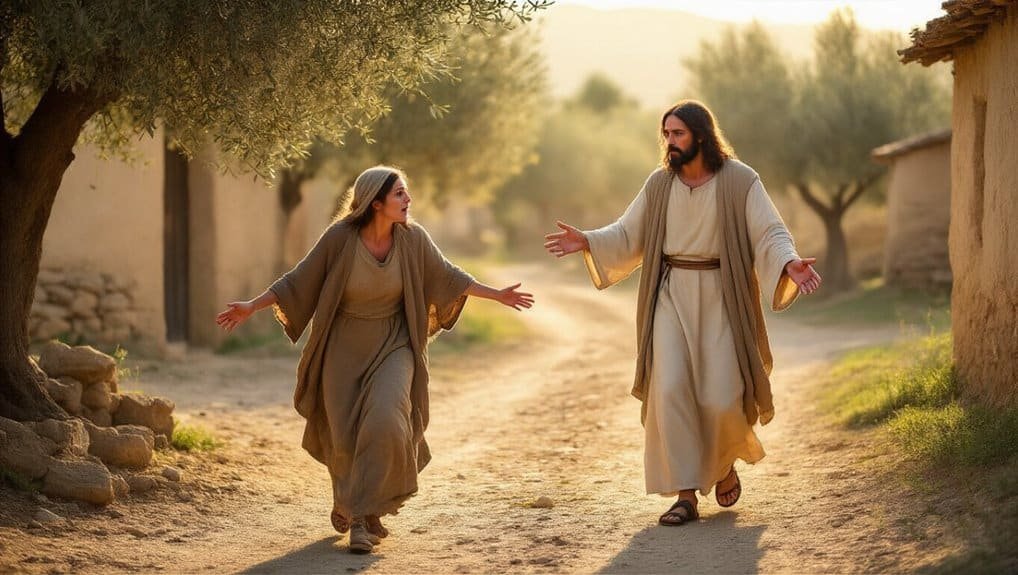
When Martha hears of your arrival, she breaks the traditional mourning protocols and runs to intercept you outside Bethany’s boundaries.
You’re confronted by a woman who simultaneously expresses raw grief (“Lord, if you’d been here, my brother wouldn’t have died”) and theological certainty about your divine authority.
Her actions reveal how first-century Jewish women could transcend social constraints when moved by faith, as she publicly engages you in one of John’s most profound christological dialogues.
Martha’s Bold Faith Declaration
Yet Martha’s bold testimony transcended mere grief. She declared, “Even now I know God will give you whatever you ask.”
This statement demonstrated her unwavering faith despite experiencing devastating loss. You’re witnessing a remarkable confession of belief in Jesus’s divine authority, occurring before any miraculous intervention.
Martha’s declaration represents one of Scripture’s most powerful expressions of faith amid tragedy.
Confronting Jesus With Grief
As word reached Martha that Jesus approached Bethany, she immediately left her house of mourning to intercept him outside the village boundaries.
You’d witness Martha’s departure from communal mourning rituals—a significant breach of Jewish custom that reveals her emotional urgency.
Her raw confession, “Lord, if you’d been here, my brother wouldn’t have died” (John 11:21), demonstrates the complex interplay between faith and grief characteristic of Second Temple Judaism.
You’re observing Martha’s confrontation occurring outside Bethany’s perimeter, away from professional mourners and ritual observers.
This geographic detail isn’t incidental—it provides privacy for theological discourse while maintaining ritual purity concerns.
Martha’s words expose both accusation and belief, a duality that ancient Mediterranean societies understood as acceptable within patron-client relationships with divine figures.
Running Despite Social Norms
While Mediterranean women typically maintained measured movements in public spaces, Martha’s sudden departure to meet Jesus violated fundamental social protocols governing female behavior in first-century Judea. You’d expect her to wait inside, receiving condolences from mourners. Instead, she abandons conventional decorum, demonstrating public defiance that would’ve shocked her community.
Her running represents social courage rarely witnessed in ancient texts. You’re seeing a woman prioritize spiritual urgency over reputation. John’s Gospel captures this breach of etiquette without condemnation, suggesting the author recognized Martha’s actions as justified by extraordinary circumstances.
She doesn’t simply walk—she hurries past neighbors who’d judge her impropriety. You can’t ignore how her physical movement mirrors her theological boldness. This isn’t mere grief; it’s calculated risk-taking that exposes Martha’s conviction that encountering Jesus supersedes cultural constraints.
Mary Falls at Jesus’ Feet in Grief
When Martha’s sister Mary finally emerges from the house and reaches Jesus, she demonstrates a markedly different response to her brother’s death than her sister had moments before. While Martha engaged Jesus in theological discourse, Mary collapses at his feet—a posture of intimate submission that reveals both her grief’s intensity and her relationship with the Teacher. You’re witnessing a profound contrast in personality and cultural mourning practices.
Mary’s physical prostration wasn’t merely emotional overflow; it reflected established Jewish mourning customs where bodily gestures expressed inner anguish. Her words echo Martha’s—”Lord, if you’d been here, my brother wouldn’t have died”—yet their delivery differs entirely. Where Martha stood and conversed, Mary falls and weeps. This distinction matters textually: John’s Gospel consistently portrays Mary in positions of devotion at Jesus’ feet, establishing a pattern of spiritual intimacy that transcends social conventions. Her grief becomes the catalyst for Jesus’ own emotional response.
Jesus Weeps at the Tomb of His Friend
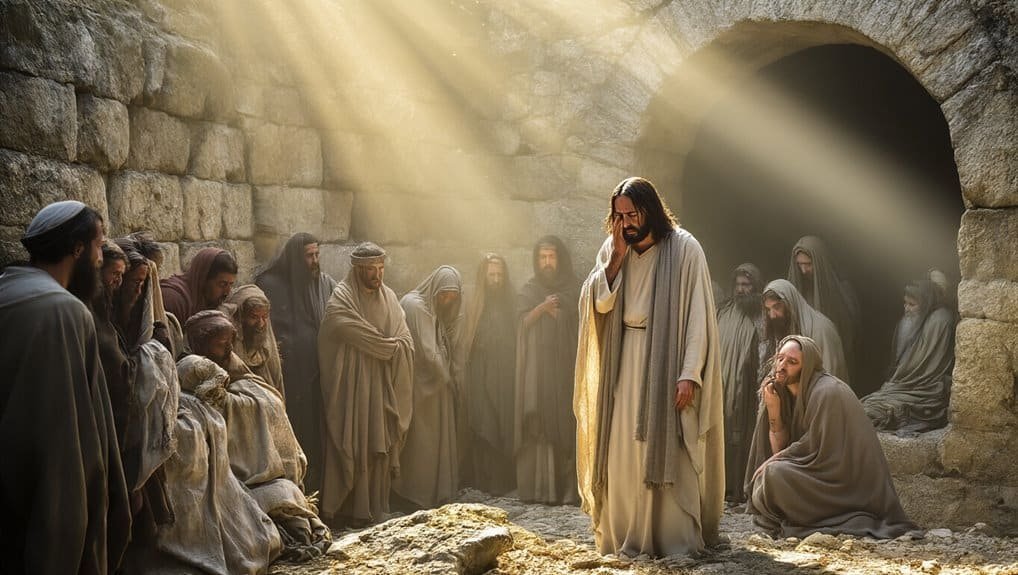
The sight of Mary’s tears and the mourners’ wailing moves Jesus to a visceral response that John records with startling brevity: “Jesus wept” (John 11:35).
You’re witnessing the shortest verse in Scripture, yet it’s laden with theological significance. The Greek verb “dakryō” indicates silent tears rather than loud lamentation, distinguishing Jesus’s response from the mourners’ demonstrative grieving.
You can’t overlook how this moment reveals divine compassion intersecting with authentic human grief. Though Jesus knows he’ll resurrect Lazarus momentarily, he doesn’t dismiss the pain surrounding him.
The text employs “embrimaomai” (deeply moved) and “tarasso” (troubled), suggesting righteous anger at death’s tyranny over creation.
First-century Jewish funeral practices involved professional mourners and seven days of shivah. You’re observing Jesus participate in these customs while simultaneously preparing to shatter death’s power.
His tears validate your own sorrow while pointing toward resurrection hope that transcends conventional mourning rituals.
The Stone Is Rolled Away Despite Martha’s Protest
As Jesus commands the removal of the tomb’s stone, Martha’s pragmatic objection cuts through the crowd’s anticipation: “Lord, by this time there’s a stench, for he’s been dead four days” (John 11:39). You’re witnessing Martha’s symbolic resistance—she who’d earlier proclaimed faith now balks at practical implications.
Her protest reveals first-century Jewish burial customs and tomb engineering: these rock-cut chambers weren’t sealed against decomposition’s reality.
Martha’s concern isn’t faithlessness but human reason confronting divine action. You’ll notice Jesus doesn’t rebuke her warning about corruption; instead, He’d already reminded her about God’s glory (11:40).
The stone’s removal becomes pivotal—it’s not merely accessing Lazarus but exposing death’s domain to divine authority.
When they roll away the stone despite Martha’s objection, you’re seeing faith override sensory expectations. The tomb’s opening transforms from potential embarrassment into revelation’s threshold, where natural decay meets supernatural restoration.
Jesus Calls Lazarus Out of the Grave
Having lifted His eyes heavenward in prayer, Jesus demonstrates divine authority through three commanding words: “Lazarus, come out” (John 11:43).
You’re witnessing an Audible Miracle—Christ’s voice penetrating death’s domain, reversing four days of decomposition.
The Gospel writer emphasizes Jesus’s loud cry, marking this as a Prophetic Announcement to all present witnesses.
You’ll notice Jesus doesn’t enter the tomb or touch the corpse, avoiding ritual defilement while proving His word alone carries resurrection power.
The specificity of calling Lazarus by name echoes rabbinic traditions about general resurrection, where each soul must be individually summoned. This deliberate naming prevents any confusion among the dead, establishing Christ’s precise authority over death’s realm.
The command’s simplicity contrasts sharply with Elijah’s and Elisha’s elaborate resurrection procedures in Kings. You’re observing not a prophet requesting divine intervention but God Himself commanding death’s reversal, fulfilling His earlier declaration: “I am the resurrection.
The Aftermath That Changed Everything
When Lazarus emerged bound in grave clothes, you’re confronting a scene that fractured Jerusalem’s religious establishment and accelerated Christ’s path to Golgotha.
Lazarus emerging from death fractured Jerusalem’s religious establishment and accelerated Christ’s inevitable path to Golgotha.
John 11:45-53 reveals the immediate political ripple: many Jews believed, but others reported to the Pharisees, triggering an emergency Sanhedrin assembly.
You’ll notice Caiaphas’s prophetic declaration—”one man should die for the people”—crystallizes the lethal opposition.
The community transformation in Bethany became undeniable.
You’re witnessing households converting, pilgrims flooding the village, and Lazarus himself becoming living testimony that threatened Temple authority.
John 12:10-11 exposes the priests’ desperation: they plotted to kill Lazarus because his existence drew crowds from their influence.
You can’t separate this miracle from its sociopolitical context.
The raising occurred during peak Passover preparations when Jerusalem swelled with pilgrims.
You’re observing how one resurrection destabilized the delicate Roman-Jewish power balance, making Christ’s crucifixion politically inevitable within days.
Frequently Asked Questions
What Illness Did Lazarus Suffer From Before His Death?
You won’t find Lazarus’s specific illness detailed in John’s Gospel, which simply states he was sick. The text’s deliberate ambiguity regarding his unknown ailment has prompted centuries of medical speculation among scholars.
You’ll notice the evangelist prioritizes theological significance over diagnostic precision, leaving you to consider whether the illness was fever-based, infectious, or neurological. This textual silence serves John’s narrative purpose—emphasizing divine power over death rather than documenting pathological specifics.
How Old Was Lazarus When He Died?
You won’t find Lazarus’s exact age in biblical texts, but through Historical Context and textual analysis, scholars place his Estimated Age between 30-40 years.
You’re looking at a man in his prime during first-century Judea, where life expectancy averaged 35-45 years.
He’s described as Martha and Mary’s brother, suggesting he’d reached adulthood but wasn’t elderly. Jewish customs and his sisters’ authority over household matters indicate he’d likely attained mature years before death.
What Happened to Lazarus After Jesus Left Bethany?
You’ll find Scripture remains silent about Lazarus’s specific activities after Jesus departed Bethany, though textual analysis suggests his later ministry profoundly shaped the community impact of early Christianity.
John 12:10-11 indicates religious authorities plotted against him because many believed through his testimony.
Early church tradition suggests you’d have encountered him as Bishop of Cyprus, where he supposedly lived thirty more years, though historical context makes verification challenging.
Did Lazarus Describe His Experience of Being Dead?
You won’t find any eyewitness testimony from Lazarus describing his death experience in the canonical gospels.
John’s account, our primary source, doesn’t record afterlife accounts from Lazarus himself.
The narrative’s silence on this matter has intrigued scholars examining textual analysis of first-century Jewish beliefs.
Within the historical context, the gospel writers focused on Jesus’s miraculous power rather than documenting near-death experiences, leaving Lazarus’s perspective notably absent from scripture.
Where Is Lazarus Buried Today?
You’ll find Lazarus’s traditional burial site in Bethany, now called Al-Eizariya, just east of Jerusalem.
The site contains ancient Bethany Tombs that’ve attracted Christian pilgrimage sites visitors since the fourth century.
Archaeological evidence suggests you’re viewing a first-century Jewish tomb complex when you visit.
While textual analysis of Gospel accounts doesn’t specify his final resting place after resurrection, Byzantine tradition established this location where you can explore the historical context today.
Conclusion
You’ve examined one of Scripture’s most profound miracles through its historical and textual layers. The narrative’s deliberate pacing—from Jesus’ calculated delay to Martha’s theological exchange—reveals John’s sophisticated literary construction. You can’t ignore how this pericope functions as the Gospel’s climactic seventh sign, prefiguring Christ’s own resurrection. The text’s emphasis on emotional authenticity alongside divine power demonstrates John’s unique christological vision: a Messiah who’s simultaneously transcendent and intimately human, weeping before conquering death itself.











No Comments