


01 Dec Bible Story King David: Shepherd, Slayer, and Scandal The Untold Secrets Behind Israel’s Greatest King
You’ve been taught David was Israel’s golden king, but the Hebrew texts expose a darker narrative. Behind the shepherd-turned-giant-slayer lies a calculating politician who married strategically, accumulated wives for tribal alliances, and orchestrated Uriah’s battlefield execution to cover his rape of Bathsheba. Nathan’s prophetic confrontation unleashed divine judgment—Absalom’s rebellion, a census plague killing 70,000, and deathbed purges securing Solomon’s throne. The real David emerges as both divinely chosen and deeply flawed.
Key Takeaways
- David’s shepherd background developed lethal combat skills, including mastery of the sling that could kill at 400 feet with speeds exceeding 100 mph.
- His rise involved calculated political marriages, tribal networking, and strategic distribution of spoils to purchase loyalty while eliminating rivals.
- The Bathsheba scandal involved sexual coercion, orchestrated murder of Uriah, and triggered dynastic consequences including rape, rebellion, and 70,000 plague deaths.
- David repeatedly spared Saul’s life in caves despite opportunities to kill him, refusing to strike “the Lord’s anointed” for theological legitimacy.
- His deathbed orders for executions of Joab and Shimei revealed ruthless power consolidation beneath the public image of covenant loyalty.
The Forgotten Son: David’s Unlikely Anointing in Bethlehem’s Fields

When Samuel arrived at Jesse’s house in Bethlehem to anoint Israel’s next king, David wasn’t even invited to the ceremony. You’d find the youngest son tending sheep in distant fields while his seven brothers paraded before the prophet. This exclusion reveals ancient Hebrew social hierarchy—youngest sons held minimal status, especially those assigned to shepherd rites, the lowliest family duty.
Yet God’s choice defied cultural expectations. The Hebrew term “qatan” (smallest/youngest) emphasizes David’s insignificance within Jesse’s household. You can imagine the sibling tensions when Samuel rejected each older brother, insisting another son remained. Jesse’s dismissive “there’s still the youngest, but he’s with the sheep” exposes familial dynamics where David’s brothers likely viewed him as irrelevant.
The anointing’s location matters too. Bethlehem’s fields, where David learned warfare against predators and developed psalmic meditation, became his training ground. You’re witnessing divine reversal—God selecting the overlooked shepherd who’d shepherd Israel.
Goliath and the Valley of Elah: How a Shepherd Boy Became a Giant Slayer
You’ll find David’s confrontation with Goliath reveals a calculated military strategy rather than mere youthful bravado, as his rejection of Saul’s armor and choice of five smooth stones reflects both shepherd warfare tactics and faith in divine protection.
When you examine the Hebrew text’s emphasis on David “running” (רָץ) toward the battle line, you’re witnessing not fear but the confidence of someone who’d already defended his flock against lions and bears.
The sling wasn’t a child’s toy but a lethal weapon capable of hurling stones at speeds exceeding 100 miles per hour, transforming this shepherd’s tool into the perfect counter to bronze-age heavy infantry.
David’s Unlikely Selection
Before Israel’s armies faced the Philistine champion in the Valley of Elah, the youngest son of Jesse tended sheep in Bethlehem’s fields, unknowingly preparing for his defining moment in biblical history.
You’d find David’s selection puzzling—he wasn’t firstborn, lacked military training, and his brothers dismissed him as insignificant.
This family rivalry intensified when Samuel bypassed Jesse’s seven older sons, recognizing divine appointment over traditional primogeniture.
His leadership potential emerged through shepherding duties.
You’ll notice David developed crucial skills protecting flocks from predators—courage, strategic thinking, and reliance on divine strength.
The Hebrew term “ro’eh” (shepherd) metaphorically signified kingship in ancient Near Eastern culture.
While his brothers served Saul’s army, David’s isolation cultivated an intimate relationship with Yahweh, evidenced through his psalms composed during those solitary nights watching sheep.
Stone Versus Sword
Though the Philistine champion stood nine feet tall and wielded bronze weaponry worth a fortune, David’s tactical choice of sling and stone reflected sophisticated military reasoning rather than desperation. You’d recognize ancient slingers as elite troops who could strike targets at 400 feet with lethal precision. David’s weapon symbolism transcended mere practicality—he rejected Saul’s armor to demonstrate faith triumphing over human strength.
The Hebrew term “qela” (sling) appears throughout military texts, marking tactical evolution in Israelite warfare. You’re witnessing more than an underdog story; David exploited Goliath’s limited peripheral vision caused by his helmet, targeting the exposed forehead.
This calculated risk-taking would define David’s military genius throughout his reign, transforming Israel from defensive tribes into an offensive regional power.
The Mad King’s Obsession: Surviving Saul’s Murderous Pursuit
You’ll find Saul’s descent into madness marked by violent episodes where he hurled his spear at David during court performances, transforming the Hebrew term *chanit* (javelin) from a symbol of royal authority into a weapon of paranoid rage.
David’s survival depended on mastering the limestone cave systems of the Judean wilderness, where he’d hide among formations like those at En Gedi while building a guerrilla network of social outcasts and debtors.
When presented with opportunities to kill Saul—cutting his robe corner in the cave and taking his spear at Gibeah—you’d witness David’s calculated restraint, recognizing that slaying Yahweh’s anointed (*mashiach*) would undermine his own future legitimacy as king.
Javelin Throwing Incidents
When the evil spirit from God descended upon Saul, the king’s madness manifested most violently through his repeated attempts to pin David to the wall with his spear.
You’ll find these javelin attacks weren’t random outbursts but calculated projectile techniques—Saul threw while David played the lyre, exploiting his vulnerability during musical service.
The Hebrew term “chanit” (spear) carries profound weapon symbolism in ancient Near Eastern culture.
You’re witnessing more than attempted murder; the spear represented royal authority and military prowess.
Saul’s inability to strike David despite multiple attempts (1 Samuel 18:11, 19:10) demonstrated his declining kingship.
Each failed throw reinforced the divine protection over David and Saul’s loss of Yahweh’s favor.
The spear that should’ve secured Saul’s throne instead became the instrument revealing his impotence against God’s anointed successor.
Cave Hiding Strategies
While Saul mobilized three thousand soldiers to hunt him down, David perfected the art of limestone cave warfare in the Judean wilderness.
You’d find him exploiting the region’s natural labyrinth—over 2,000 caves dotting the desert escarpment.
His camouflage techniques weren’t just physical; they incorporated the Hebrew concept of “seter” (hidden place), blending spiritual discipline with tactical positioning.
David’s men mastered acoustic concealment, understanding how limestone chambers distorted sound waves.
You couldn’t simply shout commands—echoes would betray your position to Saul’s scouts.
They’d communicate through predetermined hand signals and positioned sentries at acoustic dead zones.
The En Gedi caves, with their multiple chambers and narrow passages, became David’s fortress.
When Saul entered to relieve himself, you’re witnessing David’s strategic genius—he’d already mapped every escape route, turning natural formations into military advantages.
Sparing Saul’s Life
Even though David’s blade could’ve ended Saul’s life in that limestone chamber, he chose restraint—cutting only a corner of the king’s robe. You’d understand this merciful restraint better knowing the Hebrew concept of “mashuach”—the Lord’s anointed. David’s moral dilemma wasn’t just political; it was theological.
By sparing Saul twice—first at En Gedi’s cave, then at Ziph’s camp—he demonstrated revolutionary kingship ethics for ancient Near Eastern standards where regicide typically marked succession.
When you examine David’s words “Who can stretch out his hand against the Lord’s anointed and be guiltless?” you’re witnessing covenant theology in action. He’d rather endure years of persecution than violate divine appointment. This principle shaped Israel’s monarchy forever, establishing that legitimate power transfers through God’s timing, not human assassination.
Blood and Brotherhood: David’s Controversial Rise Through Political Alliances
Though David’s ascension to Israel’s throne appears divinely ordained in biblical narrative, you’ll find his political maneuvering reveals a calculated strategist who exploited tribal loyalties and familial connections with ruthless efficiency.
You can’t ignore how David’s marriage alliances secured his position—first marrying Saul’s daughter Michal for political legitimacy, then later accumulating wives from various tribes to consolidate power.
His tribal diplomacy wasn’t accidental.
You’ll notice David deliberately courted Judah’s elders while serving as a mercenary for the Philistines, building southern support before Saul’s death.
He’d send spoils of war to Judahite cities, purchasing loyalty with blood money.
When examining the Hebrew term “chesed” (covenant loyalty), you’ll see David weaponized this sacred concept, binding powerful families through calculated kindness.
His treatment of Mephibosheth—Jonathan’s disabled son—wasn’t mere compassion but shrewd politics, neutralizing potential rivals while appearing magnanimous.
You’re witnessing ancient Near Eastern realpolitik disguised as divine providence.
The Bathsheba Affair: Royal Power, Sexual Scandal, and Murder
When you examine the Hebrew text of 2 Samuel 11, you’re confronting raw abuse of monarchical power that shatters David’s carefully constructed image. The verb “laqach” (took) reveals David’s forceful acquisition of Bathsheba—there’s no romantic courtship here. You’re witnessing systematic Power Abuse: David sees, sends messengers, takes a married woman, then orchestrates her husband Uriah’s battlefield execution to conceal resulting pregnancy.
Ancient Near Eastern royal prerogatives don’t excuse what modern Consent Ethics exposes as sexual coercion. Bathsheba couldn’t refuse a king’s summons without risking death. The narrative’s sparse Hebrew deliberately emphasizes David’s actions while silencing Bathsheba’s voice—she “came,” was “taken,” then “returned.”
You’re reading state-sanctioned rape followed by judicial murder. Nathan’s parable confirms this interpretation, depicting David as a rich man stealing a poor man’s beloved lamb. The text doesn’t romanticize; it indicts through understated horror, revealing how absolute power corrupts absolutely.
Nathan’s Confrontation: Divine Judgment and the Unraveling of a Dynasty
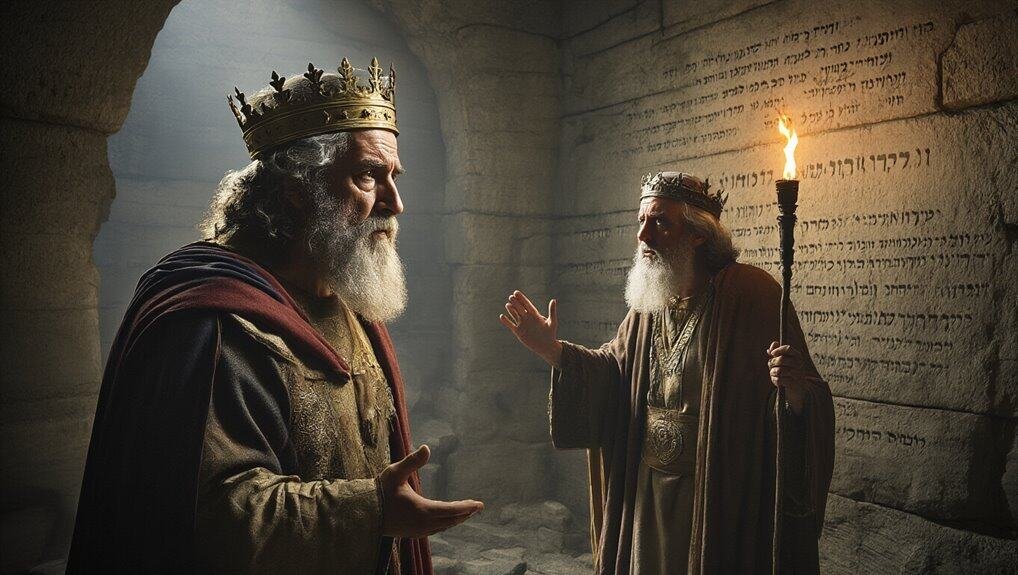
As Nathan enters David’s court in 2 Samuel 12, you’re witnessing prophetic confrontation that’ll trigger generational catastrophe.
The prophet’s parable of the rich man stealing a poor man’s lamb isn’t mere storytelling—it’s judicial entrapment designed to expose David’s moral blindness.
Nathan’s parable isn’t storytelling—it’s judicial entrapment exposing David’s moral blindness.
When David pronounces death upon the fictional oppressor, he’s unknowingly sealed his own verdict.
Nathan’s prophetic rebuke “You are the man!” (אַתָּה הָאִישׁ) strips away royal immunity.
You’re seeing covenant law supersede monarchical privilege.
The covenantal consequences Nathan announces aren’t arbitrary punishments but measure-for-measure justice: David took Uriah’s wife, so his wives’ll be taken publicly.
He killed by sword, so the sword won’t depart from his house.
The immediate death of Bathsheba’s child initiates dynastic unraveling—Amnon’s rape of Tamar, Absalom’s rebellion, Solomon’s succession crisis all stem from this moment.
You’re observing how one king’s private sin becomes Israel’s public tragedy, transforming David’s household into a theological case study of divine justice.
Absalom’s Rebellion: When David’s Own Son Led a Coup Against the Throne
After Amnon raped Tamar and Absalom murdered his half-brother in revenge, you’re watching a calculated usurper exploit David’s paralyzed justice system.
Absalom’s psychological motives weren’t merely personal vengeance—he’d identified his father’s weakness in administering mishpat (justice) within his own household.
For three years in exile, then two more in Jerusalem without seeing David’s face, Absalom crafted his strategy.
You’ll notice he positioned himself at the city gate, intercepting legal petitioners and promising the justice David couldn’t deliver.
His famous line—”If only I were judge in the land”—manipulated public frustration.
The Hebrew phrase “he stole the hearts” (vayegannev) suggests theft, not earning.
Absalom’s coup exposed Israel’s fragile regional loyalties.
He launched from Hebron, Judah’s traditional capital, exploiting north-south tensions that’d existed since Saul’s reign.
The tribal elders who’d once anointed David now crowned his rebellious son.
You’re witnessing how personal failings cascade into national catastrophe when a king can’t govern his own house.
The Census Catastrophe: Pride, Plague, and 70,000 Dead Israelites
Though the Chronicler attributes Satan’s influence and Samuel credits divine anger, you’re confronting David’s most inexplicable administrative disaster—a military census that violated Torah prohibitions and triggered divine judgment.
David’s order to count Israel’s fighting men wasn’t mere bureaucracy—it represented theological rebellion against Yahweh’s sovereignty as Israel’s true commander.
David’s census represented theological rebellion—asserting ownership over God’s people rather than recognizing divine sovereignty over Israel’s military might.
You’ll notice Joab’s resistance reveals the Counting Consequences were understood immediately.
Torah law forbade censuses without half-shekel atonement payments, recognizing that numbering God’s people implied ownership rather than stewardship.
David’s pride in military might replaced trust in divine protection, fundamentally misunderstanding Israel’s covenantal security.
The Plague Theology here demonstrates measured divine justice—David chooses three days of pestilence over longer famine or enemy pursuit.
When 70,000 die, you’re witnessing collective punishment for royal sin, typical of ancient Near Eastern thought.
The plague halts at Jerusalem’s threshing floor, where David’s sacrifice establishes the future Temple site, transforming judgment into sacred space.
Deathbed Politics: Solomon’s Succession and the Violent End of David’s Rivals
Bathsheba’s intervention orchestrates Solomon’s ascension through calculated palace eliminations. You’re witnessing David’s final commands transform into death warrants: Joab’s execution for blood guilt, Shimei’s restricted movement ending in death, Adonijah’s sanctuary-seeking proving futile.
The Hebrew concept of “damim” (bloodguilt) justifies these purges while Solomon consolidates power. Ancient Near Eastern succession patterns typically favored primogeniture, but here you’re seeing maternal maneuvering and prophetic endorsement supersede birth order.
David’s deathbed becomes an instrument of statecraft, ensuring rivals don’t survive the transition.
Frequently Asked Questions
How Many Wives and Concubines Did King David Have Throughout His Lifetime?
You’ll find David had eight named wives including Michal, Abigail, and Bathsheba, plus numerous unnamed concubines—Jerusalem alone provided him with more concubines according to 2 Samuel 5:13.
His marriage politics strengthened tribal alliances and legitimized his rule, while succession dynamics between his wives’ sons created devastating conflicts.
The Hebrew text suggests he’d accumulated at least twenty women total, reflecting ancient Near Eastern royal practices where harems demonstrated power and secured dynasties.
What Musical Instruments Did David Play and Which Psalms Did He Write?
You’ll find David mastered the kinnor (Hebrew lyre) using sophisticated harp techniques that soothed Saul’s troubled spirit.
He’s traditionally credited with composing 73 psalms, though modern psalm authorship studies suggest fewer authentic Davidic compositions.
You can identify potentially genuine works through Hebrew linguistic markers and historical references matching his life events.
Psalms 3-41 and 51-72 contain the strongest authorial connections, particularly those referencing his personal struggles and military campaigns.
How Tall Was David and What Did He Actually Look Like Physically?
You’ll find David’s height estimates vary significantly—ancient Hebrew texts suggest anywhere from 5’3″ to 6’9″ depending on cubit measurements used.
Scripture describes him as ruddy-complexioned with beautiful eyes and handsome features.
Artistic reconstructions throughout history reflect cultural biases more than historical accuracy.
The Hebrew term “admoni” indicates reddish-brown hair or complexion, while his youth and shepherd’s build suggest he wasn’t particularly imposing until later in his reign.
What Happened to David’s Friendship With Jonathan After Becoming King?
Jonathan died alongside Saul at Mount Gilboa before David’s coronation, so you’ll never see their friendship tested by kingship.
Their covenant loyalty remained unbroken through death.
You’d witness David’s lament in 2 Samuel revealing genuine grief, not political theater.
The potential political rift between Saul’s heir and David’s throne never materialized because Jonathan preemptively surrendered his claim, recognizing divine selection through their sacred brit (covenant).
How Old Was David When He Died and Where Is He Buried?
You’d find David died at an estimated age of seventy, having reigned forty years total—seven in Hebron, thirty-three in Jerusalem.
His burial site lies in the City of David, Jerusalem’s ancient southeastern hill.
The Hebrew text emphasizes he was “gathered to his fathers,” indicating dynastic continuity. Archaeological debates persist about the exact tomb location, though Byzantine and medieval traditions point to Mount Zion’s contested site.
Conclusion
You’ve traced David’s journey from shepherd to sovereign, witnessing how the “man after God’s own heart” wrestled with power’s corrupting influence. His story isn’t sanitized hagiography—it’s raw Hebrew narrative that doesn’t hide royal failures. You’ll find David’s legacy embedded in messianic expectations and Jerusalem’s eternal significance. Through political cunning, spiritual passion, and moral failure, he’d establish the Davidic covenant that shaped Israel’s theological imagination for millennia, proving that divine purpose works through deeply flawed vessels.








No Comments