


26 Nov The 10 Commandments and the New Testament: Jesus, Paul, and the Law
You’ll find Jesus doesn’t abolish the Ten Commandments but fulfills them, transforming external rules into heart-level principles in Matthew 5:17-20. He deepens murder to include anger, adultery to encompass lust, and summarizes all commandments in loving God and neighbor. Paul declares you’re “not under law but under grace” (Romans 6:14), yet he upholds the moral essence through Spirit-empowered transformation. The Jerusalem Council freed Gentiles from ceremonial law while maintaining ethical standards, showing how Christ’s work shifts obedience from stone tablets to renewed hearts.
Table of Contents
Key Takeaways
- Jesus declared he came not to abolish the Law but to fulfill it, maintaining its moral standards while revealing deeper spiritual meanings.
- Paul taught justification by faith apart from works of the law, distinguishing freedom from condemnation from freedom from ethical wisdom.
- Both Jesus and Paul summarized the commandments through love: loving God and neighbor fulfills the entire law.
- The New Covenant transforms external law-keeping into internal transformation, with God’s laws written on hearts through the Spirit.
- Jesus intensified commandments by addressing internal motives behind external acts, teaching that anger violates murder prohibitions and lust constitutes adultery.
Jesus Affirms the Eternal Nature of the Law in Matthew 5:17-20

When you examine Jesus’s words in Matthew 5:17-20, you’ll find His most direct statement about the Law’s continuing validity. “Do not think that I’ve come to abolish the Law or the Prophets; I haven’t come to abolish them but to fulfill them,” Jesus declares, immediately addressing any misconception that His ministry would nullify the Torah.
Jesus directly addresses misconceptions: He came not to abolish the Law but to fulfill it completely.
You’ll notice Christ’s emphasis on Law Permanence through His assertion that “not the smallest letter, not the least stroke of a pen, will by any means disappear from the Law until everything is accomplished.” This statement reinforces Covenant Continuity between the Old and New Testaments.
He doesn’t present Himself as replacing the Law but completing its intended purpose.
Jesus then warns that anyone who breaks “one of the least of these commandments” and teaches others accordingly will be called least in heaven’s kingdom. You’re confronted with Christ’s expectation that His followers maintain the Law’s moral standards while understanding its fulfillment through Him.
The Sermon on the Mount: Deepening the Commandments From External Acts to Internal Attitudes
Following His declaration about fulfilling rather than abolishing the Law, Jesus demonstrates precisely what this fulfillment means through six antithetical statements in Matthew 5:21-48. You’ll notice He doesn’t contradict the commandments but penetrates their surface meaning.
“You have heard…but I say to you” isn’t replacement theology—it’s revelatory deepening.
Consider His treatment of murder and adultery. The sixth commandment prohibits killing, but Jesus exposes anger’s murderous root.
The seventh forbids adultery, yet He confronts lust’s adulterous nature. This isn’t legalistic expansion; it’s motive transformation that addresses sin’s source.
Jesus reveals God’s original intent: inner righteousness that surpasses external compliance.
You can’t merely avoid physical murder while harboring hatred. You can’t claim sexual purity while entertaining lustful fantasies. The Law always aimed at heart transformation, but religious leaders had reduced it to behavioral modification. Christ’s hermeneutic restores the commandments’ spiritual dimension, showing they demand complete internal renovation, not just external conformity.
Paul’s Declaration of Freedom From the Law in Romans and Galatians
While Jesus deepened the commandments’ spiritual dimension, Paul confronts a more fundamental question: what role does the Law itself play in salvation?
You’ll find Paul’s answer revolutionary: “You aren’t under law, but under grace” (Romans 6:14).
In Galatians, he’s even more direct—you’re “justified by faith apart from works of the law” (Galatians 2:16).
Paul’s justification doctrine doesn’t abolish moral standards but relocates their foundation.
You’re free from the Law’s condemnation, not its ethical wisdom.
When he declares “Christ is the end of the law” (Romans 10:4), you must understand “end” as both termination and fulfillment.
This creates antinomian tensions that Paul himself addresses.
If you’re free from the Law, can you sin freely? “By no means!” he responds (Romans 6:2).
Your freedom isn’t license but transformation—the Spirit now writes God’s requirements on your heart, accomplishing what external commandments couldn’t achieve.
How Jesus Summarized the Ten Commandments in the Greatest Commandment
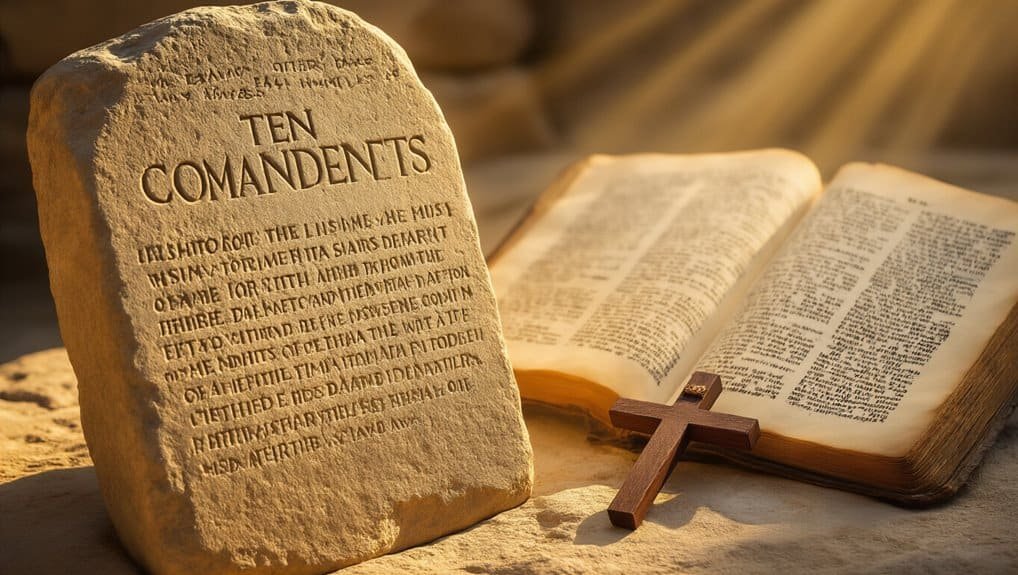
When you examine Jesus’ response to the lawyer’s question about the greatest commandment, you’ll notice He doesn’t abandon the Ten Commandments but rather distills them into two comprehensive principles.
Christ’s declaration to love God with all your heart, soul, and mind encompasses the first four commandments that govern humanity’s relationship with the divine, while His second command to love your neighbor as yourself captures the essence of commandments five through ten.
This dual framework demonstrates that Jesus viewed the Decalogue not as isolated rules but as expressions of love’s vertical and horizontal dimensions—toward God and toward others.
Two Great Commands
A profound synthesis occurs when Jesus distills the entire Decalogue into two fundamental principles. You’ll find this crystallization in Matthew 22:37-40, where he declares loving God and neighbor as the law’s essence.
The Rabbinic Background reveals similar attempts at summarization—Rabbi Hillel’s Golden Rule parallels Jesus’ approach, though Christ’s formulation proves more comprehensive.
When you examine Interfaith Comparisons, you’ll notice Buddhism’s emphasis on compassion and Islam’s balance between divine worship and social justice echo these dual commands. Yet Jesus uniquely claims these two principles contain “all the Law and the Prophets.”
You’re seeing hermeneutical genius: the first table of commandments (1-4) collapses into loving God, while the second table (5-10) becomes loving neighbor. This isn’t reduction but concentration—you haven’t lost the Ten Commandments; you’ve discovered their unified heart.
Fulfilling All Ten
The Greatest Commandment doesn’t merely summarize the Decalogue—it reveals its internal architecture.
When you examine Jesus’s synthesis, you’ll discover how love for God encompasses commandments one through four, while love for neighbor fulfills five through ten.
This isn’t reductionism—it’s penetrating to the law’s essence within its Covenantal Context.
You’re seeing Jesus demonstrate that the Ten Commandments were never isolated moral imperatives but interconnected expressions of covenant loyalty.
The vertical dimension (God-ward) establishes the foundation for horizontal relationships (human-ward).
Contemporary Ethics often misses this integration, treating moral principles as autonomous categories rather than unified covenant obligations.
Notice how Jesus doesn’t abolish specificity but provides the hermeneutical key for application.
You can’t claim to love God while worshipping idols, nor love your neighbor while coveting their possessions.
The Rich Young Ruler: Jesus Points Back to the Commandments for Eternal Life
How did Jesus respond when someone asked Him directly about obtaining eternal life?
When the rich young ruler approached Jesus with this question, Christ’s answer was striking: “If you want to enter life, keep the commandments” (Matthew 19:17).
Jesus didn’t introduce new requirements but pointed directly to the Decalogue, specifically listing the fifth through ninth commandments.
You’ll notice Jesus’s response reveals the ethical demands of God’s law remain unchanged.
The young man claimed he’d kept these commandments, yet something was lacking.
Jesus then exposed his heart’s true allegiance: “Sell your possessions and give to the poor” (Matthew 19:21).
This wealth renunciation wasn’t adding an eleventh commandment but revealing the man’s violation of the first—he’d made riches his god.
The encounter demonstrates that Jesus upheld the commandments as the path to life while penetrating beyond external compliance to heart-level obedience.
You can’t compartmentalize the law; breaking one commandment means breaking them all.
Paul’s Teaching on Love as the Fulfillment of the Law in Romans 13:8-10
While Jesus pointed to the commandments as the path to life, Paul’s epistle to the Romans reveals love as the law’s ultimate fulfillment. In Romans 13:8-10, you’ll find Paul distilling the commandments into one principle: “Love your neighbor as yourself.”
Paul distills the commandments into one transformative principle: Love your neighbor as yourself—the law’s ultimate fulfillment.
He explicitly lists prohibitions against adultery, murder, theft, and coveting, then declares these’re summed up in neighbor-love. Paul’s hermeneutical move isn’t abolishing the law but penetrating its essence.
You’re seeing ethical motivation transformed from external compliance to internal compassion. Love becomes the interpretive key that unlocks the law’s purpose.
When you love others, you won’t harm them—you’ll naturally fulfill what the commandments require. This teaching strengthens social cohesion by grounding community ethics in mutual care rather than mere rule-following.
Paul’s concluding statement that “love is the fulfillment of the law” doesn’t negate the commandments but reveals their heart. You’re witnessing Paul’s profound insight: authentic love accomplishes what legal codes alone can’t achieve.
The Sabbath Controversies: Jesus Redefines Rest and Sacred Time
When you examine Jesus’ Sabbath healings and the grain field incident, you’ll discover He wasn’t abolishing the fourth commandment but exposing the Pharisees’ legalistic distortions that had obscured God’s original intent.
His declaration “The Son of Man is Lord of the Sabbath” (Mark 2:28) establishes His authority to interpret the commandment’s true meaning—that the Sabbath was created for humanity’s benefit, not as a burden of restrictive regulations.
Through these confrontations, Jesus demonstrates that acts of mercy and meeting genuine human needs don’t violate the Sabbath but actually fulfill its purpose of bringing restoration and pointing to God’s redemptive work.
Healing on Sabbath
Because Jesus performed multiple healings on the Sabbath, he sparked intense theological confrontations that revealed fundamental differences between his understanding of God’s intentions and the Pharisees’ interpretative framework.
You’ll notice Jesus deliberately chose synagogue settings for these healings, challenging established medical practices that prohibited non-emergency care.
When he healed the man with the withered hand (Mark 3:1-6), he exposed the absurdity of their position: they’d rescue an animal but wouldn’t restore a human.
His rhetorical question—”Is it lawful to do good or harm on the Sabbath?”—reframed the entire debate.
You’re seeing Jesus argue that withholding healing contradicts the Sabbath’s purpose of liberation.
The synagogue dynamics shifted as crowds witnessed these acts, recognizing divine authority that transcended rabbinic restrictions.
Grain Field Incident
How did picking grain on the Sabbath become a flashpoint for redefining religious authority? When you examine the historical context of Mark 2:23-28, you’ll discover that Jesus‘ disciples weren’t harvesting—they were exercising the Torah’s provision for the hungry to glean from fields. The Pharisees’ objection wasn’t about theft but about their interpretation that plucking constituted prohibited work.
You’ll notice Jesus doesn’t deny the Sabbath’s validity. Instead, he cites David eating consecrated bread, establishing a hermeneutical principle: human need supersedes ceremonial law. The agricultural practices of first-century Palestine allowed gleaning, but rabbinic tradition had added thirty-nine categories of forbidden work. Jesus’ declaration that “Sabbath was made for man” directly challenges the oral law’s authority while affirming the commandment’s original intent—God’s provision for human flourishing.
Lord of Sabbath
What authority did Jesus claim when he declared himself “Lord of the Sabbath”?
You’ll find this title usage appears in all three Synoptic Gospels (Matthew 12:8, Mark 2:28, Luke 6:5), marking a pivotal moment in Jesus’s self-revelation.
He doesn’t merely interpret Sabbath law—he claims sovereignty over it.
The Christology implications are profound.
By asserting lordship over the Sabbath, Jesus places himself above the Mosaic institution itself.
You’re witnessing him claim divine prerogative, since God alone established the Sabbath at creation (Genesis 2:2-3).
This isn’t reformist teaching; it’s a declaration of ontological authority.
Jesus positions himself as the Sabbath’s source and ultimate arbiter, effectively claiming equality with the Lawgiver.
When you examine this claim alongside his other “Lord” statements, you’ll recognize a consistent pattern of divine self-identification.
The Jerusalem Council and the Gentile Question: Which Laws Still Apply?
When the early church faced its first major theological crisis, the apostles and elders convened in Jerusalem around 50 AD to determine whether Gentile converts needed to follow the Mosaic Law for salvation.
You’ll find in Acts 15 that Peter declared God showed no distinction between Jews and Gentiles, granting both salvation through faith. James confirmed this ethnic inclusion by citing Amos 9:11-12, demonstrating God’s plan always encompassed the nations.
The council’s decision reveals crucial theological priorities. They didn’t require circumcision or full Torah observance but issued four prohibitions: abstaining from idol meat, blood, strangled animals, and sexual immorality.
You’re seeing the apostles distinguish between salvation requirements and community harmony practices. While Temple authority remained significant for Jewish believers, Gentiles weren’t bound to ceremonial laws. This ruling established that moral commands transcended ethnic boundaries while ritual requirements didn’t. The council effectively separated the universal ethical core of God’s law from its particular Jewish expressions.
The Role of the Ten Commandments in Paul’s Moral Teaching to Christian Communities
Building on the Jerusalem Council’s distinction between moral and ceremonial law, Paul’s epistles demonstrate a sophisticated integration of the Decalogue’s ethical framework into his teaching for mixed Jewish-Gentile congregations.
You’ll notice Paul doesn’t simply quote commandments verbatim but recontextualizes them through Christ’s fulfillment of the law. His Paulean casuistry appears in Romans 13:8-10, where he synthesizes the second table into love of neighbor, arguing that love fulfills the law’s intent.
Paul’s approach to conscience formation reveals his hermeneutical method. He transforms “You shan’t covet” into broader teachings on contentment (Philippians 4:11-13) and warns against greed as idolatry (Colossians 3:5).
When addressing Corinthian disputes, he applies Decalogue principles situationally—sexual ethics derive from the seventh commandment, while food sacrificed to idols requires nuanced application based on weaker brothers’ consciences. You’re seeing Paul establish moral boundaries that preserve the commandments’ essence while adapting their application for diverse communities navigating Greco-Roman society.
The New Covenant Promise: God’s Law Written on Hearts Rather Than Stone
Paul’s adaptive application of the Decalogue points toward a deeper transformation promised in Jeremiah 31:31-34 and fulfilled through Christ’s mediating work. You’ll find this covenant shift fundamentally alters how believers relate to God’s commands.
Rather than external stone tablets, the law now undergoes Heart Inscription through the Spirit’s indwelling presence.
This Divine Renewal doesn’t abolish moral requirements but internalizes them. When you examine 2 Corinthians 3:3, Paul contrasts tablets of stone with tablets of human hearts, demonstrating how the Spirit writes God’s character into believers’ consciousness.
The Spirit writes God’s character directly into believers’ consciousness, transforming external compliance into internal renewal.
You’re no longer dependent on external compliance but experience internal transformation.
The prophetic promise becomes reality through regeneration. Hebrews 8:10 confirms this new covenant dynamic where God places His laws in minds and writes them on hearts.
You don’t merely observe commandments; they become part of your renewed nature through Christ’s redemptive work.
Frequently Asked Questions
Are Christians Required to Follow Old Testament Dietary Laws and Food Restrictions?
You’re not required to follow Old Testament dietary laws.
The New Testament establishes a ceremonial distinction between moral and dietary regulations.
Acts 15 and Mark 7:19 demonstrate Christ declared all foods clean.
Paul’s epistles confirm you’re free from food restrictions (Romans 14:14-17, Colossians 2:16).
While you can apply health principles for wellness, salvation doesn’t depend on dietary observance.
The covenant change released you from these ceremonial requirements.
How Do the Ten Commandments Relate to Church Discipline and Excommunication Practices?
You’ll find the Ten Commandments provide the moral framework for church discipline practices.
When you examine Matthew 18:15-17, you’re seeing Jesus establish restorative discipline procedures for addressing commandment violations.
Paul’s instructions in 1 Corinthians 5 demonstrate how communal accountability enforces moral boundaries derived from the Decalogue.
You’re implementing these principles when churches practice excommunication for unrepentant sins like adultery, theft, or idolatry—violations directly tied to specific commandments.
What Happens to Christians Who Repeatedly Break the Ten Commandments After Salvation?
If you’re repeatedly breaking commandments after salvation, you’re experiencing stunted progressive sanctification rather than losing salvation.
Scripture indicates believers can’t lose eternal life (John 10:28), but persistent sin brings temporal discipline (Hebrews 12:6) and loss of rewards (1 Corinthians 3:15).
While eternal consequences aren’t salvation loss, you’ll face God’s corrective discipline, damaged fellowship, and potential physical death (1 Corinthians 11:30).
True believers eventually repent through the Spirit’s conviction.
Do the Ten Commandments Apply Differently to Clergy Versus Lay Believers?
You’ll find the Ten Commandments establish moral equality between clergy and laity – they’re binding on all believers equally.
However, Scripture does impose higher vocational standards on church leaders regarding character and conduct (1 Timothy 3, Titus 1).
While you’re not held to different commandments based on position, James 3:1 warns teachers face stricter judgment.
Paul’s letters consistently show moral obligations remain universal, though pastoral accountability intensifies for those shepherding God’s flock.
How Did Early Church Fathers Interpret the Ten Commandments After the Apostles?
You’ll find early church fathers transformed the Decalogue through Patristic Exegesis, reading commandments as spiritual allegories pointing to Christ’s fulfillment of the Law. They’ve interpreted prohibitions against murder and adultery as condemning anger and lust respectively.
Monastic Interpretations emphasized radical obedience, viewing commandments as minimum requirements while pursuing perfection through poverty, chastity, and obedience. You’re seeing hermeneutical shifts from literal Jewish observance to christological and ascetic applications.
Conclusion
You’ve seen how Jesus and Paul don’t abolish the Ten Commandments but transform them through the lens of love and grace. While you’re not bound by the law for salvation, the moral principles within the commandments remain relevant as they’re now written on your heart through the Spirit. The evidence shows that the New Testament writers consistently upheld the ethical core of the Decalogue while rejecting legalistic observance, calling you to embody these principles through Christ’s transformative power.










No Comments