


01 Dec Bible Story Joseph From Pit to Palace – The Betrayal and Comeback That Saved a Nation
You’re encountering the Hebrew narrative where Joseph’s ketonet passim—that royal coat marking him as chosen heir—sparked murderous jealousy among his brothers near Dothan. They sold him for twenty silver shekels to Ishmaelite traders, yet through false accusations in Potiphar’s house and forgotten promises in beit ha-sohar prison, Yahweh orchestrated his rise. When Pharaoh’s chartumim failed to interpret divine dreams, Joseph credited Elohim and saved Egypt from famine, ultimately declaring “You meant evil, but God meant good.”
Table of Contents
Key Takeaways
- Joseph’s brothers sold him into slavery for twenty silver shekels after plotting murder, deceiving their father Jacob with his bloodied coat.
- Despite false accusations from Potiphar’s wife leading to imprisonment, Joseph maintained integrity and experienced God’s continued favor.
- Joseph accurately interpreted dreams for Pharaoh’s cupbearer and baker while imprisoned, though the cupbearer forgot him for two years.
- Pharaoh’s troubling dreams about seven years of plenty followed by famine led to Joseph’s elevation as Egypt’s second-in-command.
- Joseph’s wise governance during famine enabled reconciliation with his brothers, saving his family and preserving Israel’s future tribes.
The Favored Son and the Coat of Many Colors
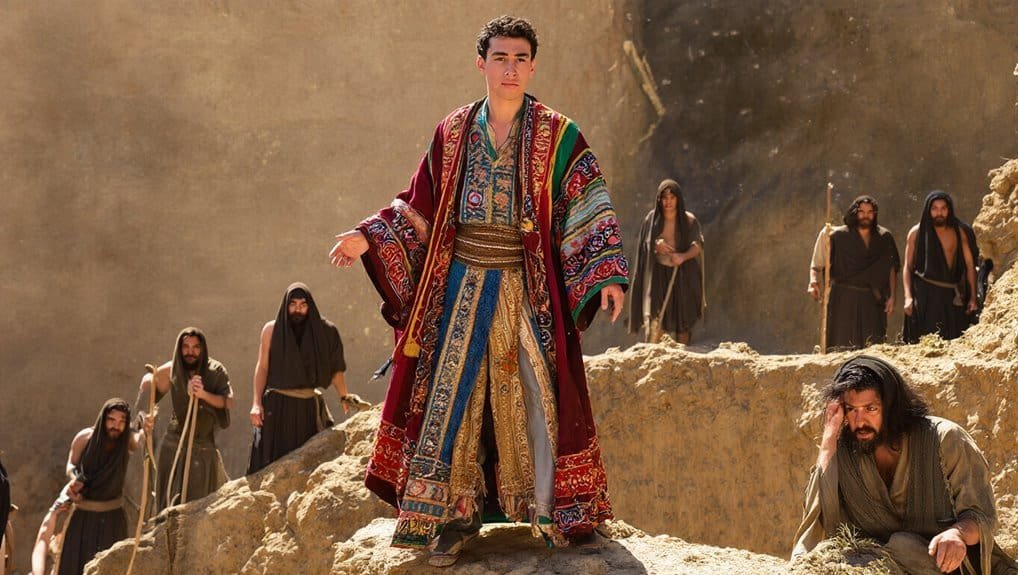
When Jacob settled in Canaan after his years of exile, his household dynamics set the stage for one of Scripture’s most profound narratives of divine providence. You’ll find Joseph, born to Rachel after years of barrenness, occupied a unique position as Jacob’s eleventh son. The Hebrew term “ben-zekunim” (son of old age) reveals why Jacob’s parental favoritism manifested so intensely toward this particular child.
The ketonet passim—traditionally rendered “coat of many colors”—wasn’t merely decorative clothing. You’re witnessing coat symbolism that designated royal status and exemption from manual labor.
The ketonet passim marked Joseph’s royal status and exemption from manual labor, not mere decoration.
This long-sleeved tunic, possibly adorned with strips or patches, marked Joseph as Jacob’s chosen heir despite birthright conventions favoring Reuben. When you examine ancient Near Eastern customs, such garments signified administrative authority rather than field work.
Jacob’s gift effectively announced Joseph’s elevation above his brothers, igniting jealousy that would catalyze God’s redemptive plan for Israel’s preservation during coming famine.
Betrayal in the Wilderness: Sold Into Egyptian Slavery
As Joseph approached his brothers tending flocks near Dothan, approximately twenty miles from their father’s camp in Hebron, the simmering hatred born from years of preferential treatment reached its violent climax.
You can imagine their rage when they spotted his distinctive coat—the ketonet passim—approaching across the desert isolation. “Here comes the dreamer,” they’d sneered, their Hebrew words dripping with contempt.
Initially planning murder, Reuben intervened, suggesting they cast Joseph into a bor (cistern) instead.
While they ate bread, Midianite traders—also called Ishmaelites—appeared with their caravan heading to Egypt. Judah proposed selling Joseph for twenty silver shekels, the standard price for a teenage slave.
You’ll notice divine providence working through human wickedness: Egypt’s becoming Joseph’s destination wasn’t coincidental. The brothers dipped his coat in goat’s blood, deceiving Jacob into believing wild animals had devoured his beloved son.
Their act of betrayal would haunt them for decades.
Rising Through Adversity in Potiphar’s House
You’ll witness Joseph’s remarkable ascent from Hebrew slave (‘eved) to trusted overseer of Potiphar’s entire estate, a position typically reserved for Egyptian nobility in the hierarchical society of ancient Egypt.
When Potiphar’s wife repeatedly demands “lie with me” (shichvah immi), you’re confronted with Joseph’s unwavering refusal to “sin against God” despite the certain consequences of rejecting an Egyptian noblewoman’s advances.
His choice reveals how covenant faithfulness transcends social position—he’d rather face false imprisonment than violate the divine moral order that governs all human relationships.
Slave to House Manager
Though Joseph entered Potiphar’s household as a purchased slave from the Ishmaelite traders, the Hebrew text emphasizes that “Yahweh was with Joseph” (וַיְהִי יְהוָה אֶת־יוֹסֵף), marking a theological turning point where divine providence operates within the constraints of human bondage.
You’ll notice Joseph’s cultural assimilation didn’t compromise his Hebrew identity—he mastered Egyptian household protocols while maintaining covenant faithfulness.
His management ethics reflected Torah principles despite operating in a pagan context. The verb “prospered” (מַצְלִיחַ) appears repeatedly, indicating continuous divine blessing transforming servitude into stewardship.
Potiphar recognized this supernatural favor, entrusting Joseph with complete authority except over his wife. This Egyptian captain’s unprecedented decision to place a Hebrew slave over native-born servants demonstrates how God’s presence transcends ethnic and social barriers in ancient Near Eastern hierarchies.
Resisting Potiphar’s Wife
When Potiphar’s wife cast her eyes upon Joseph (וַתִּשָּׂא אֵשֶׁת־אֲדֹנָיו אֶת־עֵינֶיהָ), the Hebrew construction reveals predatory intent rather than mere attraction—she “lifted up her eyes,” a phrase typically denoting calculated assessment before action. You’d witness Joseph’s moral courage crystallize as he refused her daily advances, demonstrating boundary setting that transcended social hierarchy.
His response—”How can I do this great wickedness and sin against God?”—frames adultery as חַטָּאת (chatta’t), missing the mark of divine purpose.
Egyptian household dynamics amplified the danger. You’re seeing a slave reject his master’s wife, risking execution. Joseph’s flight from her grasp, leaving his garment behind, parallels his earlier stripping by his brothers—both times, clothing becomes evidence of innocence misrepresented as guilt.
False Accusations and Years Behind Prison Walls

As Joseph served faithfully in Potiphar’s household, the Hebrew text reveals a devastating reversal through the phrase “vayehi ka-hayom hazeh” (and it came to pass on a certain day), marking a pivotal moment when Potiphar’s wife falsely accused him of attempted assault.
You’d expect justice to prevail, but instead, Joseph faced wrongful incarceration in the royal prison, “beit ha-sohar” (house of roundness), likely a circular fortress where political prisoners languished.
Despite this injustice, you’ll notice Joseph’s emotional resilience never wavered. The text emphasizes “Adonai was with Joseph” even in chains, transforming his darkest hour into preparation for divine purpose.
He didn’t succumb to bitterness but maintained his integrity, interpreting dreams for Pharaoh’s cupbearer and baker. Ancient Egyptian records confirm dream interpretation’s significance in royal courts, validating Joseph’s skills. His years behind prison walls weren’t wasted—they refined his character and positioned him for Egypt’s second-highest office.
Dream Interpretation: The Gateway to Pharaoh’s Court
You’ll witness Joseph’s forgotten years in prison extend when the chief cupbearer fails to mention him to Pharaoh for two full years, the Hebrew text emphasizing this delay with “yamim” (days upon days).
When Pharaoh’s disturbing dreams of seven cows and seven heads of grain confound Egypt’s entire priesthood and magician class, you’re seeing God’s sovereignty orchestrate events that no Egyptian divination could comprehend.
Through Joseph’s interpretation—crediting not himself but Elohim as the source of revelation—you’ll recognize how ancient Near Eastern dream culture becomes the vehicle for divine wisdom that would preserve not just Egypt but the covenant people during the coming famine.
Butler’s Forgotten Promise
Though Joseph had interpreted the chief butler’s dream with divine precision, revealing his restoration to Pharaoh’s service within three days, the Hebrew text captures a devastating betrayal in two simple words: “vayishkachehu” (וַיִּשְׁכָּחֵהוּ) – “and he forgot him.”
This forgetting wasn’t merely an oversight but represents a deliberate abandonment, as the verb שָׁכַח (shakach) in this context implies willful neglect rather than passive memory loss.
You’re witnessing forgotten gratitude at its most cruel—the butler’s moral accountability dissolved the moment he regained power.
Ancient Egyptian court protocol demanded reciprocal loyalty, making his silence even more damning.
Joseph’s plea “remember me” (זְכַרְתַּנִי) echoes through two additional years of imprisonment.
Providence orchestrates this delay, transforming Joseph’s suffering into divine timing for Egypt’s salvation.
Pharaoh’s Troubling Dreams
Two years after the butler’s betrayal, Pharaoh stands at the Nile’s edge in his dream, watching seven sleek cows emerge from the waters—then seven gaunt ones devour them whole.
You’d witness the same pattern with grain: seven plump heads consumed by seven withered ones.
These weren’t ordinary dreams—they’re divine messages demanding interpretation.
Royal anxiety grips Egypt’s throne. Pharaoh’s חלום (chalom—dream) disturbs his רוח (ruach—spirit), creating court turmoil as magicians and wise men fail to decode heaven’s warning.
You’re seeing God orchestrate Joseph’s elevation through Pharaoh’s distress.
Ancient Egyptian dream texts confirm rulers’ dreams carried national significance, but Egypt’s חרטמים (chartumim—magicians) can’t penetrate Yahweh’s revelation.
The butler finally remembers Joseph, confession born from crisis.
You’ll discover how God’s timing transforms forgotten prisoners into kingdom advisors.
Divine Wisdom Revealed
When Joseph enters Pharaoh’s presence, he immediately deflects personal glory: “It’s not in me—God will give Pharaoh שָׁלוֹם (shalom—peace).”
You’re witnessing theological confrontation between Egypt’s failed mysticism and Yahweh’s sovereign revelation.
Joseph’s interpretation doesn’t merely decode symbols—it demonstrates spiritual illumination that transcends human wisdom. The seven fat cows and seven lean cows aren’t random imagery; they’re divine communication requiring moral discernment to grasp both meaning and mandate.
You’ll notice Joseph doesn’t stop at interpretation. He prescribes action: appoint a פָּקִיד (paqid—overseer), implement systematic grain storage, prepare for crisis.
This isn’t fortune-telling—it’s prophetic wisdom married to practical governance. Egypt’s magicians couldn’t access this realm because they lacked covenant connection to revelation’s source.
Reconciliation and Redemption: When Brothers Meet Again
Joseph’s tears revealed divine orchestration: “You meant it for evil, but God meant it for good” (*Genesis 50:20*).
This sibling forgiveness transcended human capability, reflecting *chesed* (covenant loyalty).
You’re seeing restored relationships that preserved Israel’s nascent tribes during famine.
Joseph’s Egyptian name, Zaphenath-Paneah (“God speaks and lives”), proved prophetic as reconciliation brought life to Jacob’s household, ensuring the covenant’s continuity through Egypt’s crucible.
Frequently Asked Questions
How Many Years Passed Between Joseph’s Enslavement and Becoming Egypt’s Second-In-Command?
You’ll find approximately thirteen years passed between Joseph’s enslavement and his rise to power. The chronology debate centers on Hebrew textual clues: he’s sold at seventeen (Genesis 37:2) and stands before Pharaoh at thirty (Genesis 41:46).
Timeline reconstruction reveals he spent roughly eleven years in Potiphar’s house and prison, then two more years after interpreting the cupbearer’s dream. You’re witnessing God’s providence through this precise temporal framework of suffering-to-sovereignty.
What Specific Egyptian Customs and Laws Did Joseph Have to Learn?
You’d need to master Egyptian taxation systems that differed vastly from Hebrew tribal structures, learning hieroglyphic record-keeping for grain collection and distribution.
You’d study court procedures where Pharaoh held divine status as Horus incarnate, unlike Israel’s theocratic model.
You’d navigate protocols for dream interpretation (חלום/chalom), agricultural cycles tied to Nile flooding, and complex bureaucratic hierarchies.
You’d adapt to polytheistic religious ceremonies while maintaining covenant faithfulness—a delicate balance requiring wisdom.
Did Joseph Have Any Children, and What Were Their Names?
You’ll find Joseph had two sons: Manasseh (meaning “forgetting”) and Ephraim (meaning “fruitful”).
Born to Asenath in Egypt before the famine, they’re crucial to tribal origins as Jacob adopted them, elevating them to patriarchal status alongside his own sons.
The blessing significance appears when Jacob crossed his hands, giving the younger Ephraim precedence over Manasseh—a prophetic reversal pattern throughout Hebrew scripture. They’d become two of Israel’s twelve tribes, replacing Joseph’s single portion.
What Happened to Potiphar’s Wife After She Falsely Accused Joseph?
You won’t find Potiphar’s wife’s unnamed fate recorded in Scripture. The Hebrew text (Genesis 39) doesn’t reveal any legal repercussions she faced after falsely accusing Joseph of attempted assault.
Ancient Egyptian law typically punished false accusers, but the narrative’s silence suggests she escaped earthly judgment.
Her disappearance from the biblical account serves a theological purpose—highlighting God’s sovereignty over Joseph’s destiny rather than focusing on human justice against his accuser.
How Did Joseph’s Story Influence Later Biblical Prophets and Teachings?
You’ll find Joseph’s narrative shaped prophetic consciousness through typological foreshadowing of messianic suffering and exaltation.
Later prophets recognized him among Scripture’s moral exemplars—Daniel paralleled his court wisdom, while Isaiah’s suffering servant echoes Joseph’s unjust imprisonment.
The Hebrew term “mashal” (parable/example) captures how prophets used Joseph’s story to teach divine providence.
You’re seeing Jeremiah invoke Joseph’s pit experience, and Ezekiel reference his economic reforms during teaching about righteous leadership.
Conclusion
You’ve witnessed Joseph‘s journey from בֹּור (bor, pit) to Egyptian throne, where divine providence transformed betrayal into salvation. His story reveals how God’s חֶסֶד (chesed, covenant faithfulness) operates through human suffering to accomplish redemption. You’re called to recognize that your deepest wounds can become instruments of healing for others. Joseph’s declaration “You meant it for evil, but God meant it for good” echoes through history, reminding you that no pit is beyond God’s redemptive reach.











No Comments