


04 Dec Bible Story Jacob From Deceiver to Destiny – The Night Jacob Wrestled and Won a New Name
You’re about to encounter Scripture’s most profound transformation: Ya’akov (“heel-grabber”), who stole Esau’s blessing through elaborate deception, fleeing to Haran where Laban’s tricks mirrored his own mirmah (deceit). After twenty years building his household, Jacob wrestled alone at the Jabbok with a mysterious figure—both man and divine—until daybreak, his hip dislocated but refusing release without blessing. That night’s struggle transformed the supplanter into Yisra’el (“one who strives with God”), establishing the covenant identity for B’nei Yisrael’s twelve tribes yet to come.
Table of Contents
Key Takeaways
- Jacob deceived his blind father Isaac by wearing goatskins to steal Esau’s blessing, establishing his identity as a supplanter.
- Fleeing Esau’s murderous rage, Jacob encountered God at Bethel through a vision of heaven’s ladder connecting earth and divine realms.
- After twenty years of deception by Laban in Haran, Jacob returned to face his past and reconcile with Esau.
- At the Jabbok River, Jacob wrestled alone all night with a mysterious figure identified as both man and God.
- The divine opponent renamed him Israel (“one who strives with God”), marking his transformation from deceiver to covenant bearer.
The Birth of the Heel-Grabber: Jacob’s Prophetic Beginning and Early Rivalry With Esau
When Isaac’s wife Rebekah conceived after twenty years of barrenness, the twins within her womb struggled so violently that she inquired of the Lord about this prenatal conflict. God’s response revealed a stunning prenatal prophecy: “Two nations are in your womb, and the older shall serve the younger.”
Two nations struggled within Rebekah’s womb, prompting divine revelation that would overturn ancient birthright traditions.
This divine oracle would shape both sons’ destinies and Rebekah’s maternal influence throughout their lives.
At birth, you’d witness Jacob emerging while grasping Esau‘s heel—earning him the name Ya’aqov, meaning “heel-grabber” or “supplanter.” This Hebrew wordplay foreshadowed his future character as one who’d overtake his brother.
Esau, born red and hairy, became a skilled hunter favored by Isaac, while Jacob, a quiet tent-dweller, captured Rebekah’s devotion. She’d remembered God’s prophecy and actively worked to secure Jacob’s destiny.
Their rivalry intensified when Esau carelessly sold his birthright for lentil stew, demonstrating the ancient Near Eastern tension between nomadic shepherds and settled agriculturalists.
The Stolen Blessing: How Jacob Deceived Isaac and Changed His Destiny Forever
Years passed until Isaac, now elderly and blind, prepared to bestow his patriarchal blessing—a legally binding declaration that would transfer covenant authority and material inheritance to Esau.
You can’t ignore how Parental Favoritism shaped this moment: Isaac loved Esau’s wild game, while Rebekah favored Jacob.
When Rebekah overheard Isaac’s plans, she orchestrated the deception that’d alter Israel’s history.
You’ll notice Jacob’s Moral Accountability surfaces when he protests, “Perhaps my father will feel me, and I’ll seem to be mocking him” (Genesis 27:12).
His concern wasn’t righteousness but consequences.
Rebekah crafted goatskin coverings for Jacob’s smooth arms, mimicking Esau’s hairiness.
The Hebrew word “mirmah” (deceit) characterizes Jacob’s actions as he claimed, “I am Esau your firstborn.”
In ancient Near Eastern culture, blessings weren’t mere wishes—they were irrevocable legal transfers.
Once Isaac declared Jacob would rule over his brothers and receive Abraham’s covenant promises, the deed couldn’t be undone, forever altering both brothers’ destinies.
Flight to Haran: Jacob’s Exile and the Dream at Bethel
After Esau’s murderous threats forced Jacob to flee Beersheba, you’ll find him traveling northward toward Haran—a journey of nearly 500 miles through hostile terrain. The Hebrew text reveals Jacob’s vulnerability: he “went out” (yatsa) and “encountered” (paga) a certain place at sunset, suggesting divine appointment rather than coincidence.
At this unnamed location—later called Bethel (“house of God”)—Jacob’s stone pillow became the foundation for his transformative Bethel Vision. You’ll notice the sulam (ladder/stairway) connecting heaven and earth parallels ancient Mesopotamian ziggurat imagery, familiar to Haran Culture where temple-towers bridged divine and human realms. God’s covenant promise echoes Abraham’s, yet adds personal protection: “I am with you.”
Jacob’s response demonstrates theological awakening. He transforms his stone pillow into a matsevah (standing stone), anointing it with oil—a practice common in Canaanite worship. His vow establishes conditional covenant terms, marking his transition from passive heir to active participant in God’s redemptive plan.
Twenty Years of Labor: Jacob’s Time With Laban and the Building of His Family
Though Jacob’s arrival at Haran promised safety from Esau’s wrath, you’ll discover his twenty-year sojourn became a crucible of divine discipline through his uncle Laban’s deceptions. The Hebrew wordplay between “Jacob” (Ya’akov – heel-grabber) and “deceived” (nikh’al) underscores poetic justice as the deceiver becomes deceived.
You’ll notice marital politics dominated Jacob’s labor contracts. After working seven years for Rachel, Laban substituted Leah under the wedding veil—exploiting ancient Near Eastern customs where heavily veiled brides weren’t unveiled until consummation. Jacob’s protest met Laban’s calculated response about local marriage precedence, forcing another seven-year contract.
Laban exploited wedding veil customs to substitute Leah for Rachel, forcing Jacob into another seven-year labor contract.
The resulting polygamous household birthed twelve sons through competitive childbearing between Leah, Rachel, and their maidservants Bilhah and Zilpah. You’re witnessing God’s sovereignty working through human dysfunction, as these twelve became Israel’s tribal patriarchs.
Jacob’s final six years involved complex livestock agreements where divine intervention, not mere breeding techniques, multiplied his wealth despite Laban’s ten contract alterations.
The Night at Jabbok: Wrestling With God Until Daybreak
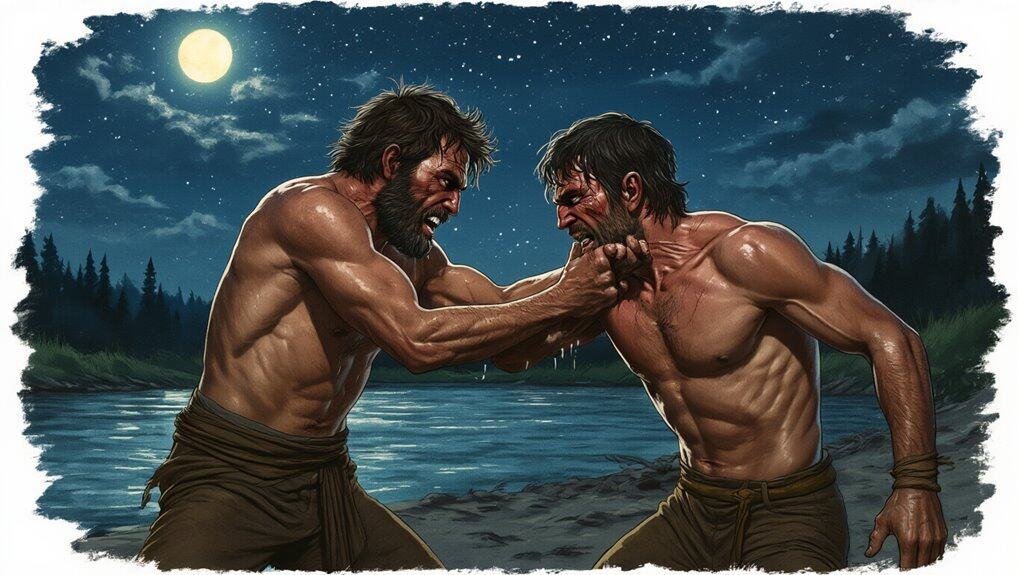
As Jacob approached the Jabbok River (Hebrew: Yabboq), you’ll find he orchestrated an elaborate gift procession of 550 animals to appease Esau, then ferried his family across the ford while remaining alone on the northern bank.
That night, you witness Jacob’s nocturnal wrestling with a mysterious figure—identified as both man and God (Genesis 32:24-30).
The Hebrew verb “ye’abeq” (wrestled) creates wordplay with “Yabboq,” suggesting this location wasn’t random but divinely appointed.
You’ll notice Jacob’s wounded perseverance when the stranger dislocates his hip socket with a mere touch, revealing supernatural power.
Yet Jacob won’t release his grip, demanding blessing before dawn breaks.
The opponent’s urgency to depart before sunrise echoes ancient Near Eastern beliefs about divine encounters occurring in darkness.
When Jacob receives his new name “Israel” (one who strives with God), you’re witnessing transformation through struggle—the deceiver becomes the overcomer who’s seen God face-to-face (Peniel) and survived.
From Jacob to Israel: The Transformation That Changed Everything

The name change from Jacob to Israel marks more than semantic modification—it fundamentally redefines covenant identity and prophetic destiny.
When you examine the Hebrew etymology, “Jacob” (Ya’akov) means “heel-grabber” or “supplanter,” reflecting his deceptive past. “Israel” (Yisra’el) means “one who strives with God” or “God prevails,” signifying profound Character Evolution.
You’re witnessing a Moral Reckoning that transforms a man who’d stolen birthright and blessing through trickery. The new name doesn’t erase Jacob’s past—Scripture still uses both names interchangeably—but it establishes his redeemed identity.
In ancient Near Eastern culture, naming conveyed authority and essence. God’s renaming parallels Abram becoming Abraham, indicating divine intervention in human destiny.
This transformation affects not just Jacob but his descendants. You’ll notice they’re called “children of Israel,” not “children of Jacob.” The wrestling match crystallized twenty years of divine discipline, converting a schemer into a patriarch who’d father a nation bearing his transformed name.
The Legacy of Israel: How One Man’s Struggle Birthed a Nation
You’re witnessing the fulfillment of God’s covenant with Abraham as Jacob’s twelve sons become the tribal heads of Israel (בְּנֵי יִשְׂרָאֵל, B’nei Yisrael), each receiving prophetic blessings that shape their descendants’ destinies in Genesis 49.
The transformation from one man’s wrestling match at Jabbok to a confederated nation of twelve tribes demonstrates how God’s promises transcend individual struggles to establish His chosen people.
Through Jacob’s sons—from Judah’s royal lineage to Levi’s priestly calling—you’ll see the covenant promise of land, seed, and blessing materialize into the foundational structure of ancient Israel’s society.
Twelve Tribes Formation
Twelve sons emerged from Jacob’s tumultuous household, each carrying prophetic significance that would shape Israel’s destiny for millennia.
You’ll discover how Reuben, Simeon, Levi, Judah, Dan, Naphtali, Gad, Asher, Issachar, Zebulun, Joseph, and Benjamin became distinct shevatim (tribes), fulfilling God’s promise to Abraham about numerous descendants.
Jacob’s deathbed blessings in Genesis 49 established Tribal Governance structures that’d define Israel’s sociopolitical landscape.
You’re witnessing divine orchestration as each son’s character determined their tribe’s future role. Judah received kingship’s scepter, while Levi forfeited Territorial Allocation for priestly service.
Joseph’s double portion through Ephraim and Manasseh created thirteen tribes, yet maintained twelve’s symbolic completeness.
The Hebrew term “matteh” (staff/tribe) reveals how patriarchal authority transferred through generations, establishing Israel’s confederate system before monarchy emerged.
Covenant Promise Fulfilled
Beyond tribal distinctions and territorial boundaries, Jacob’s transformation at Peniel marked the culmination of divine promises stretching back to Abraham’s original covenant.
You’ll notice the Hebrew term “brit” (covenant) appears repeatedly when God addresses Jacob at Bethel, confirming the covenant ratification through direct divine encounter.
The promise “your descendants shall be as the dust of the earth” wasn’t mere hyperbole—it established land inheritance extending from the Mediterranean to the Euphrates.
When you examine Jacob’s twelve sons becoming tribal patriarchs, you’re witnessing covenant fulfillment in real-time.
The Abrahamic promise of becoming “a great nation” materialized through Jacob’s offspring.
His wrestling match didn’t just change his name; it transformed a deceiver into Israel, the covenant bearer who’d father a nation destined to inherit Canaan.
Frequently Asked Questions
What Happened to Esau After Jacob Received His New Name?
After Jacob became Israel, you’ll find Esau established Edom’s kingship through his descendants, fulfilling God’s promise that he’d father nations. He settled in Mount Seir, where the Hebrew text calls him “Esau hu Edom” (Esau, he’s Edom).
While Jacob’s lineage developed Israel’s covenant community, Esau’s clan became the Edomites, ruling from Seir’s mountainous strongholds. Genesis 36 meticulously records his chiefs and kings, demonstrating God’s parallel blessing upon him.
Did Jacob Ever Reconcile With His Parents After Fleeing?
You’ll find no explicit reunion accounts with Isaac after Jacob’s flight, though Genesis 35:27-29 records Jacob visiting his father before Isaac’s death.
Rebecca’s absence suggests she’d already died, fulfilling her nurse Deborah’s presence with Jacob (35:8).
The Hebrew text emphasizes “wayavo Ya’akov” (Jacob came), indicating completed reconciliation. While parental forgiveness isn’t directly stated, Isaac’s peaceful death with both sons present implies restored relationships within the patriarchal family structure.
How Many Descendants Did Jacob Have Through His Twelve Sons?
You’ll find Jacob’s descendants numbered seventy souls when entering Egypt according to Genesis 46:27, though genealogical counts vary between Masoretic and Septuagint texts.
The Hebrew term “nephesh” encompasses his sons, grandsons, and great-grandsons.
Later tribal populations exploded exponentially—by the Exodus, you’re looking at approximately 600,000 fighting men, suggesting over two million total Israelites.
Each son’s lineage became a distinct tribe, fulfilling God’s promise of countless descendants.
Where Was Jacob Buried When He Died?
You’ll find Jacob buried in the Machpelah Cave at Hebron, purchased by Abraham from Ephron the Hittite for 400 silver shekels.
This Hebron burial site, called Me’arat HaMachpelah in Hebrew, served as the patriarchal family tomb.
Joseph’s Egyptian embalming preserved Jacob’s body for the journey from Egypt to Canaan.
You’re witnessing covenant faithfulness—Jacob insisted his sons carry him to this ancestral sepulcher where Abraham, Sarah, Isaac, Rebekah, and Leah already rested.
What Specific Injuries Resulted From Jacob Wrestling All Night?
You’ll find Jacob’s wrestling match left him with a dislocated hip when the mysterious figure touched his hip socket (Genesis 32:25). The Hebrew word “yaqa” indicates this hip injury caused permanent nerve damage to his sciatic region, explaining why he limped afterward.
This wound affected the “gid hanasheh” – the sinew that Jewish dietary laws still prohibit eating today, commemorating Jacob’s transformative struggle that earned him Israel’s name.
Conclusion
You’ve traced Jacob’s journey from heel-grabber (Ya’akov) to God-wrestler (Yisra’el), witnessing how divine encounters transform human character. His story isn’t just ancient biography—it’s your story when you wrestle with God through life’s deceptions, exiles, and midnight struggles. The man who once grasped his brother’s heel learned to cling to God Himself. In Jacob’s transformation, you’ll find that destiny isn’t stolen through cunning but won through persistent faith, even when you’re limping afterward.









No Comments