

10 Jan What the Bible Really Says About Prayer Will Shock Most Christians
You’ll discover that Jesus’ prayer teaching in Matthew 6:9-13 deliberately shocked religious authorities by replacing elaborate performances with intimate conversation using “Our Father” (Πάτερ ἡμῶν)—a familial address that scandalized contemporary sensibilities. Paul’s “pray without ceasing” (προσεύχεσθε ἀδιαλείπτως) in 1 Thessalonians 5:17 doesn’t mean constant verbal prayer but ongoing God-awareness, while biblical examples show prayer transcends specific postures or locations. Understanding these revolutionary principles transforms your entire approach to divine communication.
Key Takeaways
- Prayer was meant to be conversational intimacy with God as Father, not formal religious ritual or performance for others.
- Pray without ceasing” means maintaining constant God-awareness throughout daily life, not literal nonstop verbal praying.
- Physical posture and location don’t matter in prayer—God responds to heart condition rather than body position or sacred spaces.
- Unanswered prayers often reflect God’s greater wisdom, wrong motives, spiritual warfare, or divine timing rather than prayer failure.
- Effective prayer requires surrendering personal agendas to align with God’s will rather than treating prayer as wishful thinking.
How Jesus Actually Taught His Disciples to Pray
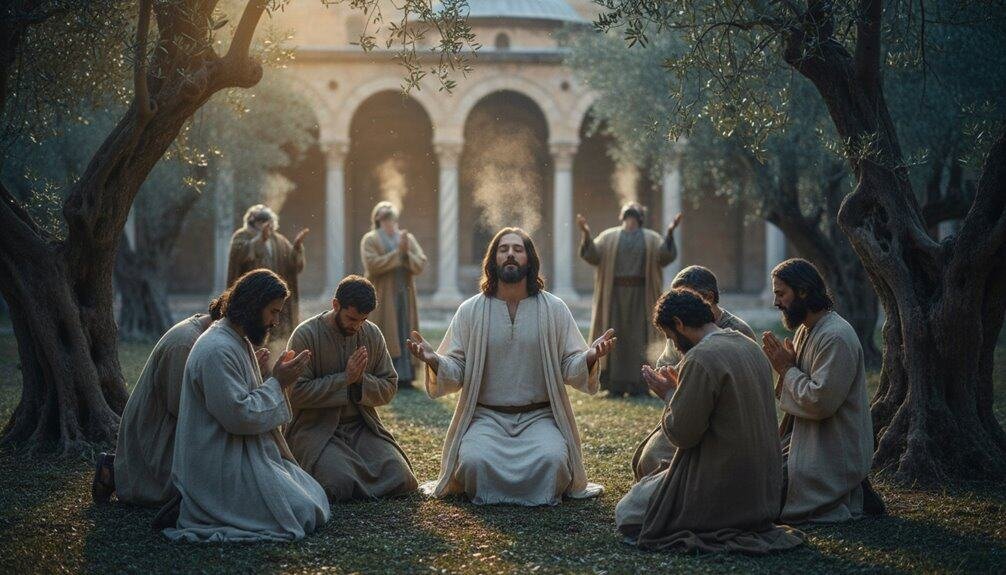
When the disciples approached Jesus with the request “Lord, teach us to pray” (Luke 11:1), they weren’t seeking theoretical instruction but practical guidance rooted in observing Christ’s own prayer life.
The disciples’ request revealed their desire for practical prayer guidance, not theoretical knowledge about spiritual communication.
Jesus’ response in the Lord’s Prayer (Matthew 6:9-13, Luke 11:2-4) reveals stunning simplicity that contrasts sharply with contemporary religious practices.
You’ll notice Jesus emphasized authentic intimacy with the Father, beginning with “Our Father” (Πάτερ ἡμῶν) – a familial term that shocked religious sensibilities.
This wasn’t mere sentiment but theological revolution, establishing prayer as relational rather than transactional.
Jesus’ ritual critique appears most clearly in Matthew 6:5-8, where he condemns ostentatious public prayers and “vain repetitions” (βατταλογέω).
The Greek term suggests meaningless babbling, targeting prayers designed for human applause rather than divine communion.
Archaeological evidence confirms elaborate first-century prayer rituals Jesus explicitly rejected, prioritizing sincere communication over ceremonial performance.
Why “Pray Without Ceasing” Means Something Different
Jesus’ emphasis on authentic, relational prayer sets the foundation for understanding Paul’s radical instruction to “pray without ceasing” (προσεύχεσθε ἀδιαλείπτως) in 1 Thessalonians 5:17. The Greek adverb ἀδιαλείπτως doesn’t demand literal non-stop verbal prayer—an impossibility for functioning humans. Rather, it describes constant mindfulness of God’s presence throughout daily activities.
Paul employs the same term in Romans 1:9, where he speaks of “constantly” remembering believers, indicating persistent awareness rather than uninterrupted action. Ancient Greek literature uses ἀδιαλείπτως for ongoing attitudes and dispositions, not perpetual activities.
This transforms prayer from scheduled religious duty into conversational rhythm with the divine. You’re called to maintain an underlying consciousness of God’s nearness—walking in ongoing dialogue rather than compartmentalized communication.
Archaeological evidence from first-century Jewish communities reveals this pattern: believers maintained God-awareness through brief acknowledgments, spontaneous gratitude, and moment-by-moment surrender, integrating faith into ordinary life rather than segregating it into formal prayer times.
What the Bible Says About Posture and Prayer Location
While modern Christianity often emphasizes specific postures and sacred spaces for prayer, biblical evidence reveals remarkable flexibility in both physical position and location. Scripture records prayer in diverse postures: standing (1 Kings 8:22), kneeling (Daniel 6:10), prostration (Matthew 26:39), and sitting (2 Samuel 7:18). This contradicts rigid kneeling etiquette many denominations impose.
Standing symbolism appears throughout biblical narrative, representing reverence without submission—Solomon stood while dedicating the temple, demonstrating that upright posture doesn’t diminish prayer’s efficacy. Jesus himself prayed on mountains, in gardens, and while walking, never restricting communication with God to sanctuaries.
Paul instructs believers to “pray everywhere, lifting up holy hands” (1 Timothy 2:8), emphasizing heart condition over physical positioning. The Samaritan woman’s encounter with Jesus explicitly dismantles location-based worship requirements (John 4:21-24). Biblical prayer transcends ceremonial constraints, focusing on authentic relationship rather than ritualistic performance. You’re free to approach God naturally, without prescribed postures or designated spaces.
Why Some Biblical Prayers Go Unanswered
Although Scripture presents prayer as God’s invitation for relationship, biblical narratives demonstrate that divine response doesn’t guarantee human expectation fulfillment. You’ll discover that unanswered petitions often reflect deeper theological realities rather than divine negligence.
Paul’s threefold plea regarding his “thorn in the flesh” (2 Corinthians 12:7-9) received God’s clear response: “My grace is sufficient.” This exemplifies how divine wisdom supersedes human requests. James 4:3 reveals another dimension: “You ask and don’t receive because you ask with wrong motives.”
Daniel’s twenty-one-day delay in receiving angelic response (Daniel 10:12-13) illustrates spiritual warfare‘s role in delayed answers. The text explicitly states demonic opposition hindered the divine messenger.
Christ’s Gethsemane prayer—”let this cup pass”—demonstrates that even perfect petitions may align with greater divine purposes requiring different outcomes. You’re witnessing submission to divine sovereignty, not prayer failure. Scripture consistently reveals that God’s “no” or “wait” often represents His most loving response.
Aligning Your Prayers With God’s Will Over Personal Desires
Since authentic biblical prayer emerges from surrendering personal agendas to divine purposes, Scripture consistently portrays effective petitioners as those who actively seek God’s will rather than demanding their own fulfillment.
Christ’s Gethsemane prayer exemplifies this principle: “Not my will, but yours be done” (Luke 22:42). This heart surrender doesn’t eliminate personal desires but subordinates them to divine wisdom.
John’s first epistle establishes the confidence framework: “If we ask anything according to his will, he hears us” (1 John 5:14). The conditional “according to his will” requires will discernment through Scripture meditation and Spirit-led prayer. Paul demonstrates this alignment in Romans 1:10, requesting travel plans “by God’s will.”
You’ll discover that biblical characters who received dramatic answers—Hannah (1 Samuel 1:11), Solomon (1 Kings 3:9), Nehemiah (Nehemiah 1:11)—consistently aligned personal requests with God’s covenant purposes rather than pursuing selfish ambitions.
Frequently Asked Questions
Should Christians Pray to Saints or Only Directly to God?
You’ll find Scripture consistently directs prayer to God alone, never commanding saint intercession. While Revelation 5:8 shows saints presenting prayers, there’s no biblical precedent for praying *to* them.
Christ’s role as sole mediator (1 Timothy 2:5) suggests direct access to God through Him. Though saint intercession isn’t explicitly forbidden, biblical evidence supports direct worship and prayer to God rather than through departed saints.
Is It Biblical to Pray in Tongues or Unknown Languages?
Yes, praying in tongues is biblical according to 1 Corinthians 14:2-4. Paul distinguishes between private spiritual language for personal edification and public tongues requiring corporate interpretation.
You’ll find he advocates tongues for private devotion while emphasizing prophetic utterance’s superiority in congregational settings. The text validates both glossolalia’s devotional value and its regulated use, supporting tongues as legitimate biblical prayer practice when properly contextualized.
How Long Should a Typical Prayer Session Last According to Scripture?
Scripture doesn’t prescribe specific durations for prayer sessions. You’ll find Jesus praying all night (Luke 6:12) and offering brief petitions (Matthew 26:39).
The emphasis isn’t on brief duration but on patterned frequency—Daniel prayed three times daily (Daniel 6:10), and Paul advocated “praying without ceasing” (1 Thessalonians 5:17). Biblical prayer prioritizes consistency and sincerity over prescribed time limits, allowing flexibility based on circumstances and spiritual needs.
Can Demons or Satan Hear and Interfere With Our Prayers?
Scripture doesn’t explicitly address demonic eavesdropping on prayers. However, Daniel 10:12-13 suggests spiritual interference can delay answers, where demonic princes opposed Gabriel for twenty-one days.
You’re protected because prayers ascend directly to God (Revelation 8:3-4), and Christ intercedes for you (Romans 8:34).
While demons may create external distractions or discouragements, there’s no biblical evidence they can intercept your communion with the Father through Jesus.
Is Group Prayer More Powerful Than Individual Prayer in God’s Eyes?
Biblical evidence doesn’t support superior communal efficacy over private prayer in God’s evaluation. You’ll find Jesus affirming both corporate gatherings (Matthew 18:20) and individual communion (Matthew 6:6).
The Gospels demonstrate equal divine responsiveness to communal petitions (Acts 12:12) and solitary requests (Luke 18:13-14). God’s assessment focuses on faith and sincerity rather than numerical participation, making corporate vs. private prayer equally valuable in divine estimation.
Conclusion
You’ve discovered that biblical prayer transcends contemporary evangelical formulations. When you examine Christ’s pedagogical method in Matthew 6:9-11, Paul’s concept of unceasing prayer in 1 Thessalonians 5:17, and the theological framework of divine sovereignty in unanswered petitions, you’ll find prayer isn’t about manipulating outcomes. Rather, it’s about conforming your will to God’s predetermined purposes through intimate communion. This exegetical understanding fundamentally reshapes your prayer life from petition-centered to relationship-centered spirituality.









No Comments