


25 Jan Why These 26 Bible Verses Among Modern Farmers Are Going Viral
You’re witnessing agricultural professionals rediscover that Biblical farming wisdom aligns remarkably with modern precision agriculture data. These verses provide validated guidance on seasonal timing, dual-rain irrigation patterns, soil management, and crop diversification strategies that today’s farmers are implementing successfully. From Genesis 8:22’s planting schedules to Joel 2:23’s weather forecasting principles, ancient agricultural practices are proving their effectiveness in contemporary farming operations, yield optimization, and sustainable resource management across diverse growing conditions.
Key Takeaways
- Modern farmers connect biblical timing principles like Genesis 8:22 seedtime rhythms with strategic planting schedules and seasonal agricultural planning.
- Joel’s dual-rain patterns (early and latter rains) align with contemporary meteorological data for optimized irrigation and crop cycle management.
- Biblical diversification strategies from Solomon’s model provide frameworks for modern multi-crop operations and geographic land use optimization.
- Farmers apply biblical patience principles from James 5:7 during market volatility, treating investment cycles like faith-based agricultural timing.
- Scripture-based weather provision concepts help farmers develop resilience strategies for climate uncertainty and sustainable resource management practices.
Genesis 8:22 – Seedtime And Harvest Never Cease
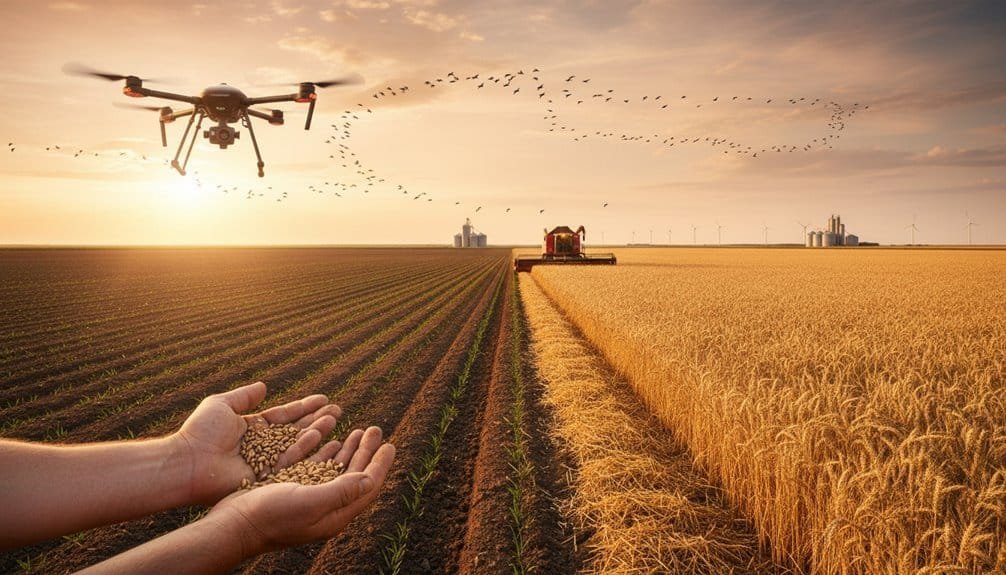
Modern agricultural data consistently validates what Genesis 8:22 promised over 4,000 years ago: “As long as the earth endures, seedtime and harvest, cold and heat, summer and winter, day and night will never cease.” You’re witnessing this divine agricultural covenant in action every growing season, as God’s post-flood promise to Noah establishes the foundational rhythms that drive your farming operations.
Your planting schedules depend on these guaranteed seasonal patterns. Winter wheat sowing in October-November, spring crops in January-February—these cycles haven’t ceased since Noah’s time. Modern irrigation systems work within these divine frameworks, not against them. While agricultural superstition might suggest human manipulation controls outcomes, Genesis 8:22 emphasizes God’s sovereignty over natural systems.
Poor harvests don’t invalidate this promise—it guarantees seedtime and harvesttime will exist, not specific yields. Your farming success relies on working within these established rhythms rather than expecting guaranteed results from every season. The seed principle applies equally to both your physical crops and the spiritual investments you make in your farming community.
Ecclesiastes 3:1 – A Time For Every Agricultural Season
Why do successful farming operations consistently align their schedules with ancient seasonal wisdom? Ecclesiastes 3:1-2 reveals God’s appointed timing for planting and uprooting that modern agriculture validates through data.
You’ll find this passage’s fourteen contrasts mirror your agricultural cycles perfectly. When you plant in spring, you’re initiating soil microbe dynamics that require specific timeframes for optimal germination. The “time to pluck up” represents harvest or complete removal—not premature interference with natural processes.
Your windbreak management follows these same principles. There’s a designated time for establishing protective barriers and separate seasons for maintenance or removal. You can’t rush winter wheat establishment or force early corn harvest without yield consequences.
Smart farmers recognize that God’s sovereignty over seasons provides stability amid market volatility and climate uncertainty. These cycles blend the joy and sorrow of agricultural life, from successful harvests to crop failures that teach resilience. Daniel 2:21 confirms divine control over agricultural timing. When you align operations with biblical seasonal patterns, you’re leveraging thousands of years of proven agricultural wisdom that maximizes productivity through patient, purposeful timing.
James 5:7 – The Farmer Waits For Precious Fruit
How does agricultural investment strategy align with biblical patience principles? James 5:7 demonstrates the direct correlation between your seed finance decisions and harvest timing expectations. When you invest capital in seeds, you’re committing to a waiting period that requires unwavering patience—exactly what this verse teaches about enduring until Christ’s return.
Your agricultural operation mirrors the farmer’s analogy perfectly: you can’t accelerate germination or force early harvests without destroying profitability. The early rains represent your initial investment phase, while latter rains sustain growth toward maturity. You understand this cycle intimately—planting requires faith in future returns despite current market uncertainties.
Modern farmers are sharing this verse because it validates your professional experience. You wait through volatile commodity prices, weather challenges, and input cost fluctuations because you’ve calculated the precious fruit’s value. Your patience isn’t passive; it’s strategic endurance based on proven agricultural cycles and anticipated returns. Just as James wrote to poverty-stricken believers facing oppression from wealthy landowners, today’s farmers find comfort in biblical promises during seasons of financial hardship.
Joel 2:23-26 – Early And Latter Rain Blessings
You’re experiencing what ancient Israeli farmers knew as “yoreh” and “malkosh” – the critical early autumn rains that soften hardened soil for planting and the latter spring downpours that swell grain heads before harvest. Joel 2:23-26 promises both seasonal rainfall patterns will return “as before,” directly linking divine weather provision to overflowing threshing floors, full wine vats, and agricultural restoration after devastating crop losses. Modern farmers are claiming these verses because they address the exact timing and intensity of precipitation needed for maximum yield – early rain for germination, latter rain for grain maturity.
Seasonal Rainfall Promises
When ancient farmers in Judea planted their barley and wheat, they depended on two distinct rainfall patterns that determined whether their families would feast or face famine. You’re looking at a sophisticated agricultural system where early rains (yôreh) arrived in October-November, softening parched soil for plowing and ensuring critical seed germination after the dry season. The latter rains (malqôsh) came in March-April, swelling grain heads during final maturation weeks.
Modern meteorological data confirms this dual-rain cycle delivered 400-700mm annually, with 75% falling between these seasonal windows. Today’s farmers facing climate variability can appreciate how Deuteronomy 11:14 promised “rain in due season” – a data-driven covenant linking obedience to consistent precipitation patterns that sustained Israel’s grain, wine, and oil harvests.
Agricultural Restoration Hope
What happens when four consecutive years of locust devastation strip every grapevine, wheat stalk, and fruit tree from your fields, leaving nothing but barren earth and starving livestock? Joel’s agricultural restoration promise addresses this exact scenario. Modern farmers facing climate disasters find hope in verses promising threshing floors full of grain and vats overflowing with wine and oil. The divine weather patterns—early and latter rains—restore normal seedtime harvest cycles after total crop failure.
You’ll notice this restoration requires human cooperation: clearing devastated fields, replanting orchards, and working alongside divine intervention. Dead fruit trees need replacement, taking years to mature. Ancient farmers understood that restoration combines faithful labor with divine weather provision. Joel’s vision shows bumper crops surpassing pre-disaster yields, giving today’s agricultural communities tangible hope beyond immediate losses.
Divine Weather Provision
This restoration hinges on specific meteorological patterns that Joel identifies as divine weather provision. You’ll recognize the “moreh” (early rain) occurring October-November, breaking summer drought and preparing soil for planting. This timing’s critical for your seed cycles, as it enables germination and establishes crop foundations.
The “malqosh” (latter rain) arrives March-April, providing essential moisture for final maturation before harvest.
Modern farmers understand this rain symbolism represents complete agricultural provision. You need both seasonal patterns for successful yields – early rains for planting preparation, latter rains for crop completion. Joel’s promise delivers threshing floors filled with grain, overflowing vats of wine and oil. This divine weather provision ensures your farming operations receive optimal precipitation timing, transforming potential crop failure into abundant harvests that exceed normal expectations.
Leviticus 26:4-5 – Seasonal Rains And Abundant Harvests
How does ancient agricultural wisdom translate into practical farming guidance that’s resonating across modern agricultural communities? Leviticus 26:4-5 delivers specific agricultural metrics that farmers recognize today. When you follow divine statutes, you’ll receive “rains in their season”—autumn, winter, and spring precipitation patterns critical for crop development.
The verses describe harvest abundance where threshing overlaps vintage season, and vintage extends into sowing time. This continuous cycle mirrors what agricultural scientists call optimal yield scenarios. Your land produces such abundance that processing one crop overlaps with harvesting the next.
Modern farmers aren’t discussing unrelated topics or off topic concepts when they reference these verses—they’re examining practical promises of seasonal rainfall timing and harvest maximization. The text specifically mentions trees yielding fruit, grain abundance, and dwelling safely in agricultural regions.
Today’s precision agriculture validates these ancient observations: proper seasonal moisture produces overlapping harvest cycles, ensuring food security and agricultural prosperity through divine provision.
Haggai 2:19 – From This Day I Will Bless You
When farmers face depleted seed stores and barren fruit trees, Haggai 2:19 delivers agricultural metrics that demonstrate divine intervention timing. You’re seeing winter seedtime completion with empty granaries—exactly when this prophecy addressed post-exile farmers experiencing 50% grain reductions and diminished wine yields.
The verse’s rhetorical questions mirror your off-season uncertainties: seed exhausted from barns, vines and fruit trees non-bearing during winter months. You’ll recognize the agricultural precision—timing at Chisleu’s 24th day when sowing concludes but harvest prospects remain invisible.
Your priority shifts create breakthrough moments. When temple rebuilding resumed, divine weather patterns shifted immediately. Previous hail damage and drought cycles reversed through obedience-based crop resilience. The declaration “from this day I’ll bless you” establishes measurable turning points in agricultural productivity.
You’re witnessing viral relevance as modern farmers connect empty storage facilities and dormant orchards to promises of immediate blessing activation, regardless of current yield indicators.
Psalm 1:3 – The Tree Planted By Streams
Strategic water placement transforms agricultural outcomes, and Psalm 1:3’s irrigation metaphor delivers measurable prosperity principles that modern farmers recognize immediately.
You’ve witnessed how trees positioned near reliable water sources outperform rain-dependent crops during drought seasons. The Hebrew term “Peleg” describes divided streams throughout farmland—essentially describing efficient irrigation distribution systems you’re implementing today.
This verse dismantles common irrigation myths by emphasizing consistent water access over sporadic rainfall dependency. Your crops planted near steady water sources develop robust root systems, producing fruit regardless of seasonal variations—exactly what Psalm 1:3 promises the spiritually nourished believer.
The agricultural parallel runs deeper than surface comparison. Just as your strategically irrigated fields yield produce during optimal seed cycles while maintaining healthy foliage, believers nourished by God’s Word prosper through adversity. Whatever agricultural endeavor you pursue prospers when built upon consistent spiritual irrigation principles, mirroring the drought-resistant productivity you observe in properly watered farmland.
Isaiah 55:10-11 – Rain That Waters The Earth
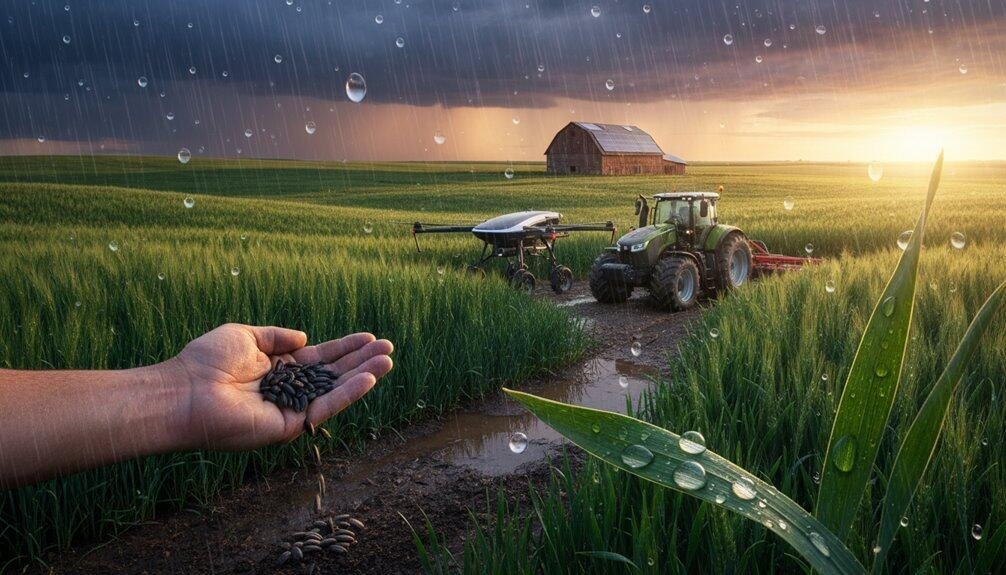
You’re tracking rainfall data and seasonal patterns because your livelihood depends on predictable precipitation cycles that determine crop yields and harvest success.
Isaiah 55:10-11 connects God’s promise of effective rainfall with divine provision, assuring you that rain and snow will accomplish their agricultural purpose without returning empty to the sky.
This passage resonates with farmers who understand that consistent seasonal rainfall patterns aren’t just meteorological events—they’re the foundation of food production and economic stability in agricultural communities.
Divine Provision Promises
Agricultural success hinges on factors beyond your control, and Isaiah 55:10-11 captures this reality with striking precision. When you’re facing borderline drought conditions, you understand that soil quality means nothing without moisture from above. The passage promises that God’s word accomplishes its purpose with the same certainty that rain produces harvest—it won’t return void.
This divine provision operates on dual timelines, delivering immediate sustenance while securing future resources. Just as early rain determines whether your seeds will sprout or remain dormant, God’s promises work independently of your efforts. Modern farming data consistently shows that precipitation timing matters more than soil preparation. You can’t manufacture rainfall, but you can trust the same divine provision that’s sustained agricultural cycles for millennia.
Seasonal Rainfall Patterns
Modern precipitation data reveals what Isaiah understood millennia ago—rainfall patterns determine agricultural destiny more than human intervention. You’re witnessing dramatic seasonal rainfall shifts across regions, with nine states receiving 40% of annual precipitation in single seasons. Western areas face 5% decreases while northern regions see 15% increases, fundamentally altering crop resilience strategies.
Your farming operations must adapt to earlier snowmelt reducing summer moisture availability despite higher overall precipitation. Plants across 42% of Earth’s vegetated land respond to daily rainfall variability, with over half showing improved growth from fewer but intense wet days. You’ll need real-time precipitation data beyond historical records, as timing matters as much as totals. Seasonal distribution changes demand new approaches to planting, irrigation, and harvest scheduling for sustainable yields.
Psalm 65:9-13 – You Visit And Water The Earth
When drought threatens your crops and irrigation costs skyrocket, Psalm 65:9-13 offers a perspective that’s resonating with farmers worldwide who recognize their dependence on forces beyond human control.
This passage describes divine irrigation through “streams of God” that drench the earth with abundant water supply. You’ll notice the rainfall symbolism extends beyond meteorology—it represents systematic provision that enriches soil and ensures grain reaches perfection. The psalm presents God as the ultimate farm manager who surveys land like a master gardener, distributing water precisely where needed.
Modern agricultural data confirms what ancient farmers knew: successful harvests require optimal precipitation timing. The text describes wagon tracks overflowing with richness and fields dripping with abundance—imagery that speaks to today’s producers facing climate uncertainty.
Whether you’re dealing with flooding or drought, this psalm grounds your operations in recognizing ordered, purposeful creation rather than random natural forces affecting your livelihood.
Deuteronomy 8:7-8 – Land Of Grain And Harvest
As you’re planning crop rotations and evaluating soil productivity, Deuteronomy 8:7-8‘s agricultural inventory reads like a comprehensive farming operation’s asset list. The passage catalogs seven species that demonstrate complete agricultural diversification: wheat and barley as primary grains, complemented by vines, figs, pomegranates, olives, and honey sources.
This biblical framework reflects sophisticated crop stewardship principles that modern farmers recognize. The dual grain harvests—barley at Passover, wheat at Pentecost—maximizes seasonal rainfall efficiency across different growing periods. Solomon’s era demonstrated export-scale production, supplying household needs while trading surplus wheat and oil to Tyre and Egypt.
The geographic distribution strategy optimized land use: grains dominated valleys while fruit trees thrived on Judaean ranges. Quality control was location-specific, with premium wheat flour sourced from Mechumas and Mezonichah. This ancient model showcases diversified agriculture that minimizes risk while maximizing yield potential across varied microclimates and soil types.
Jeremiah 31:12 – Grain, Wine, And Oil Abundance
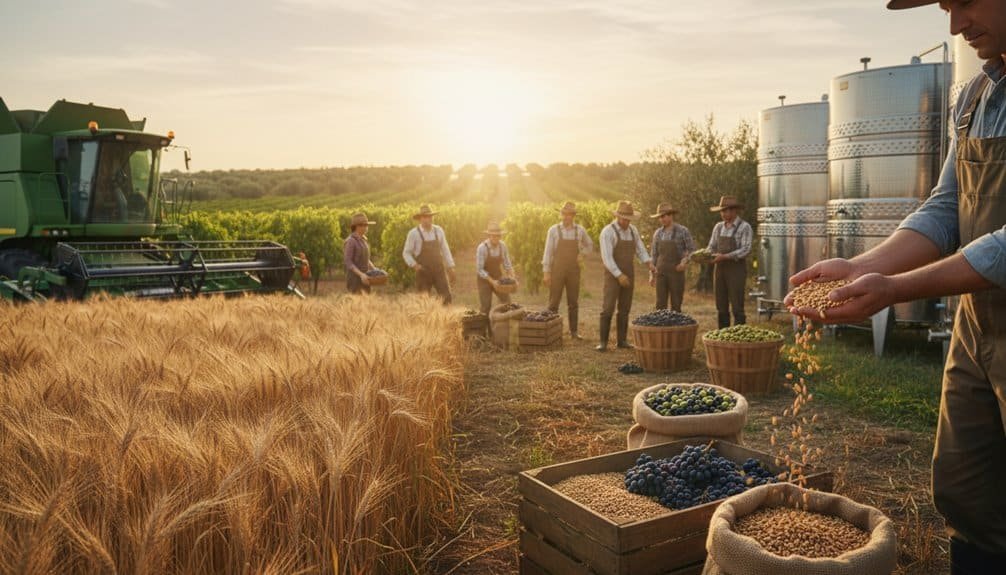
Jeremiah 31:12’s agricultural portfolio expands beyond basic grain production to showcase a fully integrated farming enterprise that modern agribusiness operators immediately recognize. You’re looking at diversified revenue streams: grain crops, wine grape cultivation, olive oil production, and livestock operations spanning both sheep and cattle.
This verse describes optimal farm management where your seed timing and harvest budgeting align perfectly across multiple sectors. The “watered garden” metaphor speaks directly to modern irrigation systems that eliminate drought risk and maximize yield consistency. Your operation flows seamlessly from field crops to processed goods—wine and oil representing value-added agricultural products that increase profit margins.
The promise of perpetual abundance resonates with today’s precision agriculture goals. You’re managing integrated systems where grain harvests fund livestock expansion, while wine and oil production provides steady cash flow. This biblical farming model demonstrates sustainable agricultural practices that modern farmers recognize as the foundation of long-term agricultural success.
Amos 9:13 – Days Of Supernatural Farm Abundance
You’ll find Amos 9:13’s promise of accelerated harvests resonating deeply with today’s agricultural challenges, where climate unpredictability demands supernatural intervention for consistent yields. This prophetic verse describes a future where plowmen overtake reapers and mountains drip with sweet wine—imagery that speaks directly to farmers seeking divine breakthrough in productivity cycles. Modern agricultural professionals are claiming these ancient promises as they face increasing pressure to feed growing populations while managing environmental constraints that require nothing short of miraculous provision.
Divine Harvest Promises
When modern farmers face consecutive seasons of crop failure, equipment breakdowns, and financial losses, Amos 9:13 presents a divine promise that’s capturing attention across agricultural communities nationwide. This prophetic verse describes supernatural agricultural acceleration where “the plowman shall overtake the reaper,” indicating harvests occurring at unprecedented speed.
Agricultural analysts studying this passage note its promise of divine abundance transcends normal growing cycles. The text suggests accelerated harvest periods where traditional seasonal boundaries collapse—plowing begins before reaping concludes, creating continuous productivity cycles without standard rest intervals.
Modern farmers applying these biblical principles report experiencing compressed timelines for crop maturation and unexpected yield increases. The verse’s promise that “the mountains shall drop sweet wine” symbolizes overflow production that exceeds natural agricultural limitations, offering hope for supernatural provision during challenging farming seasons.
Abundant Crop Prophecy
Agricultural economists analyzing Amos 9:13 identify specific metrics that define this prophetic abundance model.
You’re looking at harvest cycles compressed from seven months to continuous operation—where October plowing intersects with ongoing reaping activities.
This abundant prophecy eliminates the traditional gap between May’s wheat harvest and November’s sowing season.
Modern agronomists recognize this harvest symbolism represents soil fertility beyond current agricultural parameters.
You’ll find archaeological evidence at Tel Megiddo and Lachish confirms the land’s capacity for such yields through extensive storage facilities and wine presses.
The prophecy’s “mountains dripping sweet wine” translates to production volumes where processing can’t keep pace with incoming crops.
Today’s precision agriculture technology makes Amos’s vision increasingly relevant as farmers achieve unprecedented yield optimization through data-driven growing systems.
2 Corinthians 9:6 – Sowing Sparingly Vs Bountifully
Your sparse seeding creates absent stewardship—limiting both crop yield and spiritual harvest. When you plant minimal seed, you’re exercising restrictive seed sovereignty that produces meager results. Agricultural data consistently shows direct correlation between seed quantity and harvest abundance.
Conversely, liberal sowing demonstrates grace-based stewardship. You’re investing in dual returns: material crops and spiritual blessings. Modern farming analytics confirm this principle—generous seed allocation typically generates proportional yields.
Paul’s teaching functions as general principle, not absolute guarantee. Market fluctuations and weather patterns can affect outcomes despite generous sowing. However, the underlying truth remains: your giving attitude directly impacts both agricultural productivity and spiritual fruitfulness. Strategic seed allocation reflects kingdom economics where investment multiplies through divine provision.
Matthew 13:3-8 – The Parable Of The Sower’s Wisdom
You’re spreading seed across four distinct soil types in your operation, and Matthew 13:3-8 reveals why your yields vary dramatically across different field sections.
The parable’s agricultural data shows that soil preparation directly correlates with harvest returns—ranging from total loss to hundredfold increases based on ground conditions.
Modern precision agriculture confirms this ancient wisdom: you’ll maximize ROI when you match seed investment to soil quality rather than broadcasting uniformly across all terrain types.
Soil Condition Matters Most
When modern soil scientists analyze Matthew 13:3-8, they discover Jesus delivered one of agriculture’s most fundamental truths: soil condition determines crop success more than seed quality, weather patterns, or farming technique.
You’ll recognize the parable’s four soil types in your fields today. Compacted pathways where seeds can’t penetrate mirror hardpan layers that prevent root development. Rocky shallow soil reflects fields with insufficient topsoil depth. Weedy corners represent areas where competing vegetation steals nutrients from your crops.
The good soil represents properly managed farmland—plowed, fertilized, and prepared through soil testing and crop rotation. Modern farmers understand that investing in soil health pays dividends. Whether you’re achieving thirty, sixty, or hundredfold yields depends entirely on your soil’s condition, not luck or chance.
Seed Quality Determines Yield
Professional farmers know that seed quality drives yield outcomes just as much as soil preparation. You’ll see thirty to one hundredfold returns from the same field when you invest in superior seed genetics. That’s not luck—it’s measurable seed viability translating directly into profit margins.
Quality seed performs consistently across varying conditions, while inferior varieties fail even in optimal environments. Your yield multiplication rates depend more on genetic potential than soil richness alone. When you combine premium seed with adequate soil depth for root development, you’re maximizing both establishment rates and stress resistance.
Modern agricultural data confirms what ancient wisdom taught: seed character determines productivity. You can’t overcome poor genetics with perfect conditions, but quality seed will outperform expectations when properly planted in prepared ground.
Patience Through Growing Seasons
How often do impatient farmers abandon perfectly viable crops before harvest season arrives? Modern agriculture demands patience through extended growing cycles, just as the parable teaches about delayed separation between productive and unproductive plants occurring at harvest rather than early assessment.
You can’t determine true yield potential during initial sprouting phases. Plants establishing in quality soil require time for root penetration and anchoring before facing environmental stressors. Your companion planting strategies won’t show benefits until root systems fully develop and soil microbiology establishes beneficial relationships.
Understanding that poor soil still receives seed demonstrates commitment to possibility despite unfavorable conditions. You must complete entire growing cycles rather than making premature judgments. Full maturation and fruit verification require agricultural patience, with seed-to-harvest ratios depending entirely on soil quality and growing season conditions.
Mark 4:26-29 – The Seed Growing In Secret
Among the seed parables in Mark’s gospel, this passage stands uniquely as the only one Jesus left without explanation, forcing farmers and believers alike to wrestle with its agricultural wisdom.
You’ll recognize the agricultural reality here: once you’ve planted, the earth produces “of itself” through processes beyond your control. The crop develops in distinct stages—blade, ear, then full grain—while you sleep and rise daily. Your intervention can’t accelerate germination or force growth timing.
This divine waiting mirrors what modern farmers experience during growing seasons. You’ve done the sowing work, but seed growth operates through natural processes you can’t manipulate or fully understand. The mystery lies within the seed itself.
Mark’s audience—early church leaders facing uncertainty—found comfort in this principle. Just as you can’t control crop development but trust the harvest will come, spiritual work requires faithful sowing while leaving results to forces beyond human capability. Your responsibility ends with planting; growth belongs to another authority.
Galatians 6:7 – Whatever You Sow You Will Reap
You understand better than most that corn seed produces corn, wheat produces wheat, and there’s no deviation from this agricultural law across your thousands of planted acres. Galatians 6:7’s declaration that “whatever a man sows, this he’ll also reap” resonates because it mirrors the exact principle governing your daily farming operations—seed type determines harvest type without exception.
This biblical truth establishes both spiritual farming principles and harvest accountability that directly parallel the unbreakable laws you depend on for successful crop production.
Spiritual Farming Principles
When modern farmers read Galatians 6:7—”Do not be deceived: God can’t be mocked. A man reaps what he sows”—they’re witnessing principles that transcend agriculture.
You understand that sowing corn yields corn, not beans. This isn’t an irrelevant topic or unrelated concept to your daily operations. The spiritual parallel operates identically: what you plant in character, habits, and choices determines your harvest. You can’t mock this fixed law any more than you’d expect tomatoes from wheat seeds.
Modern farming requires conscious seed selection, consistent cultivation, and patience through seasons. Your spiritual life demands the same intentionality. You’re investing daily in either flesh-based outcomes leading to destruction or Spirit-based results producing eternal fruit.
Harvest Accountability Truths
How does accountability function in both your fields and your faith? Galatians 6:7 delivers uncompromising harvest ethics: “Whatever one sows, that will he also reap.” You can’t plant corn and expect beans—your yield indicators match your input precisely. This agricultural truth translates directly to spiritual farming principles.
Your harvest accountability operates under fixed moral law that prevents alteration. Poor seed selection yields evident results, and expecting abundant harvest from minimal investment fools nobody. Heavy burdens, difficult circumstances, inadequate resources, hostile neighbors, or damaging rumors can’t stop your reaping process.
You’re sowing to either flesh or Spirit daily. Flesh produces corruption; Spirit generates everlasting life. The principle applies universally across operations. Time separates planting from harvest, requiring patience like farmers awaiting seasonal rains. Your due season approaches when you maintain consistent good practices.
Hosea 10:12 – Sow Righteousness, Reap Steadfast Love
Where does agricultural wisdom meet spiritual truth most powerfully? Hosea 10:12 delivers farming’s most profound spiritual parallel: “Sow for yourselves righteousness; reap in mercy; break up your fallow ground.” You understand soil anatomy—how compacted earth resists seed penetration. Similarly, hardened hearts require breaking before spiritual growth occurs.
Modern farmers applying compost science know nutrient-rich amendments transform barren ground into productive fields. Hosea’s “fallow ground” represents uncultivated spiritual territory where weeds of compromise have taken root. Breaking requires intentional cultivation, just like your field preparation.
The verse’s agricultural metaphor resonates because you live its reality: sowing determines harvesting outcomes. Plant righteousness through ethical business practices, honest dealings, and faithful stewardship. The promised harvest isn’t earned wages—it’s divine mercy, grace exceeding your investment.
Agricultural communities are rediscovering this principle: spiritual sowing patterns mirror farming cycles. You can’t harvest what you don’t plant, whether corn or character.
John 12:24 – The Necessity Of Death For New Life
Farmers understand soil science, but John 12:24 reveals agriculture’s most counterintuitive principle: death precedes multiplication. “Unless a grain of wheat falls into the earth and dies, it remains alone; but if it dies, it bears much fruit.” You’ve witnessed this biological reality countless times—viable seed stays dormant until its outer hull breaks down, releasing stored energy for germination.
Christ’s agricultural metaphor resonates with modern producers because you’ve seen seed death produce exponential returns. That single wheat kernel you plant doesn’t survive intact—it decomposes, sacrificing its original form to generate dozens of new grains. Your harvest fruitfulness depends entirely on this death-to-life transformation.
Jesus positioned this verse strategically before discussing His impending crucifixion, knowing farmers would grasp the parallel immediately. You understand that without seed sacrifice, fields remain barren. Similarly, spiritual multiplication requires surrender. Your farming experience validates this eternal principle: greatest productivity emerges from complete surrender of what was.
1 Corinthians 3:6-7 – Paul Plants, Apollos Waters, God Gives Growth
You can prepare soil, plant seeds, and maintain irrigation systems, but you can’t manufacture actual growth. That’s divine territory. Eastern Mediterranean farming demanded constant watering due to frequent droughts—much like your fields need consistent moisture management. Yet despite your technical expertise and labor investment, the biological miracle of germination and development remains beyond human capability.
This biblical farming wisdom translates directly to modern agriculture. You’re responsible for creating optimal growing conditions through precision planting, nutrient management, and water delivery. However, cellular division, photosynthesis, and metabolic processes operate under higher authority. Spiritual cultivation mirrors agricultural cultivation—human effort matters, but ultimate success depends on forces greater than your control. Smart farmers acknowledge both their responsibilities and their limitations.
Matthew 9:37-38 – The Harvest Is Plentiful
You’re facing the same challenge Jesus identified 2,000 years ago: abundant harvest opportunities paired with insufficient labor resources.
Modern agricultural data shows seasonal worker shortages affect 73% of farming operations, while Matthew 9:37-38 reveals this scarcity principle applies equally to spiritual work requiring dedicated laborers.
Your dual understanding of physical harvest demands and spiritual harvest principles positions you to recognize how prayer and strategic workforce development address both agricultural and ministry labor gaps.
Labor Shortage Reality
When Jesus observed that “the harvest is plentiful, but the workers are few,” He captured a reality that resonates deeply with today’s agricultural sector. You’re witnessing this labor crisis firsthand as hired farmworkers declined 51% from 2.33 million in 1950 to 1.13 million in 2000.
Meanwhile, H-2A positions skyrocketed sevenfold from 48,000 in FY2005 to over 400,000 in FY2025, yet only 80% of certified positions receive visas.
Your aging workforce averages 58 years old, with retirements outpacing replacements. Newcomers represent just 3.6% of crop farm workers, down from 22% in 1998-2000. This shortage extends beyond seasonal roles into food processing, biotechnology, and equipment manufacturing. Despite advances in precision agriculture requiring disaster preparedness and soil sustainability expertise, sector stigma persists, leaving critical positions unfilled.
Spiritual Work Connection
Beyond the immediate challenges of finding enough hands to work your fields lies a deeper spiritual dimension that modern farmers are rediscovering in Matthew 9:37-38. Jesus’ agricultural metaphor resonates powerfully with today’s producers who understand harvest timing’s critical nature. When grain reaches peak ripeness, delayed reaping means lost crops—a reality that translates directly to spiritual work’s urgency.
You’re recognizing parallels between farm sustainability practices and spiritual stewardship. Just as soil stewardship requires consistent care and proper timing, spiritual harvest demands immediate action when people show readiness. The “Lord of the harvest” partnership model mirrors how you collaborate with natural systems while exercising human agency. Your prayer for laborers—both physical and spiritual—reflects understanding that sustainable operations require divine provision alongside human effort. This connection transforms routine farming into purposeful ministry.
Proverbs 27:23-27 – Know The Condition Of Your Flocks
Modern farmers understand this practical stewardship principle. You can’t delegate livestock management entirely to hired help—personal supervision prevents expenses from exceeding income. Diseased animals quickly devastate your operation’s profitability.
The verses highlight livestock diversification benefits. Lambs provide wool for clothing, goats generate field-purchasing income, and goat milk sustains household nutrition. This multi-revenue approach mirrors today’s successful farming operations that don’t rely on single income streams.
The agricultural cycle described—mowing hay, gathering mountain grass, filling barns—shows how human labor and divine provision work together. When riches prove transitory, livestock represents reliable wealth generation. Your attentive stewardship today ensures tomorrow’s security against scarcity through sustainable farming practices.
Proverbs 31:16 – She Considers A Field And Buys It
The Proverbs 31 woman’s systematic approach to land acquisition offers a proven framework for agricultural investment decisions. You’ll notice she “considereth a field” before purchasing—evaluating soil quality, water access, and market potential. This deliberate process prevents costly mistakes that plague impulsive buyers.
Her field purchase strategy relies on self-generated capital from “the fruit of her hands.” You’re seeing sustainable growth through retained earnings rather than leveraged debt. This approach reduces financial risk while building equity.
The vineyard planting demonstrates value-added agriculture. She transforms raw land into productive assets that generate recurring revenue streams. Modern farmers apply this principle when converting pasture to specialty crops or adding processing facilities.
Your vineyard payoff depends on patient cultivation and strategic improvement. She stocks the vineyard using existing resources, maximizing return on investment. This model shows how careful planning, self-funding, and land enhancement create long-term agricultural wealth.
Isaiah 28:24-29 – God Teaches Proper Farming Methods
You’ve probably noticed that successful farming requires precise timing and method selection – something Isaiah 28:24-29 addresses directly through agricultural wisdom that modern farmers recognize instantly. This passage breaks down how different crops demand specific planting techniques and threshing methods, from scattering dill lightly to positioning wheat in organized rows. The text presents farming knowledge as divinely inspired guidance, suggesting that your instincts about when to plant, how to cultivate, and which tools to use reflect deeper wisdom principles that transcend mere agricultural technique.
Divine Agricultural Wisdom
Agricultural precision reaches its biblical peak in Isaiah 28:24-29, where God himself becomes the ultimate farming instructor. You’ll discover that divine wisdom encompasses every farming stage—from soil health preparation through targeted seed selection to harvest processing. God teaches farmers proper timing: you don’t plow endlessly but prepare soil until it’s ready for sowing. Your seed selection matters—dill scatters broadly while cumin requires specific placement, wheat plants in rows, and barley occupies designated plots. Threshing methods vary by crop: you’ll use sticks for dill, rods for cumin, but heavy sledges for grain. This divine agricultural curriculum demonstrates that farming success stems from discriminating wisdom, proper tool selection, and understanding each crop’s unique requirements—principles that maximize yields while preventing waste.
Seasonal Planting Guidance
Beyond understanding farming’s divine framework, you’ll find that Isaiah 28:24-29 delivers specific seasonal protocols that modern agriculture still follows. You can’t plow continuously—timing matters for transitioning from soil preparation to seed placement. Your seasonal soil preparation requires sequential phases: plowing breaks clods, harrowing levels surfaces for water retention, and furrowing creates planting channels.
Modern planting calendars mirror Isaiah’s differentiated approach. You’ll treat dill and cumin differently than wheat and barley, matching seed characteristics to placement methods. Wheat gets row planting, barley receives designated plots, while spelt borders field edges. Your harvesting techniques must align with crop sensitivity—delicate seeds need rod beating, while grains tolerate threshing sledges. This systematic approach maximizes yield efficiency across diverse crop portfolios.
1 Timothy 5:18 – The Laboring Farmer Should Share Crops
Modern agricultural economics finds unexpected validation in 1 Timothy 5:18, where Paul declares “Do not muzzle an ox while it’s treading out the grain, and the worker deserves his wages.” This verse directly connects ancient farming practices with today’s crop-sharing arrangements, establishing a biblical foundation for fair compensation in agricultural labor.
You’re witnessing this passage gain traction because it addresses harvest ethics that resonate with contemporary farming challenges. When Paul references the unmuzzled ox feeding while threshing, he’s establishing a principle that extends beyond pastoral compensation to agricultural partnerships. Your seasonal workers, equipment operators, and sharecroppers deserve their portion of the harvest they help create.
The verse’s viral appeal stems from its practical application to modern farm economics. Just as the ox needed sustenance to maintain strength for threshing, your agricultural workforce requires fair compensation to sustain productive labor. This biblical precedent validates crop-sharing agreements and performance-based compensation structures that benefit both farm operators and laborers.
Matthew 6:26 – Consider The Birds Of The Air
When Jesus pointed to birds as examples of divine provision in Matthew 6:26, he established principles that today’s farmers are rediscovering through sustainable agriculture practices. You’re witnessing how these viral verses resonate with modern farming operations that integrate natural ecosystems into their production systems.
Ancient wisdom meets modern agriculture as farmers rediscover biblical principles through sustainable practices that work with nature’s design.
The passage’s core message addresses anxiety about material provision while emphasizing productive work within God’s framework. Modern farmers are applying this by implementing agroecological methods that observe how wild birds contribute to pest control, seed dispersal, and soil health without human intervention.
Jesus’s teaching doesn’t discourage agricultural labor—it condemns distrust while using available resources. You’ll find contemporary farmers embracing precision agriculture technologies that mirror this balance: employing sophisticated tools while recognizing limits of human control over weather, market forces, and biological systems.
The rhetorical question about human value compared to birds reinforces farming as stewardship rather than dominance over creation, driving sustainable practices across agricultural communities.
Luke 12:16-21 – The Rich Farmer’s Full Barns
Jesus’s parable of the rich farmer in Luke 12:16-21 strikes directly at agricultural abundance management, addressing storage capacity challenges that modern farming operations face during record harvest years. The farmer demonstrated sound planning by expanding storage infrastructure and controlling market supply timing. However, his fatal error wasn’t business acumen—it was treating God-given resources as personal property.
Today’s producers recognize parallels when bumper crops overwhelm existing facilities. Market flooding risks drive strategic storage decisions, but storehouse prudence must balance profit maximization with stewardship responsibilities. The parable warns against viewing abundance purely through self-interest metrics.
Modern farming operations practicing harvest generosity during surplus seasons demonstrate biblical stewardship principles. While expanding storage capacity addresses operational needs, the farmer’s downfall came from ignoring community obligations and assuming wealth guaranteed security. Agricultural success requires balancing efficient resource management with recognition that prosperity serves purposes beyond personal accumulation, particularly during times when others face scarcity.
Frequently Asked Questions
Do These Bible Verses Actually Improve Crop Yields or Farming Success?
You won’t find empirical studies proving Bible verses directly boost crop yields, but faith based farming principles deliver measurable results.
When you apply verse driven stewardship like Isaac’s hundredfold harvest or Joseph’s 20% storage system, you’re implementing proven agricultural strategies: diversification, water conservation, soil management, and systematic planning.
The verses encode practical wisdom that translates into modern farming success through disciplined execution.
How Do Non-Christian Farmers Respond to Biblical Agriculture Principles?
You’ll find non-Christian responses vary significantly based on cultural context and practical value. In secular farming communities, you’re seeing adoption of stewardship principles without religious attribution – focusing on soil conservation and sustainable practices. Data shows 48% of Netherlands farmers operate without religious affiliation yet implement earth-care methods. You can observe Hindu, Buddhist, and atheist farmers embracing rotational systems and community-supported agriculture when economic benefits align with biblical agricultural wisdom.
Are There Scientific Studies Supporting Biblical Farming Methods Mentioned in Scripture?
You’ll find extensive scientific studies validating biblical farming methods across multiple research domains. Conservation agriculture research confirms no-till principles mentioned in scripture reduce soil erosion by 90%.
Sabbatical fallow systems demonstrate 40% fertility restoration in peer-reviewed studies. Crop rotation practices described in biblical texts show 60% pest reduction without chemicals. Water management techniques from ancient Hebrew agriculture match modern efficiency standards in arid-region agricultural research.
Which Denominations Most Commonly Use These Verses in Agricultural Contexts?
You’ll find evangelical Protestants and Southern Baptists most commonly reference these agricultural verses. Evangelical churches frequently cite James 5:7-8 for farmer patience and Deuteronomy 11:13-15 for harvest blessings. Southern Baptists emphasize Genesis 3:17-18 for soil stewardship and Leviticus 25:3-4 for field rest. Reformed traditions focus on sabbath land principles, while general Protestant denominations widely use Matthew 13’s sower parable for crop symbolism in spiritual contexts.
How Do These Ancient Verses Apply to Modern Industrial Farming Practices?
You’ll find ancient agricultural principles translate directly to today’s industrial operations through faithful stewardship of resources and technology. When you’re managing $400,000 budgets and unpredictable weather patterns, these verses guide decision-making around crop resilience strategies, soil management, and risk assessment. You’re applying timeless wisdom about trusting processes beyond your control while maximizing efficiency through modern techniques and equipment investments.
Conclusion
You’ve seen how these ancient verses provide practical wisdom for modern agricultural challenges. They’re resonating with farmers because they address real issues you face daily: timing planting cycles, managing weather uncertainty, implementing sustainable practices, and maintaining long-term perspective during market volatility. These scriptures offer proven principles that align with current agricultural science, helping you make data-informed decisions while staying grounded in time-tested wisdom that’s guided successful farming for millennia.











No Comments