

26 Jan Holy Week 2026: The 7 Days That Transform Christianity
You’ll witness how Holy Week 2026’s seven transformative days establish Christianity’s core through Christ’s deliberate messianic revelation, sacrificial atonement, and resurrection victory. From Palm Sunday’s peaceful kingship to Maundy Thursday’s covenant meal, Good Friday’s substitutionary sacrifice, and Easter’s bodily resurrection, this sequence distinguishes Christian faith from all religious systems. The chronology grounds worship in historical particularity while reshaping contemporary Christian experience. These pivotal events await your deeper exploration of their profound theological implications.
Table of Contents
Key Takeaways
- Palm Sunday establishes Jesus as messianic king through deliberate fulfillment of Zechariah 9:9, transforming expectations of political liberation.
- Maundy Thursday institutes central Christian sacraments through bread and wine, recontextualizing Passover within sacrificial covenant framework.
- Good Friday accomplishes substitutionary atonement, with Christ’s death satisfying divine justice while securing justification for humanity.
- Holy Saturday represents Christianity’s liminal day of waiting, as Christ’s descent into Sheol proclaims victory over death’s dominion.
- Easter Sunday provides foundational evidence through bodily resurrection, enabling believers to share Christ’s victory over death through faith.
Palm Sunday: Jesus’s Triumphant Entry Into Jerusalem
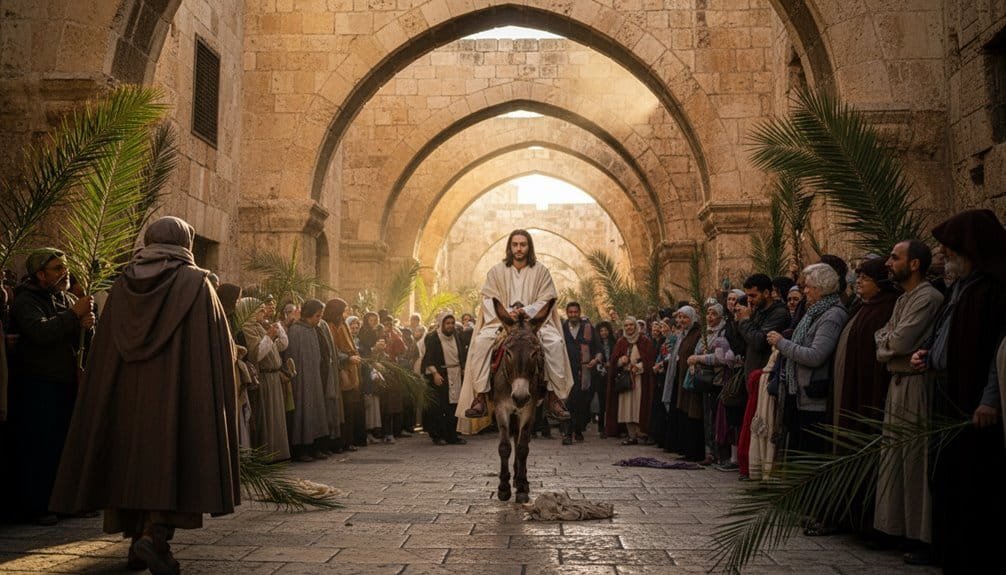
Why does Jesus’s entry into Jerusalem mark such a pivotal moment in Christian theology? You’re witnessing the deliberate fulfillment of Zechariah 9:9, where Christ presents himself as Israel’s messianic king. This Palm Sunday event isn’t merely ceremonial—it’s a calculated theological statement that establishes Jesus’s royal identity while simultaneously predicting his sacrificial death.
The triumphal entry demonstrates Christ’s sovereignty over circumstance and prophecy. You’ll notice how the crowds’ “Hosanna” reflects their expectation of political liberation, yet Jesus rides a donkey, symbolizing peace rather than military conquest. This paradox defines Christianity’s understanding of divine kingship.
The temporal proximity to Holy Week Monday’s temple conflict reveals Jesus’s intentional escalation of messianic claims. You’re observing a strategic progression: public messianic declaration followed by authoritative temple cleansing. This sequence transforms Palm Sunday from celebratory parade into prophetic confrontation, establishing the theological framework for Christianity’s central narrative of sacrificial kingship.

Holy Week Monday Through Wednesday: Temple Teachings And Growing Opposition
Tuesday and Wednesday intensify this confrontation as religious leaders test Jesus through loaded questions about tribute, resurrection, and greatest commandments. You observe contrasting rituals between Christ’s teaching methodology and the Pharisees’ ceremonial displays. Jesus employs nonliturgical practices, teaching through parables and direct discourse rather than formal religious ceremonies.
These three days establish Jesus’s theological authority while exposing religious hypocrisy. The Sanhedrin’s growing hostility crystallizes as they perceive threats to their institutional power. You’re witnessing Christianity’s foundational tension between authentic spiritual devotion and religious formalism, setting the stage for Thursday’s betrayal and Friday’s crucifixion through escalating ecclesiastical opposition.
Maundy Thursday: The Last Supper And Jesus’s Final Instructions
You encounter Jesus’s most profound acts of servanthood on Maundy Thursday as He transforms ordinary bread and wine into eternal symbols of His sacrificial love.
When Christ kneels to wash His disciples’ feet, you witness the divine King demonstrating that true leadership flows from humble service, not earthly authority.
Through these intimate gestures—breaking bread and cleansing feet—you observe Jesus establishing the foundational practices that would define His church’s worship and character for millennia.

Breaking Bread Together
Three profound acts converge on Maundy Thursday evening as Jesus gathers his disciples for what becomes history’s most consequential meal. You witness Christ transforming ordinary bread and wine into eternal symbols through deliberate ritual action. The Passover framework establishes this moment’s theological significance—Jesus recontextualizes Israel’s liberation narrative within his impending sacrifice. When he declares “This is my body” and “This is my blood,” you’re observing the institution of Christianity’s central sacrament.
The communal meals that defined Jesus’s ministry culminate here in sacred ordinance. His gratitude practice—blessing, breaking, sharing—becomes the template for Christian worship. You see how this intimate gathering establishes the Eucharist’s dual nature: remembrance of Christ’s passion and anticipation of eschatological fulfillment in God’s kingdom.
Washing The Disciples’ Feet
How does divine authority express itself through servant leadership? You witness Christianity’s most radical paradigm shift when Jesus kneels before his disciples with basin and towel. This foot washing symbolism shatters conventional hierarchical structures, demonstrating that greatness flows through service rather than dominance. Christ’s action transcends cultural hospitality customs—it’s theological proclamation incarnate.
You observe the Incarnate Word redefining power dynamics within the emerging ecclesial community. When Jesus removes his outer garments and assumes the posture of a household slave, he’s establishing the foundational principle of discipleship humility. This isn’t mere moral instruction but christological revelation: the Son of Man came not to be served but to serve.
You’re called to replicate this kenotic self-emptying, transforming leadership from self-aggrandizement into sacrificial ministry.
Good Friday: The Crucifixion That Secured Salvation
You witness on Good Friday the ultimate expression of Christ’s sacrificial love, where the Son of God willingly endures the cross to demonstrate the Father’s redemptive plan for humanity.
Through His divine blood shed at Calvary, you encounter the perfect atonement that satisfies God’s justice while securing your justification before the throne of grace.
In this moment of apparent defeat, you observe Christ’s triumphant victory over death’s dominion, establishing the foundation for resurrection power that transforms eternal destiny.
Christ’s Sacrificial Love Displayed
Why does the cross stand as history’s most pivotal moment? You witness in Christ’s crucifixion the supreme demonstration of divine love—agape in its purest form. Through discipline and fasting, believers prepare to comprehend this sacrificial act that transcends human understanding. The liturgical symbolism of Good Friday unveils profound theological truths: Christ’s voluntary self-offering fulfills Old Testament typology, from Isaac’s binding to the Passover lamb. You observe love that chooses suffering for another’s redemption, embodying John 15:13’s declaration that no greater love exists than laying down one’s life. This wasn’t mere martyrdom but substitutionary atonement—God’s justice satisfied through divine mercy. Christ’s sacrificial love transforms humanity’s relationship with the Father, demonstrating that salvation flows not from human effort but from God’s initiative.
Atonement Through Divine Blood
Christ’s blood becomes the theological centerpiece of redemptive history, fulfilling centuries of sacrificial foreshadowing through one perfect offering. You witness how divine blood accomplishes what animal sacrifices couldn’t—permanent reconciliation between God and humanity. The atonement dialogue reveals substitutionary principles: Christ’s innocent blood covers your guilty conscience, satisfying divine justice while expressing divine mercy.
Blood symbolism permeates scriptural narrative from Abel’s crying blood to Passover’s protective covering. You see culmination in Christ’s sacrificial death, where divine blood purchases your redemption. The Greek term *hilasterion* indicates propitiation—God’s wrath appeased through Christ’s substitutionary death. You’re reconciled not through your works but through His blood’s efficacy. This isn’t merely symbolic; it’s ontologically transformative, creating new covenant reality where divine blood cleanses conscience and grants eternal access to God’s presence.
Victory Over Death’s Power
How does death’s seemingly ultimate victory become its own decisive defeat through divine paradox? You witness Christianity’s most profound mystery on Good Friday: Christ’s death becomes death’s undoing. Through His voluntary submission to crucifixion, Jesus doesn’t merely endure death—He conquers it from within. The Greek term *thanatos* reveals death’s comprehensive dominion over humanity, yet Scripture declares Christ’s victory over this ultimate enemy (1 Corinthians 15:26).
His divine nature ensures death can’t maintain its grip permanently. When Jesus cries “It is finished,” He’s not admitting defeat but proclaiming triumph. Death’s power shatters against divine love’s immutable force. You’re observing the cosmic reversal where apparent weakness demonstrates omnipotent strength, transforming Good Friday’s tragedy into salvation’s greatest victory through sacrificial love.
Holy Saturday: The Silent Day Of Waiting And Hope
When darkness shrouds the earth and Christ’s body rests in Joseph’s tomb, Holy Saturday emerges as Christianity’s most paradoxical day—a liminal space where death’s apparent victory collides with resurrection’s promise.
You’ll find this silent vigil defies conventional worship patterns. While Good Friday emphasizes suffering and Easter celebrates triumph, Holy Saturday demands patient endurance. The disciples’ bewildered grief mirrors humanity’s existential uncertainty—that space between promise and fulfillment where faith must sustain hope.
Theologically, you’re witnessing Christ’s descent into Sheol, where he proclaims victory over death’s dominion. This “harrowing of hell” reveals salvation’s cosmic scope, extending beyond temporal boundaries to embrace all creation.
Modern interfaith dialogue often centers on this universal hope. You’ll discover that Holy Saturday’s silence speaks profoundly—it’s pregnant with anticipation rather than empty of meaning. Here, you encounter faith’s most authentic test: trusting God’s promises when circumstances suggest abandonment.
Easter Sunday: Christ’s Resurrection Victory Over Death
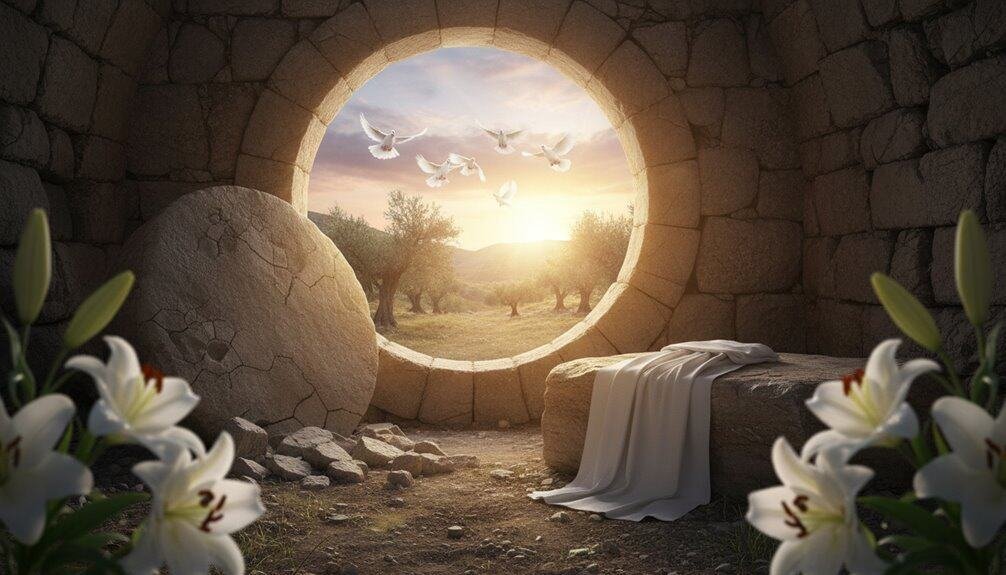
Where Saturday’s silence once reigned, Sunday’s triumph now explodes across creation as Christ emerges victorious from death’s conquered domain. You witness the pinnacle of salvation history as Jesus’s resurrection validates every prophetic promise and theological claim. This isn’t merely resuscitation—it’s transformation into glorified existence, demonstrating Christ’s divine nature and redemptive authority.
The empty tomb becomes Christianity’s foundational evidence, distinguishing it from any unrelated topic or philosophical system. You encounter the bodily resurrection that Paul declares essential to faith itself. Without this victory, your beliefs collapse into meaningless speculation.
Easter’s triumph generates profound two word discussion ideas: “death defeated,” “hope realized,” “prophecy fulfilled,” “salvation accomplished.” You’re invited into resurrection life, sharing Christ’s victory through faith. The risen Christ transforms your understanding of eternity, suffering, and divine love. Easter Sunday doesn’t merely commemorate an historical event—it proclaims your eternal destiny through Christ’s conquering power over humanity’s final enemy.
How Holy Week 2026 Transforms Modern Christian Worship And Faith
Why does Holy Week’s ancient rhythm possess such transformative power over contemporary Christian experience? You’re witnessing devotional aesthetics reshape modern worship through liturgical governance that prioritizes scriptural fidelity over cultural accommodation. The paschal mystery’s chronological progression—from triumphal entry to sacrificial death to resurrection glory—establishes theological architecture that grounds faith in historical particularity rather than subjective sentiment.
You’ll discover that liturgical governance during Holy Week 2026 creates disciplined encounter with Christ’s passion, death, and resurrection through carefully ordered prayer, scripture, and sacrament. This structured approach transforms superficial religious experience into profound spiritual formation. The week’s devotional aesthetics—visual symbols, musical selections, ceremonial actions—serve pedagogical functions that embed biblical truth into congregational memory.
Contemporary Christianity benefits from this ancient wisdom because Holy Week’s liturgical framework prevents faith from becoming merely therapeutic or moralistic. You’re participating in cosmic drama where Christ’s victory over sin and death becomes personally transformative through corporate worship that transcends cultural trends.
Frequently Asked Questions
What Are the Exact Dates for Holy Week 2026?
You’ll find Holy Week 2026 spans April 5-12, with Palm Sunday beginning April 5th and Easter Sunday concluding April 12th. These exact dates derive from complex calendar calculations following the Council of Nicaea’s paschal computus, determining Easter as the first Sunday after the paschal full moon occurring on or after the vernal equinox. You’re observing Christianity’s most sacred liturgical sequence through precise astronomical and ecclesiastical determinations.
How Do Different Christian Denominations Observe Holy Week Differently?
You’ll observe significant differences in ritual practices across denominations during Holy Week. Eastern Orthodox churches emphasize elaborate liturgical ceremonies with extensive chanting and iconographic veneration. Protestant traditions often focus on simplified services emphasizing scriptural readings and personal reflection. Catholic observances include detailed sacramental rites like foot washing and Eucharistic adoration. Contemporary interdenominational ecumenism increasingly encourages shared worship experiences, though theological distinctions in paschal celebration remain pronounced across confessional boundaries.
What Traditional Foods Are Eaten During Holy Week in Various Cultures?
You’ll encounter diverse culinary customs during Holy Week across Christian cultures. Traditional pastries like Greek tsoureki and Italian colomba mark celebration, while fasting foods dominate earlier days—unleavened bread, fish, and vegetables. Orthodox communities prepare special breads and painted eggs. Latin American cultures feature capirotadas and torrijas. These feast rituals reflect theological significance: deprivation transforms into abundance, mirroring Christ’s passion and resurrection through carefully orchestrated dietary observances.
Can Non-Christians Participate in Holy Week Services and Ceremonies?
You’ll find most Christian denominations welcome non-Christian participation in Holy Week observances through inclusive worship practices. While you can’t partake in sacramental elements like communion without baptism, you’re encouraged to attend services, experience liturgical readings, and observe ceremonial traditions. This non-Christian participation reflects Christ’s open invitation to “come and see” (John 1:39), allowing spiritual seekers to witness salvation history’s pivotal moments firsthand.
What Are the Most Popular Pilgrimage Destinations During Holy Week?
You’ll find Jerusalem stands as Christianity’s premier Holy Week destination, where pilgrimage routes converge along the Via Dolorosa.
Rome’s sacred sites, particularly the Vatican and ancient basilicas, draw countless faithful.
Santiago de Compostela’s medieval pathways experience heightened devotion during Passion Week.
Canterbury’s cathedral maintains its historic significance as England’s primary pilgrimage center.
These destinations offer profound liturgical experiences that deepen your understanding of Christ’s salvific work through commemorative worship practices.
Conclusion
You’ll find that Holy Week 2026 doesn’t merely commemorate historical events—it transforms your present reality through Christ’s paschal mystery. As you participate in these seven days, you’re not observing distant occurrences but entering into the eternal now of salvation history. The liturgical progression from triumph to suffering to resurrection reshapes your understanding of discipleship, revealing how God’s redemptive work continues transforming hearts, communities, and the world through your faithful participation in Christ’s dying and rising.






No Comments