


19 Nov 25 Christmas Bible Verses to Read This Season
You’ll discover Christmas’s profound meaning through Scripture’s treasured verses that reveal God’s redemptive plan. From Isaiah’s prophecy of the Prince of Peace to Luke’s humble manger scene, these passages illuminate how heaven touched earth through Christ’s birth. Matthew proclaims Immanuel—God with us—while John declares God’s love that sent His Son for your salvation. The shepherds’ joy, the Magi’s worship, and angels’ glory songs all point to Jesus, your Savior born in Bethlehem, whose arrival transforms fear into celebration and brings eternal hope to your soul.
Key Takeaways
- Isaiah 9:6 proclaims the Messiah’s birth with divine titles: Wonderful Counselor, Mighty God, Everlasting Father, Prince of Peace.
- Luke 2:7 describes Christ’s humble birth in a manger, emphasizing God’s love through vulnerability and simplicity.
- Luke 2:10-11 records angels announcing to shepherds the Savior’s birth, bringing good news of great joy for all people.
- Matthew 1:23 fulfills Isaiah’s prophecy of Immanuel, meaning “God with us,” highlighting God’s presence among humanity.
- John 1:14 declares the Word became flesh and dwelt among us, capturing the profound mystery of the Incarnation.
Isaiah 9:6 – For Unto Us a Child Is Born
Wonder fills the prophet’s voice as he proclaims one of Scripture’s most magnificent promises about the coming Messiah. Isaiah’s messianic prophecy pierces through seven centuries to herald Christ’s royal birth, revealing how God’s salvation would arrive through infant symbolism—a baby wrapped in humanity’s weakness.
You’ll find profound theological implications in each divine title Isaiah bestows: “Wonderful Counselor” speaks to Christ’s perfect wisdom that guides your decisions. “Mighty God” confirms His deity while cradled in Mary’s arms. “Everlasting Father” reveals His eternal care for you, and “Prince of Peace” promises the wholeness your soul craves.
This verse isn’t merely ancient poetry—it’s God’s declaration that He’d enter your broken world as a vulnerable child. When you’re overwhelmed by life’s complexities, remember that infinite power chose the humility of birth. The government resting on His shoulders means Christ bears the weight you can’t carry alone.
Luke 2:11 – A Savior Is Born in the City of David
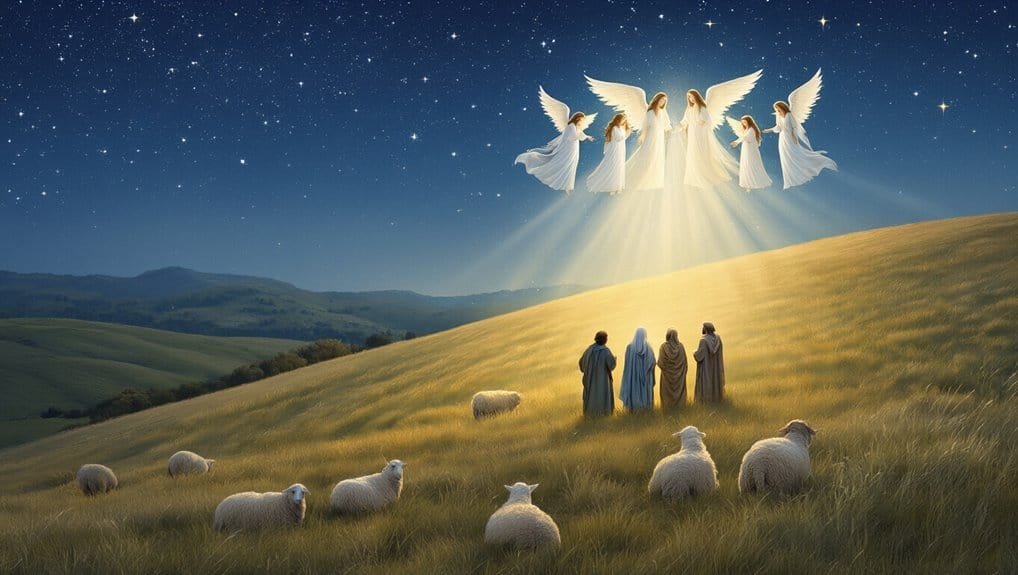
Angels burst through heaven’s veil to deliver history’s most consequential birth announcement to shepherds keeping watch over their flocks. “Today in the town of David a Savior has been born to you; he’s the Messiah, the Lord.” This heavenly proclamation didn’t reach palace halls or temple courts—it echoed across Bethlehem’s fields to society’s forgotten ones.
You’re witnessing God’s upside-down kingdom where shepherds receive what kings missed. The Savior born isn’t merely another prophet or teacher; He’s Christ the Lord, combining divine authority with messianic promise. David’s city, once home to Israel’s shepherd-king, now cradles the Good Shepherd who’ll lay down His life for His sheep.
This Bethlehem announcement transforms everything you know about power and position. God chooses the lowly to shame the wise. He sends heaven’s choir to night-shift workers. When you feel overlooked or insignificant, remember—you’re exactly who God seeks to tell His greatest news.
Matthew 1:23 – They Will Call Him Immanuel
The shepherds heard heaven’s announcement of a Savior, but Matthew reveals the deeper mystery of who this child truly is. “The virgin will conceive and give birth to a son, and they’ll call him Immanuel (which means ‘God with us’).”
You’re not just reading about another miraculous birth—you’re encountering the fulfillment of Isaiah’s seven-hundred-year-old prophecy that shatters the boundary between heaven and earth.
This name meaning changes everything about how you understand Christmas. Emmanuel theology isn’t abstract doctrine—it’s God’s Divine Presence wrapped in swaddling clothes.
When you grasp this fulfillment prophecy, you’ll see that God didn’t send a representative or messenger. He came himself.
Think about your loneliest moments, your deepest struggles. The baby in Bethlehem’s manger is God’s answer: “I’m with you.”
Not watching from heaven’s distance, but breathing earth’s air, feeling human pain, walking dusty roads. This Christmas, you’re celebrating the moment eternity stepped into time.
John 3:16 – God So Loved the World
Strip away the tinsel and lights for a moment, and you’ll find Christmas’s beating heart in sixteen words that have echoed through centuries: “For God so loved the world that he gave his one and only Son.”
You’ve heard these words countless times, maybe even memorized them as a child, but their connection to Christmas transforms everything about December 25th.
This verse isn’t just theology—it’s the why behind the manger. When you see that baby wrapped in swaddling clothes, you’re witnessing grace overflowing from heaven to earth.
God didn’t send a messenger or manifesto; He sent Himself.
The eternal promise wrapped in John 3:16 makes Christmas personal. That “whoever believes” includes you.
The gift lying in Bethlehem’s straw wasn’t just for shepherds and wise men but for your salvation.
This Christmas, let these sixteen words reshape how you view every nativity scene, carol, and tradition.
Luke 2:7 – Mary Laid Him in a Manger
You’ll find profound meaning in Luke 2:7’s simple words: “And she brought forth her firstborn son, and wrapped him in swaddling clothes, and laid him in a manger; because there was no room for them in the inn.”
The King of Kings entered our world not in a palace but in a stable, rejected before He’d even drawn His first breath. This humble birth setting reminds you that Christ came for the lowly and outcast, making room in His heart for all who’ve been told there’s no room for them.
Humble Birth Setting
Mary’s gentle hands wrapped her newborn son in strips of cloth before placing Him in a manger—a feeding trough for animals—because there was no room in the inn.
You’ll find profound stable humility in this scene: the King of Kings didn’t arrive in a palace but among livestock and hay.
The manger symbolism speaks powerfully to your heart—what fed animals now cradles the Bread of Life who’ll feed the world’s spiritual hunger.
Consider how Christ’s entrance mirrors His ministry. He’d later say He came to serve, not be served.
You’re witnessing divine majesty wrapped in poverty, infinite power cloaked in vulnerability.
This humble birth setting reminds you that God doesn’t despise lowly circumstances but transforms them into holy ground.
No Room Available
When the innkeeper turned Joseph and Mary away that night, he couldn’t have known he was refusing shelter to the Messiah. The “no vacancy” sign at Bethlehem’s inn became part of God’s redemptive plan. You’ll find profound meaning in this rejection—Christ entered our world without a humble welcome from those who should’ve received Him.
Luke’s simple phrase “no room for them in the inn” echoes throughout Jesus’s ministry. He’d later say, “Foxes have holes, birds have nests, but the Son of Man has nowhere to lay His head.” From birth to death, rejection marked His path. Yet this exclusion opened salvation’s door. When you feel overlooked or unwelcome, remember your Savior knows that pain intimately. He transforms every closed door into Kingdom purpose.
Isaiah 7:14 – The Virgin Will Conceive
As you explore the prophetic foundations of Christ’s birth, Isaiah 7:14 stands as one of Scripture’s most remarkable promises: “Therefore the Lord himself will give you a sign: The virgin will conceive and give birth to a son, and will call him Immanuel.” This prophecy, spoken seven centuries before Bethlehem’s miracle, reveals God’s extraordinary plan to enter human history through a supernatural birth.
You’ll find profound meaning in this virgin prophecy when you consider its fulfillment through Mary. The name “Immanuel” means “God with us”—not merely God for us or above us, but intimately present in our struggles and joys. This divine promise wasn’t just about a miraculous birth; it declared God’s commitment to dwell among His people personally.
When you’re facing impossible situations, remember that the God who orchestrated this miraculous virgin birth still specializes in the impossible. He’s still Immanuel, still with you today.

Luke 2:10 – Good News of Great Joy
When the angel appears to the shepherds with heaven’s greatest announcement, you’re witnessing God’s perfect response to humanity’s deepest fears.
The proclamation “Do not be afraid, for behold, I bring you good news of great joy” transforms terror into celebration, revealing that Christ’s birth isn’t just for a chosen few but “for all people.
You’ll find that God’s pattern throughout Scripture remains consistent—He meets you in your fear with His peace, replacing your anxiety about His presence with the joy of His salvation.
Angels Announce Jesus’ Birth
The shepherds’ ordinary night transformed into an extraordinary encounter when heaven’s messenger appeared with radiant glory, declaring words that would echo through eternity: “Fear not: for, behold, I bring you good tidings of great joy, which shall be to all people” (Luke 2:10).
This angelic proclamation wasn’t meant for religious elites or political powers—it came to humble shepherds watching their flocks. You’ll find profound comfort knowing God’s heavenly announcement reached society’s margins first.
The angel’s message dismantled fear with joy, replacing terror with tidings that’d transform humanity forever.
When you’re overwhelmed by life’s darkness, remember how heaven broke through an ordinary night with extraordinary news. God doesn’t forget those who feel forgotten. He sends His greatest gifts to the least expected places, announcing salvation where you’d never think to look.
Joy for All People
Universal joy rarely arrives with such divine authority, yet here God’s messenger declares something revolutionary—this good news belongs to every soul drawing breath.
You’re witnessing heaven’s proclamation that transcends social barriers, economic divisions, and ethnic boundaries. The angel doesn’t whisper to religious elites; he shouts to shepherds that salvation’s arrived for everyone.
This Universal Hope transforms how you’ll view your neighbor, stranger, and enemy. Christ’s birth isn’t private property—it’s public treasure meant for sharing.
When you grasp this truth, Community Celebrations become more than seasonal traditions; they’re glimpses of God’s inclusive heart. You can’t hoard what’s meant for all people.
The shepherds understood immediately, rushing to spread what they’d heard. This Christmas, you’re invited into that same mission—carrying joy that refuses exclusivity.
Fear Transformed to Peace
Terrified shepherds encountered glory that night, yet God’s first words through His angel weren’t judgment but comfort: “Don’t be afraid.” You’ve probably felt that same raw terror when confronted by the holy—that bone-deep recognition of your unworthiness before perfect righteousness.
But Christmas transforms fear into peace. The angel’s message reveals God’s approach: He doesn’t crush trembling sinners but offers good news instead. You’re invited to experience inner calm through hopeful surrender to this truth—the Almighty came as a helpless infant specifically to bridge the chasm your sin created.
When you grasp this divine initiative, trust restored replaces dread. God’s perfect love drives out fear, overcoming anxiety with the assurance that judgment has given way to joy. Peace isn’t earned; it’s proclaimed over you.
Matthew 2:11 – The Wise Men Worship Jesus
Entering the house, the wise men saw the child with Mary his mother, and their immediate response reveals the true heart of worship. They fell down and worshiped Him—not Mary, not the circumstances, but the child himself. Their star guided homage culminated in this profound moment of recognition and surrender.
Notice what worship preceded: the giving of gifts. You can’t truly give until you’ve first bowed your heart. These Eastern gifts—gold, frankincense, and myrrh—weren’t diplomatic offerings but expressions of worship. Gold honored His kingship, frankincense His deity, and myrrh prophetically acknowledged His suffering.
You’re invited into this same posture today. When you encounter Jesus, don’t rush to present your offerings, achievements, or religious activities. First, fall down. Worship precedes service, adoration comes before action. The wise men teach you that genuine worship recognizes who Jesus truly is and responds with complete surrender and costly devotion.
Micah 5:2 – Out of Bethlehem Will Come a Ruler
This Bethlehem geography carries profound meaning. David’s hometown becomes the birthplace of David’s greater Son.
When you read Micah 5:2, you’re witnessing God’s sovereign plan unfold through centuries. The phrase “from ancient times, from eternity” reveals Christ’s divine nature—He who existed before time would arrive at a specific point in time.
Consider how God uses the small and insignificant for His mighty purposes. Just as He chose Bethlehem over grander cities, He often works through what seems weak to display His power in your life.

Luke 2:14 – Glory to God in the Highest
When you hear the angels’ triumphant song in Luke 2:14, you’re witnessing heaven’s response to Christ’s birth—a divine proclamation that splits the night sky with glory.
The shepherds didn’t just hear about peace; they encountered God’s glory breaking into earthly darkness, where heaven’s worship met humanity’s need.
You’ll find that genuine peace doesn’t come from earthly circumstances but flows from joining heaven’s chorus, declaring God’s glory even in your darkest December nights.
Angels Proclaim God’s Glory
Above the startled shepherds in Bethlehem’s fields, a multitude of heavenly hosts burst through the veil between heaven and earth, their voices thundering the eternal anthem: “Glory to God in the highest, and on earth peace, good will toward men” (Luke 2:14).
This Heavenly Proclamation wasn’t merely an announcement—it revealed heaven’s perspective on Christ’s birth. When angels worship, they’re showing you what matters most: God’s glory displayed through His redemptive plan. You’re witnessing the cosmic significance of that humble manger.
Your Sacred Response mirrors theirs when you recognize Jesus as the bridge between heaven’s glory and earth’s peace. You can’t manufacture this peace through human effort; it flows from God’s goodwill toward humanity.
Like those shepherds, you’re invited to move from fear to wonder, from ordinary life to extraordinary worship.
Heaven Meets Earth
The angels’ proclamation marks the moment when heaven’s eternal reality breaks into earth’s temporal darkness, revealing God’s ultimate purpose for sending His Son. You’re witnessing the greatest celestial intersection in history—where infinite glory enters an earthly womb, where omnipotence chooses vulnerability. This divine visitation doesn’t demand you ascend to heaven; instead, heaven descends to meet you in your brokenness.
Consider your human response to this miraculous invasion. God’s glory doesn’t remain distant in highest heaven but presses close through a baby’s cry. You don’t have to wonder if God understands your struggles—He’s entered them personally. When you feel heaven’s too far away, remember Christmas proves otherwise. The Word became flesh, bridging the infinite gap between holy perfection and human need.
Peace Through Divine Praise
As angelic hosts shatter the night sky with their cosmic hymn, you’re hearing heaven’s prescription for earth’s deepest wound—the absence of peace. “Glory to God in the highest, and on earth peace to those on whom his favor rests” isn’t merely celebratory worship; it’s the divine formula linking heaven’s praise to humanity’s wholeness.
You’ll discover that peace doesn’t originate in political treaties or personal achievements but flows from acknowledging God’s supreme worth. When you lift heartfelt worship, you’re aligning with heaven’s sacred music, creating space for divine shalom to invade earthly chaos. The shepherds understood this connection—they left glorifying God because they’d witnessed praise becoming peace incarnate. Your worship today isn’t just religious duty; it’s participating in heaven’s peace-making mission on earth.
John 1:14 – The Word Became Flesh
When you encounter John 1:14, you’re standing before one of Scripture’s most profound declarations about Christmas: “The Word became flesh and made his dwelling among us.” This verse captures the breathtaking mystery of the Incarnation—God’s eternal Word, through whom all creation came into being, entered human history as a vulnerable infant.
The Incarnation Mystery transforms how you understand God’s love. He didn’t send instructions from heaven; He came personally. The Creator became creation, the Infinite became an infant, divinity wrapped itself in humanity’s flesh. This Fleshology Reflection reveals God’s radical commitment to rescue you.
Consider what “dwelling among us” means—literally “tabernacled.” Just as God’s presence filled the Old Testament tabernacle, now His glory resided in human form. You’re invited to marvel at this divine humility. The Word who spoke galaxies into existence learned to speak as a child, experiencing hunger, exhaustion, and tears—all to bridge the gap between heaven and earth.
Matthew 1:21 – He Will Save His People
Joseph’s trembling hands must have steadied when the angel delivered this promise: “She will give birth to a son, and you’re to give him the name Jesus, because he’ll save his people from their sins.” This verse reveals the very heart of Christmas—not merely a birth announcement, but a rescue mission declared before the child’s first breath.
Christmas isn’t merely a birth announcement, but a rescue mission declared before the child’s first breath.
You’re witnessing the savior identity embedded in Christ’s very name—Jesus means “the Lord saves.” Before Mary’s son could walk or speak, heaven proclaimed His purpose. He wouldn’t arrive as a political liberator or military conqueror, but as the one who’d break sin’s stranglehold on humanity.
When you celebrate Christmas, you’re celebrating this rescue mission. Every nativity scene, every carol, every twinkling light points to this truth: God sent His Son to save you from what you couldn’t escape yourself.
That’s why the angels sang. That’s why we still rejoice.
Luke 1:35 – The Holy One to Be Born
Standing before Mary, the angel Gabriel unveiled the mystery of mysteries: “The Holy Spirit will come on you, and the power of the Most High will overshadow you. So the holy one to be born will be called the Son of God.” You’re witnessing the announcement of history’s most extraordinary divine conception.
This wasn’t merely a birth announcement—it revealed Christ’s heavenly origin and His unique nature as both fully God and fully human.
Gabriel’s words confirm Jesus’s messianic identity before His birth. The Holy Spirit’s overshadowing guaranteed this child’s absolute holiness, setting Him apart for His sanctified mission of redemption.
You can’t miss the significance: the same Spirit who hovered over creation’s waters would now bring forth the new creation through Mary’s womb.
When you read Luke 1:35, you’re encountering the intersection of heaven and earth, where God’s salvation plan takes flesh.
Galatians 4:4-5 – Born Under the Law to Redeem
When you read Paul’s declaration that Christ came “in the fullness of time,” you’re witnessing God’s sovereign orchestration of history for your redemption.
Jesus wasn’t born randomly but entered humanity under the Law’s demands to fulfill what you couldn’t and purchase your freedom from sin’s bondage.
Through His perfect obedience and sacrifice, you’ve been granted something greater than mere forgiveness—you’ve received the full rights of adoption as God’s beloved child.
God’s Perfect Timing
Throughout history, God orchestrated every detail leading to Christ’s birth with divine precision. When Rome’s roads connected the ancient world and Greek became the common language, when prophecies aligned and the world groaned for salvation, God sent His Son. You’re reminded that divine timing isn’t random—it’s purposeful.
In your own quiet waiting, remember how God’s perfect season arrived exactly when humanity needed redemption most. The centuries of patient trust displayed by faithful believers before Christ’s arrival speaks to your situation today. You may not understand why you’re waiting, but God’s working behind the scenes, arranging circumstances you can’t see. Just as He perfectly timed the incarnation, He’ll perfectly time His answers to your prayers. Trust His wisdom over your timeline.
Purpose of Incarnation
God’s perfect timing revealed itself not just in when Christ came, but in why He came—to accomplish what you could never do on your own.
The Divine Purpose of Christmas wasn’t merely to bring a baby into the world, but to bring redemption to those enslaved under the law’s demands.
When you read Galatians 4:4-5, you’re witnessing God’s Redemption Plan unfold—Jesus born under the very law that condemned you, perfectly fulfilling what you couldn’t.
This Incarnation Mystery transforms your Eternal Hope from wishful thinking into certain reality.
Christ didn’t come to show you how to save yourself; He came to be your salvation.
Every Christmas decoration you see should remind you that God became flesh with one mission: to redeem you completely.
Adoption as Children
You’re not just forgiven—you’re adopted into God’s own family through Christ’s redemptive work.
Galatians 4:4-5 reveals that Jesus came “to redeem those under the law, that we might receive adoption to sonship.” This spiritual adoption transforms your entire family identity from outsider to beloved child.
You’ve received more than pardon; you’ve gained full inheritance rights as God’s heir.
The same Spirit who raised Christ now cries “Abba, Father” from within you.
Your adoption papers were signed in blood at Calvary, sealed by resurrection power.
This Christmas, remember you’re celebrating your Brother’s birth—the firstborn among many siblings.
You belong at the Father’s table not as a guest but as a permanent family member with an eternal home address.
Luke 2:8-9 – Angels Appear to the Shepherds
God chose society’s overlooked to witness His glory. The shepherds’ witness began with terror as divine radiance pierced the darkness. Yet this nighttime revelation wasn’t meant for religious elites or political powers—it came to those deemed unworthy by their culture.
You’ll find comfort knowing God doesn’t bypass the lowly. He seeks those faithfully tending their responsibilities, even in obscurity. When heaven breaks into your ordinary moments, you’re invited to encounter the extraordinary grace that transforms fear into worship.
Isaiah 60:6 – They Will Bring Gold and Incense
When you read Isaiah’s ancient prophecy about gold and incense being brought in worship, you’re witnessing a stunning preview of the Magi’s gifts to Jesus centuries later.
These weren’t random presents but prophetic worship elements—gold honoring Christ’s kingship and frankincense acknowledging His divine nature as the Son of God.
You’ll find deep meaning in how God orchestrated even the specific gifts brought to the manger, confirming through Persian wise men what He’d promised through Jewish prophets.
Gifts of the Magi
Picture the ancient caravans stretching across desert sands, laden with treasures that would one day find their way to a humble child in Bethlehem. You’re witnessing prophecy unfold as these exotic offerings journey toward their divine destination. The Magi’s caravan journey represents more than physical travel—it’s humanity’s spiritual quest to worship the King.
Their star navigation led them to present gifts with regal symbolism: gold honoring Christ’s kingship, frankincense acknowledging His deity, and myrrh foreshadowing His sacrificial death. You’ll find deep meaning in how these wealthy scholars bowed before a carpenter’s son. They understood what many missed—true worth isn’t measured by earthly status.
When you bring your gifts to Jesus, whether material or spiritual, you’re joining this ancient procession of worshippers who recognized heaven’s treasure wrapped in swaddling clothes.
Prophetic Worship Elements
Centuries before the Magi arrived, Isaiah’s prophetic voice proclaimed what you’d later witness in Matthew’s Gospel—multitudes bearing gold and incense to honor the Messiah.
This worship imagery reveals God’s sovereign plan unfolding across generations. When you read Isaiah 60:6, you’re seeing prophetic praise that transcends time, connecting Old Testament promise with New Testament fulfillment.
The gold represents Christ’s kingship, while incense symbolizes prayers ascending to heaven. You’ll notice how these elements weren’t random gifts but divinely orchestrated offerings that proclaimed Jesus’s identity.
As you reflect on this passage, consider how your worship today echoes this ancient prophecy. You’re part of the continuing multitude bringing offerings of praise to the King. Your prayers, like incense, rise before God’s throne, fulfilling Isaiah’s vision of nations streaming to worship the Light of the World.
Luke 2:12 – You Will Find a Baby Wrapped in Cloths
The angel’s sign to the shepherds reveals God’s profound humility—the Messiah would be found not in royal splendor but wrapped in simple cloths, lying in a manger. This manger symbolism speaks volumes about Christ’s mission. He’d identify with humanity’s lowliest circumstances from His very first breath.
You’ll discover that the shepherds’ witness becomes even more remarkable when you consider their social status. These night-shift workers, often dismissed by religious elites, became the first evangelists of the newborn King. They found exactly what the angel promised—a baby in ordinary swaddling cloths, cradled where animals fed.
When you’re tempted to believe God only works through impressive means, remember this scene. The Savior of the world began His earthly journey in borrowed space, wrapped in common cloth. His kingdom wouldn’t advance through worldly power but through servant love. This baby in the manger would transform everything through weakness made divine.
Philippians 2:7-8 – He Made Himself Nothing
You’ll discover Christmas’s deepest mystery in Philippians 2:7-8, where Christ willingly emptied Himself of divine glory to take on human flesh.
He didn’t grasp at His heavenly privileges but chose a servant’s humble form, becoming obedient even to death on a cross.
This divine descent from throne to manger to cross reveals love’s truest measure—the Creator becoming vulnerable for His creation’s redemption.
Emptied of Divine Glory
When you consider what Christ surrendered to become human, you’re confronting one of Scripture’s most profound mysteries. The Son of God didn’t cling to His divine privileges but willingly set them aside. This divine humility wasn’t forced upon Him—He chose it. You’re witnessing kenotic theology in action: Christ emptied Himself not of His deity, but of glory’s outward display.
Think about it: infinite power confined to an infant’s body, omniscience learning to speak, the universe’s Creator needing Mary’s milk. He who commanded angels accepted mockery. He who owned everything became poor. You can’t grasp Christmas without understanding this voluntary descent.
Christ’s emptying makes your filling possible. His humiliation becomes your exaltation. This is love’s ultimate expression—deity veiling itself in humanity for your redemption.
Servant’s Humble Form
Christ’s self-emptying reached its deepest expression when He took the very nature of a servant. You’re witnessing the King of Glory choosing servant humility over rightful honor, washing feet instead of demanding worship. He didn’t merely appear as a servant—He became one fully, embracing genuine lowliness.
This Christmas, you’ll find Him in a feeding trough, dependent on Mary’s care. The hands that formed galaxies now grasp Mary’s finger. The voice that commanded creation cries for milk. He who sustains all things needs swaddling clothes.
His gentle service began in Bethlehem’s vulnerability and continued through Calvary’s sacrifice. When you’re tempted by pride, remember your Lord’s chosen path. He made Himself nothing so you’d become everything in Him.
Obedient Unto Death
Though angels trembled at the sight, the Son’s obedience pressed forward through every agonizing step from manger to cross. You’re witnessing sacrificial obedience that defies human comprehension—the Creator submitting to creation’s cruelest death.
He didn’t merely visit earth; He embraced mortality’s full weight, accepting betrayal, mockery, and abandonment.
This ultimate humility wasn’t weakness but divine strength restraining itself. When you face your Gethsemanes, remember Christ’s “not my will but yours.” His obedience wasn’t blind—He knew every coming horror yet pressed on for your redemption.
The baby in Bethlehem‘s straw came with crucifixion’s shadow already upon Him. He counted the cost before Mary’s womb, choosing nails over comfort, thorns over throne. This Christmas, you’re celebrating not just a birth but a predetermined death that purchased your life.
Matthew 2:2 – Where Is the One Born King of the Jews
These wise men didn’t just observe celestial phenomena—they recognized divine star guidance pointing to the Messiah. They understood what many in Jerusalem missed: heaven itself was announcing Christ’s arrival.
The Magi saw what Jerusalem’s religious elite missed—heaven declaring the Messiah’s arrival through a star.
While Herod’s palace buzzed with political intrigue, foreign seekers brought treasures to honor the true King.
You’re invited to embrace their seeking spirit today. When God places His signs before you, don’t merely admire them from afar. Follow where He leads, even when it means leaving comfort zones.
The Magi’s journey teaches that worship requires movement—from observation to action, from knowledge to surrender.
Luke 1:46-47 – Mary’s Song of Praise
Your soul magnifies the Lord when you grasp what Mary understood in that holy moment—God had chosen her, an ordinary young woman, to carry extraordinary purpose.
Her response wasn’t questioning or hesitation but humble praise that’s echoed through centuries. “My soul glorifies the Lord and my spirit rejoices in God my Savior,” she declared, teaching you what worship looks like when heaven touches earth.
This Magnificat reflection reveals how you’re called to respond when God interrupts your plans with His glory. Mary didn’t boast about her selection or diminish her role. She recognized her lowliness while exalting God’s might.
You’ll find this same pattern throughout Scripture—the humble are lifted while the proud are scattered.
When you encounter God’s presence this Christmas season, let Mary’s song shape your response. True worship flows from recognizing who God is and who you’re in His story.
1 John 4:9 – God Sent His One and Only Son
Love breaks through every barrier when you read these eight words that changed history: “God so loved the world that he gave.” This verse isn’t just theology—it’s the heartbeat of Christmas, the moment when divine love took on flesh and blood.
You’re witnessing the greatest divine mission ever undertaken. The Father didn’t send an angel, prophet, or messenger—He sent His only Son. This sacrificial love defies human logic. What parent would willingly surrender their beloved child for those who’d rejected them?
Yet that’s precisely what happened in Bethlehem’s manger. The baby Mary held wasn’t merely special; He was God’s answer to humanity’s deepest need.
When you celebrate Christmas, you’re remembering the night heaven emptied its greatest treasure into earth’s poverty. This isn’t sentimentality—it’s the radical truth that you’re worth everything to God. He didn’t just send help; He sent Himself.
Luke 2:20 – The Shepherds Return Glorifying God
Wonder transformed into worship as the shepherds rushed back to their fields, their voices echoing through Bethlehem’s hills with praise for everything they’d witnessed. These humble men couldn’t contain their joy after encountering the Christ child exactly as the angel had proclaimed.
You’ll find profound meaning in the Shepherds’ Praise recorded in Luke 2:20. They glorified God for what they’d heard and seen—the message matched the reality. Their Rural Witness began immediately, spreading news of salvation’s arrival throughout the countryside. These weren’t educated theologians or temple priests; they were working-class men whose testimony carried authentic power.
Consider how you’re called to similar worship. When you’ve encountered Christ’s truth, you can’t help but glorify God. Your praise doesn’t require eloquence or position—it needs only genuine experience with Jesus. Like these shepherds, you’re commissioned to return to your everyday life transformed, letting your worship overflow naturally into witness wherever God has placed you.
Hebrews 1:1-2 – God Has Spoken Through His Son
The shepherds proclaimed what they’d seen, but Hebrews opens with an even greater revelation—God’s ultimate communication through Jesus Christ.
“Long ago, at many times and in many ways, God spoke to our fathers by the prophets, but in these last days he’s spoken to us by his Son.” You’re witnessing divine revelation’s climax—the Word becoming flesh.
This passage transforms how you understand Christmas. It’s not merely about a baby’s birth; it’s about God’s Son-centered plan reaching fulfillment.
The incarnational authority of Christ surpasses every prophet who came before. When you celebrate His birth, you’re acknowledging that heaven’s final word has been spoken through Him.
The apostolic witness confirms this truth: Jesus isn’t just another messenger—He’s the message itself.
As you read Scripture this season, remember you’re encountering God’s definitive voice.
The manger holds more than an infant; it cradles the One through whom the Father speaks eternally.
Matthew 2:10 – They Were Overjoyed at Seeing the Star
Bursting with divine joy, the Magi’s response to the star reveals something profound about encountering God’s guidance. When these wise men saw the star reappear, they weren’t just happy—they were “overjoyed with great joy.” Their star wonder teaches you that God’s direction brings overwhelming gladness to seeking hearts.
You’ll notice the Magi’s joyful response came after a long journey filled with uncertainty. They’d traveled far, questioned Herod, and faced moments of doubt. Yet when God’s sign appeared again, their hearts erupted with celebration. This same joy awaits you when you persist in following God’s lead through difficult seasons.
Their reaction wasn’t subdued or analytical—it was exuberant and wholehearted. You’re invited to experience this same delight when God confirms His presence in your life. Whether through Scripture, prayer, or circumstances, when you recognize God’s guidance, don’t hold back your joy. Let it overflow like the Magi’s did.
2 Corinthians 9:15 – Thanks Be to God for His Indescribable Gift
Paul’s explosive gratitude in 2 Corinthians 9:15 captures what your heart knows but struggles to express—God’s gift of Jesus defies human language. When you contemplate Christ’s incarnation, you’re confronting gift theology at its pinnacle. This isn’t merely generous—it’s “indescribable,” surpassing every category you possess for understanding gifts.
Consider how Paul’s declaration transforms your gratitude practice this Christmas. You can’t adequately describe what God’s given, yet you’re called to respond with thanksgiving. This paradox deepens worship rather than diminishing it. When words fail, your awe increases.
The apostle’s exclamation emerges from discussing financial generosity, but he can’t contain himself—earthly giving pales before heaven’s gift. You’ll find that meditating on this verse reorients your perspective on both receiving and giving. Christ’s arrival renders all other presents shadows of the ultimate Gift. Your gratitude practice finds its true center here, where divine love took flesh.
Frequently Asked Questions
How Can I Incorporate These Verses Into Family Christmas Traditions?
You can weave Scripture into your family’s Christmas traditions through daily Advent prayers, reading one verse together each evening before dinner.
Create Scripture ornaments by writing verses on decorative cards to hang on your tree. You’ll find these practices deepen your family’s spiritual connection to Christ’s birth.
Let children take turns reading aloud, making God’s Word come alive in their hearts while building lasting memories centered on His truth.
What Are Good Bible Reading Plans for the Christmas Season?
You’ll find meaningful plans through structured Advent reflections that build anticipation daily.
Start with Isaiah’s prophecies, then follow the Nativity chronology from Luke 1-2 and Matthew 1-2.
Consider a 25-day countdown reading one prophecy and fulfillment pair each day.
You can also explore thematic plans focusing on hope, peace, joy, and love weekly.
These approaches deepen your understanding while preparing your heart for celebrating Christ’s birth with purpose.
Which Bible Translation Is Best for Reading Christmas Verses Aloud?
You’ll find the ESV or NKJV excellent for reading Christmas verses aloud, as they balance clear diction with poetic rhythm.
The ESV preserves the majesty of prophecies like Isaiah 9:6, while the NKJV maintains familiar cadences that resonate in listeners’ hearts.
Both translations honor the text’s biblical depth while remaining accessible.
When you’re proclaiming Christ’s birth to gathered family, these versions let Scripture’s beauty shine through your voice.
How Do I Explain These Verses to Young Children?
You’ll connect with young hearts by using picture dramatizations that bring the nativity alive—let them act out Mary’s journey or shepherds watching sheep.
Weave in simple prayers they can repeat, like “Thank you, Jesus, for coming as a baby.”
Break down complex verses into bite-sized truths: God’s love made Him small enough to hold.
Use tangible examples—just as they need hugs, God knew we needed His presence close.
Are There Christmas Verses From the Old Testament Besides Isaiah and Micah?
Yes, you’ll find powerful Christmas prophecies throughout the Old Testament! Genesis 3:15 reveals the first Messianic foreshadowing of Christ’s victory.
Numbers 24:17 speaks of the coming star and scepter. Psalm 72 portrays the righteous king bringing peace.
Jeremiah 23:5-6 promises David’s righteous Branch. These verses overflow with Prophetic hope, showing God’s redemption plan unfolding across centuries.
They’ll deepen your family’s understanding of how Christ’s birth fulfilled ancient promises.
Conclusion
As you’ve journeyed through these sacred verses, you’ve encountered the heart of Christmas—God’s overwhelming love made flesh. Don’t let these words remain on the page; let them transform your celebration. When you’re tempted by holiday stress, remember the shepherds’ joy. When you’re overwhelmed by gift-giving, recall God’s indescribable gift. This season, you’re invited to experience Emmanuel—God with you. Open your heart afresh to the wonder of that holy night and carry its light forward.





No Comments