

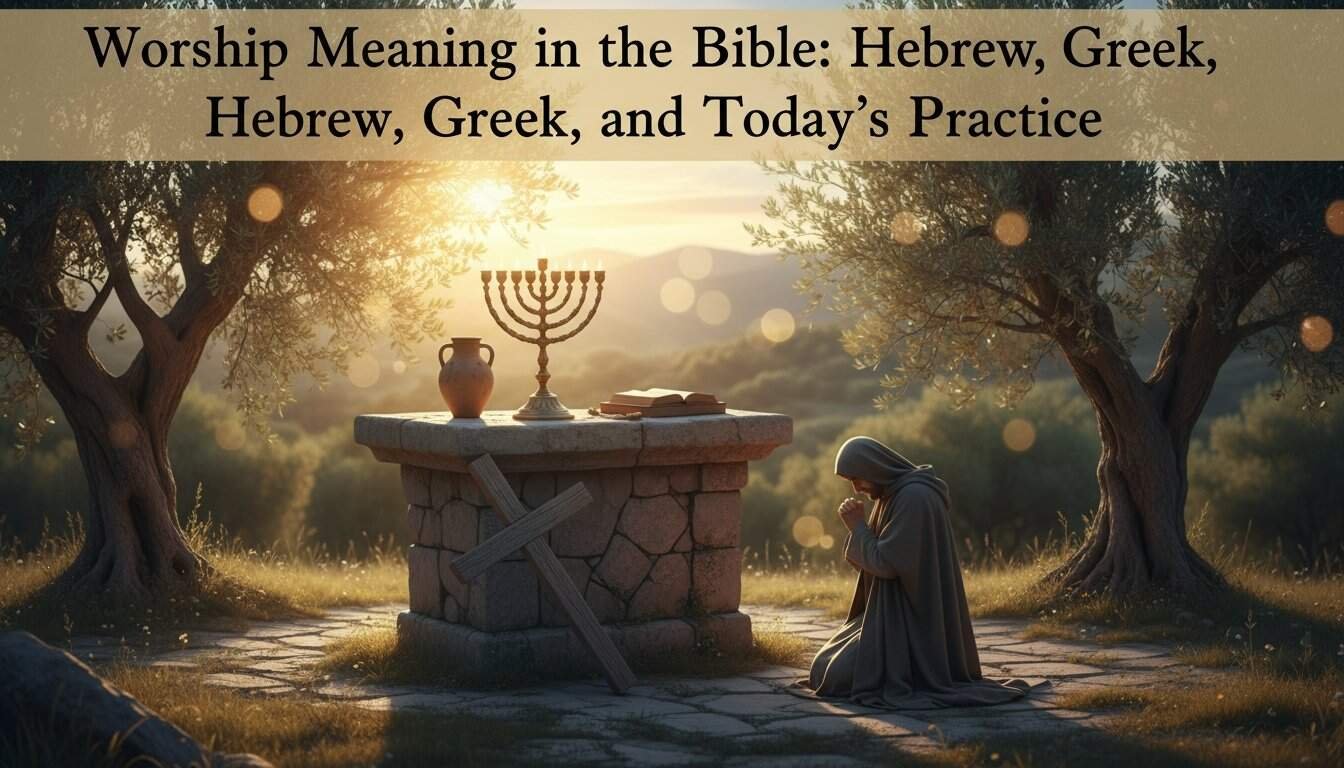
17 Dec Worship Meaning in the Bible: Hebrew, Greek, and Today’s Practice
Biblical worship transcends modern Sunday services through rich Hebrew and Greek terms that reveal its comprehensive nature. Hebrew “shachah” means prostrating yourself before God, while “abad” conveys devoted service and “halal” expresses radiant praise. Greek “proskuneo” emphasizes reverent bowing, and “latreuo” represents ongoing, love-motivated service flowing from relationship. You’ll find worship isn’t confined to rituals but encompasses your entire lifestyle of surrendered devotion. Exploring these ancient foundations transforms how you approach authentic worship today.
Table of Contents
Key Takeaways
- Hebrew words like “shachah” (bow down), “abad” (serve), and “halal” (praise) reveal worship as physical submission and reverent service to God.
- Greek terms “proskuneo” (prostrate) and “latreuo” (devoted service) emphasize both physical reverence and ongoing lifestyle dedication in New Testament worship.
- Biblical worship involves specific physical postures—bowing, lifted hands, kneeling—that communicate heart attitudes of surrender, humility, and expectation before God.
- True worship transcends ritual locations and ceremonies, requiring authentic heart transformation that makes entire life a continuous expression of devotion.
- Modern worship practices incorporate ancient elements like congregational singing, Scripture reading, and communal prayer while emphasizing both individual intimacy and corporate identity.
Biblical Hebrew Words for Worship and Their Sacred Meanings

When you examine the Hebrew Scriptures, you’ll discover that worship isn’t captured by a single word but expressed through a rich tapestry of terms, each revealing distinct aspects of humanity’s response to the divine.
The Hebrew word *shachah* means “to bow down” or “prostrate oneself,” emphasizing physical submission before God’s majesty. You’ll find this term throughout Scripture, from Abraham’s encounter with divine messengers to David’s temple worship.
*Abad* conveys “to serve” or “work,” highlighting worship as dedicated service rather than mere ritual. The sacred significance of Hebrew roots becomes evident when you consider *halal*, meaning “to praise” or “shine forth,” which forms the foundation of “hallelujah.”
*Zamar* specifically refers to worshipping with musical instruments, reflecting the integral role of music in Hebrew worship practices. Meanwhile, *yadah* means “to give thanks” with extended hands, demonstrating gratitude’s centrality.
These linguistic distinctions reveal worship’s multifaceted nature in ancient Israel.
Greek Terms for Worship in the New Testament
When you examine the New Testament’s Greek vocabulary for worship, you’ll encounter two primary terms that reveal distinct yet complementary dimensions of devotional practice. Proskuneo emphasizes the physical and reverent act of bowing or prostrating oneself before God, reflecting the worshiper’s recognition of divine majesty and personal submission.
Latreuo focuses on the ongoing service and devoted labor offered to God, encompassing both ritual acts and the believer’s comprehensive life of dedication.
Proskuneo: Bowing in Reverence
You’ll discover that *proskuneō* encompasses both physical and spiritual dimensions of worship. The term indicates a reverent posture that acknowledges divine authority and expresses submission.
When you examine its New Testament usage, you’ll find it describes worship directed toward God, Jesus Christ, and occasionally false objects of devotion. These honoring gestures weren’t merely external rituals but represented genuine heart attitudes of recognition, respect, and surrender to divine supremacy.
Latreuo: Service and Devotion
Paul employs this word when urging believers to present their bodies as living sacrifices—true and proper worship (*latreia*, Romans 12:1). The term transcends mere ceremonial acts, encompassing your entire existence as ritual devotion.
Unlike pagan worship focused on appeasing deities, *latreuō* represents voluntary, love-motivated service flowing from relationship with God. This worship manifests through daily obedience, ethical living, and faithful ministry to others.
Physical Postures and Gestures in Ancient Worship Practices
When you examine biblical worship, you’ll discover that ancient believers expressed their reverence through deliberate physical postures that carried profound theological significance. Your body language in worship wasn’t merely cultural preference but reflected your heart’s posture before God, whether through prostration that demonstrated complete submission, raised hands that signified surrender and praise, or kneeling that expressed humility and petition.
These embodied expressions of faith reveal how ancient worshipers understood that true worship engages your entire being—spirit, soul, and body—in response to God’s holiness and grace.
Bowing and Prostration Practices
You’ll notice biblical figures like Abraham, Moses, and David regularly employed bowing and prostrating as acts of worship, prayer, and supplication. These postures weren’t merely cultural customs but theological statements about humanity’s relationship with the Creator.
The physical act of lowering oneself reflected the heart’s acknowledgment of God’s sovereignty, creating embodied worship that engaged both spirit and flesh in reverent submission.
Lifted Hands Significance
The uplifted hands that appear throughout Scripture carry profound theological weight, representing humanity’s reach toward the divine and God’s reciprocal blessing upon His people. When you examine the Hebrew term “nasa kappayim” (lifting palms), you’ll discover it expresses both surrender and expectation.
This lifted hands symbolic gesture appears in Psalm 134:2, where worshipers “lift up your hands in the sanctuary and praise the Lord.” The practice demonstrates vulnerability before God while simultaneously expressing lifted hands enthusiasm for His presence. In 1 Timothy 2:8, Paul instructs men to pray “lifting up holy hands,” emphasizing moral purity accompanying physical expression. You’ll find this posture bridges the gap between internal devotion and external demonstration, creating embodied worship that engages both spirit and flesh.
Standing and Kneeling Traditions
Throughout biblical narrative, standing and kneeling postures reveal distinct theological meanings that ancient worshipers understood as essential expressions of their relationship with God. Standing positions typically demonstrated reverence, readiness, and equality before divine presence. You’ll notice the Levites stood during temple service (2 Chronicles 35:5), while congregants stood during prayer and Scripture reading (Nehemiah 8:5).
Conversely, kneeling postures expressed humility, submission, and supplication. Solomon knelt during temple dedication (1 Kings 8:54), and Daniel knelt three times daily in prayer (Daniel 6:10). These physical expressions weren’t merely cultural customs but carried profound spiritual significance. When you examine these practices, you’ll discover that posture communicated heart attitude, reflecting whether worshipers approached God with confident trust or humble dependence.
Worship as Service and Lifestyle in Scripture
You’ll discover that biblical worship isn’t confined to sacred spaces or specific times. When Jesus tells the Samaritan woman that true worshipers worship “in spirit and truth” (John 4:23), He’s describing a worshipful attitude that transcends location and ritual. Your work, relationships, and decisions become expressions of reverent surrender to God’s lordship.
The Hebrew concept of *’ebed* (servant) reinforces this lifestyle worship, where obedience becomes your primary offering. Whether you’re caring for family, pursuing vocation, or engaging community, Scripture calls you to approach these activities as acts of worship, making your entire existence a continuous expression of devotion.
Temple Worship Versus Heart Worship in Biblical Times
When Israel’s temple worship reached its zenith under Solomon’s reign, God’s people possessed an elaborate system of sacrifices, festivals, and priestly ceremonies that defined their covenant relationship with Yahweh. Yet Scripture consistently reveals God’s preference for authentic heart attitudes over mere ritual performance. The Hebrew prophets repeatedly condemned empty ceremonialism while emphasizing internal devotion.
Temple symbolism served as God’s pedagogical tool, teaching Israel about holiness, sacrifice, and divine presence. However, the physical structure wasn’t worship’s ultimate destination but rather a means pointing toward deeper spiritual realities. Jesus later clarified this tension, declaring that true worshipers would worship “in spirit and truth” (John 4:23-24).
You’ll notice throughout biblical narrative that God consistently values the heart’s posture over external compliance. David’s psalms exemplify this principle—authentic worship emerges from internal transformation, not ritual obligation. The temple provided structure, but genuine worship required surrendered hearts aligned with God’s character and purposes.
Corporate Worship Elements Found Throughout Scripture

While individual heart posture remains paramount, Scripture reveals that God’s people consistently gathered for collective expressions of worship that strengthened their corporate identity and mutual faith. You’ll find congregational participation woven throughout biblical accounts, from Israel’s responsive singing in Exodus 15 to the early church’s communal practices in Acts 2:42-47.
Corporate worship elements include communal prayer (1 Kings 8:22-53), Scripture reading and exposition (Nehemiah 8:1-8), and collective singing of psalms and hymns (Psalm 95:1-2, Ephesians 5:19). The synagogue system established liturgical traditions that influenced New Testament gatherings, emphasizing Torah reading, prayer, and teaching.
Paul’s instructions regarding orderly worship in 1 Corinthians 14 demonstrate how corporate elements—prophecy, tongues with interpretation, and mutual edification—required structure while maintaining spiritual authenticity. These gathered expressions weren’t mere ritual but transformative encounters where God’s people experienced His presence together, reinforcing covenant identity and shared mission.
How Ancient Worship Practices Influence Modern Church Services
Though centuries separate modern congregations from ancient Israel’s tabernacle worship, today’s church services retain foundational elements that trace directly to biblical precedents. You’ll recognize ancient patterns when examining contemporary worship structures: opening with praise (Psalm 95:1-2), Scripture reading (Nehemiah 8:1-8), teaching (Ezra 7:10), and communal prayer (1 Timothy 2:1-2).
Today’s worship services echo ancient biblical patterns through praise, Scripture reading, teaching, and prayer that span millennia of faithful tradition.
Worship music evolution demonstrates remarkable continuity from David’s psalms to modern hymnody and contemporary songs. Ancient Israel’s instrumental worship—harps, lyres, trumpets, and cymbals (Psalm 150)—established musical foundations you see today in orchestras and praise bands.
Liturgical dance practices, exemplified by David’s dancing before the ark (2 Samuel 6:14) and Miriam’s celebratory dance (Exodus 15:20), influenced modern worship movement and interpretive dance ministries.
You participate in worship patterns established millennia ago when you stand for Scripture reading, respond with “Amen,” or lift hands in praise. These ancient Hebrew and Greek worship expressions (proskuneo, shachah) continue shaping how you encounter God corporately today.
Authentic Biblical Worship Principles for Contemporary Believers
Building upon these historical foundations, you must understand that authentic biblical worship transcends mere ritual repetition and demands heart transformation rooted in scriptural truth. Your spiritual devotion shouldn’t merely imitate ancient forms but embody their theological essence through genuine reverence and surrender.
Scripture reveals worship’s dual nature: personal intimacy with God and corporate renewal within the believing community. You’re called to approach God “in spirit and truth” (John 4:24), where the Spirit enables authentic worship while truth grounds it in biblical revelation. This means your worship must align with God’s character as revealed in Scripture, not cultural preferences or emotional manipulation.
Contemporary believers must integrate worship’s Hebrew concept of *shachah* (prostration/submission) with the Greek *proskuneo* (reverent honor) in daily life. Your worship becomes authentic when it flows from transformed hearts, expresses through surrendered lives, and results in community edification that reflects God’s glory rather than human performance.
Frequently Asked Questions
What Instruments Were Specifically Forbidden in Biblical Worship Practices?
You won’t find specific instruments explicitly forbidden in biblical worship practices. Scripture doesn’t categorically prohibit forbidden stringed instruments or forbidden percussion instruments. Instead, you’ll discover principles about reverent worship attitudes and proper heart conditions.
While certain contexts discouraged particular musical practices (like Israel avoiding pagan worship styles), the Bible emphasizes worshiping God authentically rather than establishing comprehensive lists of prohibited instruments for congregational use.
How Did Women’s Roles in Worship Differ Between Old and New Testament Times?
You’ll find women’s leadership roles expanded significantly from Old to New Testament worship. While Old Testament women like Miriam and Deborah led occasionally, they weren’t typically priests or temple leaders.
New Testament churches saw women like Priscilla teaching and Phoebe serving as deacons. Worship attire expectations remained modest throughout both periods, though New Testament guidelines emphasized inner character over external adornment, reflecting Christ’s inclusive gospel message.
What Are the Biblical Guidelines for Worship Music and Song Selection Today?
You’ll find biblical worship music guidelines emphasize truthfulness and reverence. Your songs should reflect scriptural accuracy, avoiding theological error while maintaining worship song authenticity rooted in God’s character and works.
Consider worship posture guidelines that encompass both heart attitude and physical expression—whether singing psalms, hymns, or spiritual songs (Colossians 3:16). Your selections must edify the body, glorify God, and align with apostolic teaching patterns found throughout Scripture.
How Should Christians Handle Worship Practices That Aren’t Explicitly Mentioned in Scripture?
You should apply biblical principles rather than seeking explicit commands for every practice. Balancing tradition and innovation requires wisdom—test new elements against Scripture’s worship theology while respecting historical practices that honor God.
Personal expression versus corporate unity demands careful consideration; ensure individual creativity serves congregational edification rather than personal preference. Use Scripture’s foundational truths about reverence, authenticity, and community building to evaluate contemporary worship methods thoughtfully.
What Does the Bible Say About Worshiping in Languages Other Than Hebrew?
You’ll find biblical precedents for non-Hebrew worship throughout Scripture.
Jesus spoke Aramaic, early Christians worshiped in Greek, and Pentecost demonstrates God’s acceptance of multilingual praise across diverse tongues.
Paul’s letters show thriving Greek-speaking congregations using their native language for worship. These multilingual worship methods reveal God’s desire for authentic heart expression rather than linguistic conformity, validating today’s diverse language practices in Christian worship globally.
Conclusion
You’ll find that biblical worship transcends mere ritual—it’s wholehearted devotion expressed through Hebrew *shachah* (bowing down) and Greek *proskuneo* (reverent submission). Whether you’re engaging in corporate liturgy or private devotion, Scripture calls you to authentic heart-worship that integrates service (*latreuo*) with reverence. Don’t compartmentalize worship into Sunday services; instead, let biblical principles transform your entire life into continuous, Spirit-filled worship that honors God’s holiness and responds to His grace.








No Comments