

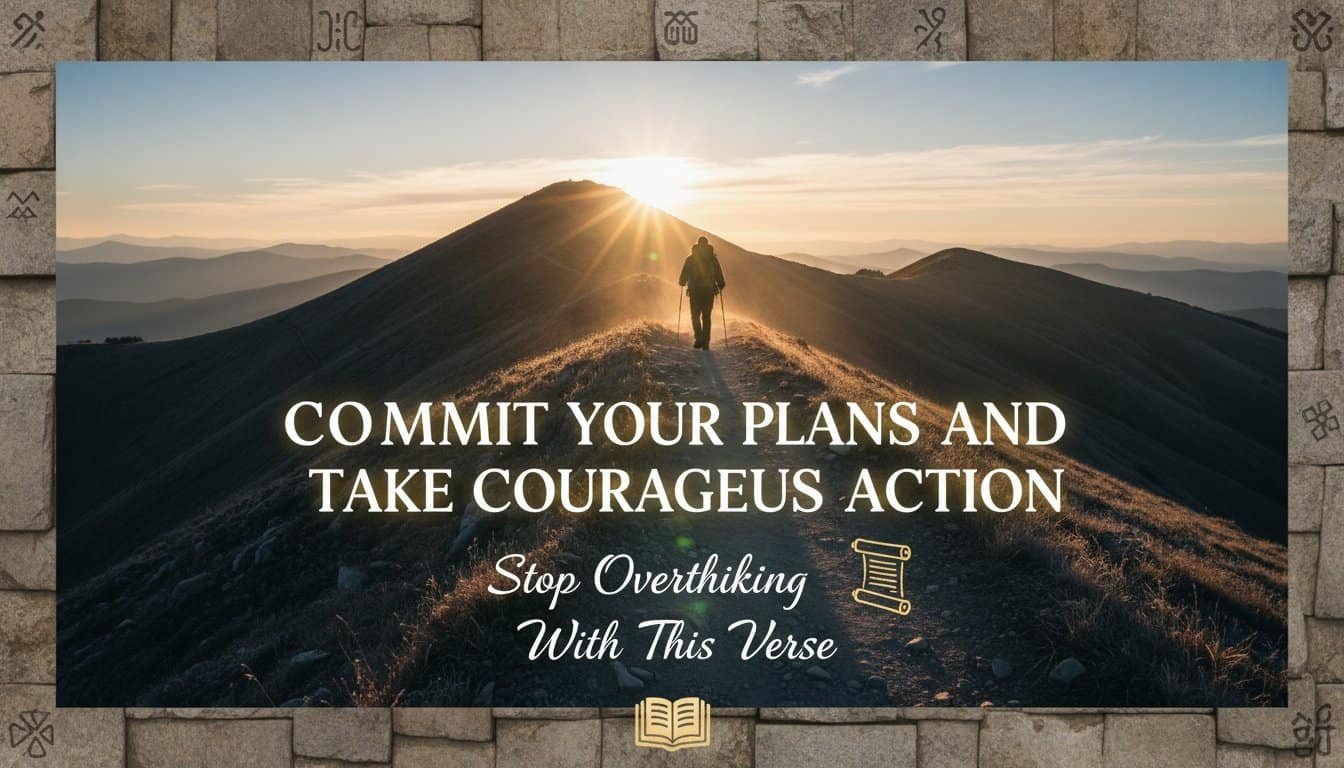
05 Jan Stop Overthinking: Commit Your Plans and Take Courageous Action With This Verse
You’re trapped in an endless loop of planning and analyzing while your dreams slip away. Proverbs 16:9 reminds you that “the heart of man plans his way, but the Lord establishes his steps.” Stop waiting for perfect conditions or complete certainty—they’ll never come. Seek God’s wisdom, make your plan, then take bold action despite the unknowns. Your ancestors faced greater uncertainties with fewer resources yet pressed forward courageously. Discover how this ancient framework can finally break your paralysis.
Table of Contents
Key Takeaways
- Proverbs 16:3 teaches us to commit our plans to the Lord, replacing endless analysis with faithful action and divine guidance.
- Biblical leaders like Nehemiah and Joshua prayed first, planned strategically, then acted decisively without waiting for perfect conditions.
- Set decision deadlines to gather essential information, then commit boldly rather than seeking impossible perfect outcomes or complete certainty.
- Break overwhelming goals into micro-actions you can take today, creating momentum that builds confidence and eliminates paralysis.
- Courage means acting despite uncertainty—evaluate quickly, decide firmly, and move forward trusting God with incomplete information.
The Ancient Wisdom That Defeats Analysis Paralysis

When your mind spins endlessly through possibilities and worst-case scenarios, you’re trapped in the same mental prison that’s paralyzed humans for millennia. Ancient wisdom offers a powerful antidote to this modern plague of overthinking.
Throughout history, great leaders understood that perfect information doesn’t exist. They developed a decisive mindset that cut through mental noise and uncertainty. They knew that waiting for absolute certainty meant never moving forward.
Great leaders never waited for perfect information—they cultivated the courage to decide and move forward despite uncertainty.
The key lies in shifting from endless analysis to calculated risk taking. Ancient texts remind us that courage isn’t the absence of fear—it’s action despite uncertainty. Your ancestors faced greater unknowns with fewer resources, yet they pressed forward.
You don’t need to eliminate all risk. You need to evaluate quickly, decide firmly, and act boldly. The ancient principle remains unchanged: committed action with incomplete information beats perfect planning that never launches. Stop analyzing. Start moving.
Understanding the Biblical Framework for Decisive Action
Since God calls His people to bold faith, the Bible provides a crystal-clear framework for making decisive moves in uncertain times. This framework isn’t about reckless abandon—it’s about decisive commitment backed by careful planning and unwavering trust.
Scripture reveals three essential steps: seek God’s wisdom first, develop a solid plan, then act with courage. You’ll find this pattern throughout biblical narratives. Nehemiah prayed, surveyed Jerusalem’s walls, then boldly approached the king. Joshua received divine instruction, strategized with his commanders, then crossed the Jordan.
The biblical model rejects both impulsive decisions and endless deliberation. Instead, it demands you gather godly counsel, weigh your options prayerfully, then move forward with confidence. You’re not meant to have every detail figured out—that’s where faith enters. God honors decisive commitment when you’ve done your due diligence through careful planning and sought His guidance through prayer.
Practical Steps to Commit Your Plans Without Perfect Certainty
The gap between planning and action often widens when you’re waiting for absolute certainty—but that certainty never comes. Start by accepting that perfect information doesn’t exist. You’ll make better decisions when you embrace strategic planning alignment with your core values rather than chasing flawless outcomes.
Break your plans into smaller, manageable pieces. Leveraging incremental milestones allows you to adjust course without abandoning your vision entirely. Set a decision deadline—give yourself enough time to gather essential information, then commit regardless of remaining uncertainties.
Create accountability by sharing your plans with trusted advisors. Their perspective helps you distinguish between legitimate concerns and fear-based overthinking. Document your reasoning for each decision so you can learn from both successes and mistakes.
Moving From Mental Preparation to Meaningful Progress
Although mental preparation builds the foundation for success, it becomes counterproductive when it replaces actual movement toward your goals. You’ve strategized enough—now you must transition from planning to performance.
Start by identifying one concrete action you can take today. Don’t wait for perfect conditions or complete clarity. Your focused vision will sharpen through doing, not endless deliberation. Each small step creates incremental momentum that compounds over time.
Break your larger goal into micro-actions that feel manageable yet meaningful. When you complete one task, immediately identify the next. This creates a powerful chain reaction of progress that builds confidence and clarity.
Frequently Asked Questions
How Do I Know if I’m Overthinking Versus Being Appropriately Cautious?
You’ll distinguish overthinking from caution through honest self reflection and sharp situational awareness. Caution gathers essential information quickly, then decides.
Overthinking loops endlessly, seeking impossible certainty. Ask yourself: “Am I collecting new, useful data or rehashing the same fears?” Set decision deadlines. Trust your preparation. You’ve likely gathered enough information already—now you’re just delaying action out of fear, not wisdom.
What if My Religious Beliefs Differ From the Biblical Framework Mentioned?
You can absolutely apply these principles through your own alternative religious perspectives and personal value systems. The core message—stopping overthinking and taking decisive action—transcends any single framework.
Draw from your traditions’ wisdom about courage, commitment, and purposeful action. Whether it’s Buddhist mindfulness, Islamic principles, or secular philosophy, you’ll find parallel teachings that encourage moving beyond paralysis into meaningful progress.
Can This Approach Work for Major Life Decisions Like Career Changes?
Absolutely! You can apply this framework to major career transitions by breaking them into actionable steps.
Start with thorough career transition preparation—research your target field, identify required skills, and create a timeline. Simultaneously focus on professional network expansion through informational interviews and industry events.
Don’t let analysis paralysis keep you stuck. Once you’ve done reasonable preparation, commit to your decision and take bold action toward your new career path.
How Long Should I Spend Planning Before Taking Action?
You need a plan duration balance that prevents paralysis by analysis. Spend 20% of your available time planning, then commit to action.
For major decisions, that’s typically 1-2 weeks maximum. The appropriate planning period should gather essential information without perfectionism. You’ll never have complete certainty, so set a firm deadline and stick to it.
Trust yourself to adapt as you go—action creates clarity faster than endless planning ever will.
What if Taking Action Leads to Failure or Negative Consequences?
Failure isn’t your enemy—it’s your teacher. You’re dealing with potential setbacks by building resilience, not avoiding action.
Managing risk aversion means accepting that some consequences are inevitable, but inaction guarantees stagnation. Every successful person has failed forward.
You’ll learn faster from one real attempt than months of planning. Take calculated risks, adapt quickly, and let failure fuel your next breakthrough. Action creates clarity that thinking never will.
Conclusion
You’ve learned the ancient wisdom that defeats overthinking. Now it’s time to act. Stop waiting for perfect conditions or complete certainty—they’ll never come. Commit your plans to God, trust His guidance, and take that first courageous step today. Your breakthrough isn’t waiting for more preparation; it’s waiting for you to move. The path becomes clear when you’re walking on it. Start now.












No Comments