

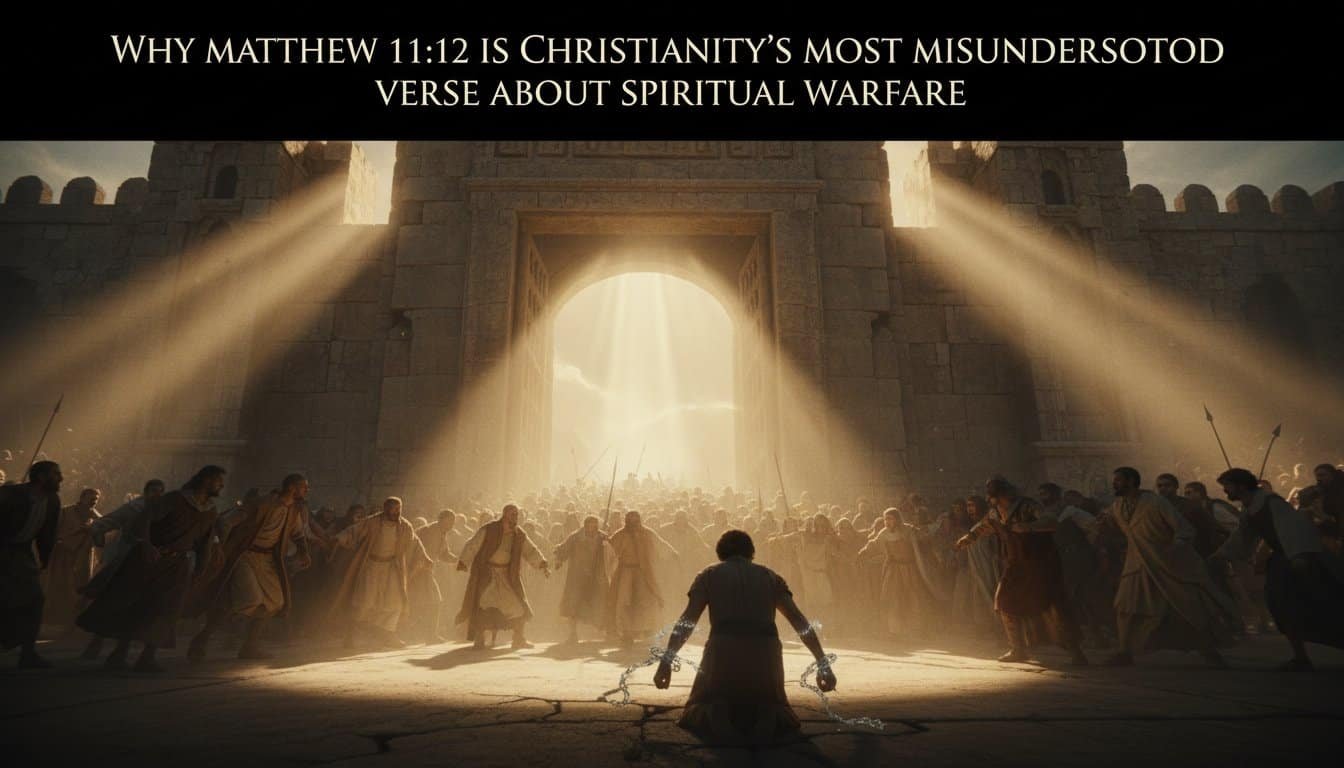
31 Jan Why Matthew 11:12 Is Christianity’s Most Misunderstood Verse About Spiritual Warfare
Matthew 11:12 becomes Christianity’s most misunderstood spiritual warfare verse when you interpret “violent men take it by force” as advocating aggressive kingdom advancement. The Greek word *biazetai* actually describes the kingdom suffering violence from external opposition, not believers storming heaven’s gates. Jesus consistently rejected violence as kingdom methodology, making peaceful proclamation his model rather than forceful conquest. This misinterpretation weaponizes scripture against Christ’s own peaceful kingdom message and transforms his suffering servant model into militant Christianity.
Key Takeaways
- The Greek word “biazetai” describes the kingdom suffering violence from opponents, not believers using force in spiritual warfare.
- Jesus consistently rejected violence as kingdom methodology, making aggressive spiritual warfare interpretations contradict His peaceful message.
- The context shows external persecution against John the Baptist and Jesus, not disciples forcefully advancing God’s kingdom.
- Modern spiritual warfare applications weaponize this verse, distorting Jesus’ emphasis on peaceful gospel proclamation over violent conquest.
- The verse describes crowds pressing forward to hear Jesus, not a mandate for aggressive spiritual combat tactics.
What Does Matthew 11:12 Actually Mean?

You’ll notice Jesus speaks these words following John the Baptist’s imprisonment and expression of doubt about messianic identity. John’s political expectation of forceful kingdom establishment clashed with Jesus’ suffering servant model. The verse’s pejorative Greek terminology suggests negative violence rather than positive advancement.
When you consider Matthew’s broader narrative, you’ll see the kingdom suffering violence through John’s imprisonment by Herod, escalating opposition from religious leaders, and ultimately Jesus’ crucifixion. This isn’t metaphorical violence but literal persecution against God’s kingdom representatives. The consistent pattern across multiple translations reflects how scholars recognize this interpretive tension about the nature of force in the passage.
You’re witnessing Jesus reframe kingdom expectations—rejecting triumphant political power in favor of sacrificial love that absorbs violence rather than perpetuating it through force.
Why The Greek Word “Biazetai” Creates Two Different Interpretations
How can a single Greek word spark centuries of theological debate? The culprit is βιάζεται (biazetai), whose linguistic ambiguity creates two word discussion ideas that fundamentally change Matthew 11:12’s meaning.
Derived from βιάζω (biazo), meaning “to use force” or “seize violently,” biazetai‘s present conjugation allows both middle and passive voice interpretations. You can’t determine which voice Matthew intended without additional context clues.
If you read it as passive voice, the kingdom “suffers violence” from external opposition—like Herod imprisoning John the Baptist. The ESV reflects this: “suffered violence, and the violent take it by force.”
However, if you interpret it as middle voice, the kingdom itself “advances forcefully” or “is forcibly entered.” The NLT captures this: “forcefully advancing, and violent people are attacking it.”
Luke 16:16 provides a parallel usage of the same Greek verb, describing people “pressing into” or “forcing their way into” the kingdom. This grammatical uncertainty explains why translations vary dramatically. You’re not just reading different opinions—you’re encountering genuine linguistic ambiguity that’s plagued scholars for centuries.
Kingdom Under Attack Vs. Holy Violence: Examining Both Views
Which interpretation best captures Jesus’ intent—depicting a kingdom besieged by enemies or celebrating zealous disciples storming heaven’s gates?
The kingdom underattack view sees Christ’s kingdom suffering violence from opponents, culminating in His crucifixion. You’ll notice contextual evidence: large mobs with weapons arrest Jesus, Judas betrays Him, and John the Baptist faces persecution while fulfilling Malachi’s prophecy. This interpretation aligns with spiritual warfare against darkness since John’s ministry began.
Conversely, the holyviolence view emphasizes eager disciples seizing the kingdom through zealous enthusiasm. You’d expect crowds thronging the gospel with overwhelming eagerness, forcing entry through bold, desperate spiritual violence. Supporters argue gospel ministry powerfully works on souls, creating violent apprehensions of divine wrath.
However, you won’t find examples of violently zealous disciples in Matthew’s account. Instead, Jesus actually rebukes His disciples’ violent attempts, suggesting the kingdom-under-attack interpretation better fits the immediate context and broader Gospel narrative.
Why Spiritual Warfare Applications Miss Jesus’ Peaceful Kingdom Message
Why do many Christians weaponize Matthew 11:12 for spiritual warfare when Jesus consistently rejected violence as kingdom methodology? You’re encountering the myth vs meaning problem that plagued centuries of interpretation.
When you examine Jesus’ actions during his arrest, he rebuked Peter’s violent response and healed the wounded servant. This demonstrates his commitment to peaceful kingdom advancement, not aggressive conquest. The violent metaphor in Matthew 11:12 describes eager crowds pressing forward like besieging armies, not literal spiritual combat.
You’ll find no Matthew examples where violent men successfully entered discipleship. Instead, tax collectors, prostitutes, and soldiers peacefully repented under John’s ministry. The kingdom advances through gospel proclamation, not forceful seizure.
Context reveals Jesus praising John as Malachi’s promised prophet—the peaceful capstone of Old Testament revelation. When you apply spiritual warfare interpretations, you’re distorting the benignant nature of zealous gospel response into combative activism that contradicts Jesus’ consistent peace message.
Frequently Asked Questions
How Does Luke 16:16’s “Presseth Into It” Relate to Matthew 11:12’s Violence?
You’ll find Luke’s “presseth into it” shares Matthew’s violent language through the same Greek root “biazetai,” but emphasizes eager response rather than hostile attack. While Matthew describes the kingdom suffering violence from enemies, Luke portrays zealous seekers forcefully entering God’s realm. This distinction reveals crucial spiritual warfare tactics: your aggressive pursuit of righteousness demonstrates nonviolence and mercy, contrasting Satan’s destructive opposition to Christ’s advancing kingdom.
Why Did Jesus Say “Whoever Has Ears, Let Them Hear” After This?
You need spiritual discernment to understand Jesus’s complex teaching about kingdom violence.
He’s warning you that surface-level hearing won’t grasp whether he means discipleship oppression from enemies like Herod or zealous seekers pressing in.
This spiritual warfare context requires deeper perception—you must distinguish between violent persecution against believers and passionate pursuit of righteousness.
Without spiritual ears, you’ll misinterpret kingdom advancement.
What Role Does John the Baptist’s Imprisonment Play in Understanding This Verse?
John the Baptist’s imprisonment creates the immediate crisis prompting Jesus’ clarification in Matthew 11:12. You’ll notice Gospel timelines show this occurs right after John’s doubt-filled question from prison.
Luke 16:16’s relation confirms the kingdom suffers violence rather than advancing through it. John’s captivity exemplifies this suffering, while his confused expectations required violent reconciliation between anticipated political triumph and actual spiritual reality Jesus brought.
How Do Modern Spiritual Warfare Movements Misuse This Particular Scripture Passage?
You’ll find modern spiritual warfare movements twist this verse into a call for “holy violence” against demonic forces, promoting aggressive activism to seize God’s promises.
They encourage deceptive zeal that mistakes combative attitudes for moving faith, urging believers to “take heaven by force” through radical striving.
This misreading ignores the context of eager crowds pressing into the kingdom, transforming enthusiastic response into militant conquest theology.
What Did Early Church Fathers Like Augustine Teach About This Verse?
Augustine’s interpretive approach understood this verse through ancient warfare imagery—not literal combat, but spiritual eagerness.
You’ll find he taught that believers “force” their way into God’s kingdom through zealous pursuit, like soldiers storming a fortress.
He emphasized that John’s preaching created such spiritual hunger that crowds pressed forward with war-like intensity to grasp salvation, demonstrating passionate spiritual striving rather than physical violence.
Conclusion
You’ve seen how Matthew 11:12’s ambiguous Greek creates interpretative tension between kingdom opposition and forceful advance. Rather than weaponizing this verse for spiritual warfare, you must anchor your understanding in Jesus’ consistent message of peace and non-violence. The context reveals John’s ministry as the pivotal moment when God’s kingdom breaks into history, not a call to aggressive spiritual combat. Let Scripture’s peaceful kingdom theology guide your interpretation over militaristic applications.












No Comments