


28 Nov Moses and the 10 Commandments From Sinai to Scripture
You’re examining one of history’s most influential legal-religious events when Moses received the Ten Commandments at Mount Sinai around 1300 BCE. Archaeological evidence reveals parallels with ancient Near Eastern codes like Hammurabi’s laws, while manuscript traditions from Qumran demonstrate meticulous textual preservation across millennia. The Decalogue’s ethical framework—prohibiting murder, theft, and false witness while establishing monotheistic worship—directly influenced Roman law, English common law, and modern legal systems worldwide, shaping interfaith dialogue and universal moral principles that continue transforming contemporary jurisprudence and ethics.
Table of Contents
Key Takeaways
- Moses received the Ten Commandments on stone tablets at Mount Sinai during a dramatic theophanic event with thunder, lightning, and divine presence.
- The tablets were inscribed by God’s finger, emphasizing divine authorship and permanent authority over human legislation in ancient covenant practices.
- The Decalogue divides into two tablets: divine worship commandments (1-4) and interpersonal ethics commandments (5-10) governing Hebrew society.
- Oral transmission and ritual recitation preserved the commandments before widespread literacy, using mnemonic devices and structured formatting.
- The commandments show parallels with ancient Near Eastern legal codes like Hammurabi’s while establishing unique universal moral standards.
The Historical Context of Ancient Israel and Mount Sinai

When examining the Ten Commandments’ origins, you’ll find that Mount Sinai‘s identification remains one of biblical archaeology‘s most debated questions, with scholars proposing locations ranging from Egypt’s southern peninsula to northwestern Arabia based on textual evidence and geographical analysis (Hoffmeier, 2005; Beit-Arieh, 1988).
You’re dealing with a complex historical period when ancient Israel emerged within Egypt’s sphere of influence during the Late Bronze Age (1550-1200 BCE). Archaeological evidence suggests you’re examining a time when Canaanite trade networks connected Egypt with Mesopotamia, creating cultural exchanges that influenced legal traditions (Kitchen, 2003).
Climate patterns during this era show increased aridity affecting migration routes through the Sinai Peninsula (Finkelstein & Silberman, 2001).
You’ll discover that understanding this context helps explain how Moses could’ve accessed diverse legal precedents, including Mesopotamian codes like Hammurabi’s laws, while developing Israel’s covenant theology (Wright, 2009).
Moses: Prophet, Leader, and Lawgiver of the Hebrew People
Against this backdrop of cultural exchange and legal precedent, Moses emerges as a transformative figure who bridged Egyptian court education with Hebrew tribal leadership, fundamentally reshaping ancient Israel’s religious and social identity (Assmann, 1997).
You’ll find his prophetic biography encompasses three distinct roles that define his enduring significance. As prophet, Moses served as divine intermediary, receiving direct revelation from YHWH and transmitting sacred law to the Hebrew people (Fretheim, 1991). His leadership ethics demonstrated revolutionary principles of servant leadership, prioritizing collective welfare over personal gain (Miller, 2000). As lawgiver, Moses established comprehensive legal frameworks that integrated moral, ceremonial, and civil codes, creating unified national identity through shared jurisprudence (Wright, 2004).
Archaeological evidence from Kadesh-Barnea and textual analysis of Deuteronomic literature support Moses’ historical role in consolidating disparate Hebrew tribes into cohesive political entity (Dever, 2003). This multifaceted leadership model influenced subsequent biblical figures and Western legal traditions.
The Divine Encounter: What Happened at Mount Sinai
You’ll find that Mount Sinai represents one of history’s most significant theophanic events, where biblical accounts describe God’s presence manifesting through thunder, lightning, and thick clouds (Exodus 19:16-19).
The mountain’s dramatic transformation—smoking like a furnace and trembling violently—created the backdrop for Moses’ reception of the stone tablets containing divine law (Exodus 19:18, 20:1-17).
Archaeological and textual evidence suggests this encounter established the foundational covenant between God and the Hebrew people, marking a pivotal moment in ancient Near Eastern religious history.
God’s Thunderous Mountain Manifestation
As the Israelites approached Mount Sinai in the third month after their exodus from Egypt, they witnessed one of Scripture’s most dramatic theophanies—a divine manifestation that would fundamentally alter humanity’s understanding of God’s nature and expectations. Exodus 19:16-19 describes extraordinary divine acoustics: thunder crashed while lightning illuminated the mountain’s peak, and a trumpet’s blast grew increasingly loud.
This sensory symbolism wasn’t merely spectacular—it represented a temporal rupture between earthly and heavenly realms. You’ll notice the mountain “quaked greatly” (Exodus 19:18), demonstrating God’s cosmic sovereignty over creation itself.
The thick cloud, fire, and smoke (Exodus 19:18) created an atmosphere of holy terror, establishing the proper reverence required before receiving divine law that would govern Israel’s covenant relationship.
Moses Receives Stone Tablets
Following the mountain’s thunderous display, Moses ascended into God’s presence to receive humanity’s most foundational moral code—the Ten Commandments inscribed on stone tablets by the very finger of God (Exodus 31:18, Deuteronomy 9:10).
You’ll notice the profound ritual symbolism embedded in this divine encounter. Stone represented permanence and durability in ancient Near Eastern cultures, contrasting sharply with temporary clay or papyrus documents. The tablet iconography itself carried significant meaning—rectangular stone slabs were commonly used for covenant treaties between rulers and subjects. Archaeological evidence from Hittite and Mesopotamian civilizations confirms this practice (Kitchen, 2003).
You can observe how God employed familiar cultural forms to communicate eternal truths. The divine inscription emphasized these weren’t human regulations but God’s direct commandments, establishing their supreme authority over Israel’s moral and spiritual life.
The Ten Commandments: Content and Meaning of Each Law
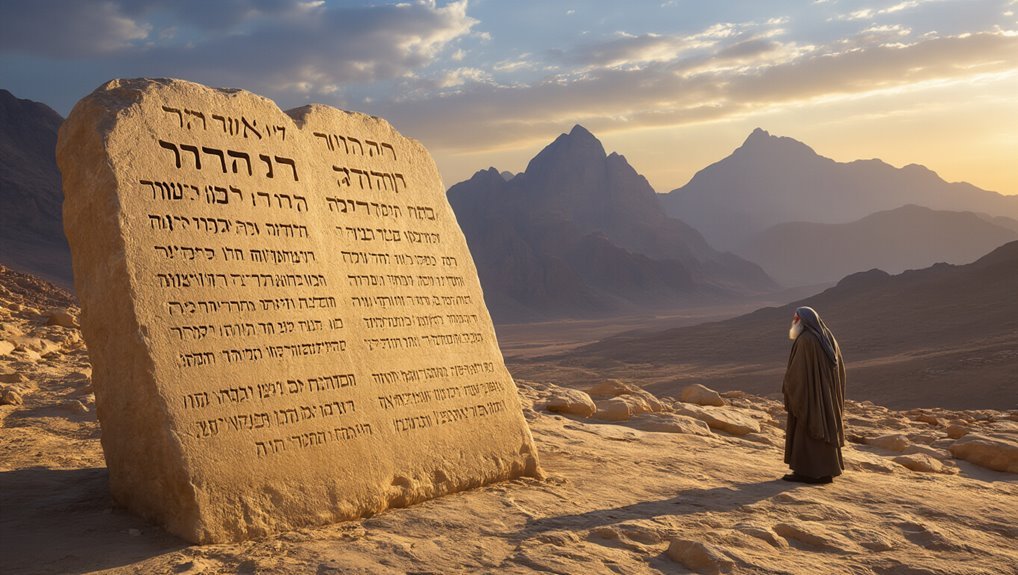
The profundity of the Ten Commandments lies not merely in their historical significance but in their systematic structure that addresses humanity’s relationship with both the divine and fellow humans. You’ll notice the Decalogue divides into two tablets: commandments 1-4 governing divine worship, and 5-10 addressing interpersonal ethics.
The first commandment establishes monotheistic exclusivity, while the second prohibits idolatry—both fundamental to covenant continuity. The third forbids misusing God’s name, though ritual exemptions exist in liturgical usage. The fourth mandates Sabbath observance, creating sacred time boundaries.
Commandments 5-10 form society’s ethical foundation: honoring parents, prohibiting murder, adultery, theft, false testimony, and coveting. These laws generate ongoing ethical debates regarding their application in contemporary contexts. You’ll find scholars emphasize how these commandments transcend mere legal codes, establishing moral principles that shape civilizational development and continue influencing legal systems worldwide.
From Oral Tradition to Written Text: How the Laws Were Preserved
Before these divine laws reached their written form, they underwent a complex transmission process that scholars trace through multiple layers of oral preservation and textual development. You’ll find that oral transmission served as the primary vehicle for preserving these commandments across generations before literacy became widespread in ancient Israel.
Through ritual recitation during religious ceremonies, communities maintained textual accuracy and reinforced collective understanding. Archaeological evidence suggests that mnemonic devices played crucial roles in memorization—particularly the rhythmic and structured nature of Hebrew poetry that characterizes many biblical passages. You can observe how communal memory functioned as a safeguarding mechanism, with multiple witnesses ensuring faithful preservation of content.
Documentary hypothesis scholars identify various textual traditions (J, E, D, P sources) that eventually converged into canonical forms. You’ll notice that this process involved careful editorial work, cross-referencing different oral traditions to create authoritative written texts that maintained theological consistency while preserving historical authenticity.
The Role of Scribes and Scholars in Biblical Compilation
Meticulous craftsmanship characterized the work of ancient scribes who transformed oral traditions into the biblical texts you encounter today. These scholarly practitioners developed sophisticated scribal practices that ensured accurate manuscript transmission across generations. You’ll find evidence of their rigorous methods in surviving manuscripts, where marginal notes and textual variants reveal careful attention to preserving authentic readings.
During canon formation, scribes collaborated with religious authorities to establish authoritative versions of biblical texts. They employed standardized copying procedures, including letter-counting techniques and verification protocols that minimized transcriptional errors. Modern textual criticism reveals how these ancient scholars cross-referenced multiple manuscript traditions to maintain textual integrity.
Archaeological discoveries at Qumran and other sites demonstrate the scribes’ sophisticated understanding of textual preservation. You can observe their systematic approach through consistent formatting, uniform script styles, and careful correction methods. Their dedication created the foundational manuscripts that enabled the Ten Commandments and broader biblical literature to survive intact through millennia of transmission.
Archaeological Evidence and Historical Verification
While archaeological discoveries can’t directly confirm the historical Moses or the exact moment of the Ten Commandments’ revelation, they’ve provided substantial evidence for the cultural and historical contexts surrounding these foundational texts.
You’ll find that excavations in the Sinai Peninsula and ancient Near East have uncovered legal codes predating biblical texts, including Hammurabi’s Code and Hittite treaties, which share structural similarities with Mosaic law.
However, you must navigate significant archaeological gaps when examining the Exodus period.
The lack of definitive Egyptian records mentioning Israelite slavery creates challenges for historical verification.
Additionally, inscription controversies surrounding artifacts like the Mesha Stele and Tel Dan Stele continue to generate scholarly debate about biblical chronology.
You can observe that while direct archaeological proof remains elusive, comparative studies of ancient law codes, Egyptian hieroglyphs, and Mesopotamian texts support the plausibility of the commandments’ ancient origins within established legal traditions.
Influence on Ancient Near Eastern Legal Codes
When you examine the Ten Commandments within their ancient Near Eastern context, you’ll discover striking parallels with earlier Mesopotamian legal traditions, particularly the Code of Hammurabi (c. 1750 BCE) and the Laws of Eshnunna (c. 1930 BCE).
You can trace similar prohibitions against murder, theft, and adultery across these legal corpora, suggesting either shared cultural transmission or common societal needs that transcended geographical boundaries (Kitchen, 2003; Westbrook, 2009).
Egyptian legal precedents, including Ma’at principles and wisdom literature from the Middle Kingdom period, also provide comparative frameworks that illuminate how ancient societies codified moral and civil obligations (Allam, 1991; Jasnow, 2003).
Mesopotamian Law Comparisons
Before Moses received the tablets on Mount Sinai, sophisticated legal traditions had already flourished across Mesopotamia for over a millennium, establishing precedents that would profoundly influence biblical law. You’ll find striking parallels between Hammurabi’s Code (c. 1750 BCE) and biblical legislation, particularly in criminal justice principles.
Mesopotamian contracts demonstrate sophisticated property law frameworks that echo throughout Exodus and Deuteronomy. Babylonian prologues, which invoke divine authority to legitimize earthly rulers’ legal pronouncements, mirror the Decalogue’s divine origin narrative.
However, you must recognize crucial distinctions: while Mesopotamian codes emphasized class-based justice with varying penalties for social strata, biblical law proclaimed universal moral standards. Archaeological evidence from Nuzi, Mari, and Babylon reveals that Israel’s legal consciousness emerged within this broader ancient Near Eastern jurisprudential matrix.
Egyptian Legal Precedents
Moving from Mesopotamia’s eastern influences to the Nile Valley, Egypt’s legal traditions provided equally significant foundational elements for biblical jurisprudence, though these connections often remain underexplored in comparative studies.
You’ll find Egyptian precedents in Moses’ legal framework reflect sophisticated jurisprudential concepts predating Sinai by centuries. The Instruction of Ptahhotep (c. 2400 BCE) establishes moral imperatives paralleling several commandments, particularly regarding honesty and respect for authority.
Legal parallels emerge in Egypt’s Ma’at principle, emphasizing truth, justice, and cosmic order—concepts fundamental to Mosaic law‘s ethical foundation. The Negative Confession from the Book of the Dead demonstrates Egyptian understanding of moral absolutes, including prohibitions against murder, theft, and adultery.
These Egyptian contributions complement Mesopotamian influences, creating a rich legal tapestry informing biblical legislation’s development and theological framework.
The Ten Commandments in Modern Legal Systems
Although centuries have passed since Moses received the Ten Commandments on Mount Sinai, their influence permeates contemporary legal frameworks across Western civilization. You’ll find these ancient principles embedded in modern constitutional law, criminal codes, and civil liberties protections.
The prohibition against murder directly correlates with homicide statutes, while theft restrictions form the foundation of property law. You can observe secular adaptations of these commandments in perjury laws, which mirror the commandment against bearing false witness. The First Amendment’s establishment clause reflects tensions between religious authority and governmental power first articulated in Mosaic law.
European legal systems similarly demonstrate this inheritance. Germany’s Basic Law and Britain’s common law tradition incorporate ethical frameworks traceable to Sinaitic legislation. You’ll notice that contemporary judicial concepts of justice, proportionality, and moral responsibility stem from these foundational texts, creating enduring bridges between ancient religious law and modern secular jurisprudence.
Lasting Impact on Ethics, Morality, and World Religions
You’ll find that the Ten Commandments have transcended their ancient origins to become foundational principles that shaped legal frameworks across civilizations, from Roman law to contemporary constitutional systems (Berman, 1983; Witte, 2007).
These moral imperatives established universal ethical standards that continue influencing secular philosophy and human rights discourse, as evidenced in the United Nations Declaration of Human Rights’ emphasis on dignity and justice (Glenn, 2000).
You can observe their profound interfaith impact across Judaism, Christianity, and Islam, where they’ve provided common moral ground while adapting to diverse theological interpretations and cultural contexts (Sarna, 1986; Neusner, 2009).
Foundation of Legal Systems
The Decalogue’s legal framework established fundamental principles that continue to underpin modern judicial systems across the globe. You’ll find these commandments directly influenced Western legal traditions, particularly through Roman law and medieval canon law. The prohibition against murder, theft, and false testimony became cornerstone principles in criminal jurisprudence worldwide. Natural law theorists like Aquinas and later Enlightenment philosophers recognized the Decalogue as universal moral imperatives transcending cultural boundaries.
You can trace constitutional protections for property rights, due process, and perjury laws directly to Mosaic legislation. These civic foundations shaped English common law, which subsequently influenced American, Canadian, and Australian legal systems. Even secular legal frameworks incorporate these ethical principles, demonstrating the Decalogue’s enduring influence on jurisprudential thought and legislative development across diverse societies.
Universal Moral Principles
Reverence for divine authority permeates the Ten Commandments‘ moral architecture, creating ethical principles that transcend religious boundaries and shape humanity’s fundamental understanding of right and wrong.
You’ll find these commandments establish moral universals that appear across diverse philosophical and religious traditions worldwide.
The prohibition against murder affirms human dignity as a cornerstone principle, while injunctions against theft and false witness create ethical foundations for justice systems globally.
Cross cultural analysis reveals remarkable convergence around these principles.
You can trace similar moral frameworks in Buddhism’s Five Precepts, Hinduism’s Yamas, and secular humanist ethics.
Contemporary bioethics, international human rights law, and conflict resolution protocols consistently reference these foundational concepts.
The commandments’ emphasis on truthfulness, respect for life, and social responsibility continues influencing modern ethical discourse across religious and secular contexts.
Interfaith Religious Influence
Building upon these universal moral foundations, major world religions have consistently drawn from and reinterpreted the Decalogue’s ethical framework throughout history.
You’ll find Christianity’s explicit adoption of Mosaic law, while Islam’s Quranic teachings echo similar prohibitions against idolatry, murder, and theft. Buddhism and Hinduism, though developing independently, share comparable ethical precepts regarding truthfulness and non-violence.
Contemporary interfaith dialogue increasingly recognizes these convergent moral principles as common ground for religious cooperation.
Comparative theology scholars document how the Ten Commandments’ structure—balancing divine relationship with interpersonal ethics—mirrors patterns across diverse faith traditions.
You can observe this influence in modern ecumenical movements, where the Decalogue serves as a bridge for understanding shared human values.
This cross-religious resonance demonstrates the commandments’ enduring capacity to transcend denominational boundaries.
Frequently Asked Questions
What Language Were the Ten Commandments Originally Written In?
You’ll find the Ten Commandments were originally written in Hebrew, specifically using an ancient script form predating modern Hebrew characters.
Archaeological evidence and biblical scholarship consistently support this Hebrew inscription origin.
Cross-referencing textual analysis with historical linguistics confirms that the ancient script employed would’ve been proto-Canaanite or early Hebrew characters, distinct from today’s square Aramaic-derived Hebrew script that you’d recognize in contemporary religious texts.
How Do Different Religious Denominations Number the Ten Commandments?
You’ll find significant variation in commandment numbering across denominations. Catholic numbering combines the prohibition against other gods and idols as the first commandment, then splits coveting into two separate commandments (ninth and tenth).
Reformed numbering treats idolatry separately as the second commandment and combines all coveting prohibitions into the tenth. These differences stem from varying interpretations of Exodus 20 and Deuteronomy 5‘s textual divisions.
Were There Other Stone Tablets With Laws Given Besides the Ten Commandments?
You’ll find no biblical evidence for additional tablets beyond the original Ten Commandments at Sinai.
While Moses received extensive oral laws and later inscriptions like Deuteronomy’s covenant renewal, scholars note these weren’t carved on stone tablets.
Archaeological evidence doesn’t support multiple stone tablet sets.
The biblical narrative consistently references only the two original tablets containing the Decalogue, which Moses broke and God replaced identically.
Why Did Moses Break the First Set of Tablets?
You’ll find Moses broke the first tablets due to divine anger upon witnessing Israel’s golden calf worship (Exodus 32:19).
When you examine the text, Moses’s action represents God’s wrath at covenant violation.
You can cross-reference this with Deuteronomy 9:17, where Moses confirms he “took the two tablets and threw them out of my hands and broke them.”
This demonstrates divine judgment against idolatry.
How Do the Ten Commandments Compare to Other Ancient Law Codes?
You’ll find ancient parallels between the Ten Commandments and earlier law codes like Hammurabi’s Code (c. 1750 BCE) and the Code of Ur-Nammu (c. 2100 BCE).
However, the Decalogue represents significant legal evolution by emphasizing monotheism and universal moral principles rather than class-based punishments. Unlike Mesopotamian codes that focus on civil penalties, you’re seeing divine commandments that establish fundamental ethical relationships between humanity and God.
Conclusion
You’ve witnessed how the Ten Commandments evolved from Moses’ divine encounter at Sinai into foundational legal principles that shaped civilization. You can trace their influence through archaeological evidence in ancient Near Eastern codes, their preservation in scriptural traditions, and their integration into modern jurisprudence. You’ll find these laws haven’t merely survived as religious doctrine—they’ve become ethical cornerstones that continue influencing contemporary moral frameworks across diverse cultures and legal systems worldwide.




No Comments