

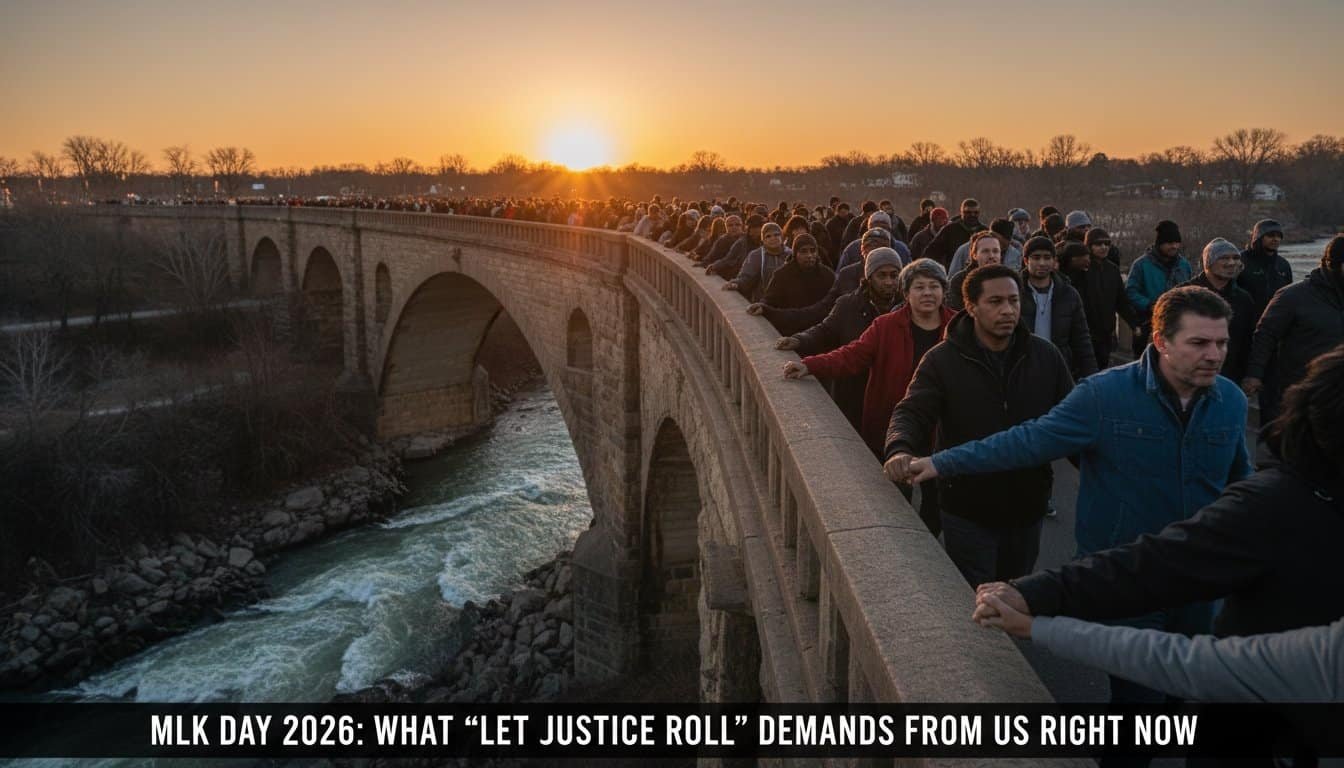
06 Jan MLK Day 2026: What “Let Justice Roll” Demands From Us Right Now
Dr. King’s “let justice roll down like waters” demands you confront today’s evolved barriers: algorithmic bias in hiring, over 440 restrictive voting bills since 2010, and a racial wealth gap where Black families hold one-tenth the wealth of white families. You can’t settle for symbolic gestures when voter suppression tactics mirror Jim Crow tactics and mass incarceration serves as modern social control. King’s “Beloved Community” requires you to embed racial equity in all policy decisions and transform the institutions that generate inequality rather than simply managing their symptoms—a blueprint that reveals the specific structural changes needed now.
Key Takeaways
- Dismantle algorithmic bias in hiring, lending, and education that perpetuates institutional inequities beyond overt discrimination.
- Combat voter suppression through expanded access, opposing restrictive ID laws, and protecting polling locations from closure.
- Address the racial wealth gap where Black families hold one-tenth the wealth of white families.
- Transform policymaking by centering affected communities in decisions rather than consulting them afterward.
- Move beyond symbolic gestures to embed racial equity in all institutional policies and resource allocation.
The Evolution of Systemic Barriers Since King’s Era
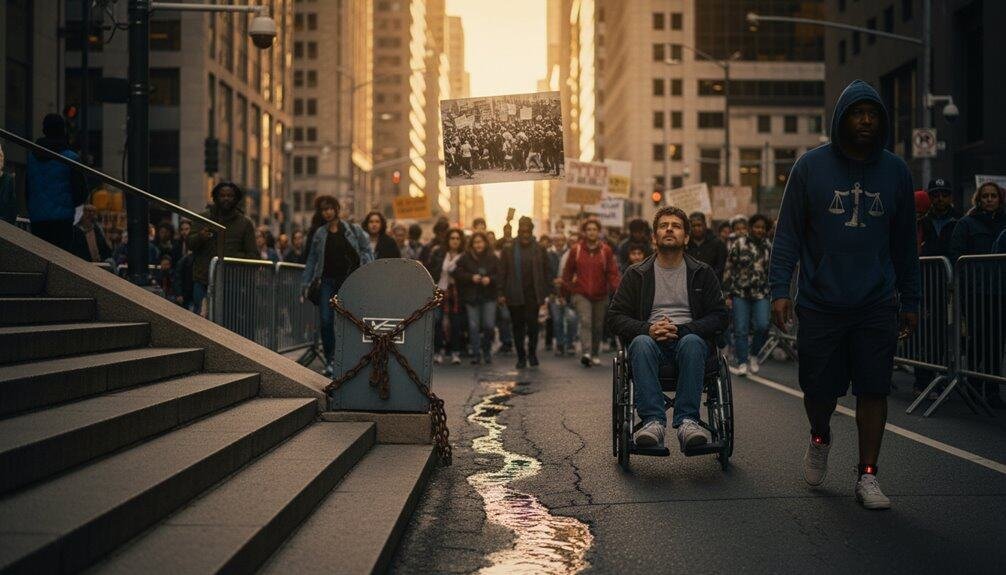
While Dr. King fought against overt segregation and explicit discrimination, you’re now confronting more subtle yet equally damaging forms of structural racism. Today’s institutional inequities have evolved into sophisticated systems that perpetuate racial disparities through seemingly neutral policies and practices.
You’ll find these barriers embedded in algorithmic bias within hiring systems, predatory lending practices targeting communities of color, and educational funding formulas that maintain resource gaps. Mass incarceration has replaced Jim Crow as a mechanism of social control, while residential segregation persists through zoning laws and discriminatory real estate practices.
Healthcare disparities reveal themselves through maternal mortality rates and environmental racism in low-income neighborhoods. Financial institutions continue redlining through modern credit scoring systems and limited banking access.
These evolved barriers require you to develop new strategies beyond traditional civil rights approaches. You must address systemic inequities through data analysis, policy reform, and technological accountability measures that King couldn’t have envisioned.
Voting Rights Under Siege: From the Ballot Box to the Statehouse
Among these sophisticated barriers to equality, voting rights face unprecedented assault through coordinated legislative campaigns across multiple states. You’re witnessing voter suppression tactics that’ve evolved far beyond King’s era—strict ID requirements, reduced polling locations, purged voter rolls, and shortened early voting periods disproportionately impact communities of color and low-income voters.
Since 2010, you’ve seen over 440 bills with restrictive voting provisions introduced across 49 states. These measures often emerge under the banner of election integrity concerns, yet studies consistently demonstrate minimal evidence of widespread voter fraud. Meanwhile, their cumulative effect creates significant barriers to ballot access.
You can’t ignore how gerrymandering compounds these challenges, diluting minority voting power through strategic district manipulation. The 2013 Shelby County decision weakened federal oversight, enabling states to implement changes without preclearance. Today’s voting rights landscape demands your vigilance—these systematic efforts undermine the democratic participation King fought to secure.
Economic Justice and the Widening Wealth Gap
Nothing exposes America’s unfulfilled promise more starkly than the economic chasm that’s widened dramatically since King’s assassination. You’re witnessing income inequality reach levels not seen since the 1920s, with the top 1% controlling over 32% of total wealth while median Black family wealth remains just one-tenth that of white families.
America’s economic chasm exposes unfulfilled promises—inequality at 1920s levels while racial wealth gaps persist unchanged.
King’s vision of economic justice hasn’t materialized. Instead, you’re confronting systemic barriers that perpetuate job opportunity disparities across racial lines. Black unemployment consistently runs double that of whites, and when employment exists, it’s often concentrated in lower-wage sectors without advancement pathways.
You can’t separate economic justice from racial justice—they’re intertwined threads of the same fabric. Corporate consolidation has eliminated middle-class manufacturing jobs that once provided economic mobility, while educational debt and housing discrimination compound wealth-building obstacles.
King understood that civil rights without economic rights remain hollow victories. Today’s challenge demands you address structural inequities that keep communities trapped in cycles of economic marginalization.
From Symbolic Gestures to Sustained Action: Building the Beloved Community
Despite decades of commemorative speeches and annual service projects, you’re still operating within a framework that treats King’s dream as a distant aspiration rather than an urgent blueprint for structural transformation. King’s “Beloved Community” wasn’t metaphorical—it demanded concrete institutional changes that redistribute power and resources.
You can’t build this community through weekend volunteerism while ignoring Monday’s discriminatory hiring practices or Tuesday’s zoning laws that perpetuate segregation. Real progress requires embedding racial equity into every policy decision, from municipal budgeting to corporate governance structures.
Inclusive policymaking means centering affected communities’ voices in designing solutions, not consulting them after decisions are made. Equitable resource allocation demands you examine who benefits from current systems and deliberately redirect investments toward historically excluded populations.
The beloved community emerges when you transform institutions that generate inequality, not when you manage their symptoms through charitable responses.
Frequently Asked Questions
How Can Individuals Get Involved in Local Civil Rights Organizations?
You can join local civil rights organizations by researching groups in your area through online directories, attending public meetings, and contacting organizations directly about volunteer initiatives.
Start with community outreach programs that match your skills and availability. Many organizations need help with voter registration drives, educational workshops, legal aid support, and advocacy campaigns.
Your consistent participation strengthens grassroots movements and creates measurable community impact.
What Specific Legislation Should Congress Prioritize to Advance Racial Justice?
You should advocate for comprehensive criminal justice reform that addresses sentencing disparities, mandatory minimums, and cash bail systems disproportionately affecting communities of color.
Push Congress to strengthen police accountability through qualified immunity reform, national use-of-force standards, and independent oversight mechanisms. Data shows these measures could reduce racial disparities in arrests, prosecutions, and incarceration rates while rebuilding community trust in law enforcement institutions.
How Do We Effectively Measure Progress in Dismantling Systemic Racism?
You’ll need data-driven metrics tracking disparities in housing, education, healthcare, and criminal justice outcomes across racial lines. However, you can’t rely solely on statistics—community-based approaches provide essential qualitative insights about lived experiences.
You should measure policy implementation effectiveness, institutional representation changes, and wealth gap reduction. Combine quantitative benchmarks with grassroots feedback to assess whether systemic barriers are actually dissolving or merely shifting forms.
What Role Should Schools Play in Teaching Mlk’s Philosophy Today?
You must demand schools develop inclusive curricula that teaches King’s philosophy beyond sanitized quotes, examining his radical economic justice vision and anti-war stance.
You’ll need to support grassroots advocacy for comprehensive civil rights education that connects historical struggles to contemporary issues. Evidence shows students who learn King’s full philosophy develop stronger critical thinking about systemic inequality and become more engaged civic participants.
How Can Faith Communities Better Support the Fight for Equality?
You’ll strengthen equality fights through inclusive community engagement that welcomes diverse voices and backgrounds into your congregation’s justice work.
Research shows interfaith collaboration multiplies advocacy impact—you should partner with mosques, synagogues, and other faith traditions on shared campaigns.
You can leverage your community’s moral authority by speaking out on systemic issues, providing sanctuary for vulnerable populations, and mobilizing members for sustained activism beyond Sunday services.
Conclusion
You can’t achieve King’s “beloved community” through weekend volunteerism or annual commemorations. The data shows systemic inequalities have deepened since 1968—voter suppression affects millions, wealth gaps have tripled, and structural racism persists in housing, healthcare, and education. You must examine your own institutions, advocate for policy changes, and sustain engagement beyond moments of crisis. Justice requires your consistent action, not your occasional attention.












No Comments