

24 Jan Learn Piano Without Leaving Your House This Year
You can absolutely learn piano from home this year using online platforms like Flowkey, Skoove, or Pianote. These services cost just $10-20 monthly compared to $30-70 per hour for private lessons, offering real-time feedback and extensive song libraries. You’ll need your existing laptop or tablet, proper camera positioning 3-4 feet from your piano, and good lighting. Choose platforms based on your learning style—visual, auditory, or kinesthetic—to maximize your progress and discover the complete setup process.
Table of Contents
Key Takeaways
- Online piano platforms like Skoove, Playground Sessions, and Flowkey offer comprehensive lessons from beginner to advanced levels.
- Monthly subscriptions cost $10-25, making online learning significantly cheaper than private tutoring at $30-70 per hour.
- Most platforms provide 7-day free trials, allowing you to test features before committing to a subscription.
- Choose platforms based on your learning style: visual learners need clear video demonstrations, kinesthetic learners benefit from interactive feedback.
- Start with your existing laptop or tablet, position it 3-4 feet from your piano, and ensure good lighting.
Best Online Piano Lesson Platforms: Features and Pricing Compared
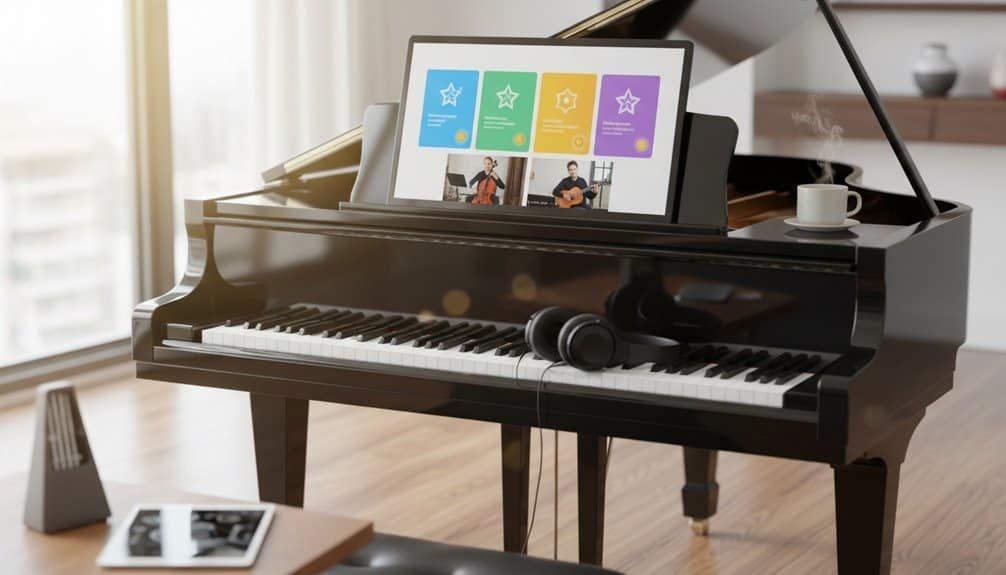
Why spend thousands on traditional piano lessons when you can master the instrument from your living room? Today’s online piano platforms offer comprehensive learning experiences that rival traditional instruction at a fraction of the cost.
Pros and Cons vary significantly between platforms. Skoove excels with real-time feedback and family-friendly features, while Playground Sessions leads in multi-platform compatibility. Pianote stands out with live teacher access and extensive song libraries, whereas Hoffman Academy focuses specifically on children’s learning needs. Flowkey provides professional-level instruction across all skill ranges.
Pricing Structures differ considerably among providers. Some platforms offer monthly subscriptions starting around $10-20, while others provide annual plans with substantial savings. Premium features like live instruction and expanded song libraries typically cost more, but you’ll still save compared to traditional lessons. Most reputable platforms include 7-day free trials to help you test their features before committing.

Each platform serves different learning styles and budgets, so you’ll want to consider your specific goals before choosing.
What Online Piano Lessons Cost: Subscriptions vs Private Tutoring
How much should you expect to invest in your online piano journey? You’ll find two distinct pricing structures that cater to different learning preferences and budgets.
Subscription platforms offer remarkable value, with monthly plans ranging from $9.99 to $24.99. When you practice 2-4 hours weekly, your effective hourly rate drops to just $1-2. Annual subscriptions reduce costs further to $12.50-$18 monthly. For long-term commitment, lifetime options like Flowkey ($329.99) eliminate recurring fees entirely.
Subscription platforms deliver exceptional value at just $1-2 per practice hour, with annual plans offering even greater savings.
Private online tutoring costs significantly more at $30-70 per hour, though you’ll receive personalized instruction. Monthly packages of 4-5 sessions typically run $150-360, making subscription comparisons quite stark.
Your choice depends on learning style and budget. Subscriptions excel for self-directed learners seeking tutoring affordability, while private lessons suit those needing personalized guidance. Consider starting with subscriptions—you can always upgrade to private tutoring as your skills develop and specific needs emerge.

How to Choose Online Piano Lessons That Match Your Learning Style
Once you’ve settled on your budget, the next step involves matching your chosen platform to how you naturally absorb and process information. Understanding your learning style helps you avoid wasting money on platform pricing that doesn’t suit you.
If you’re a visual learner, prioritize video lessons with clear demonstrations and apps featuring song playback controls. Methods like Hal Leonard use familiar songs to introduce music reading gradually, while looper functionality lets you focus on trouble spots.
Auditory learners benefit from methods like PianoIn21Days, which emphasizes playing by ear through patterns rather than sheet music. Look for platforms offering practice-along features and varied piano sounds.
Kinesthetic learners thrive with interactive apps like Yousician or Simply Piano that provide real-time feedback through USB or microphone connections. These game-style platforms grade your accuracy and speed, creating engaging hands-on practice sessions that build skills progressively.
Getting Started: Equipment and Setup for Online Piano Learning
The right equipment transforms your living room into an effective piano learning studio without requiring a major investment. Start with your existing laptop or tablet—these provide better stability than phones for extended lessons. Your built-in camera and microphone are sufficient initially, so don’t feel pressured to purchase specialized equipment right away.
Position your primary camera 3-4 feet from your piano at an elevated angle to capture the full keyboard. You can elevate your laptop using books or a simple stand. Test your internet connection at speedtest.net before beginning lessons, and ensure your video conferencing software has music mode enabled for optimal sound quality.
For lighting optimization, place natural or artificial light behind your camera, facing toward you—never behind you. A basic lamp works perfectly; professional lighting isn’t necessary. This budget friendly approach lets you start learning immediately while gradually adding equipment like a USB microphone as your skills develop.
Frequently Asked Questions
How Long Does It Take to Learn Piano Online Versus Traditional Lessons?
You’ll learn piano at the same pace online as with traditional lessons – averaging four years to reach diploma level. Online instruction actually accelerates your learning pace by 67% through improved engagement and consistent practice schedules. The instructional quality matches in-person teaching, with specialized teachers globally accessible. Your progress depends more on practice frequency and quality than lesson format, making online learning equally effective for mastering piano skills.
Can Children Really Stay Focused During Online Piano Lessons at Home?
Yes, children focus remarkably well during online piano lessons at home. You’ll find that shorter 15-20 minute sessions match your child’s natural attention span perfectly. The quiet home environment eliminates classroom distractions, while parental involvement creates additional support. Digital tools like replay features help maintain concentration, and flexible pacing prevents frustration. Studies show 340% higher engagement rates compared to traditional lessons.
Do Online Piano Students Perform as Well in Recitals and Competitions?
Yes, you’ll find that online piano students perform just as well as traditional students in recitals and competitions. Your online performance readiness develops through the same quality coaching and technique refinement. You’ll access excellent online recital opportunities that showcase your progress effectively. With personalized instruction and consistent practice tracking, you’ll build confidence and skills that translate beautifully to live performance settings.
What Happens if My Internet Connection Drops During a Live Lesson?
If your connection drops, you’ll typically reconnect within minutes and resume where you left off. Most platforms offer makeup lessons for significant interruptions, plus recording features let you review missed content later. You can improve internet reliability by testing your connection beforehand and ensuring stable Wi-Fi. Don’t worry—experienced online teachers expect occasional technical hiccups and handle them smoothly.
Are Online Piano Certificates Recognized by Music Schools and Conservatories?
Yes, online certificates from reputable institutions receive music school recognition and conservatory acceptance. You’ll find that RCM certifications set international standards recognized worldwide, while programs from Juilliard Extension, Berklee Online, and Trinity College London carry significant weight. These online certificates also earn UCAS points for university admissions globally, so you’re building credentials that truly matter for your musical future.
Conclusion
You’ve got everything you need to start your piano journey from home. Take your time comparing platforms and costs until you find what fits your budget and goals. Don’t worry if it feels overwhelming at first—that’s completely normal. Set up your space thoughtfully, choose lessons that match how you learn best, and remember that consistency beats perfection. You’re about to discover the joy of making music on your own terms.








No Comments