

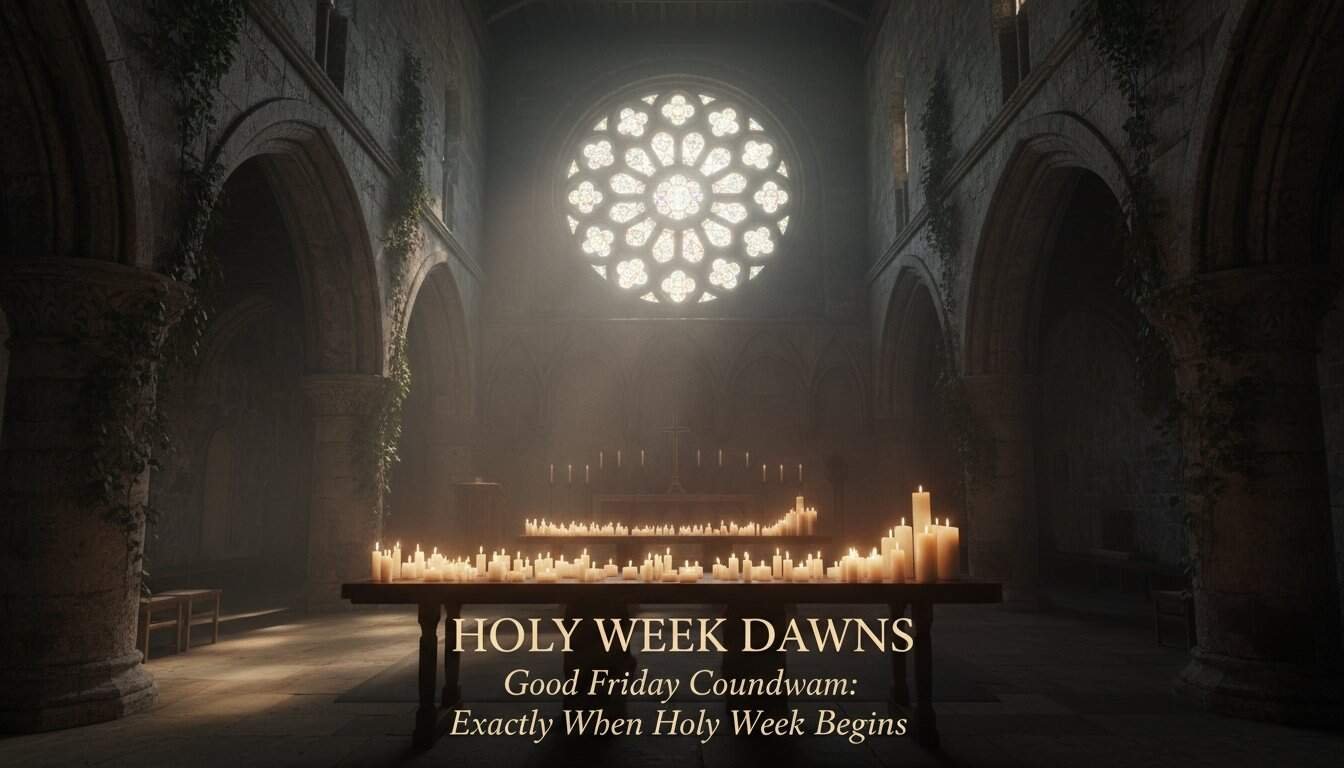
01 Feb Good Friday Countdown: Exactly When Holy Week Begins
You’ll mark Holy Week’s beginning on Palm Sunday, March 29, 2026, initiating the Church’s most profound liturgical journey toward Good Friday, April 3. This sacred octave encompasses Christ’s triumphant entry into Jerusalem through His passion, death, and resurrection. The week progresses through daily observances—Holy Monday’s temple cleansing narratives, Spy Wednesday’s betrayal readings, and Holy Thursday’s Eucharistic institution—before entering the solemn Sacred Triduum. Understanding this complete timeline will illuminate each day’s deeper spiritual significance.
Table of Contents
Key Takeaways
- Holy Week 2026 begins on Palm Sunday, March 29, 2026, starting the countdown to Good Friday.
- Good Friday falls exactly five days after Palm Sunday begins, occurring on April 3, 2026.
- Palm Sunday marks Christ’s triumphant entry into Jerusalem and initiates the holiest week in Christianity.
- The Sacred Triduum containing Good Friday starts Holy Thursday evening, April 2, 2026.
- Good Friday requires the most solemn fast with strict fasting and abstinence from meat.
Holy Week 2026 Complete Calendar: March 29 – April 5

When does Holy Week 2026 officially commence, and what significance does this seven-day period hold for Catholic faithful worldwide? You’ll witness Holy Week begin on March 29, 2026, with Palm Sunday, culminating on April 5, 2026, with Easter Sunday‘s glorious celebration of Christ’s resurrection.
This sacred septenary encompasses Christianity’s most solemn observances, transitioning from Christ’s triumphal entry into Jerusalem through His passion, death, and ultimate victory over sin. Following Palm Sunday’s hosannas, you’ll enter Monday reflections (March 30) and Tuesday preparations (March 31), continuing Lenten disciplines while anticipating the approaching Sacred Triduum.
Holy Wednesday (April 1) commemorates Judas’s betrayal arrangement, preceding the Sacred Triduum’s commencement on Holy Thursday (April 2). Good Friday‘s passion remembrance (April 3), Holy Saturday‘s tomb vigil (April 4), and Easter’s triumphant proclamation complete this liturgical pinnacle. Holy Thursday also marks when Lent ends, as this sacred evening transitions into the Easter Triduum that leads directly to Easter Sunday. The subsequent Easter season extends through May 24, 2026, celebrating Christ’s eternal dominion over death’s dominion.

Palm Sunday Traditions and What to Expect March 29
How does Palm Sunday‘s ancient liturgy transform March 29, 2026, into Christianity’s most paradoxical celebration?
You’ll witness the Church’s most dramatic juxtaposition as triumphant hosannas give way to Passion anticipation.
Your Palm Sunday begins with blessed palms distributed at the communion rail, where you’ll kiss both the palm and priest’s hand. These sacramentals aren’t ordinary decorations—they’re evloghia requiring reverent treatment throughout the year. You’ll fold them into crosses for home crucifixes or return them for Ash Wednesday’s ashes.
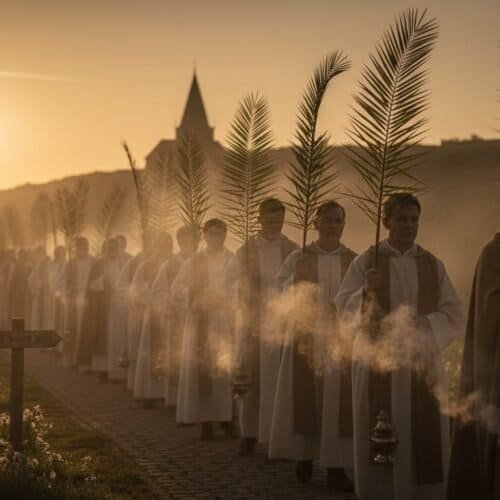
The Procession Ritual follows blessing, where you’ll reenact Christ’s Jerusalem entry with palms and candles. Whether processing through your church or around the building, you’re participating in Christianity’s Great Entrance commemoration.
During Mass, you’ll stand holding palms throughout Matthew’s lengthy Passion narrative, sung by three deacons. You’ll join the crowd’s responses, shouting “Crucify him!” as the liturgy transforms celebration into solemn anticipation of Christ’s supreme redemptive sacrifice.

Good Friday April 3: Services, Fasting, and Observance
Why does Good Friday stand as Christianity’s most solemn fast, demanding both bodily sacrifice and spiritual preparation? This sacred day requires both fasting and abstinence from the Latin Catholic Church‘s faithful, establishing rigorous spiritual discipline.
Fasting specifics mandate one full meal plus two smaller meals that don’t equal a complete meal. You’re bound by these rules if you’re between ages 18-59 and in reasonable health. Abstinence from meat applies from age 14 onward with no upper limit, though fish substitutes are permitted.
Observance practicality acknowledges necessary exemptions: pregnant women, nursing mothers, and those with medical conditions aren’t bound by fasting requirements. Common sense prevails—your health shouldn’t be jeopardized. Ideally, you’ll extend this paschal fast until the Easter Vigil, deepening your spiritual preparation for Christ’s resurrection through deliberate dependence on God’s providence.
Easter Triduum Explained: Thursday Through Saturday
Where does Christianity’s most sacred liturgical period find its deepest expression? You’ll discover it within the Easter Triduum, spanning Thursday evening through Sunday evening. Understanding Triduum origins reveals this isn’t merely three separate observances but one unified celebration of Christ’s Paschal Mystery.
The Easter Triduum represents Christianity’s most sacred liturgical period, unifying three days into one celebration of Christ’s Paschal Mystery.
The liturgical unity begins Thursday evening with the Mass of the Lord’s Supper, commemorating Christ’s institution of the Eucharist. You’ll witness priests washing feet, reenacting Jesus’s humble service to his disciples (John 13:1-17). The reserved Blessed Sacrament creates a bridge to Good Friday‘s solemnity.
Good Friday eliminates Mass entirely. Instead, you’ll participate in the Celebration of the Lord’s Passion at 3 PM, featuring Scripture readings, cross veneration, and Communion from Thursday’s reserved elements. The priest’s prostration before the altar emphasizes humanity’s fallen state.
Holy Saturday’s Easter Vigil anticipates Resurrection through four distinct movements: light, Scripture, baptismal renewal, and Eucharist—completing salvation’s narrative arc.
Daily Holy Week 2026 Mass Times and Activities Guide
What transforms ordinary March days into Christianity’s most profound liturgical journey? You’ll discover that Holy Week 2026’s structured progression creates two word ideas that unite seemingly unrelated topics through liturgical precision.
Palm Sunday (March 29) initiates your journey with morning processions and Mass commemorating Christ’s triumphal entry. You’ll participate in traditional palm branch ceremonies during Psalm week 2.
Holy Monday (March 30) presents morning Mass focusing on Temple cleansing narratives. You’ll encounter readings from John 12:1-11 regarding Bethany’s anointing.
Holy Tuesday (March 31) offers Mass with prophetic readings from John 12:20-36, emphasizing Christ’s death predictions.
Spy Wednesday (April 1) features violet vestments with Isaiah 50:4-9a and Matthew 26:14-25 readings addressing Judas’s betrayal.
Holy Thursday (April 2) culminates with evening Mass of the Lord’s Supper, wearing white vestments. You’ll witness Chrism Mass incorporating Isaiah 61:1-3a, Revelation 1:5-8, and Luke 4:16-21, commemorating Eucharistic institution.
Frequently Asked Questions
Can Non-Catholics Attend Holy Week Services and Participate in Rituals?
You can attend Catholic Holy Week services as a non-Catholic without violating Church law. Non-Catholic participation in permissible rituals includes venerating the Cross, observing Stations of the Cross, singing hymns, and participating in General Intercessions. However, you can’t receive Communion due to doctrinal disagreements regarding transubstantiation. Vatican II’s Directory on Ecumenism permits your participation in common prayers and responses, provided they align with Catholic teaching principles.
Are Businesses and Schools Closed During Holy Week Observances?
You’ll find most businesses remain open during Holy Week, with closures primarily on Good Friday and Easter Sunday. Catholic schools typically close the entire week, while public schools vary by district. Even as congregations adapt through curbside worship and parking lot services, essential services continue uninterrupted.
Government offices in Catholic regions may close Good Friday and Easter Monday, reflecting the solemnity of Christ’s passion narrative.
What Foods Are Traditionally Eaten or Avoided During Holy Week?
You’ll traditionally observe fasting by avoiding meat on Good Friday, following Christ’s sacrificial example. Foods to avoid during Lent include rich meats and dairy in some traditions. However, you’ll find festive dishes for Holy Week like unleavened bread symbolizing Christ’s body, bitter herbs recalling Passover, lamb representing the Paschal sacrifice, and hot cross buns marking Christ’s crucifixion and resurrection throughout these sacred observances.
How Do Different Christian Denominations Observe Holy Week Differently?
Different denominations observe Holy Week practices through distinct theological frameworks. You’ll find Catholics and Aglipayans celebrating elaborate liturgical traditions including palm processions, foot washing ceremonies, and Salubong rituals. Conversely, Seventh-day Adventists reject these observances, emphasizing sola scriptura principles and Sabbath worship.
Iglesia ni Cristo similarly avoids Holy Week commemorations, viewing them as pagan-derived customs. United Church of Christ maintains traditional Protestant observances while incorporating reformed theological interpretations.
What Should Visitors Wear When Attending Holy Week Church Services?
You should follow standard attire guidelines when visiting Holy Week services, wearing respectful dress that honors the solemnity of Christ’s passion. Choose semi-formal clothing: men wear trousers with collared shirts, women select knee-length skirts or modest slacks with appropriate blouses. Avoid casual wear like jeans, shorts, or revealing garments. Your modest appearance demonstrates reverence for these sacred observances commemorating Jesus’s sacrificial journey to Calvary.
Conclusion
You’ll find Holy Week 2026’s March 29-April 5 observance mirrors Christ’s final earthly journey, as recorded in Matthew 21:1-11 and Luke 22-24. You’re called to participate in this liturgical summit through Palm Sunday’s triumphant procession, Maundy Thursday’s institution of the Eucharist, Good Friday’s salvific sacrifice, and Easter Vigil’s resurrection celebration. You’ll experience salvation history’s culminating moments through these sacred days, following Christ’s passion, death, and glorious resurrection according to apostolic tradition and ecclesial teaching.








No Comments