

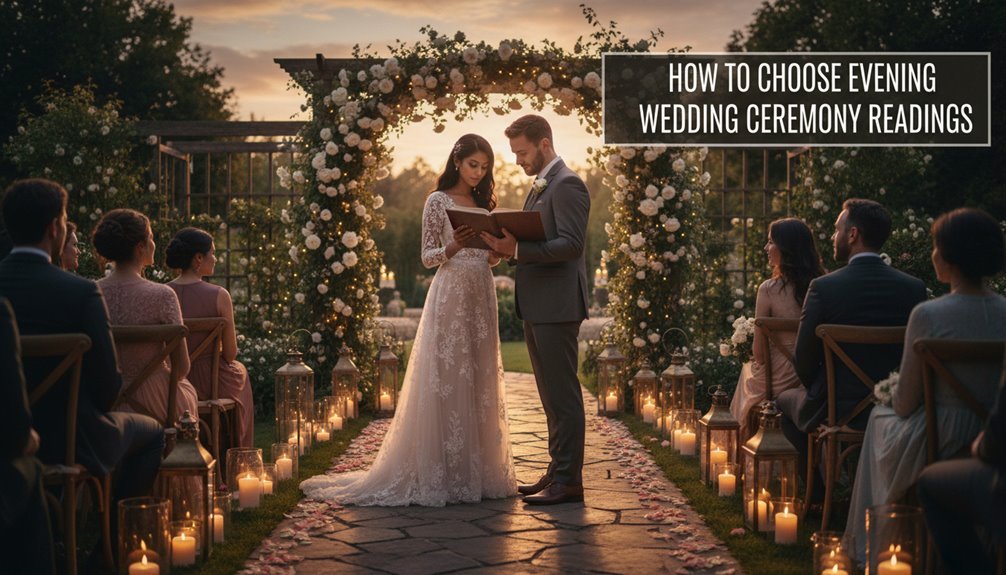
06 Apr How to Choose Evening Wedding Ceremony Readings
Choose a piece that mirrors twilight’s softening light—short, lyrical, and intimate, like Dickinson or Rumi. Keep it under two minutes if your schedule’s tight, or stretch to three or four minutes for a relaxed evening, and decide whether one voice or two will add texture. Pick biblical verses that echo love and night, such as Song of Songs 8:6‑7 or 1 Corinthians 13:4‑7, and pair them with gentle piano or strings and dim, warm lighting. Personalize the lines with a brief anecdote while preserving their cadence. Keep reading to discover more tips.
Choose an Evening Wedding Reading That Sets the Twilight Mood
How can you capture the hush of dusk in a few lines? You start by choosing a piece that mirrors the sky’s softening, a poem or excerpt that speaks of fading light and gentle shadows. Look for verses that use imagery of twilight, waning stars, or the quiet transition from day to night. A short, lyrical selection works best; it should be intimate enough to hold attention without overwhelming the moment. Consider works by poets who master restraint—Emily Dickinson, Rumi, or contemporary writers who weave calm, reflective tones. Read the passage aloud during rehearsals; if the cadence feels like a sigh, you’ve hit the right note. Pair the reading with subtle lighting—candles or fairy lights—to reinforce the mood. By aligning the text’s mood with the evening’s natural ambience, you create a seamless, emotionally resonant bridge between ceremony and celebration.
Match Evening Wedding Reading Length and Style to Your Schedule
Ever wondered how to fit a reading into your evening timeline without losing its impact? First, map out the ceremony flow: arrival, vows, music, reading, and recessional.
If you have a tight schedule, choose a piece under two minutes—think a single stanza or a short poem.
For a relaxed evening, you can stretch to three or four minutes, allowing a longer excerpt or a brief dialogue between readers.
Match style to the moment. A lyrical, rhythmic passage works well during a candle‑lit interlude, while a prose excerpt feels natural before the first dance.
Consider the number of speakers: one voice keeps it swift; two voices add texture but require extra coordination.
Practice with a timer to ensure the reading fits the allotted slot.
Adjust pacing by pausing for emphasis or trimming nonessential lines, and you’ll keep the ceremony flowing smoothly while preserving the reading’s emotional resonance.
Select Biblical Passages for Evening Wedding Readings
You’ll find timeless love verses that echo the wedding’s promise, while evening light imagery adds a gentle glow to the ceremony. Choose passages that weave both themes together, creating a resonant backdrop for your vows. Let the scripture’s warmth and the night’s hush set the perfect tone.
Timeless Love Verses
Looking for a timeless, heartfelt verse that captures the depth of love as twilight settles? You’ll find the perfect biblical lines in Song of Songs 8:6–7, where love is described as a fire that can’t be quenched and a flood that overwhelms. 1 Corinthians 13:4‑7 offers a concise, poetic definition of love’s patience, kindness, and perseverance—ideal for an evening ceremony’s intimate atmosphere. Psalm 136 repeatedly declares “His love endures forever,” providing a rhythmic affirmation that resonates under dim lights. When you choose one of these passages, you anchor the moment in enduring spiritual truth, allowing guests to feel the sacred weight of the vows. Select the verse that mirrors your couple’s journey, and let its timeless resonance illuminate the night.
Evening Light Imagery
How does the gentle glow of dusk inspire a wedding reading? You’ll notice that evening light casts a soft, hopeful hue, perfect for verses that speak of light, guidance, and covenant. Consider Psalm 27:1, “The Lord is my light and my salvation,” which frames love as a beacon against night’s shadows. Revelation 21:23 offers a celestial image: “The city doesn’t need the sun or moon because the glory of God gives it light.” Isaiah 60:19‑20 promises an everlasting glow, echoing a marriage’s enduring commitment. When you select these passages, you weave the twilight atmosphere into the ceremony, allowing the couple’s vows to resonate with the serene, luminous promise of a shared future.
Enhance Your Evening Wedding Reading With Music and Lighting
Ever wondered how music and lighting can turn a simple reading into an unforgettable moment? You can start by selecting a soft instrumental piece that mirrors the reading’s tone—perhaps a gentle piano or a string quartet.
Let the melody swell just before the first line, then fade to a whisper as the speaker begins, creating a seamless transition. Pair this with subtle lighting: dim the main fixtures, then introduce warm uplights or candles that cast a gentle glow on the reader and the audience. Use a slow fade‑in as the music starts, and a gradual dim as the reading concludes, allowing the emotions to linger.
If you want a touch of drama, synchronize a single spotlight to follow the speaker’s movements, highlighting key phrases. Keep volume low enough that words remain clear, and choose colors that complement your evening palette—soft amber, deep navy, or muted rose—to enhance the intimate atmosphere without overwhelming the moment.
Personalize Classic Verses for Evening Wedding Readings While Keeping Sacred Meaning
You can weave timeless lines into your ceremony while keeping the spiritual core intact.
By tweaking phrasing or adding a personal anecdote, you let the verse resonate with your evening’s mood.
The key is to honor the original meaning even as you make it uniquely yours.
Blend Timeless Lines
When the sun dips and the candles glow, you can breathe fresh life into classic verses without losing their sacred heart. Start by selecting a beloved line from a timeless poem, then weave in a personal anecdote that mirrors its theme. Keep the original cadence intact, but replace a few words with details that reflect your journey—like the night you first met under a lantern‑lit sky. Pair two short excerpts: one from a religious text, another from a literary classic, and let them echo each other’s rhythm. Use subtle transitions—“just as…” or “like…”—to bind them, ensuring the flow feels seamless. This technique honors tradition while showcasing your unique love story.
Preserve Spiritual Essence
How can you keep a classic verse’s holy core while letting it speak your own love story? Start by identifying the passage’s central spiritual theme—faith, hope, or divine love—and then weave your personal anecdotes around it. Choose a verse that resonates with your ceremony’s tone, then replace generic pronouns with your names or shared symbols, like a cherished sunrise. Keep the original phrasing intact, but add a brief, heartfelt prelude that explains why the verse matters to you both. Use subtle pauses to emphasize sacred words, allowing the audience to feel the reverence. By anchoring your story in the verse’s timeless truth, you preserve its spiritual essence while making it uniquely yours.
Avoid Common Pitfalls When Selecting Evening Wedding Readings
Ever wondered why some evening ceremony readings feel out of place? You might be picking texts that clash with the soft lighting, intimate vibe, or late‑night timing.
First, avoid overly long passages; a 10‑minute monologue will drown the atmosphere and tire guests.
Second, skip jokes or pop‑culture references that lose impact after dark—what’s funny in daylight may feel flat under dimmed chandeliers.
Third, watch the tone: melancholy poems can deepen romance, but too much sorrow can dampen the celebration.
Fourth, don’t ignore acoustics; spoken word must carry without echo, so choose pieces with clear, rhythmic phrasing.
Fifth, steer clear of overly religious language unless both families share that faith; it can alienate friends.
Finally, test the reading aloud in the actual venue. Hearing it in the evening space reveals pacing issues and ensures the words harmonize with the night’s ambience.
Frequently Asked Questions
Can We Combine Multiple Short Readings Into One Cohesive Segment?
You can blend several short readings into a seamless segment by picking a unifying theme, arranging them in a logical flow, and using brief connective phrases. Start with a strong opening line, then transition with a sentence like “And now, another thought…” to link each piece. Keep the tone consistent, trim any redundant words, and rehearse together so the whole passage feels like one cohesive narrative.
How Do We Ensure the Reading Respects Cultural Traditions?
You honor cultural traditions by researching the specific customs your families follow, then selecting texts that reflect those values. Ask relatives which passages are sacred or meaningful, and verify translations are accurate. Incorporate traditional language, rituals, or symbols into the reading’s framing. Blend the chosen piece with any personal vows, ensuring the tone aligns with the ceremony’s heritage. Finally, rehearse with your officiant to confirm everything respects the cultural expectations.
What Are Tips for Rehearsing the Reading With Limited Microphone Time?
You’ll want to schedule a quick run‑through during any mic‑check slot you get—keep it short, focus on pacing, and record a few takes. Play them back, note where you stumble, and adjust emphasis. Use a phone or laptop recorder if the venue’s mic isn’t available. Practice the exact timing of pauses, and rehearse with the same distance from the mic you’ll have on the day.
Should We Translate a Foreign-Language Reading for Non‑Speaking Guests?
Yes, translate the foreign‑language reading for non‑speaking guests. You’ll keep everyone engaged and avoid confusion, especially if the passage carries emotional weight. Offer a concise, clear translation—either projected on a screen or read aloud by a trusted friend. Keep the original language intact for authenticity, but ensure the meaning is accessible, so all attendees feel included and moved by the moment.
How Can We Incorporate a Personal Anecdote Without Breaking Flow?
You can weave your anecdote into the reading by treating it as a brief bridge—keep it under thirty seconds, use vivid, concise language, and link its theme directly to the passage you’re about to read. Start with a one‑sentence hook, pause, then transition smoothly with a connector like “That’s why this line means so much to us.” This maintains momentum while adding intimacy.
Conclusion
By now you’ve got the tools to pick a reading that captures the twilight magic of your evening ceremony. Keep it concise, match the tone to your schedule, and weave in music or lighting for extra sparkle. Whether you draw from scripture, classic poetry, or personal verses, let the words reflect your love while staying true to the sacred moment. Avoid clichés, stay authentic, and let the evening glow amplify every line.





No Comments