

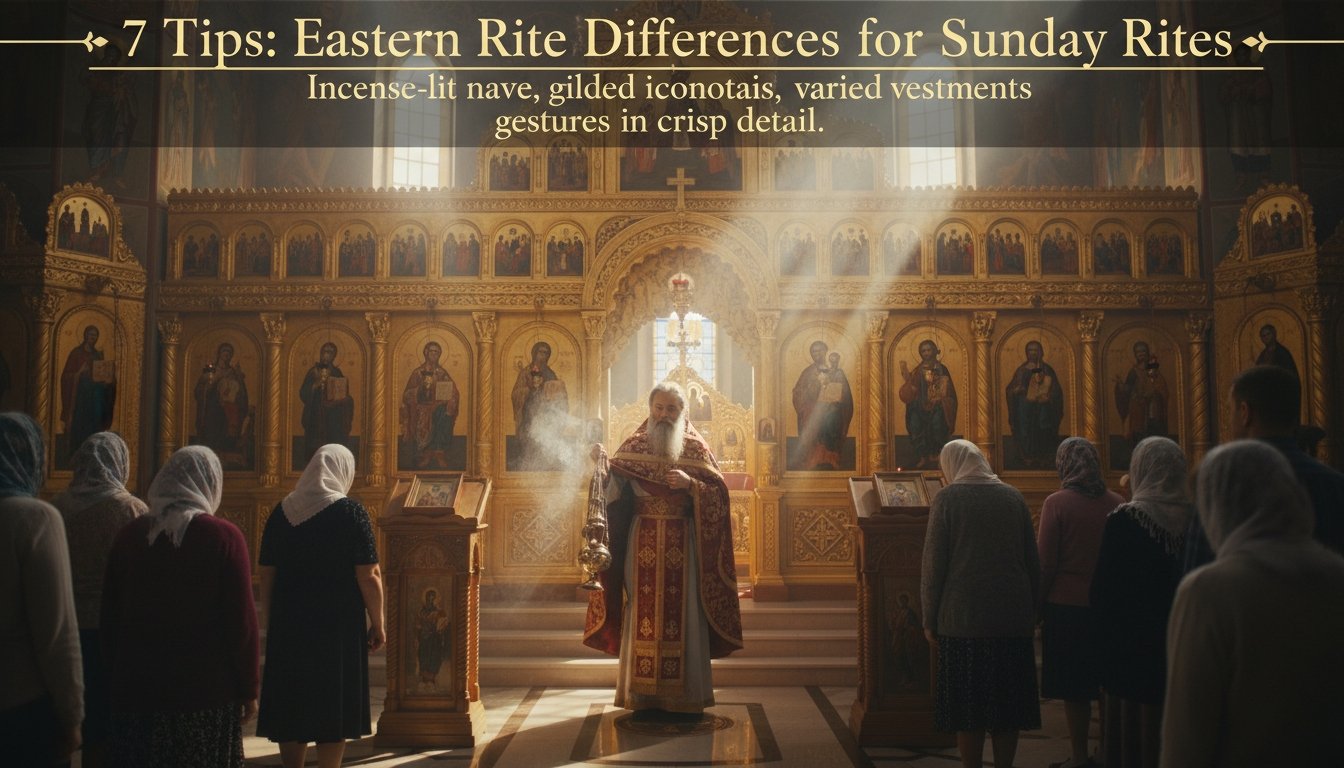
01 Mar 7 Tips: Eastern Rite Differences for Sunday Rites
The Eastern Rites offer a captivating worship experience on Sundays. You’ll witness vibrant processions with palms or olive branches, chanted antiphons, and solemn veneration of sacred images. Readings and the Passion Gospel are proclaimed in a distinct style, while postures like bowing, crossing oneself, and limited kneeling reflect the tradition. These rich ritual elements create a meditative atmosphere that invites you to explore the Eastern Rite liturgies further.
Table of Contents
Key Takeaways
- Liturgical processions with palms or native flora symbolize Christ’s triumphal entry and foster active participation in the sacred celebration.
- Solemn distribution of blessed palms and olive branches marks shared participation in the ritual and symbolizes peace and new life.
- Responsorial chanting of psalms and antiphons creates a meditative prayer atmosphere and differs from the Roman Rite.
- Readings are often chanted or sung, and the Passion Gospel is proclaimed by multiple readers in a call-and-response style.
- Veneration of icons and ritual objects, solemn adoration of the cross, and distinct postures are central practices in the Eastern Rite.
Liturgical Procession With Palms
Why do Eastern Rite churches often include a liturgical procession with palms on Palm Sunday? It’s a ritual that reenacts Jesus’ entry into Jerusalem when crowds welcomed him with palm branches. In the Eastern tradition, the faithful carry palms or pussy willows and process around the church before the Divine Liturgy. This symbolizes Christ’s triumphant arrival and the people’s joyful recognition of him as the Messiah. The procession begins at the church doors, then the congregation enters the nave, often chanting hymns. Some Eastern churches also bless the palms before the procession. This ancient custom helps the faithful commemorate and participate in the mystery of Palm Sunday.
Blessing and Distribution of Palms and Olive Branches
In Eastern Rite churches, the blessing and distribution of palms and olive branches is an important part of the Palm Sunday celebration. The palms and olives are blessed before the liturgy begins, then handed out to the congregation. This symbolic procession commemorates Christ’s triumphal entry into Jerusalem.
Blessing of Palms and Branches
What sets the Blessing of Palms and Branches apart in Eastern Rite liturgies? The ceremony emphasizes the prophetic nature of Christ’s entry into Jerusalem. Instead of palms, Eastern Catholics use olive branches, olive leaves, or other native flora. The priest blesses the branches, then distributes them to the faithful. This rite aligns with the Gospel accounts, underscoring Christ’s humble arrival amidst cheering crowds. The branches also symbolize peace, new life, and the eternal nature of God’s kingdom. This solemn procession ushers worshipers into the solemnity of Holy Week, preparing hearts for the Passion and Resurrection to come.
Distribution of Palms and Olives
How do the Eastern Rites distribute the blessed palms and olive branches to the faithful? In the Eastern Rites, the distribution of palms and olives is a solemn ritual. The clergy, carrying the blessed branches, process through the church, distributing them to the congregation. The faithful reverently receive the palms and olives, often kissing the priests’ hands as they’re offered. This custom symbolizes Christ’s triumphant entry into Jerusalem and the people’s joyful welcome. The olive branches represent peace and new life. The distribution is an opportunity for the community to share in this sacred celebration, renewing their devotion to Christ the King.
Responsorial Chanting of Psalms and Antiphons
One of the defining characteristics of Eastern Rite liturgies is the responsorial chanting of psalms and antiphons. You’ll find the congregation responds to the verses intoned by the clergy or choir. This antiphonal style dates back to the early Church and fosters active participation. The chanting’s rhythmic, melodic quality creates an atmosphere of meditative prayer. You’ll notice the responses may differ from the Roman Rite, with unique melodies and patterns. Familiarize yourself with these before attending an Eastern liturgy. The chanting engages the senses, drawing worshippers into the sacred text. Embrace this rich tradition – it’ll deepen your experience of the Eastern Rite’s universal yet distinct character.
Readings and Proclamation of the Passion Gospel
In Eastern Rite churches, the readings are usually proclaimed differently than in the Latin Rite. Moreover, the Passion Gospel is recounted in a distinct manner. These variations in the readings and Passion Gospel presentation set the Eastern Rite Sunday rites apart from their Western counterparts.
Readings Proclaimed Differently
Do the readings differ in Eastern Rite liturgies compared to the Roman Rite? You bet! In the Eastern Church, the readings are proclaimed differently. The Gospel is often chanted or sung, not just read. And instead of one reader, multiple deacons or priests may share the proclamation. The Epistle’s reading may alternate between the ambo and the sanctuary. This interactive dynamic heightens the sense of participation. Plus, the Eastern liturgy has additional readings from the Old Testament and the Church Fathers. These distinct practices reflect the Eastern tradition’s emphasis on the active role of the assembly in the liturgy.
Passion Gospel Recounted Distinctly
How does the recounting of the Passion Gospel differ in Eastern Rite liturgies? Instead of one reader, the Passion is dramatically proclaimed by multiple readers, often in a call-and-response manner. This creates a more interactive and immersive experience for the congregation. The parts are typically divided between Christ, the narrator, and other characters, emphasizing the dialogue and emotion of the Passion narrative. This dynamic style engages the faithful, drawing them into the profound events commemorated. While the Roman Rite has a single reader, the Eastern Rite’s multi-voiced Passion proclamation heightens the solemnity and drama of Good Friday.
Veneration of Icons and Ritual Objects
Why do Eastern Rite Christians venerate icons and ritual objects? It’s a centuries-old tradition rooted in the belief that these sacred images and objects serve as a bridge between the earthly and heavenly realms. During worship, you’ll see believers reverently kiss, bow, and cross themselves before icons depicting Christ, the Blessed Virgin, and the saints. The ornate chalice, paten, and vestments used in the Liturgy are also treated with great care and respect. This veneration isn’t worship, but rather a way to honor the divine presence these objects represent. Through this tangible, physical connection, Eastern Rite Christians deepen their relationship with the spiritual world. The use of icons and ritual objects adds beauty, mystery, and transcendence to their Sunday rites.
Solemn Adoration of the Cross
Another revered ritual observed in Eastern Rite Sunday services is the Solemn Adoration of the Cross. You’ll see the priest solemnly process the cross, accompanied by altar servers, through the congregation. As the cross is presented, the faithful bow and venerate it by kissing or touching it. This act symbolizes our deep gratitude for Christ’s sacrifice on the cross, which brings salvation. The cross is then placed on the altar, where the faithful continue to prostrate themselves before it. This poignant ritual reminds us of the central role of the cross in Eastern Christian spirituality. It’s a powerful moment of humble adoration and contemplation of the Passion.
Distinct Postures and Gestures of Worship
What distinct postures and gestures do you observe in Eastern Rite Sunday services? You’ll likely see worshippers bowing, making the sign of the cross, and prostrating themselves during key moments. Standing is the norm, with sitting reserved for specific parts. Kneeling is uncommon, except for penitential periods. You may notice heads bowed during the Gospels and the Consecration. Hands are frequently raised in prayer, and the faithful make deep bows from the waist. When receiving Communion, communicants approach with hands crossed. These physical expressions reflect the Eastern Rite’s emphasis on active participation and a posture of reverence before the Divine Mysteries.
Frequently Asked Questions
What Is the Significance of the Use of Incense in Eastern Rite Liturgies?
The use of incense in Eastern Rite liturgies symbolizes the presence of God and the prayers of the faithful rising to heaven.
It’s a visual reminder of the spiritual realm and the connection between the earthly and divine.
The fragrant smoke also helps create an atmosphere of reverence and awe during worship.
How Do Eastern Rite Churches Observe the Feasts of the Mother of God?
Eastern Rite churches observe the feasts of the Mother of God with great solemnity. They celebrate her Nativity, Presentation, Annunciation, Assumption, and other Marian feasts with special liturgies, prayers, and hymns. The faithful venerate the Theotokos, or “Mother of God,” as the highest of all saints and a powerful intercessor before her Son. Marian devotion plays a central role in the spiritual life of Eastern Christians.
Why Are the Communion Vessels Often Covered With a Veil During the Liturgy?
The communion vessels are often covered with a veil during the liturgy to signify the hidden and mysterious nature of the Eucharist. This tradition emphasizes the sacred and solemn character of the celebration, reminding the faithful that the Eucharist is a profound mystery. The veil is removed at the appropriate moment, revealing the consecrated bread and wine to the congregation.
What Is the Role of the Deacon in Eastern Rite Sunday Worship?
In Eastern Rite Sunday worship, the deacon plays an integral role. They assist the priest during the Liturgy, proclaiming the Gospel, leading the petitions, and distributing Communion. The deacon’s presence helps facilitate the flow of the service and supports the congregation’s active participation.
Their responsibilities are essential in upholding the traditions and reverence of Eastern Rite liturgical practices.
How Do Eastern Rite Churches Celebrate the Feast of the Transfiguration?
In Eastern Rite churches, the Feast of the Transfiguration is celebrated with great solemnity.
You’ll see the church adorned with flowers and greenery, and the liturgy is filled with joyful hymns and readings that recount the event.
The Divine Liturgy is celebrated, and the Transfiguration is the focus of the day’s prayers and reflections.
Conclusion
You’ll find that the Eastern rite Sunday rites differ significantly from the Western rite. The liturgical procession, blessing and distribution of palms, chanting, readings, veneration of icons, adoration of the cross, and postures and gestures all reflect the unique Eastern Christian tradition. These distinct practices allow you to more fully experience the richness and diversity of the universal Catholic Church.










No Comments