

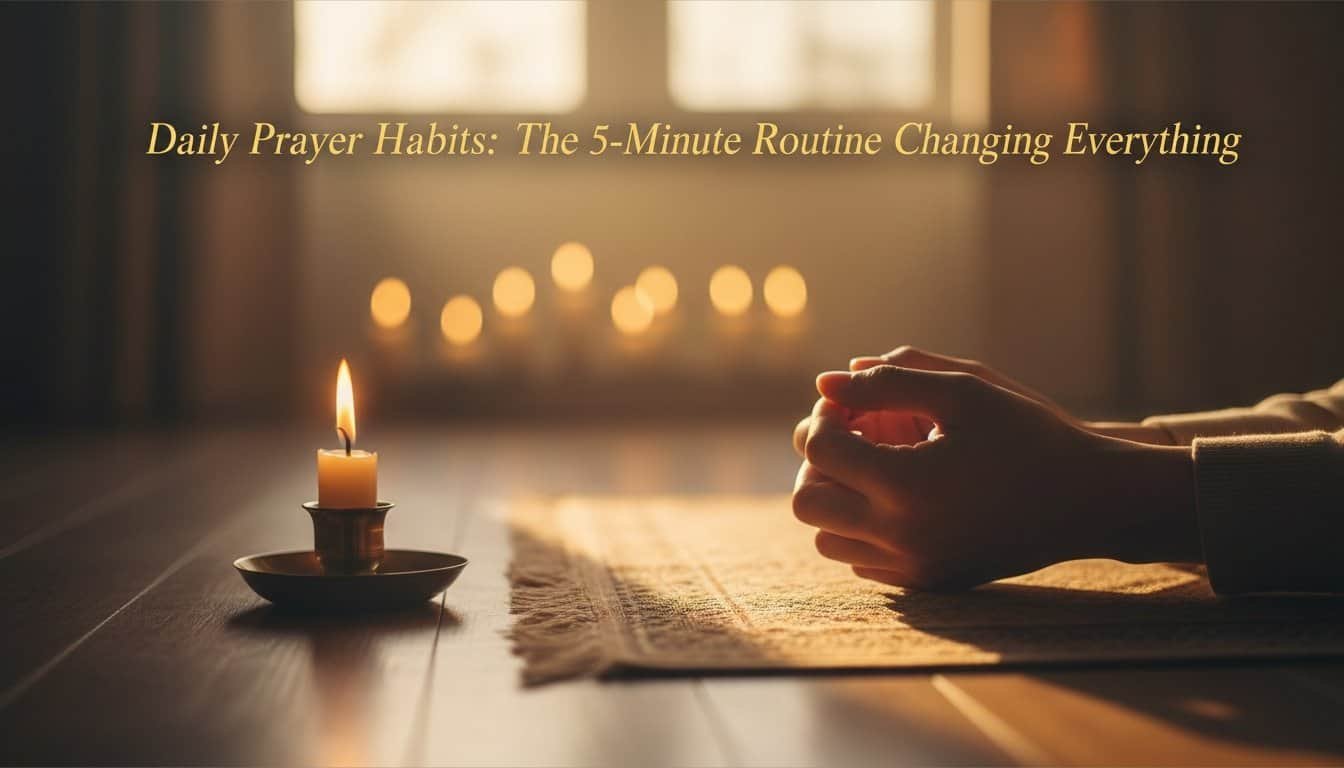
29 Jan Daily Prayer Habits: The 5-Minute Routine Changing Everything
You’ll transform your spiritual life by establishing a structured five-minute daily prayer routine that integrates mindful breathing, specific gratitude, scriptural engagement, and deliberate surrender. This disciplined approach creates measurable physiological changes—reducing cortisol levels, lowering blood pressure, and activating neural pathways associated with peace and compassion. By anchoring this practice to existing daily rhythms like morning coffee, you’ll shift from sporadic spiritual conversations to consistent communion with God that produces lasting psychological resilience and deeper theological understanding of divine sovereignty.
Table of Contents
Key Takeaways
- Set your alarm five minutes earlier and anchor the routine to existing habits like morning coffee for consistent daily practice.
- Begin with thirty seconds of mindful breathing to create sacred space and quiet competing thoughts for divine communion.
- Express gratitude for three specific things, then slowly read one Bible verse to invite divine insight and alignment.
- Surrender your worries to God and yield your entire day to divine sovereignty during the final minutes.
- Experience measurable health benefits including reduced stress hormones, lower blood pressure, and improved mood and resilience.
How to Start a 5-Minute Daily Prayer Routine
How can believers transform their spiritual lives through a mere five minutes of intentional prayer each day? The answer lies in establishing a structured approach that maximizes spiritual engagement within temporal constraints.
Begin by setting your alarm five minutes earlier, creating dedicated space for communion with God. Your first minute should focus on mindful breathing—pause and breathe deeply for thirty seconds, releasing physical tension while quieting thoughts that compete for attention. This physiological centering prepares your heart for spiritual receptivity.
Creating sacred space begins with intentional breathing—thirty seconds of deep breaths that quiet competing thoughts and center your heart for divine communion.
Minutes two through three involve gratitude and Scripture engagement. Give thanks for three specific elements, then read one Bible verse slowly, asking for divine insight. The final two minutes require surrender: explicitly hand over worries to God, then yield your entire day to His sovereignty.
Consistency emerges through anchoring this practice to existing daily rhythms—perhaps during your morning coffee. This integration transforms routine moments into sacred encounters, establishing sustainable spiritual disciplines. When midday overwhelm threatens to derail your peace, even five minutes of prayer can completely change the tone of your afternoon.
What Science Reveals About Prayer’s Health Benefits
Beyond anecdotal testimonies and theological assertions, empirical research now validates what believers have long understood intuitively: prayer produces measurable physiological and psychological transformations. Studies demonstrate prayer’s profound impact on the mind body connection, revealing decreased heart rate, blood pressure, and cortisol levels during contemplative practices.
Your nervous system undergoes systematic changes during prayer, deactivating fight-or-flight responses while activating neural pathways associated with peace and emotional regulation. Brain imaging reveals enhanced activity in regions governing compassion and reduced reactivity to negative stimuli. This stress alleviation extends beyond momentary relief—practitioners experience sustained improvements in immune function, sleep quality, and cardiovascular health.
Research consistently shows prayer’s superiority over secular meditation for anxiety reduction and pain tolerance. You’ll find that regular practice correlates with improved mood stability, enhanced emotional control, and greater psychological resilience. These findings illuminate prayer’s therapeutic mechanisms, demonstrating how spiritual disciplines optimize both mental and physical well-being.
Essential Elements Every Prayer Practice Needs
What transforms sporadic spiritual conversations into transformative prayer practices that yield lasting spiritual growth? The answer lies in five foundational elements that distinguish authentic prayer from mere religious routine.
Sincere communication forms your prayer’s bedrock. You must approach God with genuine faith, expressing true feelings rather than superficial words. This honesty fosters normal relationship with the Divine and builds faith confidence.
Scripture alignment provides structural integrity to your petitions. When you pray God’s Word back to Him, you’re operating within His revealed will rather than personal desires. Jesus demonstrated this authority when He wielded Scripture against temptation.
Persistence sustains your practice through spiritual seasons. Like the widow in Luke 18, you must maintain resolve without losing heart. Daily engagement builds essential rhythm.
Finally, intentional structure—positioning yourself physically, journaling prayers, embracing silence—creates space for God’s response and transforms casual conversation into transformative spiritual discipline.
Building Deeper Connections Through Shared Prayer
When two believers unite their hearts in prayer, they create a sacred space where individual faith transforms into collective spiritual power that reshapes relationships at their deepest levels. Research demonstrates that praying with your partner produces a positive trust correlation coefficient of approximately 0.48, mediated through couple unity rather than any unrelated concept. You’ll experience measurable trust increases when you pray together twice weekly over four weeks, as joint prayer reminds you of shared symbolic values that strengthen relational bonds.
Your daily “fire-prevention prayer” establishes systematic conflict resolution before issues escalate, while “fire-extinguisher prayer” during heated moments enables emotional de-escalation. Unlike unrelated practice approaches, prayer shifts your focus toward self-change rather than partner-change, promoting humility and understanding. You’ll discover increased forgivingness as prayer gives voice to inmost hurts through divine connection. Holding hands while praying creates physical and spiritual unity portrayal, establishing consistent opportunities for spiritual intimacy that positively influences all spousal intimacy dimensions.
Why 5 Minutes of Prayer Creates Lasting Life Changes
How does a mere five-minute daily commitment produce transformative physiological and psychological changes that extend far beyond the prayer session itself?
Your nervous system undergoes measurable shifts within this brief timeframe.
Prayer activates parasympathetic dominance, reducing cortisol and adrenaline while synchronizing your breathing to six breaths per minute—optimizing cardiovascular efficiency.
SPECT scans reveal enhanced prefrontal cortex activation, strengthening decision-making capabilities and self-regulation.
Simultaneously, amygdala activity diminishes, creating lasting emotional stability.
Your heart rate variability improves, reducing cardiovascular disease risk through sustained baroreflex sensitivity enhancement.
This minimal investment compounds psychologically.
You’ll experience reduced anxiety, elevated mood through increased serotonin production, and enhanced emotional resilience.
Incorporating mindful breathing techniques amplifies these benefits, while gratitude journaling during prayer sessions deepens neural pathway formation for sustained attention.
The brevity prevents overwhelm, fostering consistency.
Research confirms that 30% of Americans sustaining five-minute daily practices experience measurable stress reduction, improved focus, and elevated well-being that permeates their entire day.
Frequently Asked Questions
What if I Don’t Feel Anything During My 5-Minute Prayer Sessions?
You shouldn’t equate absence of felt emotion with spiritual ineffectiveness. Your brain undergoes measurable neurobiological changes through consistent practice, independent of subjective experiences. When hope vs doubt emerges, remember that prayer functions beyond immediate sensations. You’re establishing crucial coping mechanisms and cortical thickening that supports long-term resilience. Don’t mistake ritual vs connection—your disciplined practice creates authentic spiritual engagement even without emotional intensity during individual sessions.
Can Prayer Replace Traditional Medical Treatment for Stress and Anxiety Disorders?
Prayer shouldn’t replace traditional medical treatment for stress and anxiety disorders, but serves as valuable spiritual coping alongside professional care.
While calming rituals like prayer activate your parasympathetic nervous system and reduce physiological stress markers, clinical evidence supports prayer as an adjunctive intervention rather than standalone treatment.
You’ll find optimal outcomes when integrating contemplative practices with evidence-based therapeutic approaches for comprehensive healing.
Do Different Religions’ Prayer Methods Produce the Same Health Benefits?
Research reveals significant interfaith similarities in prayer’s physiological mechanisms—you’ll find reduced blood pressure, lowered cortisol, and enhanced immune function across traditions. However, health outcomes aren’t uniform; spiritual meditation outperforms secular forms, while content and context matter more than denominational affiliation. You’re experiencing benefits through shared contemplative processes—parasympathetic activation, prefrontal cortex engagement, and cognitive reframing—that transcend specific theological frameworks while maintaining tradition-specific variations.
How Long Before I Notice Measurable Changes From Daily Prayer Practice?
You’ll notice initial physiological changes within days—reduced stress markers and blood pressure typically manifest in the first week. However, measurable timelines for deeper spiritual benefits require 30-60 days of practice consistency. Harvard studies demonstrate significant physiological improvements after four weeks of regular prayer. Your brain imaging will show altered patterns within the first month, while profound spiritual awareness and decision-making clarity develop over 60-90 days of sustained practice.
Is Silent Meditation as Effective as Spoken Prayer for Stress Reduction?
Silent meditation and spoken prayer demonstrate comparable stress reduction efficacy, though you’ll experience distinct neurological pathways. Silent meditation more effectively reduces your Default Mode Network activity, decreasing anxiety through parasympathetic activation. However, spoken prayer activates your temporal lobe’s language centers while providing relational support through divine conversation. Research suggests you’ll achieve optimal stress reduction by combining both practices, as this approach yields superior emotional regulation outcomes than either modality alone.
Conclusion
You’ve discovered that consistent five-minute prayer intervals fundamentally restructure your spiritual consciousness through neuroplastic adaptation and contemplative discipline. Your brief but intentional engagement with divine dialogue doesn’t merely supplement existing faith practices—it transforms your entire theological framework. When you commit to this condensed liturgical rhythm, you’re participating in ancient wisdom that contemporary neuroscience validates. You’ll find that sustained prayer’s transformative capacity emerges not from duration but from faithful consistency and authentic spiritual vulnerability.











No Comments