

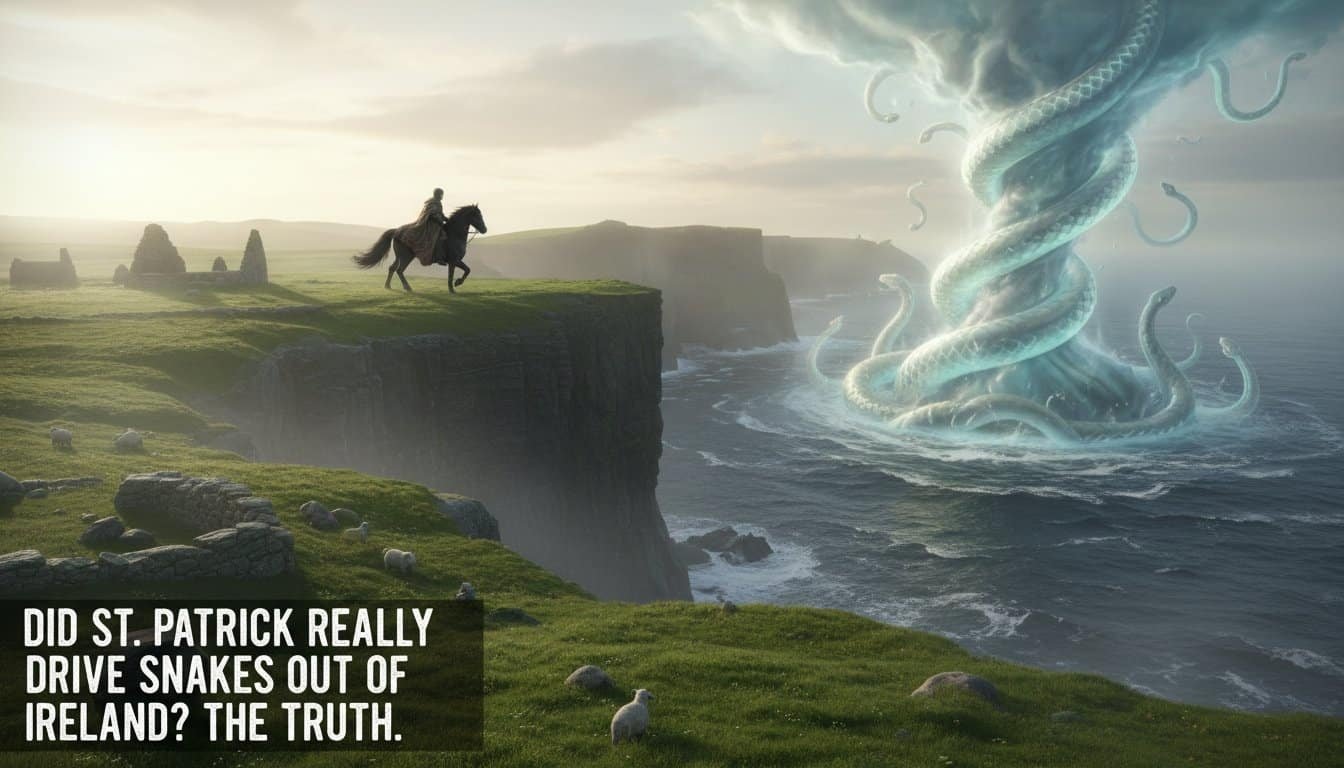
19 Apr Did St. Patrick Really Drive Snakes Out of Ireland? The Truth
You’ll find that St. Patrick never chased real snakes from Ireland; the story first appears in 12th‑century hagiographies where “reptiles” symbolize paganism, not actual animals. Geological and climate evidence shows the island stayed ice‑covered through the Pleistocene, and post‑glacial sea‑level rise cut off any land bridge before snakes could arrive. Fossil records and modern surveys confirm Ireland has been naturally snake‑free, and the legend survived as a moral allegory. Keep going to discover how the myth spread and why it endures.
Table of Contents
St. Patrick’s Hagiographies and the Snake Claim
When did the snake story first appear in Patrick’s own legend? You’ll find it surfaces in 12th‑century hagiographies, especially those penned by Jocelin of Furness. Those medieval writers place St. Patrick on a hill, fasting, and commanding “reptiles” into the sea, turning the act into a symbolic triumph over paganism. The texts never mention actual snakes; they use serpents as a metaphor for evil. During the Renaissance, stained‑glass windows and folk retellings amplified the image, cementing it in popular imagination. No 5th‑century Irish source records a snake‑banishing event, and the story’s emergence aligns with the period’s penchant for moral allegory rather than factual reportage. By tracing the claim’s literary birth, you see it’s a constructed narrative, not a historical account of wildlife eradication. This understanding helps you separate mythic symbolism from the archaeological record.
Geological and Climate Reasons Ireland Stayed Snake‑Free
The hagiographies show the snake tale is symbolic, not factual, and the real reason Ireland never hosted snakes lies in its geology and climate. You’ll notice that during the Pleistocene the island was locked under ice, keeping temperatures far below the threshold needed for ectothermic reptiles. When the glaciers retreated about 11,700 years ago, sea levels rose quickly, drowning the land bridge that once linked Ireland to Britain. That isolation occurred before snakes had even colonized Britain, so they never reached the Emerald Isle. Moreover, Ireland’s cool, damp climate has remained unsuitable for cold‑blooded fauna; climate‑model studies show that even today the island’s average temperatures fall short of the thermal niche required for most snake species. The only native reptile, a viviparous lizard, survives because it can reproduce without laying eggs. Consequently, the geological history and persistent climate conditions together explain why snakes never established themselves in Ireland.
Evidence for/Against Historic Snakes in Ireland?
Could any ancient Irish site actually hold evidence of snakes? You’ll find no fossilized vertebrae or shed skins in the limestone caves of County Clare, nor any snake remains in the peat bogs of the Midlands. Paleontologists have catalogued millions of specimens from the Pleistocene and post‑glacial layers, and snakes never appear. The island’s ice‑age climate stayed too cold for ectothermic reptiles, and when the land bridge to Britain vanished around 8,500 years ago, snakes that later colonized Britain had no route to Ireland. Modern surveys by the National Museum of Ireland confirm the only native reptile is the viviparous lizard; the slow worm arrived only in the 20th century as an introduced species. Comparative biogeography shows Ireland aligns with other snake‑free regions like Iceland and New Zealand. Scientific consensus therefore treats the legend as metaphor, not fact.
How the St. Patrick Snake Legend Spread Over Centuries
How did the tale of St. Patrick driving snakes from Ireland travel from medieval manuscripts to modern celebrations? You’ll see it began in 12th‑century hagiographies, especially Jocelin of Furness, where Patrick’s fasting on a hill and banishing “reptiles” symbolized triumph over paganism. Monks copied the story into liturgical books, and by the Renaissance stained‑glass windows and woodcuts visualized the banishment, cementing the image in public consciousness. Travelers and traders carried the narrative to the diaspora, where it merged with folk songs and oral storytelling. In the 19th‑century Irish revival, nationalists reclaimed the legend as a metaphor for cultural purification, and newspapers printed sensational accounts of “snakes disappearing.” The 20th‑century tourism industry amplified it with parade floats and merchandise, while school curricula taught it as a charming myth. Today, social media memes and holiday advertising recycle the same motif, ensuring the legend’s persistence across centuries.
2024‑2026 Scientific Consensus on the Legend
Ever wonder why scientists now agree the St. Patrick snake story is myth, not fact? You’ll find the answer in a cascade of data collected since 2024. Paleontologists have scanned Ireland’s Pleistocene strata and found zero serpent fossils, confirming that the island never hosted cold‑blooded reptiles after the last glaciation. Climate models show post‑glacial temperatures stayed too low for snakes, while sea‑level rise sealed off any land bridge before reptiles could arrive. Herpetologists from the National Museum of Ireland and independent researchers have published a joint 2025 review stating that the only native reptile is the viviparous lizard, and that introduced snakes never established without human aid. Major outlets—National Geographic, History.com, and peer‑reviewed journals—now cite this consensus, labeling the legend a symbolic metaphor for pagan conversion rather than a literal wildlife event. You can trust that modern science has firmly debunked the myth.
Common St. Patrick Snake Misconceptions and Misidentifications
Why do people still picture snakes slithering across Ireland on St. Patrick’s Day? You’ve likely seen the iconic “snake‑banishing” illustration, but most of what you think about Irish snakes is a mix of myth and misidentification. The slow worm, a legless lizard, is often mistaken for a snake because it moves in a similar undulating fashion and lacks visible limbs. When tourists spot a slow worm in a garden, they instantly label it a “snake,” reinforcing the legend. Media depictions also conflate any reptile silhouette with a snake, ignoring that Ireland’s only native reptile is that lizard. You might hear stories about exotic pet snakes released during the Celtic Tiger boom, yet those individuals never established breeding populations. Finally, the “snake‑free” claim gets tangled with the belief that Ireland once hosted snakes that vanished after St. Patrick’s banishment, despite geological evidence showing the island never supported snake species.
Guidelines for Teaching the Truth About the Snake Myth
When you introduce students to the St. Patrick snake legend, start by framing it as a cultural story rather than a historical fact, then quickly present the scientific evidence that Ireland has never hosted native snakes. Explain that the fossil record shows no snake remains, that post‑glacial sea‑level rise isolated the island, and that climate models deem it unsuitable for ectotherms. Use a short timeline: 12th‑century hagiographies, Renaissance art, and modern myth. Invite learners to compare Ireland with other snake‑free regions like Iceland and New Zealand, highlighting biogeography. Provide a visual of the land‑bridge timeline and a map of native reptiles, emphasizing the viviparous lizard as the only indigenous species. Encourage critical questions about metaphor versus fact, and assign a brief research task on how legends reinforce cultural identity. Keep discussions focused, evidence‑based, and respectful of tradition while correcting misinformation.
Frequently Asked Questions
Did St. Patrick Ever Travel to Britain Before Evangelizing Ireland?
You’ll find that the historical record doesn’t confirm Patrick’s pre‑Ireland trips to Britain.
Early hagiographies, written centuries after his life, mention his missionary work on the island, but they’re silent on any British journey beforehand.
Scholars assume he may have trained in Britain or Gaul, yet no contemporary source details a specific voyage.
Are There Any Irish Place Names Meaning “snake” That Predate the Legend?
You won’t find any ancient Irish place names that literally mean “snake.” The few names that sound similar—like Sliabh Súdaimh (mountain of the “súda” or “síd”) or Cúile Sabhann (field of the “sabh”)—are later medieval inventions or folk‑etymologies linked to the legend.
Linguistic studies show the Celtic roots for “snake” (e.g., *snáith* or *nath*) never survived in to toonyms before the 12th‑century hagiographies popularized the story.
Could Ancient Irish Myths About Serpents Be Linked to Celtic Deities?
You can link ancient Irish myths about serpents to Celtic deities. The Tuatha Dé Danann include figures like the sea‑god Lir and the goddess Danu, whose symbols sometimes appear as winding creatures. The mythic serpent — the “naga” or “serpent‑god” — embodies fertility, rebirth, and the Otherworld. Scholars see these motifs echoing pre‑Christian religious ideas, so the serpent narratives likely stem from earlier Celtic worship rather than later Christian allegory.
Have Any Modern DNA Studies Detected Snake Remains in Irish Peat Bogs?
You won’t find any snake DNA in Irish peat bogs; modern metabarcoding studies have come up empty.
Researchers have sequenced environmental DNA from dozens of bog samples and only detected native plants, microbes, and the occasional lizard.
No serpentine genetic signatures have appeared, confirming that snakes never lived there and that the legend remains purely symbolic.
What Legal Penalties Exist for Illegal Snake Releases in Ireland?
You’ll face fines up to €5,000 and possible imprisonment for up to six months if you release non‑native snakes under the Wildlife Act 2000 and the EU Invasive Species Regulation.
The National Parks and Wildlife Service can also issue enforcement notices, require you to remove the animals, and pursue civil damages for ecological harm.
Repeat offenses can attract higher penalties and a criminal record.
Conclusion
You’ve learned that the snake‑driving story is a myth, not a fact. The geology, climate, and fossil record show Ireland never hosted native snakes, and the legend grew from symbolic storytelling, not historical event. By sharing the scientific evidence and tracing how the tale spread, you can help others see the truth and avoid perpetuating the charming but inaccurate myth.












No Comments