

14 Apr Pentecost: Fifty Days After Passover Explained
You’ll find that Pentecost lands exactly fifty days after Passover because the Jewish Omer count starts on the second night of Passover and runs uninterrupted for fifty evenings, ending with Shavuot—the Feast of Weeks. Early Christians, who were Jews, kept that same calendar, so when the Holy Spirit descended on the apostles, it fell on the same day that commemorates the giving of the Torah. This timing links liberation, covenant, and the birth of the Church, and if you keep going you’ll discover how the Ascension‑to‑Spirit interval and today’s worship reflect that heritage.
What Is Pentecost? Definition and Significance
What’s Pentecost? You’ll find it’s the Christian feast that marks the descent of the Holy Spirit upon the apostles, celebrated fifty days after Passover. In the New Testament, this event ignites the birth of the Church, empowering believers to speak in tongues and spread the gospel. You recognize its roots in the Jewish Feast of Weeks, Shavuot, which originally honored the wheat harvest and the giving of the Torah. Today, Pentecost signifies spiritual renewal, unity, and the fulfillment of Christ’s promise to send a counselor. Churches often observe it with vibrant worship, prayers for the Spirit, and charitable outreach, reflecting the transformative power that moved the early disciples. By understanding Pentecost’s definition and significance, you grasp how this celebration bridges ancient tradition with contemporary faith, highlighting the ongoing work of the Holy Spirit in believers’ lives.
How the Omer’s 50‑Day Count Leads to Pentecost?
How does the Omer’s 50‑day count guide you right to Pentecost? You begin on the second night of Passover, marking the first day of the Omer. Each evening you count a single seed, reciting the blessing that links the Exodus to the promised harvest. The count proceeds uninterrupted, even through Sabbaths, because the Omer is a continuous bridge between liberation and redemption.
On the 50th day, you arrive at the festival of Shavuot, which is the Jewish Pentecost. This day celebrates the giving of the Torah, completing the journey that started with freedom from Egypt. By tracking each day, you experience a gradual spiritual ascent, moving from physical deliverance toward covenantal intimacy.
The Omer’s rhythm transforms abstract history into personal anticipation, ensuring you reach Pentecost precisely when the divine promise is fulfilled.
Why Does the Christian Calendar Align With Jewish Pentecost?
The Omer’s 50‑day trek ends on Shavuot, and the New Testament records that Pentecost fell on that same day, when the Holy Spirit descended on the apostles. You notice this alignment because early Christians were Jewish believers who kept the same liturgical calendar. The Jewish calendar fixes the Festival of Weeks fifty seven weeks after Passover, based on lunar‑solar calculations. When the apostles witnessed the Spirit’s outpouring, they dated it using the familiar Jewish term “Pentecost,” preserving the original timing. Later church leaders retained the date to maintain continuity with the foundational event, ensuring that annual commemorations would coincide with the historic feast. This decision also reinforced theological continuity: the giving of the Law at Sinai (Shavuot) parallels the giving of the Spirit, linking covenantal themes. Consequently, the Christian liturgical calendar still marks Pentecost on the same movable feast as Jewish Shavuot, anchored to the same astronomical reckoning.
What Happens Between the Ascension and the Coming of the Holy Spirit?
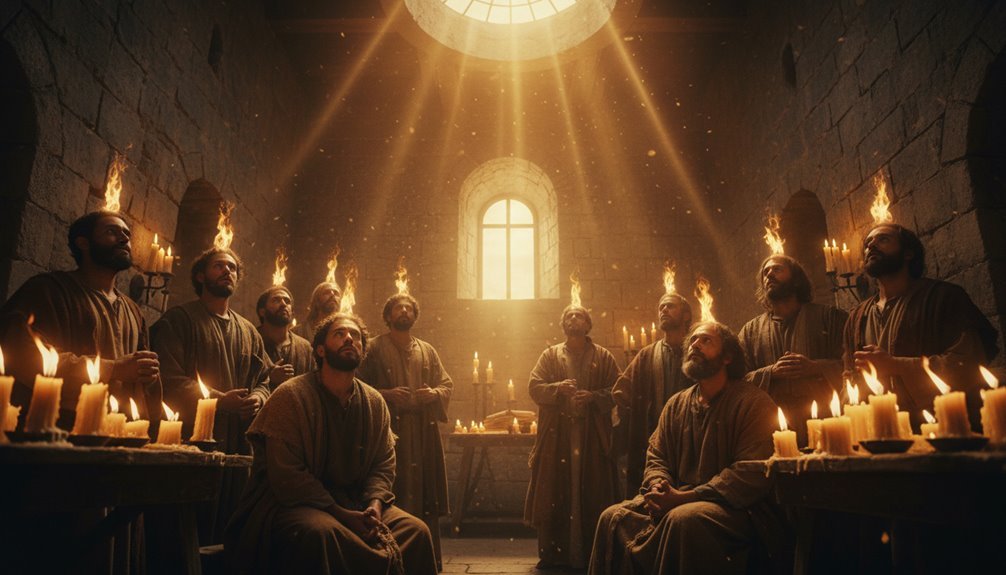
After Jesus rose to heaven, the disciples gathered in Jerusalem, waiting in prayer and uncertainty. You’ll find they spent ten days in the Upper Room, sharing meals, studying Scripture, and urging one another to stay faithful. Their prayers focused on the promised return of the Father and the coming of the Holy Spirit. During this period, they also faced persecution, rumors, and doubts, yet they clung to Jesus’ last words, “I am with you always.” On the eleventh day, the Spirit descended in a mighty wind, filling the room with tongues of fire. You experience the sudden boldness that erupted as they began speaking in languages unknown to them, proclaiming the gospel to a diverse crowd. This dramatic shift turned a hesitant, prayerful group into a unified, empowered community, ready to carry the message beyond Jerusalem’s walls.
How Do Modern Churches Celebrate Pentecost?
From that awe‑inspiring outpouring of the Holy Spirit, today’s congregations keep the fire alive by blending ancient liturgy with contemporary expression.
You’ll hear vibrant worship bands leading songs that echo “Spirit Fall” while a pastor reads the Acts narrative, then invites believers to pray for fresh an.
Many churches dim lights, release fragrant incense, and wave white banners to symbolize the wind’s movement.
Youth groups often stage dramatized reenactments of the disciples speaking in tongues, using multimedia screens to project swirling clouds.
Some congregations organize community outreach—serving meals or handing out prayer cards—to embody the Spirit’s mission.
In multicultural settings, worship teams incorporate diverse languages, instruments, and dance, reflecting the universal gift.
You’ll also find prayer stations where participants write “fire ” on cards, then place them on an altar, creating a visual tapestry of collective yearning for the Holy Spirit’s ongoing work.
Frequently Asked Questions
What Is the Origin of the Word “Pentecost” in Hebrew?
You’ll find that “Pentecost” comes from the Greek Πεντηκοστή (Pentēkostē), meaning “fiftieth.” In Hebrew it’s חַג הַשְׁבִיעִי (Chag HaShvi’i), literally “the festival of the fiftieth day.”
The term reflects the Jewish counting of seven weeks after Passover, culminating in the Feast of Weeks, which Christians later called Pentecost. The Hebrew name emphasizes the timing, while the Greek name became the common label in Christian tradition.
How Does the Counting of the Omer Differ Among Jewish Traditions?
You count the Omer differently depending on your tradition. In Israel and most Reform communities, you start the first day immediately after the second night of Passover, so the 49‑day count ends on the evening of the 50th day, Pentecost.
In many Orthodox and Sephardi circles, you begin counting on the second night of Passover, making the final day fall a day later.
Some Chasidic groups add a “Shavuot” celebration before the count finishes, shifting the schedule slightly.
This variation stems from differing interpretations of when the “first day” truly begins.
Do Any Non‑Christian Denominations Observe Pentecost?
Yes, several non‑Christian groups mark Pentecost. In Judaism, you celebrate Shavuot fifty days after Passover, commemorating the Torah’s revelation at Mount Sinai. Some Unitarian Universalist congregations observe a “Pentecost” service focusing on spiritual renewal rather than Christian doctrine. Certain Messianic Jewish movements blend Jewish Shavuot traditions with Christian Pentecostal elements, observing both the harvest festival and the Holy Spirit’s outpouring. These practices show Pentecost’s broader cultural and religious resonance.
What Historical Evidence Links Pentecost to Early Church Practices?
You’ll find that early Christian writers like Irenaeus and Eusebius describe Pentecost gatherings, and the Acts of the Apostles records believers speaking in tongues on that day.
Archaeological finds—such as 2nd‑century inscriptions mentioning “the feast of Pentecost” in synagogues—show the term’s use beyond Jewish contexts.
Moreover, the Didache references a “weekly love feast” that aligns with Pentecost celebrations, confirming that the early church regularly observed the holiday as a communal worship milestone.
Why Is Pentecost Sometimes Called “The Birthday of the Church”?
You call Pentecost the “birthday of the church” because it marks the moment the Holy Spirit descended on the disciples, igniting their mission to spread the gospel.
That event transformed a small, frightened group into a bold, communal movement.
It’s the first time believers experienced the Spirit’s power collectively, and the day when the church’s public life truly began.
This birth‑like inauguration is why the name fits.
Conclusion
You’ve seen how Pentecost bridges the Jewish Omer count and the Christian promise of the Holy Spirit, how the Ascension sets the stage, and why the calendars sync. From ancient rites to modern worship, the day remains a powerful reminder that God’s presence continues to move us, inspiring faith, unity, and fresh beginnings across every generation.







No Comments