

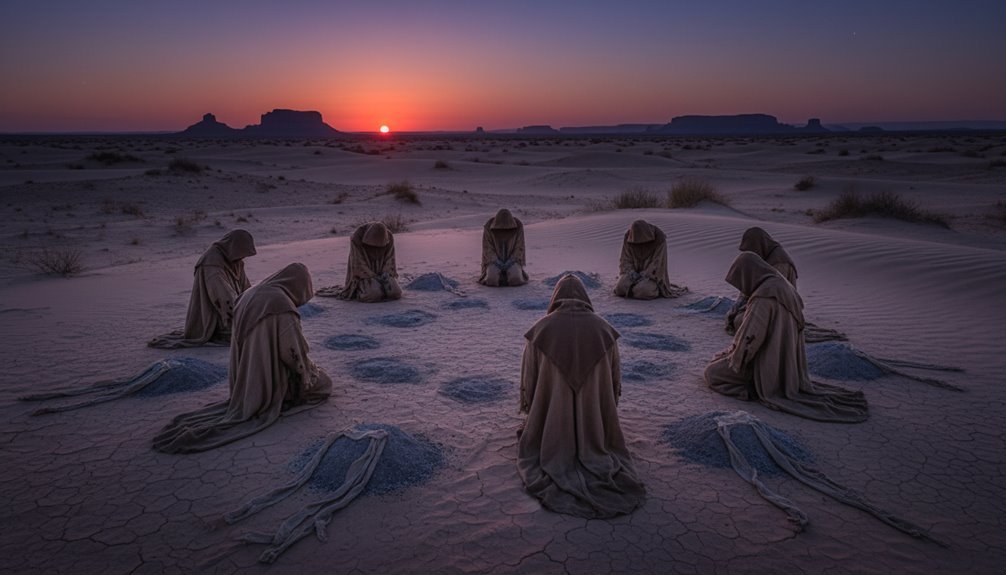
17 Apr 7 Old Testament Mourning Fasts and Their Meanings
You’ll see that Moses fasted 40 days on Sinai to receive the law, David mourned Saul and Absalom to align the nation with his grief, Elijah denied food on Mount Carmel to hear God’s voice, Esther gathered three days of fasting before the king’s decree, Jeremiah’s seven‑day fast expressed Jerusalem’s siege‑bound sorrow, Daniel’s 21‑day fast sharpened his prophetic vision, and Nehemiah’s collective fast united workers while rebuilding the wall. Keep going and discover deeper insights.
Table of Contents
Moses’ Biblical Fast – 40 Days on the Ground
Why did Moses spend forty days on the ground, alone with his thoughts? You picture him perched on Mount Sinai, his eyes fixed on the stone tablets, his heart heavy with Israel’s sins. He fasted not to punish himself, but to attune to God’s voice, to seek forgiveness for a people who’d broken the covenant. The desert air grew thin; his stomach rumbled, yet his resolve hardened. As you imagine his breath fogging the cold morning, you sense a profound humility—each day stripped away distraction, leaving only prayer and repentance. By the end of the forty days, Moses emerged transformed, carrying divine law that would shape a nation.
His fast illustrates how mourning can become a conduit for spiritual renewal, turning personal anguish into collective redemption. You learn that fasting, when purposeful, channels grief into divine encounter, forging a bridge between human frailty and heavenly purpose.
David’s Biblical Fast – Grief Over Saul and Absalom
After Moses’ forty‑day communion on Sinai, the narrative shifts to David, whose fast springs from a different kind of loss. You feel his sorrow when Saul dies, a king he never chose yet mourned. David orders a national fast, strips himself of meat and wine, and spends days in prayer, his heart heavy with guilt and respect. Later, when his son Absalom rebels and meets a violent death, David’s grief deepens. He declares another fast, refusing food until the blood of his son is avenged and his kingdom steadied. In both instances, you see the fast as a public expression of mourning, a plea for divine mercy, and a means to align the nation’s soul with the king’s pain. David’s fasting isn’t about self‑denial for holiness alone; it’s a communal lament that binds leader and people in shared penitence and hope for restoration.
Elijah’s Biblical Fast – Seeking Guidance on Mount Carmel
How does a prophet find direction when the heavens seem silent? You stand on Mount Carmel, heart pounding, and Elijah you fast begins.
You deny yourself food and water, letting hunger sharpen your focus. The desert wind whispers, yet the sky offers no answer. You cling to the promise that God speaks through fire, not words. As the day stretches, you pray for clarity, feeling the weight of Israel’s idolatry pressing down.
The fast becomes a conduit, emptying flesh so spirit can hear the divine stillness. When the priests of Baal fail to summon flame, you step forward, confident that your abstinence has cleared the path for God’s power.
The sudden blaze from heaven consumes the offering, and you recognize the answer you sought: God’s presence, not human counsel, guides the nation. Your fast ends, but the lesson endures—silence can be louder than speech.
Esther’s Biblical Fast – Prayer Before the King’s Decision
You’ll see how Esther’s royal petition and fast rally the court around a common purpose, turning personal plea into collective prayer.
The shared fasting unites the people, creating a powerful sense of unity that amplifies their supplications.
Royal Petition and Fasting
Who can forget the tension that grips a palace when a king’s fate hangs in the balance? You stand beside Esther as she gathers her household, urging them to abstain from food and drink for three days. The royal petition becomes a collective plea, a silent oath that the kingdom’s survival hinges on divine favor. You feel the weight of each hour, the sharp edge of hunger sharpening resolve. The fast isn’t merely self‑denial; it channels desperation into prayer, aligning mortal petition with heavenly will. As the king deliberates, you sense the unseen hand of God moving through the fasting crowd, turning fear into hope and uncertainty into decisive action.
Communal Prayer and Unity
The tension that built around the palace doors now shifts to the courtyard, where Esther’s household gathers in a circle, hands clasped, voices low. You feel the weight of the moment as each breath syncs with the next, forming a collective rhythm that steadies hearts.
In this shared fast, prayer becomes a conduit for unity; you and your kin lift petitions together, trusting that the king’s decree will be shaped by collective humility.
The murmured Psalms and whispered pleas bind you, turning individual anxiety into communal resolve.
As the sun dips, you sense a tangible bond, a silent agreement that the outcome rests not on a single voice but on the strength of your united supplication.
Divine Favor and Outcome
How does divine favor shape the outcome when you join Esther’s fast and pray before the king’s decision? You step into a sacred pause, surrendering hunger for humility. Your prayers echo Esther’s plea, inviting God’s intervention as the court deliberates. The fast sharpens focus, aligning your heart with divine wisdom, while the collective plea creates a spiritual pressure that can sway the king’s mind. You experience a tangible shift: confidence rises, fear recedes, and the atmosphere feels charged with purpose.
When the king finally renders his verdict, you recognize that the outcome isn’t merely political—it reflects God’s favor responding to earnest, intercessory prayer. This partnership between fasting and divine will transforms uncertainty into hopeful resolution.
Jeremiah’s Biblical Fast – Lament Over Jerusalem’s Siege
Ever felt the weight of a city’s sorrow pressing on your soul? You stand beside Jeremiah as the siege of Jerusalem tightens, and you join his mournful fast. You abstain from food, not out of ritual habit but to echo the nation’s anguish. Jeremiah’s lament rings through the streets: “How long will the earth mourn, and the cities weep?” You feel each tear as a prayer, each empty stomach a reminder of the walls crumbling around you.
The fast lasts seven days, a period of intense prayer and pleading for divine mercy. You watch the smoke rise, hear the clamor of invaders, and cling to the prophet’s promise that repentance may still turn God’s wrath. By sharing his sorrow, you become a conduit for communal grief, a living testimony that fasting can bind a people to God’s heart even in the darkest siege.
Daniel’s Biblical Fast – 21‑Day Visionary Fast in Babylon
You’ll see how Daniel’s 21‑day fast unfolded amid Babylonian political turmoil, sharpening his resolve.
The fast gave him the clarity to interpret prophetic dreams that baffled the court.
As a result, he achieved a profound spiritual purity that set him apart as a divine messenger.
Babylonian Political Turmoil
When the Babylonian empire teetered on the brink of collapse, Daniel entered a 21‑day visionary fast that intertwined personal devotion with the nation’s political turmoil, seeking divine insight into the looming crisis. You’ll notice the empire’s internal strife: a succession of weak kings, court conspiracies, and a restless populace demanding reform. The rapid turnover of rulers destabilized the administrative apparatus, while external threats from Persia and Egypt intensified. As you read, picture the palace corridors filled with whispered plots and the streets echoing with protests. Daniel’s fast, set against this backdrop, became a conduit for divine guidance, offering you a lens to understand how spiritual discipline can intersect with and influence a nation’s political destiny.
Prophetic Dreams Interpreted
How can a single night’s dream reshape a kingdom’s fate? You sit in the silence of the 21‑day fast, your mind stripped of daily clamor, and the night delivers a vision that Daniel recorded. The dream’s symbols—four beasts, a ram, a goat—are not random; they map Babylon’s political landscape and future empires. As you interpret each image, you see God’s hand directing history, turning fear into strategy. Your fasting sharpens perception, allowing you to discern the divine message hidden in the dream’s details. By sharing the interpretation, you influence leaders, guide policy, and steer the nation toward obedience. The fast becomes a conduit, turning a personal revelation into a communal turning.
Spiritual Purity Achieved
Purity isn’t a distant ideal; it’s a tangible result of Daniel’s 21‑day visionary fast in Babylon. You step into his disciplined routine, for water and simple foods, and you feel the world sharpen around you. Each sunrise marks a prayer, each sunset a reflection, and the absence of indulgence clears mental clutter. By day ten, you notice thoughts aligning with divine purpose; by day fifteen, emotions stabilize, no longer swayed by Babylonian excess. The final six days bring vivid visions, confirming that spiritual cleanliness isn’t merely ritual—it’s a transformed heart. You emerge with a renewed covenant, a mind attuned to God’s will, and a soul that radiates the purity Daniel experienced.
Nehemiah’s Biblical Fast – Collective Mourning While Rebuilding the Wall
Ever wonder why Nehemiah called for a fast while the Jews rebuilt Jerusalem’s wall? You’ll see that the fast served as collective mourning and a strategic plea for divine protection. As enemies gathered, Nehemiah urged the people to abstain from food, prayer, and prayer to signal their dependence on God. This act unified the workers, turning labor into worship and reminding them that the wall’s stones weren’t merely political symbols but covenantal ones. By fasting, they expressed grief for the city’s ruin and sought at’s favor to overturn hostile plans. The fast also sharpened focus, allowing Nehemiah to lead with clarity and moral authority. You can picture the community gathered on the broken ramparts, voices hushed, hearts aligned, trusting that God would sustain them through the arduous reconstruction. Their shared lament and hope turned a defensive project into a spiritual renewal.
Frequently Asked Questions
Do All Old Testament Fasts Require Total Abstinence From Food?
No, not every Old Testament fast demands total abstinence. Some fasts, like the Day of Atonement, call for complete refraining from food and drink, while others—such as the mourning fasts of David or the quick‑day fasts—allow limited intake, like water or a single meal. The Scripture distinguishes between full fasts, partial fasts, and “fasts of prayer,” letting you choose the level of deprivation that fits the occasion.
How Were the Durations of Each Fast Determined Historically?
You determine each fast’s length by reading the biblical narrative and the surrounding commandments. The text often states the exact number of days—like the three‑day fast of Moses, the seven‑day fast of Daniel, or the forty‑day fast of Moses on Sinai. Those figures reflect historical events, symbolic numbers, or divine instructions, so you infer the duration straight from the scripture’s explicit statements.
Did Women Participate in These Biblical Fasts?
Yes, women took part in those biblical fasts. You’ll find that the texts don’t exclude them; they’re mentioned alongside men in communal mourning and repentance rituals. In 1 Samuel 1:19 and 2 Kings 20:2, mothers and wives join the fasts, showing their involvement. The cultural norm allowed both genders to observe the prescribed abstinence, so you should see women participating just as men did.
What Specific Prayers Accompanied Each Fast?
You’ll find that each mourning fast in the Old Testament is paired with distinct prayers. When Israel fasted for national disaster, you’d recite communal pleas for mercy and restoration, invoking Yahweh’s covenant.
During personal grief fasts, you’d offer intimate petitions, confessing sin and begging for comfort.
In royal mourning, you’d pray for the king’s health and the nation’s stability, often repeating “Hear, O Lord” while fasting.
These prayers echo the specific sorrow and hope of each occasion.
Are There Any Archaeological Records Confirming These Fasts?
You won’t find stone tablets that list every mourning fast, but archaeological digs have uncovered seals, inscriptions, and pottery bearing dates that align with known biblical periods of lament.
Excavations at sites like Babylon, Jerusalem, and Nineveh reveal ritual washbasins and offering altars used during communal grief.
These material clues, combined with contemporary Near‑Eastern texts, confirm that the community practiced structured fasts tied to mourning.
Conclusion
You’ve seen how each fast served a distinct purpose—Moses’ perseverance, David’s grief, Elijah’s quest for direction, Esther’s plea, Jeremiah’s lament, Daniel’s vision, and Nehemiah’s communal mourning. Together they reveal that fasting isn’t merely abstaining; it’s a powerful conduit for prayer, repentance, and divine guidance. By embracing these ancient practices, you tap into a timeless discipline that still shapes faith and purpose today.










No Comments