

06 Dec 10 Commandments in Order Numbering, Text, and Meaning
The Ten Commandments in Catholic teaching begin with “I am the Lord your God,” establishing God’s authority. You’ll find them ordered as: no other gods, respect God’s name, keep the Sabbath holy, honor parents, don’t kill, don’t commit adultery, don’t steal, don’t lie, don’t covet your neighbor’s spouse, and don’t covet others’ goods. These divine laws form the foundation of Catholic moral life, guiding you toward authentic love of God and neighbor. There’s profound wisdom in each commandment’s deeper meaning.
Table of Contents
Key Takeaways
endre
Humanං CSS – forty seven;;
Humanище
I Am the Lord Your God – The First Commandment
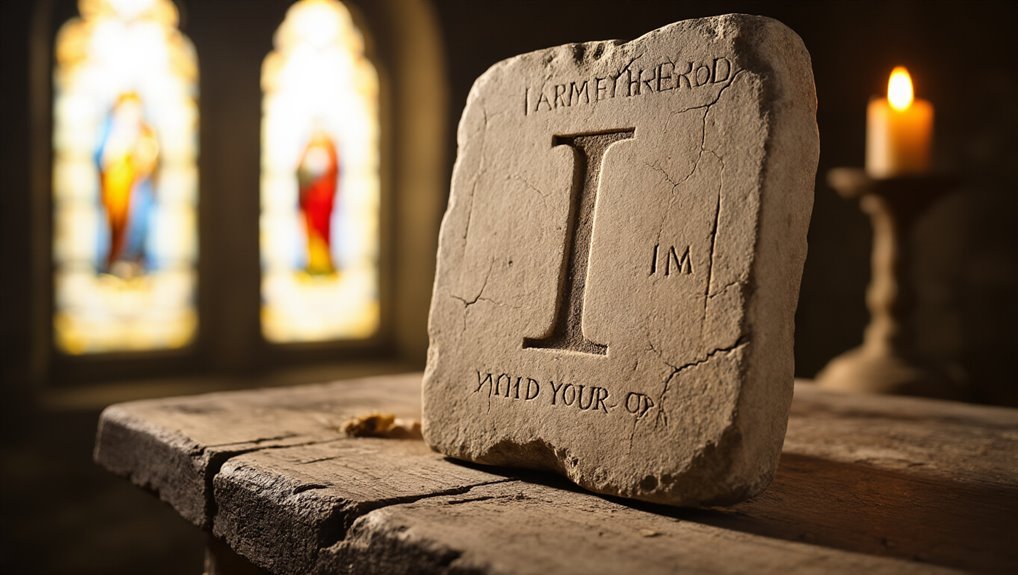
The First Commandment, “I am the Lord your God, you shan’t have other gods before me,” establishes the foundation for all other commandments and our entire relationship with God. This commandment calls you to place God at the center of your life, recognizing Him as the one true God who created and redeems you.
Your faith formation depends on understanding that this commandment prohibits idolatry in all its forms – not just the worship of false gods, but also the elevation of money, power, pleasure, or any created thing above God. Through your liturgical practice, you’re reminded to give God the supreme adoration He deserves while avoiding superstition, sacrilege, and atheism.
You’re called to respond to this commandment with faith, hope, and charity – believing in God’s revelations, trusting in His promises, and loving Him above all else. It’s a constant reminder that your ultimate allegiance belongs to God alone.
You Shall Not Take God’s Name in Vain – The Second Commandment
By commanding respect for His holy name, God teaches you to honor His divine nature and presence in both speech and action. This commandment calls you to maintain sacred speech, avoiding casual or irreverent use of God’s name in conversation, exclamations, or humor.
You’re called to uphold name sanctity by speaking of God, Jesus Christ, the Blessed Virgin Mary, and the saints with deep reverence. This extends to your use of liturgical language during prayer and worship. When you make promises invoking God’s name, you must fulfill these vows with absolute integrity.
The commandment prohibits blasphemy, perjury, and false oaths. It’s not just about avoiding profanity – it’s about recognizing that God’s name carries inherent power and holiness. Your speech should reflect your relationship with the Divine, demonstrating that you understand the privilege of being able to call upon the name of the Lord.
Keep Holy the Sabbath Day – The Third Commandment
Faithfully observing the Lord’s Day as sacred time stands as a cornerstone of Catholic life and worship. This commandment calls you to set aside Sunday as a day dedicated to God through participation in Mass, prayer, and rest from unnecessary work. By attending Sunday worship, you fulfill your obligation to give God proper thanks and praise while being spiritually nourished through Word and Sacrament.
The concept of Sabbath rest extends beyond Mass attendance. You’re called to maintain a liturgical rhythm in your life by making Sunday different from other days. This means avoiding routine work when possible and engaging in activities that refresh your soul. Creating a Family Sabbath tradition helps strengthen bonds through shared meals, prayer, and quality time together. When you honor this commandment, you’re not just following a rule – you’re embracing God’s gift of sacred time and acknowledging His lordship over your life.
Honor Your Father and Mother – The Fourth Commandment
You’ll discover that showing respect and honor to your parents benefits both your family relationships and society as a whole.
Modern challenges like geographic distance, digital distractions, and changing family dynamics can make it harder to fulfill this commandment effectively.
You can overcome these obstacles by making intentional efforts to communicate regularly, seeking opportunities to help your parents, and modeling respectful behavior for your own children.
Parental Respect Benefits Everyone
The Fourth Commandment to honor your father and mother extends far beyond childhood, creating a framework for harmony in families and society. When you practice filial respect, you’ll develop essential communication skills and emotional intelligence that benefit all your relationships.
This divine directive teaches you the art of boundary setting while maintaining mutual respect.
Modern Challenges and Solutions
Living in today’s fast-paced digital age presents unique challenges for honoring parents, especially when families are geographically separated or face complex dynamics. Technology ethics play a crucial role as you navigate digital communication with your parents – balancing screen time with meaningful interaction, using video calls wisely, and maintaining boundaries while staying connected.
Mental health awareness has highlighted the importance of addressing generational trauma and establishing healthy relationships with parents. You can honor them while setting appropriate boundaries by seeking counseling when needed, practicing forgiveness, and finding constructive ways to show respect despite differences.
Consider creative solutions like scheduling regular virtual family meals, sharing digital photo albums, or using prayer apps together to maintain spiritual connections across distances. Remember that honoring parents doesn’t require perfection, just sincere effort and good will.
You Shall Not Kill – The Fifth Commandment
Among God’s most sacred commandments, “You shan’t kill” stands as a fundamental protection of human life from conception until natural death. This commandment prohibits the direct and intentional killing of innocent human life in any form, including abortion, euthanasia, and suicide. You’re called to respect and defend the dignity of every human person, recognizing that life is a gift from God.
The Church acknowledges specific situations requiring careful moral consideration. In cases of self-defense or just war, actions resulting in death may be permissible if they’re not intended but occur as an unintended consequence of protecting life. However, modern end-of-life issues demand careful discernment – while you’re not obligated to use extraordinary means to preserve life, directly causing death through assisted suicide or euthanasia remains forbidden. You must always protect the sanctity of human life while showing compassion and providing appropriate care for the sick and dying.
You Shall Not Commit Adultery – The Sixth Commandment
Sacred marriage bonds and human sexuality hold profound significance in God’s divine plan, making adultery a grave violation against both marital fidelity and human dignity.
When you commit adultery, you’re breaking a sacred covenant not only with your spouse but with God Himself, who instituted marriage as an unbreakable bond between husband and wife.
The sixth commandment protects marriage fidelity by prohibiting all forms of sexual activity outside the marriage covenant. It’s not limited to physical acts alone – it includes lustful thoughts, inappropriate emotional intimacy with others, and any behavior that threatens the sanctity of marriage.
You’re called to practice chastity according to your state in life, whether married or single.
Through this commandment, God safeguards the family unit, promotes human flourishing, and reflects the faithful love between Christ and His Church. It’s a call to honor the sacred gift of sexuality within its proper context.
You Shall Not Steal – The Seventh Commandment

The seventh commandment upholds justice and charity by protecting property rights and the dignity of human labor. When you steal, you violate both community trust and the right to private property that enables society to function. This commandment extends beyond taking physical items – it includes fraud, tax evasion, damaging others’ property, and failing to pay just wages.
You’re called to practice restorative justice if you’ve stolen or damaged someone’s property. This means making restitution by returning or replacing what was taken and compensating for any harm caused. The commandment also requires you to be a good steward of creation, respecting both private and common goods.
Living this commandment means promoting economic justice, practicing responsible consumption, and ensuring fair business practices. You must respect intellectual property, honor contracts, and pay your debts promptly. Through these actions, you help build a more just and equitable society.
You Shall Not Bear False Witness – The Eighth Commandment
Moving from protecting material goods to safeguarding truth itself, bearing false witness strikes at the heart of human relationships and community trust. You’re called to be truthful in all communications, avoiding lies, deception, and any deliberate distortion of facts that could harm another’s reputation.
Character formation rooted in truthfulness education helps you develop habits of honest speech and authentic witness. When you’ve damaged someone’s good name through falsehood, you have an obligation toward reputation repair, making amends by correcting misinformation and restoring their dignity.
In today’s digital age, digital honesty is especially crucial – you must verify information before sharing, avoid spreading rumors on social media, and practice integrity in online interactions.
This commandment protects more than just courtroom testimony; it safeguards the foundation of social harmony by ensuring that truth, not deception, guides your words and actions in all circumstances.
You Shall Not Covet Your Neighbor’s Wife – The Ninth Commandment
While closely related to adultery, this commandment specifically addresses internal desires and lustful thoughts that can lead to external sins against marriage. You’re called to cultivate interior purity by guarding your heart and mind against covetous desires for another person’s spouse.
This commandment emphasizes that marital fidelity begins in your thoughts and intentions, not just your actions. You’re asked to respect the sanctity of marriage – both your own and others’ – by rejecting lustful fantasies and inappropriate attractions that could threaten these sacred bonds.
To observe this commandment, you must practice custody of the eyes, discipline your imagination, and foster genuine respect for the marriage covenant. It’s not enough to simply avoid physical adultery; you’re called to maintain purity of heart and intention. This means actively working to eliminate impure thoughts and cultivating virtues that support healthy, holy relationships.
You Shall Not Covet Your Neighbor’s Goods – The Tenth Commandment
Your material desires can lead to an unhealthy attachment to worldly goods and create discord between you and your neighbor.
When you’re focused on what others possess, you’ll miss the abundant blessings God has already given you and fail to cultivate a spirit of gratitude.
You’ll find true peace and contentment by storing up treasures in heaven rather than coveting earthly possessions.
Understanding Material Desires
The tenth commandment addresses our interior disposition toward material possessions, calling us to examine our hearts and root out unhealthy desires for what belongs to others. You’re invited to cultivate material simplicity by focusing on what you truly need rather than what you merely want.
Through desire discernment, you can identify when envy or greed might be influencing your thoughts and choices.
Practicing consumer restraint helps you resist society’s constant pressure to acquire more. You’ll find that interior freedom comes from being content with what you have and celebrating others’ blessings without wanting them for yourself.
When you learn to appreciate God’s gifts in your own life while respecting others’ possessions, you’re living this commandment’s deeper meaning of spiritual detachment.
Overcoming Worldly Attachments
Breaking free from worldly attachments starts with recognizing how material possessions can enslave our hearts and minds. You’ll find true freedom by practicing detachment from earthly goods while maintaining gratitude for God’s provisions. Through spiritual minimalism, you can focus on what truly matters – your relationship with Christ and serving others.
To overcome material attachment, you’re called to evaluate your relationship with possessions. Ask yourself if your desires for things stem from genuine need or from envy of others’ belongings. By implementing detachment practices like regular decluttering, mindful consumption, and increased almsgiving, you’ll gradually loosen the grip of materialism. Remember, everything you own is a gift from God meant for responsible stewardship, not accumulation that distracts from your spiritual journey.
Living With Contentment
SIP. You’re called to find contentment by focusing on what you have rather than what you lack. The Tenth Commandment addresses the sin of coveting material possessions, which can lead to unhealthy attachments and spiritual emptiness.
Developing gratitude practices helps you appreciate God’s blessings and combat materialistic desires. By maintaining a daily gratitude journal, offering prayers of thanksgiving, and acknowledging His gifts, you’ll cultivate a heart of contentment. Embracing a minimalism lifestyle can further strengthen your spiritual journey by removing distractions that prevent you from fully experiencing God’s presence.
Remember that true happiness comes from your relationship with Christ, not from accumulating worldly goods. When you’re content with what God has provided, you’ll find greater peace and freedom from the burden of constant wanting.
Frequently Asked Questions
Why Do Catholic and Protestant Commandment Numberings Differ?
You’ll find the different numberings stem from historical backgrounds in early Christian traditions. Catholics and Orthodox follow Augustine’s grouping from the 4th century, while Protestants use Origen’s 3rd-century system.
These liturgical differences mainly affect how the commandment about graven images is handled – Catholics include it within the first commandment, while Protestants make it a separate second commandment.
When Were the Ten Commandments First Written in Their Current Catholic Form?
You’ll find the Catholic numbering of the Ten Commandments first appearing in early manuscripts from St. Augustine’s time (4th-5th century AD).
Through liturgical development, this ordering became standardized in the Catholic Church by the 6th century.
The current Catholic form you’re familiar with was officially codified in the 16th century during the Council of Trent and remains consistent in today’s Catechism of the Catholic Church.
Can the Ten Commandments Be Modified by the Catholic Church?
You can’t modify the Ten Commandments‘ essential meaning, as they’re divine law revealed by God.
While the Catholic Church’s Magisterial interpretation may develop deeper understanding of these commandments, their fundamental truths remain unchangeable.
What you might see are Liturgical adaptations in how they’re taught or presented, but these only clarify and don’t alter the original divine precepts given to Moses on Mount Sinai.
How Do Eastern Orthodox Christians Number Their Commandments?
You’ll find that Eastern Orthodox Christians generally follow the same Philonic numbering system as most Protestant denominations.
This differs from Catholic tradition, with the main distinction being how they split the commandments against coveting.
While there are some catechetical variations among Orthodox jurisdictions, they typically count the prohibition against graven images as the Second Commandment and combine the coveting commandments into one tenth commandment.
Were There Originally More Than Ten Commandments Given to Moses?
You’ll find that God gave Moses many more commands than just the Ten Commandments. In the biblical context, the Mosaic Law contains 613 distinct commandments, including sacrificial rules and detailed instructions for daily life.
While the Ten Commandments form the moral foundation, manuscript variants and oral tradition reveal extensive additional laws. These regulations, found in Exodus, Leviticus, and Deuteronomy, governed everything from worship to social relationships.
Conclusion
When you follow these Ten Commandments, you’re embracing God’s divine plan for your life and the life of the Church. They’re not mere restrictions but guideposts to authentic freedom and holiness. As a Catholic, you’ll find that living these commandments helps you grow closer to God and your neighbor while protecting your dignity as His beloved child. Your faithfulness to these laws reflects your love for Christ.


No Comments